The Best Way to Fix the Supreme Court’s Attack on Voting Rights
https://newrepublic.com/article/209825/supreme-court-callais-proportional-representation
The Best Way to Fix the Supreme Court’s Attack on Voting Rights
If U.S. electoral politics is going to survive the high court’s attack on equal rights, the game will have to change.
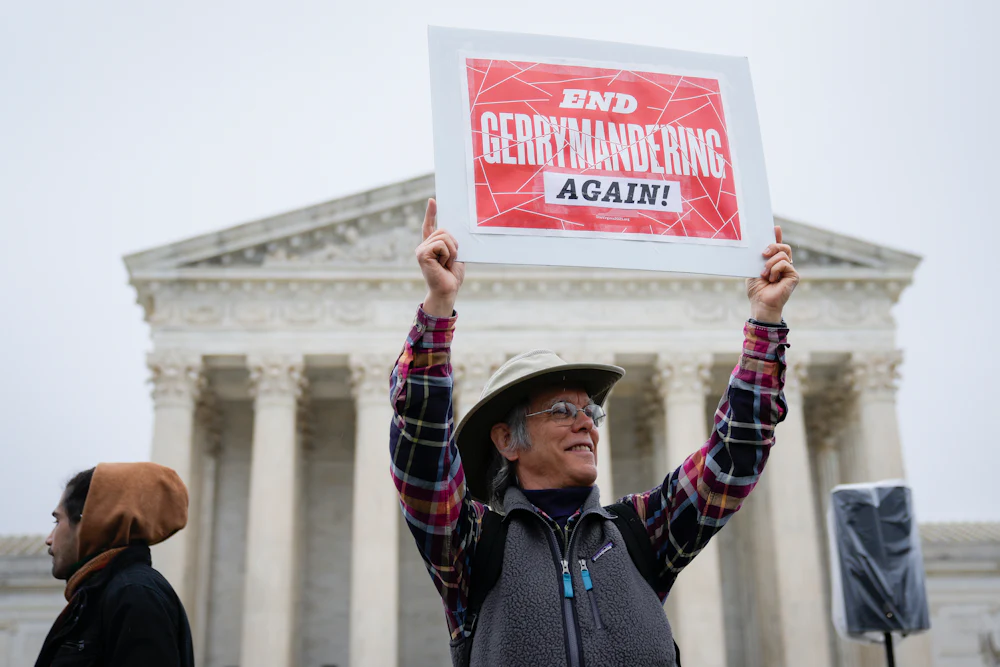
The Supreme Court’s decision this week to destroy what remained of the Voting Rights Act of 1965 compels us to consider structural reforms to the court itself to preserve the republic. By giving a de facto blank check to Republican-led states to racially gerrymander Black Americans out of electoral power, the court has delegitimized itself and damaged the nation’s multiracial democracy.
Rick Hasen, a UCLA law professor who specializes in election law, described Wednesday’s court’s ruling in Louisiana v. Callais as “one of the most pernicious and damaging Supreme Court decisions of the last century.” Hasen, whose research was cited in Justice Elena Kagan’s dissent, is hardly a firebrand. He argued that Democrats must now “consider reform of the Supreme Court itself, a conclusion I had been resisting until the Court made this unavoidable.”
I agree. On racial and political gerrymandering in particular, however, there is another important reform that a Democratic Congress and president could also implement at the next opportunity: abolishing the House’s current system of single-member districts and electing members by proportional representation instead.
Article 1 of the Constitution gives Congress the power to set the “time, manner, and place” of federal elections. States administer elections within the bounds that Congress sets for them. For the first half of the nineteenth century, Congress allowed states a certain amount of discretion to devise their own electoral system, so long as it elected the apportioned number of representatives to the House. (The Senate, which would not become elected until the early twentieth century, is not at issue here.)
Many states adopted single-member districts. Under this method, which survives to this day, state lawmakers divide the state into congressional districts, each of which elects a single representative to the House. Like any electoral system, this approach has some benefits—greater regional diversity, direct constituent representation, and so on.
It also has some drawbacks. The most obvious of these is gerrymandering. The term derived its name from Elbridge Gerry, an early American statesman who served as governor of Massachusetts from 1810 to 1812. His tenure coincided with the 1810 census and the reapportionment of House seats that occurs every 10 years. To maintain control of Massachusetts’s state legislature, Gerry’s fellow Democratic-Republicans drew an obviously manipulated map to maintain their majority. After Gerry signed the new map into law, Federalist denunciations ensured that the practice became forever associated with his name, to Gerry’s great consternation.
This is fairly rote stuff for high school American civics. What is less well known is that single-member districts weren’t the only method of electing House members in the early republic. One common alternative was known as a “general-ticket” election. Under this system, voters would cast votes for as many candidates as there were seats, and the candidates who received the most votes would be elected to those seats.
General-ticket voting had problems as well. For one thing, it essentially transformed each state’s House races into a winner-take-all system, with one party often able to win an entire state’s delegation with a simple majority of votes. While Northern and Southern states both used general-ticket elections at first, the method was eventually associated with Southern states that wanted to maximize the Democratic Party’s control of Congress.
Some larger states also used what were known as “plural districts.” Under this method, a single district would elect the top two candidates to the House on a general ticket. Some states, like New York and Pennsylvania, mixed plural districts in urban areas with single-member districts for rural ones. Others, like New Jersey, divided themselves into multiple plural districts.
Perhaps the best example of the early republic’s patchwork system is the Thirteenth Congress, which served from 1810 to 1812. Connecticut, Delaware, Georgia, New Hampshire, and Vermont used the general-ticket system, with each one resulting in one-party slates. Maryland, New York, New Jersey, and Pennsylvania elected representatives through at least some plural districts, producing a mixture of party representation. Massachusetts, North Carolina, Ohio, South Carolina, Tennessee, and Virginia exclusively used single-member districts, with similarly diverse results.
Only in 1842 did Congress begin to standardize House elections. Until the 1920s, lawmakers would adopt a new Apportionment Act after each census to expand the House of Representatives to match the nation’s population growth. The Apportionment Act of 1842 was a milestone because it sought to reduce, not grow, the number of House seats for the first time. It also sought to constrain how each state elected its representatives.
With the new act, Whig lawmakers sought to dismantle single-party rule in the South and increase their own chances of securing a House majority in the future. By this point, Alabama, Georgia, Mississippi, Missouri, New Hampshire, New Jersey, and Rhode Island still used the general-ticket method. Southern Democrats argued for a greater role for states in determining how federal elections could be run, but the Whigs’ reading of Congress’s election powers won out.
The 1842 act was less successful than its drafters had hoped, in no small part because Democrats retook the House in the following election and seated members elected by general-ticket systems anyway. But the law hastened the country’s drift toward single-member districts. Only a few states retained statewide at-large districts into the twentieth century. Finally, in 1967, as part of a legislative negotiation over reapportionment after the Supreme Court’s “one man, one vote” rule, Congress formally forbade any other method of electing representatives to the House.
This diversity of House electoral methods shows that single-member districts, though now ubiquitous, are not an intractible constitutional command. What Congress makes, it can also unmake. Democratic lawmakers in recent years have proposed bills that would require states to elect members via proportional representation instead. Proportional representation can take a number of different forms, but in the general strokes, it would allocate each state’s House delegation according to the ratio of votes that each party received.
Abolishing single-members districts would re-enfranchise tens of millions of Americans who have no real opportunity to cast a meaningful vote for a House candidate. In the 2024 elections, voters in Texas cast roughly 6.2 million ballots for Republican candidates and 4.3 million ballots for Democratic candidates. Thanks to the state’s harsh gerrymander, Texas Republicans won 65 percent of the seats despite obtaining only 58 percent of the vote. Some states had even wider disparities: North Carolina Republicans won 10 of the state’s 14 congressional districts despite only obtaining 52 percent of the vote.
Under single-member districts, millions of voters in each state are effectively disenfranchised by preordained outcomes in their House seats. Proportional representation’s benefits would not be exclusively felt by Democrats, of course. That same year, California voters cast nine million ballots for House Democratic candidates and 5.9 million ballots for House Republican candidates. Though Democrats only received 60 percent of the vote, they captured 76 percent of the state’s House delegation.
Since many House seats are only competitive in the primary elections, single-member districts also produce more extreme candidates by insulating lawmakers from a broader segment of the electorate. Most Americans do not live in a competitive House district, giving them little influence over their own representation. Since 2010, when the GOP embraced extreme partisan gerrymandering on a national scale, the Senate has arguably become more representative than the House since its candidates must answer to a broader, more diverse electorate.
A group of House Democrats introduced a bill in 2025, for example, that would require any state with six or more House seats to create multimember districts under proportional representation. For states with five or fewer House seats, members would be elected at large instead. It would also require ranked-choice voting, which is not strictly necessary for proportional representation but may be incorporated into it.
I’ve called for Congress to adopt some form of proportional representation for the last few years. But reforms are particularly urgent after the Supreme Court’s malfeasance on gerrymandering. It was no surprise that the conservative justices demolished what was left of the Voting Rights Act in Louisiana v. Callais this week. But the way in which they did it suggested that the nation’s ongoing redistricting wars may have played a role.
The court originally appeared set to decide that Section 2 of the Voting Rights Act’s limits on racial gerrymandering were no longer needed now that Jim Crow had been dismantled and Black electoral participation had risen far above its pre-1965 levels. While that reasoning was present in the final opinion by Alito, it played a secondary role to his interest in protecting partisan gerrymandering.
The Supreme Court had ruled in 2019 that federal courts could no longer hear partisan-gerrymandering claims. What was framed as a lamentable practice that courts could not solve in 2019 was now an important state interest that must be protected in 2024. “The upshot of Rucho [v. Common Cause] was that, as far as federal law is concerned, a state legislature may use partisan advantage as a factor in redistricting,” Justice Samuel Alito wrote for the court. “And litigants cannot circumvent that rule by dressing their political-gerrymandering claims in racial garb.”
I will not claim to have any special insight into Alito’s private thinking on this case, nor that of any other justice who participated in it. But it is hard to escape the sense that Democrats’ embrace of partisan gerrymandering over the last year—driven in response, of course, to Trump’s own demands to retain power in this year’s midterms—may have played a role in how the Supreme Court framed Callais.
After all, Democrats in California, Illinois, and Virginia can pursue extreme partisan gerrymandering without risk of Voting Rights Act litigation because their own states are much more racially diverse. But Republicans face an inherent hurdle when trying to maximize their own seats, particularly in the South: They can only gerrymander away so many seats before they eventually run into the majority-minority districts created through past VRA litigation. Since Black voters typically vote for Democrats in unusually lopsided margins, partisan gerrymanders tend to become racial gerrymanders, as well, past a certain point.
Given the choice between the VRA and the court’s racial gerrymandering precedents on one hand, and the prospect that the GOP might face a structural asymmetry in American elections on the other hand, the conservative justices sided with the GOP. The results will be catastrophic for Black electoral representation in the South, both in the House and in state legislatures, where Congress has no power over redistricting.
Proportional representation may not be the panacea for all that ails our nation’s politics. But it stands the best chance of ensuring that Americans will have competitive congressional elections no matter the state in which they live. It is indisputably constitutional, derived both from Congress’s own Article 1 powers as well as past diversity in electoral methods. And it would make it impossible for state legislatures to deny fair representation to any American because of their race ever again by making gerrymandering—whether racial or partisan—a thing of the past.


No comments:
Post a Comment