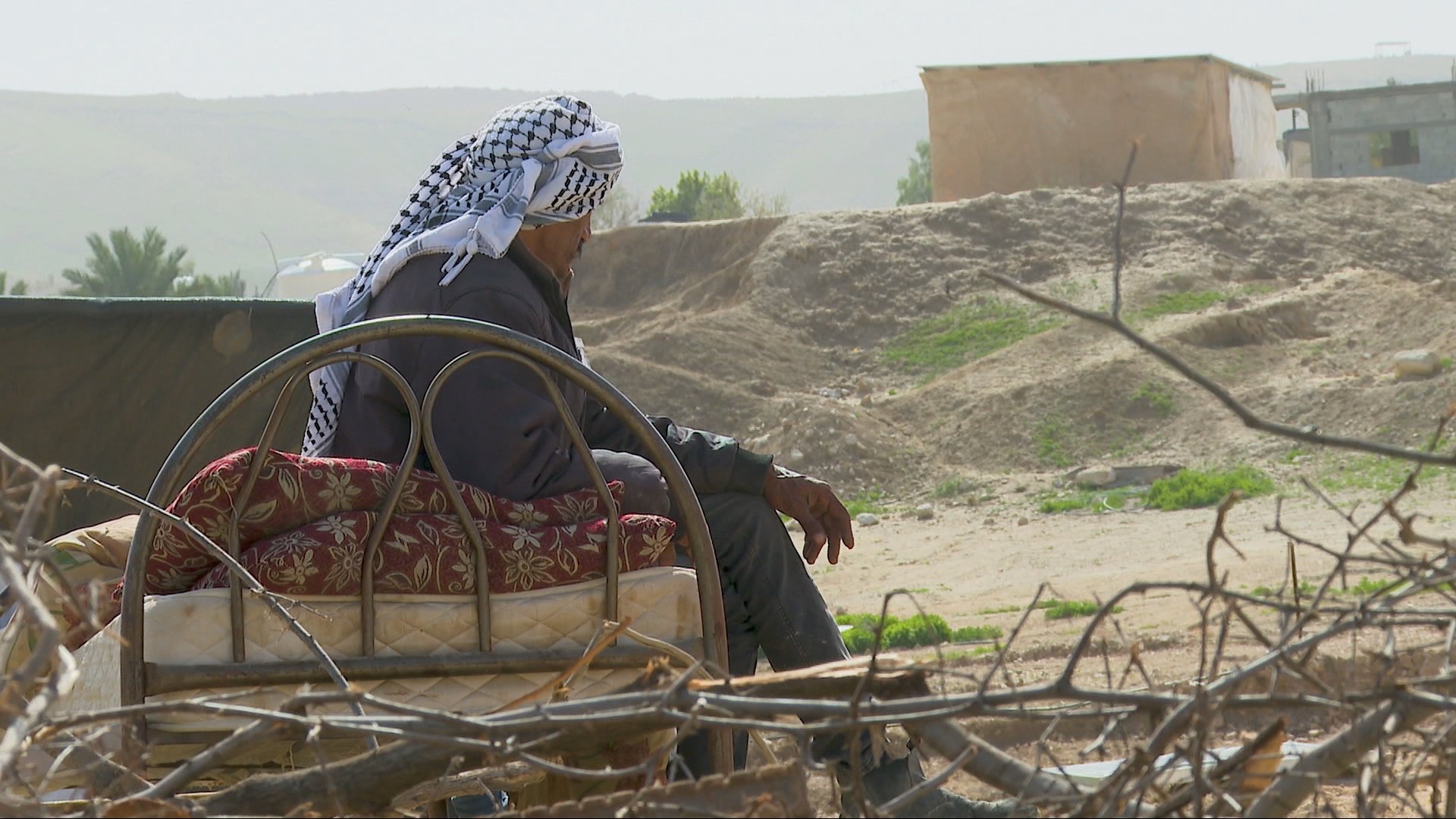
Analysis: Israel’s government can’t disown West Bank settler violence
Rights groups warn settler and state-led violence aim to displace Palestinians and annex land in the occupied West Bank.
Qusra
Mayor Abdulatheem Wadi points his mobile phone at Palestinian houses
which were besieged by Israeli settlers in Qusra village in the
Israeli-occupied West Bank [Ali Sawafta/Reuters]
Events in Qusra, a village south of Nablus, where Israeli settlers have laid siege
to three Palestinian households since Sunday, have even led to a rare
condemnation of settler behaviour by the Israeli government, with
spokesperson David Mercer calling the settlers’ actions “deplorable” and
“unacceptable”, and promising that Israeli authorities would
investigate and arrest those responsible.
Analysts,
campaigners, and Israeli parliamentarians who spoke to Al Jazeera have
reacted to that with disbelief and incredulity, pointing to the
inability of the Israeli military to stop the siege, in which the
settlers have cut off water and electricity to Qusra. Israeli soldiers
were initially even seen mingling and even praying with settlers in
Qusra.
9:36
Now Playing
09:36
Palestinian Family in Qusra Faces Siege and Threat of Forced Displacement
Next
02:26
What’s next for far-right Reform UK after Farage’s by-election win?
Complicity
“Government
attempts to distance themselves from the violence are ridiculous,” Aida
Touma-Sliman, a member of the Israeli parliament representing the
left-wing Hadash party, told Al Jazeera. “They can say what they want,
but they’re complicit.”
“If you look at the West Bank, you can no
longer differentiate between the army and the settlers,” she said,
adding that many of the settlers had been allowed to carry out their
military service protecting the same illegal settlements they had come
from. “The government is supplying them, protecting and arming them. It
isn’t opposed to them. Supporting them is policy,” she added.
“There
is nothing new in what’s happening in Qusra,” Yair Dvir of the Israeli
rights organisation B’Tselem said. “We’ve been seeing this for decades.
When there’s international criticism of the violence, the government
condemns it, the settlers withdraw, and then return as soon as attention
shifts.”
Israeli
soldiers stand in front of the entrance of a besieged Palestinian house
by Israeli settlers in the village of Qusra, south of Nablus, in the
occupied West Bank [AFP]
“Let’s be clear,
settler violence is state violence,” Dvir added. “They both have the
same aim: to displace Palestinians and to take their land.”
The
speed and brutality of the Israeli government’s encroachment upon
Palestinian land, in defiance of both international law and the ruling
of the International Court of Justice (ICJ) that it should stop its
illegal settlement of Palestinian territory, has increased in recent
months. United Nations Office for Humanitarian Affairs monitoring shows
settler violence to be increasing with every week that Israel’s October
election – and the potential end of Prime Minister Benjamin Netanyahu’s
far-right government – draws nearer.
“We’re definitely seeking an
escalation of violence across the occupied West Bank, East Jerusalem,
and in other areas, such as Gaza, in the build-up to the election,”
saidNeve Gordon, a professor of International Law at Queen Mary
University, London, and the author of “Israel’s Occupation”.
“The
vote is like a rallying cry for that entire [settler] constituency that
they have to do as much as they can, while they can,” he said of fears
among settlers and the radical Israeli right that they might lose what
many regard as their allies in Netanyahu’s coalition.
Settlement unchained
The
Israeli government has done little to distance itself from the actions
of the settlers. Instead, prominent members of Netanyhu’s Likud party
have attended prominent settlement conferences, including those
explicitly focused on ethnically cleansing Gaza. Netanyahu himself
responded to recent violence in the Palestinian village of Tal – which
prompted the United Nations to warn that the entire West Bank was at “breaking point” – by promising to recognise even more illegal settlements.
At
the heart of government policy on settlements have been the polarising
figures of National Security Minister Itamar Ben-Gvir and Finance
Minister Bezalel Smotrich.
1:07
Israeli soldiers prevent aid delivery to besieged Palestinians
Smotrich has proven to be one of the most
consequential Israeli politicians in history in promoting the cause of
illegal settlements.
As well as normalising political references
to the annexation of the Palestinian territory, Smotrich made being
granted partial administrative control over the occupied West Bank a key
condition of his joining Netanyahu’s coalition. He has since overseen
the expansion of illegal settlements at an unprecedented rate.
Smotrich has also boasted
of making the two-state solution a practical impossibility with the
announcement of the E1 settlement project, joining occupied East
Jerusalem and the Maale Adumim settlement, in August of last year.
However, focusing on just two of the coalition’s more controversial figures was to miss the point, Gordon argued.
“It’s
too easy to say it’s all the fault of these few people and if they were
gone it would all be OK,” Gordon said. “It goes far wider.”
“The
ethnic cleansing we’re seeing of the West Bank, as well as that being
undertaken by the army in the territory’s refugee camps, such as Jenin,
needs the complicity of the police, the attorney general, the military
and, ultimately, the public,” the professor noted. “Without the umbrella
they provide, none of this would be possible.”
Jericho, occupied West Bank –
Where Palestinian homes once stood among orchards and swimming pools on
the southwestern edge of Jericho, there is now only flattened earth.
Somewhere
beneath the packed dirt lie entire houses, dumped into pits and
smoothed over. Only a few severed water pipes hint that anyone ever
lived here – that, and the piles of rubble yet to be buried by an
Israeli settler’s excavator.
“Why
do you hide the crime you’re committing?” asked Khalil al-Razim, 60, a
Jerusalemite who has spent his summers on a plot of land here in the
area of Ein al-Duyuk for more than a decade.
Beside al-Razim’s
house, a pile of rubble more than two metres high blocks the entrance to
the home of his neighbour, Mohammad Salah. Next to the pile, Salah
stood with one of his four children. He now climbs his own fence to
reach his house.
Six months earlier in February,
during the first settler attack to tear through the area – with homes
demolished and damaged, and residents attacked and robbed – a settler
arrived with a bulldozer and began demolishing fences and houses in the
neighbourhood, including parts of Salah’s home. This summer, the same
work resumed under the guise of “clearing” the ruins those earlier
attacks had left behind – and in the process, the Israeli excavator
dumped piles of rubble in front of Salah’s home.
“How am I supposed to get into my own house?” Salah recalled asking the settler.
“That’s
not my problem, how you get into your house,” the man told him,
according to Salah. “Can’t get into your house? Go around another way
from here. This land is not coming back to you.”
Since July 19,
settler-operated excavators have kept coming on a near-daily basis – for
the supposed purpose of “clearing waste”, but doing far more than that.
The settler behind the attacks, identified by locals and in legal
filings from the Israeli state as Hanan Herbst, is escorted by soldiers
on every visit. No order has ever been shown to residents – no paper a
lawyer can hold up in court. “Not an official order,” Salah said. “It’s
all thuggery. Just brute force, nothing else.”
What is unfolding
here, according to residents, lawyers and the state’s own court filings,
is a subversion of normal legal processes that have all but erased the
line between settler ambition and state authority. In practice, Israeli
authorities have given the settlers close to a free hand over an entire
Palestinian neighbourhood.
“This is a state with no law,” Salah said. “No decency in it. A state of thugs.”
Want to come back to this article? Save it for later.
Al
Jazeera reached out to Israeli authorities for comment, but received no
response. Herbst was also reached by phone, but hung up after being
told he was being contacted by Al Jazeera. He has not responded to
further attempts at contact.
Ali Kaabneh in front of his partially destroyed home he still lives in [Courtesy of Unarmed Civilian Protection in Palestine]
A minister and a pogrom
Herbst
owns an Israeli settler outpost called Armonot Farm, built without
authorisation on a ridge overlooking Ein al-Duyuk in the summer of 2024.
It was initially illegal even under Israel’s own rules, but the Israeli
cabinet formally recognised it as a settlement, under the name Daya, at
the end of March.
The neighbourhood below, known locally as Stih,
sits a few dozen metres from the ruins of the Hasmonean and Herodian
winter palaces, an archaeological site Israel’s government has
designated a flagship for a planned network of “Judeo-centric” heritage
parks across the West Bank. On the morning of February 10, Heritage
Minister Amichai Eliyahu posted a video of himself at the ruins, Israeli
flag in hand. “Any place built on the heritage of the Jewish people,”
he said, “we will destroy it.”
Within hours of the post,
Palestinian residents said, dozens of masked settlers descended on the
area from the Armonot settlement and other outposts in what activists
and residents call an eight-hour “pogrom”. Two Palestinian communities
sit side by side here, and both were hit that day: a group of Bedouins
closest to the ruins, home to roughly a hundred people from the Kaabneh
tribe, and the neighbourhood of mostly villa-style homes belonging to
Palestinian families from elsewhere, including Salah’s and al-Razim’s.
Ali Kaabneh, 40, a Bedouin herder, was inside his house when the February 10 attack began.
“They
started throwing stones at me,” he said. “They forced me and my wife
out of the house. There were 13 families with me – they drove us out
with stones and weapons. It was a threat: I’m going to die if I don’t
get out.”
When the settlers withdrew roughly eight hours later,
Kaabneh’s 150 sheep had scattered, and his licensed tractor was gone,
driven up towards the settlement. Thirteen houses in the Bedouin
compound were demolished that day, he said. In the neighbouring
community, three homes were destroyed completely, according to Hussein
Taha, a longtime resident.
Many of the Bedouin families have lived
since then in the ruins of their partially destroyed homes, or without
shelter at all, according to Kaabneh.
A view of the area Palestinian residents say was razed by an Israeli settler in Ein al-Duyuk [Al Jazeera]
‘Clearing waste’
For
months afterwards, “there was a kind of calm”, Taha said, during which
settlers nonetheless carried out thefts of people’s properties and
uprooted trees. “But whoever wanted to fix his wall, [Herbst] would come
to him and stop him.”
But behind the scenes, developments
continued. In March, the Israeli military issued a seizure order for a
strip of Palestinian land for an access route to the archaeological site
– an order not handed to affected residents until weeks after it was
issued – part of a sharp increase in such orders that Israeli NGOs Emek
Shaveh and Kerem Navot say now overwhelmingly serve settler rather than
security interests.
That “calm” ended on July 19, at 8:30am, when
Herbst arrived with a bulldozer – ostensibly to bury rubble from
February’s attack, but soon damaging and destroying property well beyond
it. The walls of four homes were destroyed or damaged in the first day
alone, according to Taha. When residents and Israeli solidarity
activists reached out to police, the military, the Palestinian District
Coordination and Liaison Office (DCO) and the Civil Administration that
day, they were told no one knew anything about it.
By afternoon,
the official line had shifted, according to Yael Sela, a cofounder of
the Palestine Solidarity co-op that has maintained a presence in the
community since February: an unnamed “high-ranking” military figure, she
was told, had authorised the work – to “clear waste”.
In the
weeks since, residents and activists say, the bulldozers have demolished
or damaged additional houses, alleys, orchards and gardens, and dug
pits to bury the debris inside the residential area. Soldiers escort
Herbst and keep activists back, citing an ambiguous “closed zone”; no
official order has been produced for locals, though activists attempting
to enter and document the site have been arrested.
Lawyer Tawfiq
Jabareen filed for an emergency injunction at Israel’s High Court on
July 23, then again, urgently, on July 29, when the demolitions
intensified rather than stopped.
What came back, on the night of
July 30, was the state’s own account of how Herbst came to be there – a
filing, which Al Jazeera obtained, that revealed an extraordinary
example of the state deputising settlers to carry out demolitions and
land takeover.
The
filing revealed that a state-backed arrangement granting Israeli
settlers agricultural use of the land long predated February’s settler
attack. According to the state’s account, a March 2025 agreement was
reached between Herbst and the Settlement Division of the World Zionist
Organization to cultivate “state land” for agriculture.
Following
February’s mass settler attack that demolished the Palestinian homes in
the area, in May, the Binyamin Regional Council asked the Civil
Administration to let Herbst clear “building waste” from “previous
demolitions”, without specifying that those demolitions were the
settlers’ own making. Nonetheless, the Civil Administration approved the
request. The Jordan Valley Brigade commander, Colonel Gilad Shriki, then approved a military escort for Herbst.
At
least some of the Palestinian homes in the area have been under a
longstanding Israeli court injunction protecting them from demolitions.
The agreement instructed Herbst not to damage structures or trees and to
stay within the allocated area – instructions that, residents and
activists say, have been violated at every turn, under military escort.
“The
settler has demolished, and continues to demolish, buildings and uproot
trees, despite the existence of restraining orders from the court in
Jerusalem barring the army from demolishing them,” said Jabareen, who
filed his petition against the army, the settler and the state
prosecution together. “That is: the army circumvented the court’s
decision and sent the settler to do the demolishing instead.”
“The
Prosecution claims the [Settlement Division of the World Zionist
Organization] leased the land to the settler,” he said, “even though the
Civil Administration itself had barred the settler from demolishing any
building or any tree.”
“My analysis,” Jabareen said, “is that the
army and the Civil Administration are now in the settlers’ grip, and
there’s no longer any real difference between them.
“The law and court rulings mean nothing to them. They believe imposing facts on the ground is stronger than any court decision.”
Destroyed home in the Bedouin community in Ein al-Duyuk [Courtesy of Unarmed Civilian Protection in Palestine]
‘Why can’t I go back to my home?’
Across
the razed land, what remains standing is small strips of common-area
vegetation belonging to no one in particular. The state’s initial
response suggests Herbst plans to begin cultivating the razed land as
early as this week. The state maintains the ground itself is state land,
now allocated to Herbst for agricultural use – though, as Sela noted,
no map or boundary of that allocation has ever been produced.
“The
purpose of this act of destruction was to terrorise the Bedouin
community, and to create the impression that this was an empty area with
nobody living there – only piles of demolished concrete,” said Hussein
Taha. “Then this ‘kind settler’ wants to come and ‘clean up’ the area,
cultivate it, and benefit from it, because he supposedly loves
agriculture and green gardens.”
For al-Razim, whose family bought
land here more than a decade ago, what is happening feels familiar. He
is from Silwan, in occupied East Jerusalem, where settlers have spent
decades pushing Palestinian families out through a legal system that, he
says, offers no real recourse. His own son’s rented home in Silwan was
demolished by authorities. Due to the traditional system of ownership in
the area, Palestinian-held land often remains undivided family
inheritance, unregistrable under rules that demand proof no family can
produce.
“They know there’s no tabu [land deed] for it,” al-Razim said. “But [they tell us to] bring proof. So they exploit that gap.”
Unable
to safely reach their home and fearing settler attacks, Salah has moved
his wife and four children into a rented apartment in Bethlehem, for
2,000 shekels ($667) a month, though he is unable to find work there. He
goes back to what used to be his house, mostly alone, when he can.
“Any
time I bring it up with my wife, she breaks down,” said Salah outside
his blocked home. “She says to me, ‘We want to go back to our home.’ My
kids say to me, ‘Why can’t we go back to our home?’ I don’t know what to
say to them.”
Attempts to reason with the settlers have failed.
“These settlers don’t try to speak with you,” he added. “They only speak
in the language of power.”
He paused. “I feel like I’m weak,” he
said. “In front of my son, I’m weak – I can’t protect him, I can’t get
him back to his home. There’s no worse feeling than standing in front of
your kids and your wife and not being able to protect your home.”
Salah
glanced at his son accompanying him that day. “I always told my kids:
If you don’t make trouble, nobody will bother you. If you don’t cause
problems, the government won’t come after you. And my son says to me,
‘Dad, you’re a liar. Look – we don’t make trouble. And yet they came and
destroyed our house.'”
He gestured at the razed land adjacent to
their home, on the other side of the rubble. He looked up towards the
hillside above – Herbst’s excavator visible on the slope of the
now-legalised settlement.
“What am I supposed to say to him?”
2:27
Now Playing
02:27
New Israeli cabinet plans deepen existing Palestinian displacement, dispossession in West Bank
Trump’s Vile New Birthright Stance Is So Toxic, Even Fox Admits It
Mike
Johnson is now floating a “legislative fix” to birthright citizenship.
That’s an assault on the Constitution—and a vote that vulnerable
Republicans will hate, if recent polling from Fox News is any
indication.
Shawn Thew/EPA/Bloomberg/Getty Images
After
the Supreme Court handed Donald Trump a major defeat by upholding
birthright citizenship last month, an angry Trump took to Truth Social
to urge Republican lawmakers to overturn it with legislation. “Congress
should start TODAY,” Trump demanded, adding: “No long and unwieldy Constitutional Amendment is necessary!”
That’s nonsense—five justices affirmed
that just about all children born on U.S. soil, including those with
undocumented parents, are citizens under the Fourteenth Amendment. But
House Speaker Mike Johnson knows he must appear prepared to obey Trump’s
command, so on Fox News Sunday, he declared that House Republicans are examining ways to undo what the Constitution says.
“If
there’s some legislative fix, we’ll advance that immediately,” Johnson
insisted. Note the word “immediately,” which seems to mean “between now
and Election Day.” Is this something vulnerable House Republicans will
really want to vote on?
Doubtful. Indeed, look carefully and
you’ll see the beginnings of a pattern: Republicans like Johnson—who
know this would be extremely unpopular—are conjuring up a new tone and
new language designed to recast it as a modest step, and not as the
radical upheaval it would truly represent. Just watch Johnson’s full quote on this matter:
🚨
IT'S OFFICIAL: Speaker Johnson announces he's coming up with
legislation to STRIKE DOWN rampant birthright citizenship and tourism
scams for illegal aliens
GOOD! Act fast!
"I really enjoyed Justice Clarence Thomas' dissent, everybody should read that. And he explained that… pic.twitter.com/GT2z3kgeV6
Birthright
citizenship might require a mere “legislative fix,” Johnson says,
because under it, citizenship has been “devalued” by “birth tourism.”
That last phrase has long been a noxious rallying cry on the
anti-immigrant right. But in Johnson’s hands, it’s meant to portray the
birthright citizenship “problem” as no biggie, as a trivial matter that
just needs a little patching up. And note the oh-so-casual tone he
strikes throughout, as if he’s discussing an adjustment to marginal tax
rates.
Or take Vice President JD Vance, who recently described
ending birthright citizenship in similarly bland terms. “It’s
fundamentally a loophole that exists in our immigration system that
rewards illegal aliens,” Vance said on Fox News Sunday. “There are a
number of things that we’re already looking at to close that loophole.”
Note Vance’s repetition of the word “loophole,” which seems suspiciously deliberate. Why, this would be a mere tweak—akin to a new coat of paint on the garage door or oiling a squeaky hinge, you see.
Theoretically, Johnson and Republicans could
write legislation that, say, prohibits the grant of citizenship to any
babies born to one or two parents who entered illegally and/or were
undocumented at the time of the birth. Right now, such a bill would
presumably be upheld as constitutional by “only” four Supreme Court
justices: Samuel Alito, Clarence Thomas, and Neil Gorsuch voted to
overturn birthright citizenship on constitutional grounds, and Brett
Kavanaugh sided with the majority but only on a statutory basis, not a
constitutional one.
That’s alarming. It means only five justices now believe birthright citizenship is a “foundational guarantee,” explains Slate’s Mark Joseph Stern,
so opponents need only to “nab one more vote” on the court to create a
majority to uphold a congressional statute ending it. So Republicans
might try to pass something that might be invalidated now but could test
the court again—and lay the groundwork for more efforts later, similar
to how Roe v. Wade foes chipped away at it for years before succeeding.
The
irony to Johnson’s effort to make all this sound trivial is that the
problem he identifies—people coming into our country solely to have a
baby and scam the system into letting them stay—actually is very insignificant. A brief in the case by over 100 specialists
in social science, demography, and other fields notes that the
government’s own numbers put such births at far less than 1 percent of
overall U.S. births. And even that low figure is almost certainly wrong:
The real total, they detail, is far more “infinitesimal.”
But the
change that Republicans are contemplating would be a moral,
substantive, humanitarian, and constitutional earthquake. As Amanda Frost explains,
ending birthright citizenship could lead to hundreds of thousands of
newborn babies per year going forward remaining undocumented. That would
mean they have less earning power as adults, harming the economy.
Alternatively, if they are removed (or not born here at all), that means
a future of national demographic decline.
Here it’s critical to stress that the overwhelming majority of those people would not
be the children of “birth tourists.” They wouldn’t be the children of
people who came here solely to have babies and are getting “rewarded”
for this, as it doesn’t earn the parents legal status in any case.
Instead, the parents constitute families already in the process of
immigrating here for the same reasons immigrants long have done—to
participate productively in our economy and communities and, ultimately,
in our democracy.
So while Johnson and Vance are aiming their rhetoric at “birth tourists”—an easy-to-demonize group—their actual concern is with the much larger class of people who want to settle here for reasons that are recognizably American. That’s who they want to keep out.
Further
underscoring the point, don’t overlook Johnson’s assertion that our
citizenship is being “devalued” by birthright citizenship. Two of the
justices—Thomas and Alito—used similar terms, insisting the children of
undocumented immigrants “devalue” and “degrade” American citizenship
more broadly. That’s extremely loaded language: As Adam Serwer notes, it echoes Civil War–era language
about freedom for enslaved people “degrading” the white race, thus
casting all those undocumented children as fundamentally “inferior” to
other American-born children.
Which is ultimately why all this strikes so hard at our constitutional order. Ketanji Brown Jackson’s concurrence forcefully points out
that birthright citizenship enshrines the promise of equality in part
precisely by overturning “bloodline” as the “marker” of belonging. The
key is that the child’s status should not be hereditary. Vance and
Johnson want to undo that, reversing what Jackson calls the Fourteenth Amendment’s destruction of “racial caste.”
So
let’s step back and really appreciate Johnson’s vile two-step. He
claims in passing that birthright citizenship “devalues” American
citizenship, casually endorsing a disgusting attack on the hallowed
principle that a child’s status should depend on birthplace, not
heritage or inheritance. Undoing this would be seismic, yet
he frames it as a mere “fix” to “birth tourism,” making it sound benign
to those who might not immediately appreciate the grand principles at
stake here.
“The new quote-unquote ‘fixes’ try to shift the
public’s focus to the legal status of the parents, away from the
geographical birthplace of the child,” Anna O. Law, a historian of immigration law,
tells me. “For people who don’t know the history of the Fourteenth
Amendment, it might sound plausible. But it would blow a huge hole in
the U.S. Constitution. It’s deeply cynical.”
It would also be deeply, deeply unpopular. A recent Fox News poll
found that 69 percent of Americans think a kid born to an “illegal
immigrant” (Fox’s language) should “automatically become a U.S.
citizen.” That includes 65 percent of noncollege white voters, 61
percent of rural whites, and even 57 percent of white evangelicals. As
Fox quietly reported in March (how often do you hear this finding on the network?), relative to previous years, support for it is up.
To be sure, now that Trump and MAGA have taken up this cause, it might shift some Republican voters their way. Focus-grouping by The Bulwark’s Sarah Longwell shows some Trump voters are now echoing his own language about it.
But
still: It’s very, very doubtful that Johnson really wants vulnerable
House Republicans to vote on such legislation before the midterms. Yet
he’s now been pushed into the position of keeping expectations for a
legislative “fix” alive with MAGA—all because he’s required to pretend
Trump’s command for legislation is rooted in something real. And Vance
will have to champion this when his presidential run starts next year,
no matter how unpopular it remains. When he does, he’ll use euphemisms
like “loophole” to mask how wildly radical and destructive it is. And
it’ll be squarely on us to prevent him, at all costs, from getting away
with it.






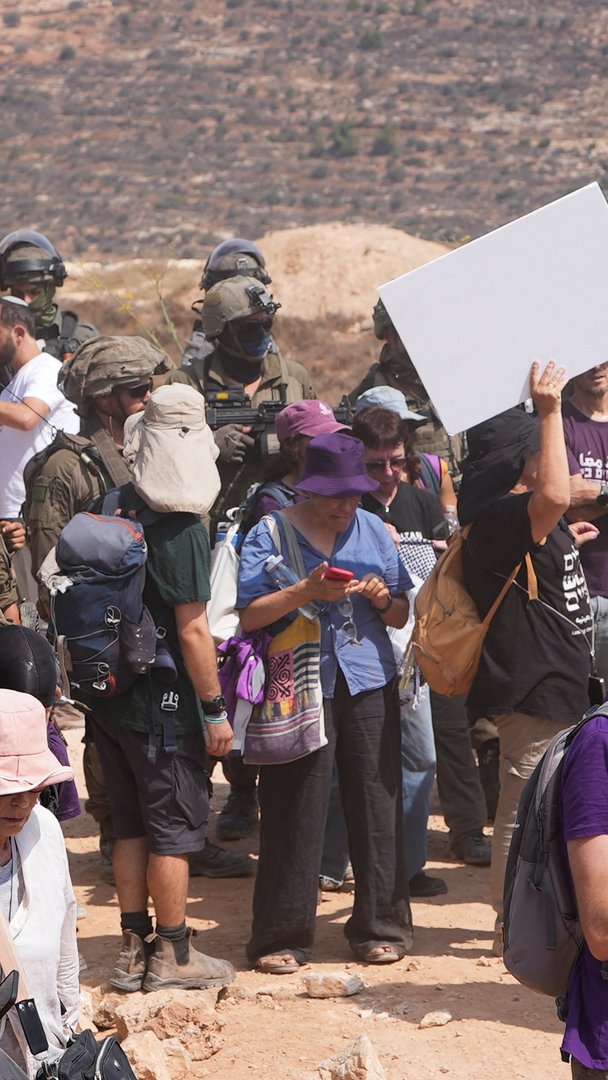

![Palestinian in Ein al-Duyuk sees settler bulldozer furthering damage in yard [Courtesy of Unarmed Civilian Protection in Palestine]](https://www.aljazeera.com/wp-content/uploads/2026/08/Palestinian-in-Ein-al-Duyuk-sees-settler-bulldozer-furthering-damage-in-yard-PC-Unarmed-Civilian-Protection-in-Palestine-1786475166.jpg?resize=770%2C513&quality=80)

![Ali Kaabneh in front of his partially destroyed home he still lives in [Courtesy of Unarmed Civilian Protection in Palestine]](https://www.aljazeera.com/wp-content/uploads/2026/08/Ali-Kaabneh-in-front-of-his-partially-destroyed-home-he-still-lives-in-PC-UCPIC-1786475292.jpg?w=770&resize=770%2C579&quality=80)
![A view of the area Palestinian residents say was razed by an Israeli settler in Ein al-Duyuk [Al Jazeera]](https://www.aljazeera.com/wp-content/uploads/2026/08/ANother-view-of-area-razed-by-Herbst-1786475352.jpg?w=770&resize=770%2C578&quality=80)
![Destroyed home in the Bedouin community in Ein al-Duyuk [Courtesy of Unarmed Civilian Protection in Palestine]](https://www.aljazeera.com/wp-content/uploads/2026/08/Destroyed-home-from-Bedouin-Stih-community-PC-UCPIC-1786475404.jpg?w=770&resize=770%2C579&quality=80)