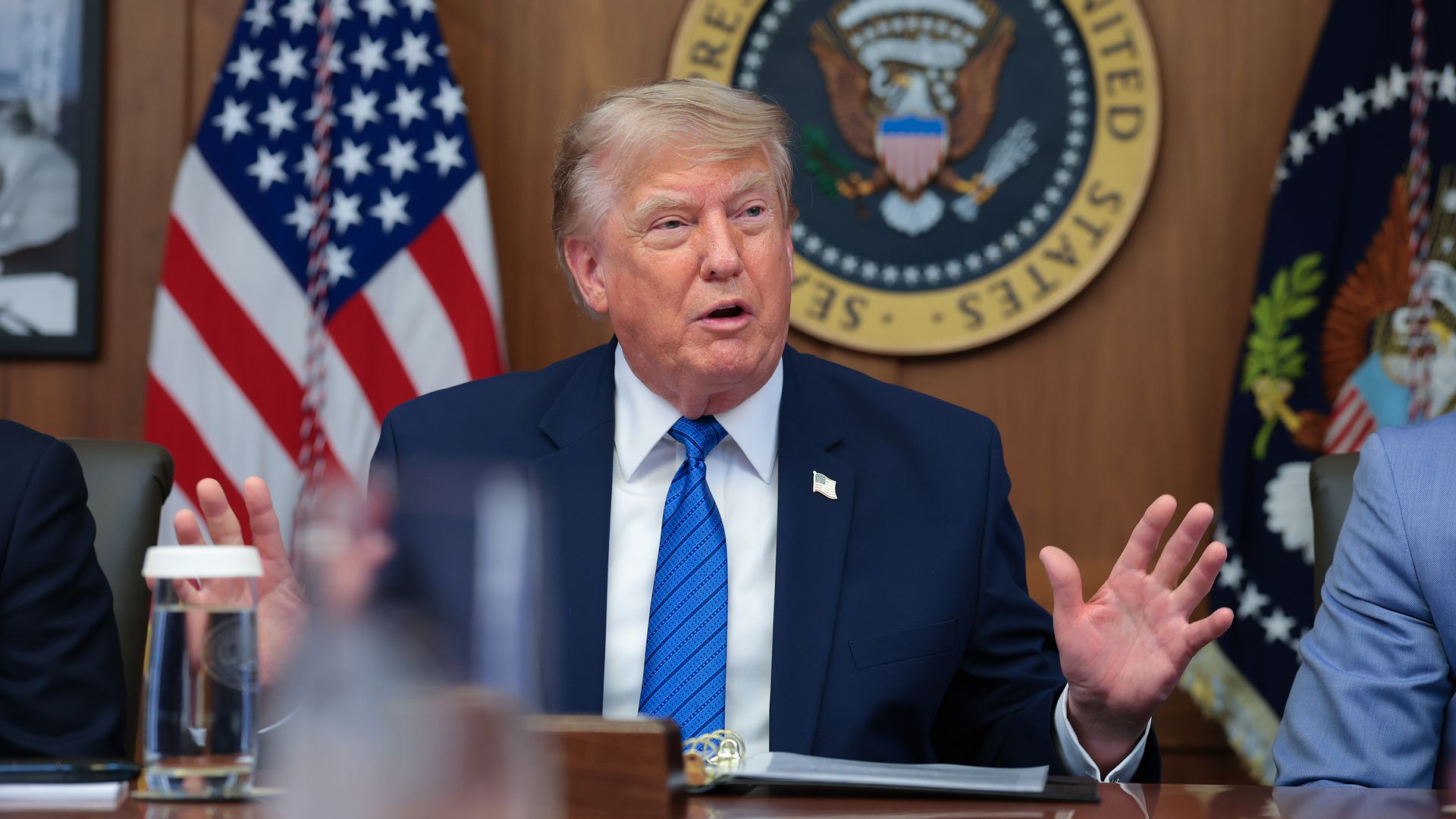
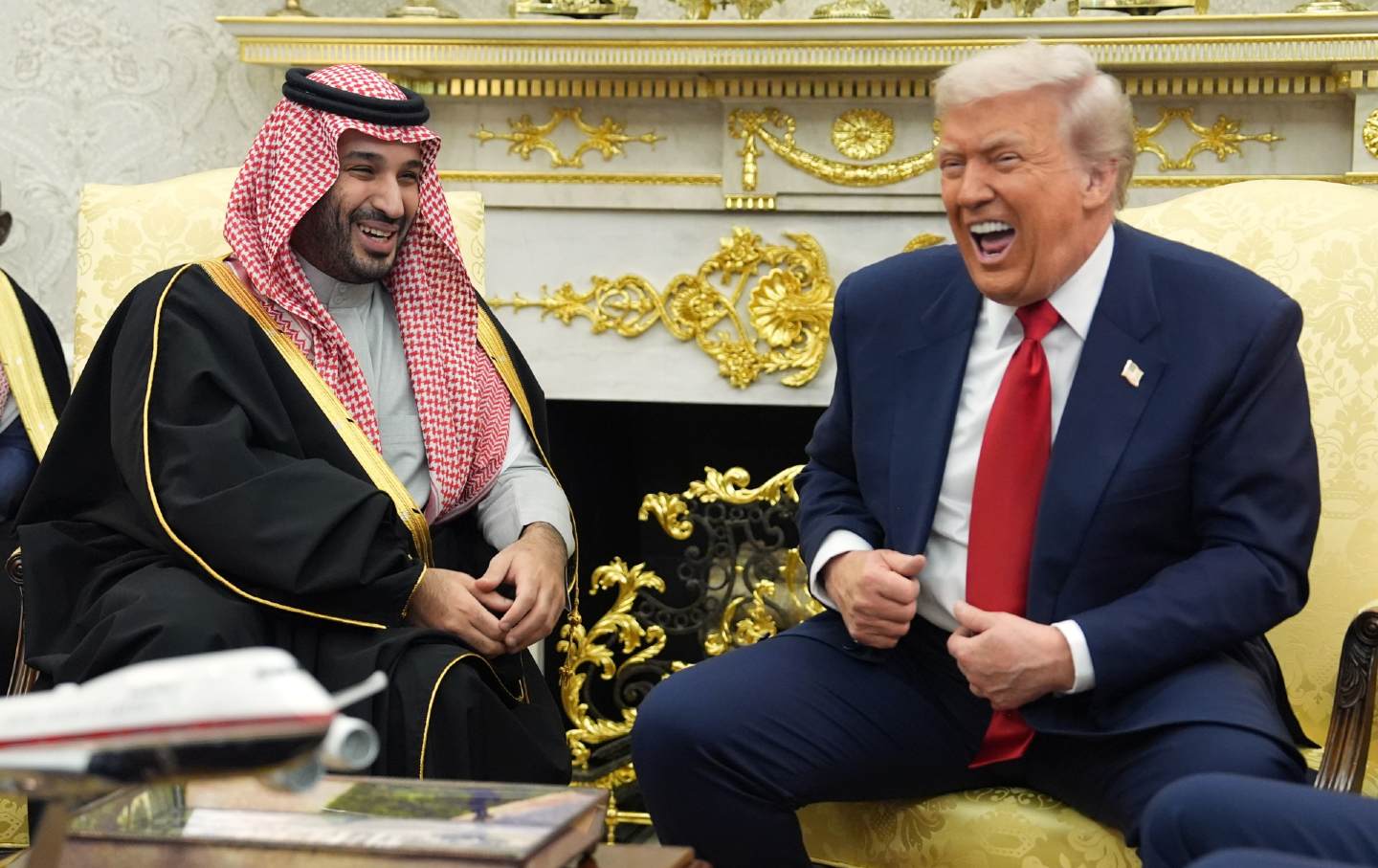
President
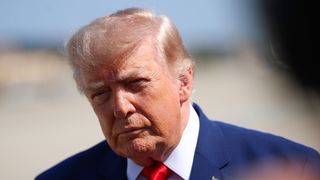
Donald Trump answers questions from reporters during a Cabinet meeting
at Camp David on July 31, 2026. (Photo by Anna Moneymaker/Getty Images)
President Trump is seriously considering launching attacks against energy targets in Iran in the next few days, but hasn't given final orders to do it, a U.S. official told Axios on Friday.
Why it matters: A new U.S. bombing campaign in Iran
against energy and infrastructure targets would be aimed at trying to
get the Iranians to agree to the United States' terms in ongoing
ceasefire negotiations.
The strikes could also involve the Israeli military for the first time
in many weeks, and such an escalation would likely lead to Iranian
missile attacks on Israel.
CBS News and the Wall Street Journal first reported about the potential strikes.
What they're saying:
At the start of Friday's Cabinet meeting, Trump alluded to the
potential attack, saying: "Well, we'll be hitting them very hard and,
you know, at some point they're going to say, we just can't take it
anymore."
He added that the more the U.S. conducts strikes, the weaker the Iranians get "and then they peter out."
"As
President Trump said at his Cabinet meeting today, the United States
will win, and Iran will not have a nuclear weapon under his watch,"
White House Press Secretary Karoline Leavitt told Axios.
Between the lines: A U.S. official said the Iranians have been "very aggressive" in recent days.
Some U.S. officials were stunned by how much the Iranians were willing to escalate.
After
their surprise missile attack against a U.S. base in Jordan on
Wednesday, the Iranians launched additional attacks against U.S. forces
in the region, a U.S. official said, declining to give more details.
The Iranians also attacked commercial ships in the Strait of Hormuz on Thursday.
President
Trump threatened several days ago that any new attacks on ships would
be answered with U.S. strikes on power plants and bridges in Iran,
including in Tehran.
The other side: Tasnim
news agency, which is affiliated with Iran's Revolutionary Guards,
quoted a senior security official saying that U.S. strikes on Iranian
infrastructure targets would be "an act of madness."
"We have
prepared a broad response plan that includes strikes against the
Zionist regime's critical infrastructure and U.S. energy infrastructure
in the region, and we are fully prepared to carry it out," the Iranian
security official told Tasnim.
This is a developing story. Check back for updates.
Trump’s Lethal Ad-Libbing in Iraq Enters Its Most Dangerous Phase
A new round
of US bombing will only reinforce the dynamics pointing to an American
loss—but that wouldn’t prevent the president from adopting still more
destructive measures.
Since
the collapse of June’s hastily signed Memorandum of Understanding
between Iran and the United States, President Donald Trump has responded
to the steady reversal of American progress in the Iran War by
repeatedly going through a now-familiar cycle of feigned indifference,
theatrical threats, and humiliating retreats. Last week, the
administration signaled that it was preparing for a significant bombing
campaign, only to back off at the last moment—reportedly after the
Pentagon warned
the president that supplies of critical munitions and already-scarce
missile interceptors would be depleted by such an escalation. After a
brief lull in the fighting earlier this week succumbed to a fresh round
of Iranian ballistic missile attacks on US bases in Jordan, the
president promised
on Wednesday morning, with his typical lack of decorum, to “beat the
fucking shit” out of Iran and then launched a new round of strikes on
Thursday. The clear takeaway from all these frantic off-the-cuff bids to
reshape the guiding narrative of the conflict is that the Trump
administration no longer bothers trying to connect the use of violence
to any kind of political goal.
A casual observer could be forgiven for thinking that we are trapped
in some kind of eternal recurrence loop, condemned to experience its
clear pattern of escalation and retreat “once more and innumerable times
more,” as Nietzsche once wrote. But despite the sometimes bleakly
amusing nature of the president’s ineptitude, we may now be entering the
most dangerous moment of the conflict, with no clear off-ramp for
either side. Iran’s leaders believe, with pretty good reason, that they
have the upper hand and can now wait for Trump to buckle under the
coming waves of economic pain. Iran doesn’t seem to care whether
negotiations are restarted at all, given that their American
counterparts can’t be trusted to send professional negotiators or follow
through on their commitments—and that the United States reveals a fresh
strategic vulnerability every time the shooting resumes.
On the Iranian side, the conflict is threatening to engulf more of
the region. Tehran has already demonstrated the ability to disrupt
operations at the UAE’s Fujairah port facility. This site marks the
terminus of an East-West pipeline whose capacity the Emirati regime is seeking to double
by next year and whose output has helped keep the global energy crisis
from spiraling. But a simple glance at a map demonstrates why continued
reliance on Fujairah is not a workable long-term strategy if Iran is
committed to establishing its hegemony over regional energy exports. The
port sits just outside the Strait of Hormuz on the Gulf of Oman, well
within range of Iran’s ultra-cheap drones and stockpile of ballistic
missiles.
Meanwhile, the Saudi port of Yanbu, while further from Iran, has a
similar set of vulnerabilities. Pipelines are relatively easy to repair,
but that’s not the case for the expensive, vulnerable infrastructure at
the ports. And because the cost of offensive weapons will always be
lower than the cost of missile-defense systems, there is no feasible way
to ensure the long-term safety of these facilities as long as the
Iranian regime exists in its current incarnation.
Reader-Funded since 1865
This article has been made free to read. Keeping it that way isn't.
Iran’s Houthi allies in Yemen have also joined the war effort by announcing their intent to close the Bab al-Mandab strategic shipping chokepoint, impose
passage fees through the waterway and harass shipping in the Red Sea
moving to and from the Suez Canal. The Houthis control the vast majority
of Yemeni territory and are eager to demonstrate their leverage, which
has fundamentally altered Iran’s strategic position in the Strait of
Hormuz. Iran’s direct hit on an American base in Jordan on July 17 and
18, which killed
three service members, also revealed a significant new weakness for the
United States and its regional basing strategy and may have played a
role in Trump’s once again backing down from threats.
As if all this isn’t bad enough for the United States, the war, which
was meant to last days at most, is now clearly on track to become
another regional forever war. The latest round of fighting now threatens
to interrupt energy flows that thus far have survived relatively
unscathed, and even reach into the Russia-Ukraine conflict in Europe. On
Monday, Ukraine struck
an Iranian vessel in the Caspian Sea—an incursion that represents the
first time the two countries have traded blows directly despite Iran’s
supplying Russia with drones and drone technology throughout its
barbaric war against Ukraine. The precision of Iranian strikes against
American and allied assets in the region suggests that Russia is, in turn, providing advanced targeting data to Tehran.
After mostly sitting on the sidelines early in the war, Saudi Arabia is now participating directly in combat, as are the United Arab Emirates, Kuwait, and Bahrain. The United States and Saudi Arabia are carrying out strikes against Iranian proxies in Iraq, much to the chagrin of the Iraqi government. Iranian drones struck
two American ships, including a natural gas tanker, in Egypt on
Wednesday, essentially putting the region on notice that it can reach
and damage energy infrastructure much further afield than the Strait of
Hormuz. This is exactly the spiral of region-wide escalation and
retaliation that credible experts warned would be the inevitable outcome
of an attempted regime-change operation against Iran.
What might Trump be willing to do to extricate himself from the hole
he has dug for himself? For months, he has intermittently and casually
threatened to attack Iranian civilian infrastructure like power plants,
bridges and even water-desalination plants. His gobsmacking threat
to eradicate Iranian civilization was issued fewer than four months
ago. So the idea that this is some kind of moral line that Trump would
never cross is absurd. After all, the man who talked him into the Iran
fiasco in the first place, Israeli Prime Minister Benjamin Netanyahu,
still presides over the wanton and deliberate destruction of Palestinian
civilian infrastructure in Gaz—and both he and Trump have shrugged off
the resulting humanitarian crisis. If it bothers the president that
millions of Palestinians are living in rubble-strewn squalor without
electricity or running water, he has never said so in public.
Having effectively signed off on the ongoing atrocities in Gaza, how
would Trump be prevented from doing the same to Iran? These prospective
war crimes would almost certainly fail to achieve the objectives of
either dislodging the Iranian regime or forcing it to reopen Hormuz on
America’s terms—but that’s far from any guarantee that a reckless and
inattentive figure like Trump wouldn’t try. Yet such attacks would only
lead to further Iranian escalation, including assaults on undersea fiber optic cables that have thus far been deemed off limits even by the aggressive new leadership in Tehran.
In the midst of all this feckless mayhem, Iran’s leaders almost can’t believe their dumb luck. Whether it’s the still-unseen
Supreme Leader Mojtaba Khomeini pulling the strings or a de facto
Islamic Revolutionary Guard Corps junta, Tehran’s strategy has quickly
evolved from bare regime survival to something more far-reaching. Far
from being eager to settle and return to the status quo ante—which
included crippling sanctions, the constant threat of Israeli or American
assassinations and sabotage, and the distinct possibility of being
overthrown in a popular uprising—Tehran now sees a path to a decisive
break with its prewar predicament and an end to America’s decades-long
policy of “containment” against the Islamic Republic. This new status
quo would position Iran as by far the most powerful state in the region,
unshackled from the preexisting global sanctions regime and free to
pursue both conventional and nuclear capabilities. Any deal that Tehran
would agree to today is likely to offer substantially worse terms to the
United States than the one Trump signed in June.
America’s ongoing inability to bring Iran to heel only accelerates
this dynamic. With Iran’s pivotal control over the Strait of Hormuz
firmly established alongside its demonstrated ability to destroy both
American bases and energy infrastructure at will, there will be no more
unanswered bombing raids of Iranian nuclear facilities, cost-free
assassinations of senior IRGC leaders, or open-ended backing of
opposition groups. If Iran can credibly threaten the global economy, and
the United States either can’t or won’t do what is necessary to
neutralize that threat, it’s no longer clear that any element of the
prewar containment regime can survive for long.
The only way to prevent this bleak outcome from taking shape, as
Trump surely knows by now, is to depose the Iranian regime with a
massive ground invasion. But even that dire move may not be possible,
given the country’s challenging terrain, capable defenses, and motivated
population. Just pacifying Tehran, a sprawling, mountain metropolis of
15 million people—not much smaller than the entire population of Iraq circa 2003—would be a daunting task. A March report from
the Cato Institute’s Brendan Buck argued that 1.6 million troops would
be required to mount an invasion of Iran—a figure that exceeds the
current number of combat troops available to the whole US military. Even
if the actual figure is half that, it would require a vast and costly
mobilization on a scale not seen since the Vietnam War. Political
blowback from that sort of commitment could put a filibuster-proof
Senate majority for Democrats in play this November.
It would be easy to glibly dismiss the possibility that Trump will
elect to pursue such a disastrous course of action. But he has a
lifelong track record of making terrible, immoral choices and a very
recent history of happily inhaling the vapors of whatever his most
militant interlocutors are smoking. Eventually, he is going to run out
of patience with his own bomb-and-bail routine, which is paying zero
dividends. At that point, he will confront the same choices he’s had
before him for months: return to some version of the bitter peace that
he agreed to in June, give aerial war crimes a try, or prepare for the
biggest war that nearly anyone currently alive has witnessed. Whatever
he chooses, it is likely now far too late for the midterm elections to
be anything other than a referendum on the Trump administration’s
decision to plunge the country into this hopeless situation.
David Faris is a professor of political science at Roosevelt University and the author of It’s Time to Fight Dirty: How Democrats Can Build a Lasting Majority in American Politics. His writing has appeared in Slate, The Week, The Washington Post, The New Republic, and Washington Monthly. You can find him on Bluesky at @davidfaris.bluesky.social.
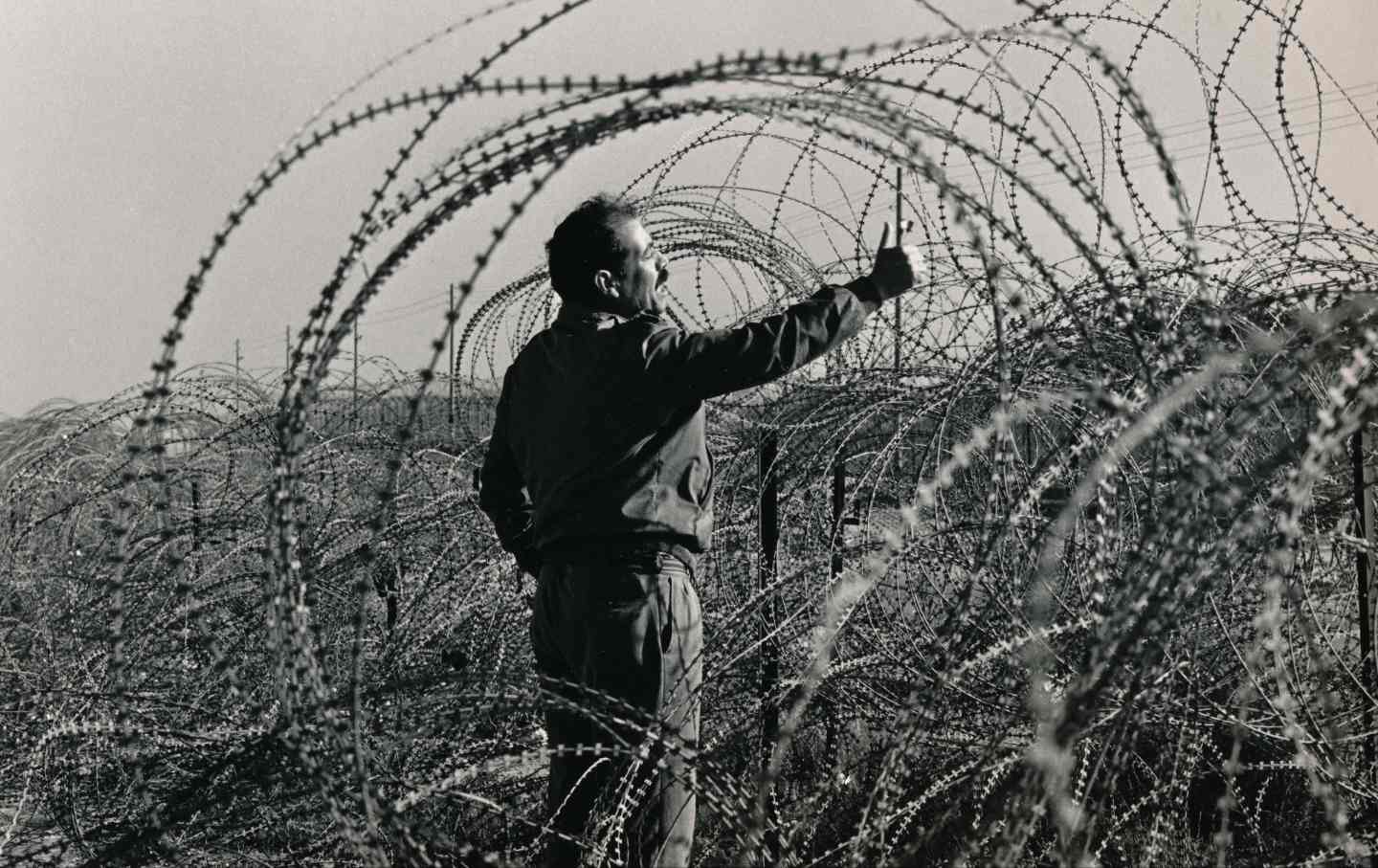
For
decades, thousands of Palestinians were trapped in a camp in Egypt,
within shouting distance of their homeland in Gaza. This is what
happened to them.
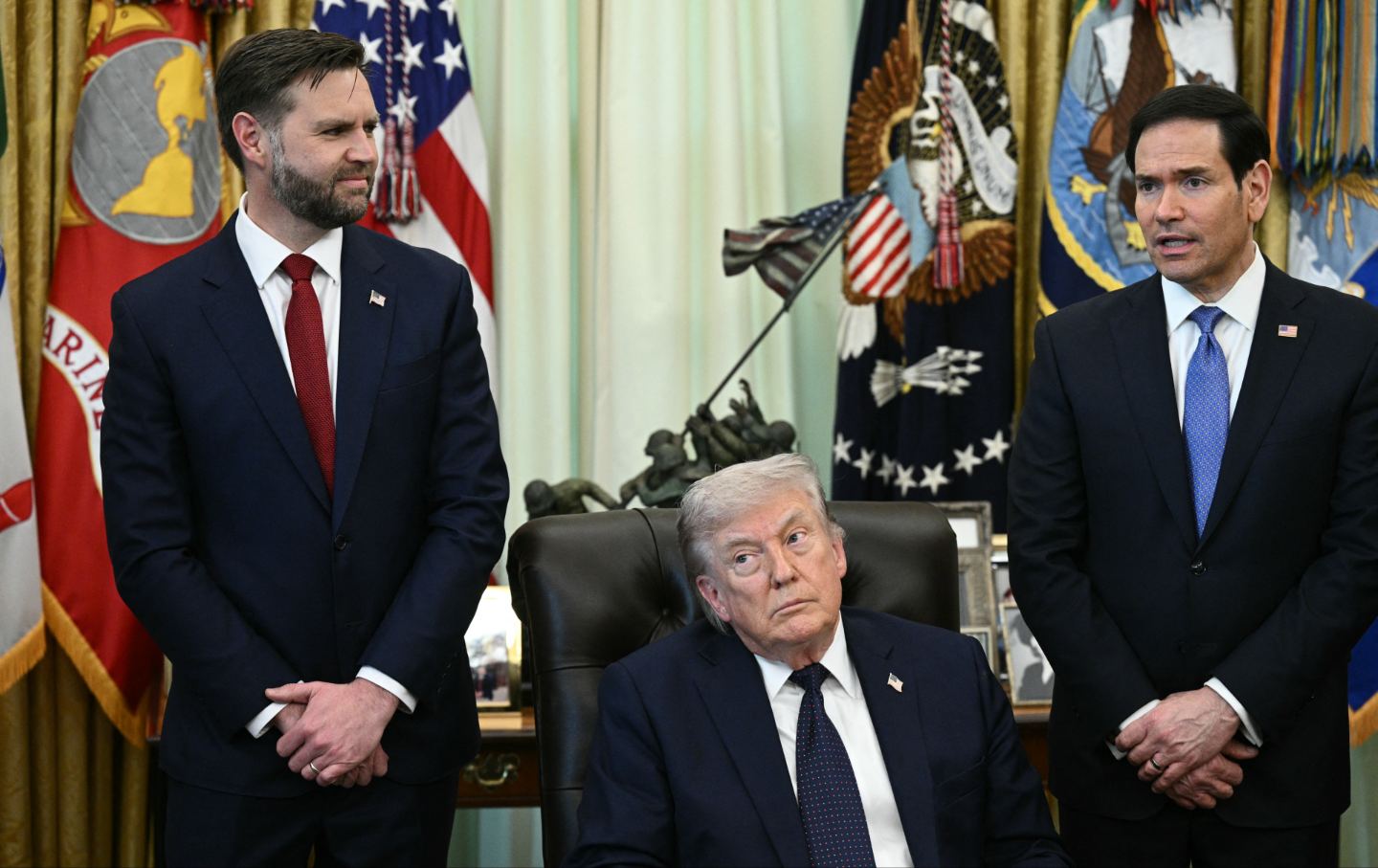
President Donald
Trump told reporters in the Oval Office of the White House in
Washington, D.C., on Wednesday, that the U.S. military would conduct
retaliatory attacks against Iran. Photo by Aaron Schwartz/UPI | License Photo
July 29 (UPI) -- The U.S. military
announced a new wave of strikes against Iran early Thursday, as the
brief detente between Washington and Tehran appeared to have been
short-lived.
U.S. Central Command said
the strikes began at 8 p.m. EDT Wednesday, ended at 10 p.m. and were "a
powerful response to yesterday's attempted Iranian attacks on U.S.
forces based in the Middle East."
CENTCOM said it struck dozens of Islamic Revolutionary Guard Corps targets, including military command centers, maritime capabilities, missile and drone facilities and coastal surveillance and defense sites. The extent of the damage was not immediately clear.
The strikes followed a roughly four-day lull in fighting between the
two countries to allow efforts to revive diplomacy. The pause appeared
to have ended early Wednesday local time when Iran's Islamic
Revolutionary Guard Corps fired ballistic missiles at the Muwaffaq Salti
Air Base and what it said was CENTCOM's headquarters in Jordan.
CENTCOM said all five missiles were intercepted. No casualties or damage were immediately reported.
Ask UPI
The IRGC said the attack was in response to U.S. military actions against Iran, saying that unspecified "threats by U.S. officials and illegal interventions against our interests must stop."
Separately, the United States and Saudi Arabia conducted joint strikes against Iran-backed proxies in Iraq, which they said had targeted Saudi energy infrastructure over the last few days.
The strikes were the first announced U.S. attacks specifically
targeting Iran since the previous wave ended on Friday. They came after
U.S. President Donald Trump said earlier Wednesday that the U.S. military would retaliate.
"We're going to be hitting them very hard because it's our turn," he said in an Oval Office press conference.
"They know it's coming. They're asking us not to do it, but, you know, they tried shooting at [us] last night."
He said Iran's attack consisted of five ballistic missiles, all of which were intercepted.
"But they nevertheless took a shot, so it's our turn, and we'll see
if we get there with an agreement at some point, but we're going to hit
them very hard."