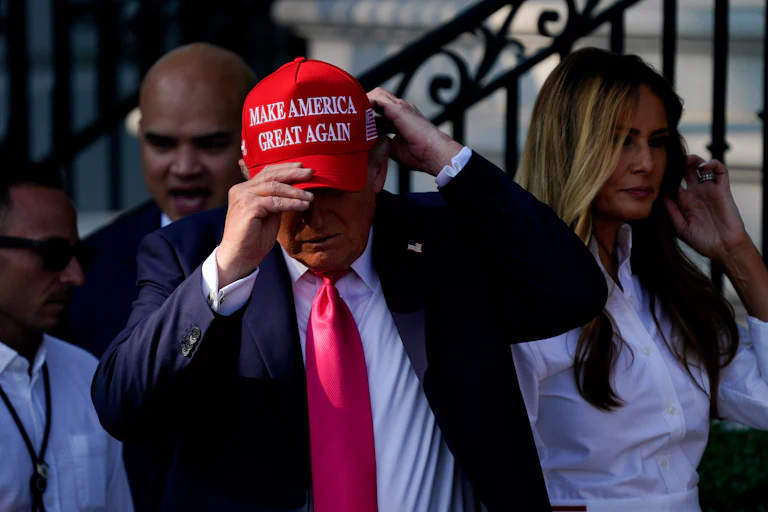
Foreign Company at Center of Trade Dispute Paid Trump Millions
Donald Trump keeps finding new ways to make money off the presidency.
Kent Nishimura/Bloomberg/Getty Images
The
main investor in a South Korean aluminum company facing an
investigation by the Department of Commerce paid $2 million to President
Trump’s holding company last year.
Trump included the payment from Base Group in his financial disclosure form in late June, The New York Timesreports.
The form stated that the payment was for a “nonrefundable development
fee” and part of a “letter of intent,” but offered no further
explanation. The Trump Organization told the Times in a statement that the payment is part of a golf course project that has yet to be announced.
“We
have been in the golf, hospitality, and real estate business for
decades and have entered into transactions with countless companies
around the world,” Alan Garten, chief legal officer for the Trump
Organization, said in the statement. “Any suggestion that this
transaction was driven by anything other than legitimate business
considerations is pure fiction.”
The Trump family has
a longstanding relationship with Base Group, which exclusively sells
Trump-branded wine in South Korea. The company hosted the president’s
son Eric in February at its headquarters in Seoul for a meeting to
increase trade between South Korea and the U.S.
The
Commerce Department found in 2023 that Korea Aluminum, of which Base
Group has a major stake, skirted trade duties on Chinese-made aluminum.
Since then, the company has significantly cut its exports to the U.S.
The Timeshas
not found any evidence that the president or his family members have
tried to advocate for Base Group or Korea Aluminum with government
officials. But the payment raises questions about conflicts of interest
concerning the president and his family with government operations.
Trump has close to 30 different ventures with foreign businesses around
the world, according to the Times, creating issues that were unheard of in any previous presidential administration.
Trump has made a whopping $2.2 billion
in his second term as president from cryptocurrency, foreign real
estate, stock trading, and other ventures. Being president isn’t
supposed to be a business move to increase one’s personal fortune, but
Trump has used the office to make himself wealthier, ignoring the Emoluments Clause of the Constitution with the Supreme Court’s assent.
We
only have the Trump Organization’s word that this South Korea payment
didn’t come with any government favors. Who knows whether that is true,
or if Trump has taken money in other cases from businesses in exchange
for favorable policies.
Trump Threw Missing GOP Representative Under the Bus While He Was Out
Representative
Tom Kean Jr., who is running for reelection in November, was greeted by
an unpleasant Department of Homeland Security decision.
Graeme Sloan/Bloomberg/Getty Images
Representative Tom Kean Jr.
Representative Thomas Kean Jr.’s grand return to Capitol Hill has come fully loaded with a no-win dilemma.
The
New Jersey Republican inexplicably disappeared for several months, only
to reemerge on the House floor late last month, claiming that he had
struggled with depression and was therefore unable to vote on behalf of
his constituents.
But
Kean has since been forced between a rock and a hard place by the Trump
administration after the Department of Homeland Security renewed a bid
to resurrect a detention facility proposal in northern New Jersey,
despite unified local opposition to the effort.
The
conundrum has put Kean in an impossible position, requiring him to
either infuriate voters in his district or publicly break with the White
House, mere weeks out from a contentious midterm election that has him
pitted against well-funded Democrat Rebecca Bennett for New Jersey’s 7th
congressional district. As of Monday afternoon, Kean had not taken a
firm position for or against the facility.
“I have
remained actively engaged on this issue from the beginning, and I will
continue to bring together multiple levels of government to find a
responsible, workable solution,” Kean said in a statement to Politico. “My priority is ensuring the residents of Roxbury are respected, heard, and represented every step of the way.”
Conservative
strategists warned that the fallout for Kean could be just as bad on
the right-wing side of politics if he decides to support the detention
center’s construction.
“There are going to be
conservative voters who are concerned about this development going in
their backyard, which they very much don’t want, and it will affect
their votes in November,” Carlos Cruz, a Republican consultant, told
Politico.
Locals have already taken notice of Kean’s indecision.
“Even
the Republican-led Roxbury Township Council has called out Congressman
Kean Jr. for refusing to advocate on behalf of their community,” a
spokesperson for Kean’s Democratic opponent, Bennett, told Politico.
“His job title is representative, but he consistently fails to show up
and fight for the people of New Jersey.”
The issue
had almost resolved itself without Kean’s input. On June 29, DHS
indicated in a legal filing that it no longer intended to convert the
warehouse into a detention facility following a bipartisan lawsuit
brought by Governor Mikie Sherrill’s administration and the
Republican-run Roxbury Township.
But that same day, DHS Secretary Markwayne Mullin put his foot down, insisting that the agency would not let go of the site.
“DHS will NEVER back down. We will be keeping this site for a detention center,” Mullin wrote on X.
Days
later, DHS followed Mullin’s lead, writing in another legal filing that
the “agency intends to move forward with plans to consider the
retrofitting of the Roxbury Township warehouse facility for use as a
detention facility.”
Trump Pulls Abrupt 180 on Strait of Hormuz After Iran Humiliates Him
Donald Trump had proposed tolling the Strait of Hormuz, but 24 hours later, he was singing a different tune.
SAUL LOEB/AFP/Getty Images
Rather
than provide steady, articulate leadership and communication during his
Iran war, the commander in chief has embraced bluster and erratic
flip-flopping. The latest example of this came Tuesday, when President
Donald Trump adopted a stance on the Strait of Hormuz diametrically
opposed to the one he had announced the day before.
On
Monday, Trump decided that the United States would seize control of the
strait. “We’ll become the guardian of the strait,” he told
Fox News. “Now we’re gonna guard it, and we’re gonna get paid for
guarding it. A lot of money. But we just want to be reimbursed.” In a
Truth Social post, he said a 20 percent toll would be imposed on “all cargo shipped” through the strait.
It was a stark reversal of the administration’s previous stance; Secretary of State Marco Rubio and Vice President JD Vance had stated unequivocally that no country would impose such a toll.
Then the sun set and rose again, and Trump had yet another 180-degree change of heart.
Tuesday, Trump declared that there would be no toll after all. Instead, he said vaguely in a Truth Social post
that the U.S. would pursue “Trade and Investment Deals” with Gulf
states. Shortly thereafter, he confirmed this new approach during a
press conference. “I don’t think anybody should be able to charge a fee
for the strait,” the president said,
“or for any other strait relationship in terms of other sections of the
world. I don’t think anybody should be really in that position.”
What spurred Trump’s whiplash-inducing reversal of an already-reversed course?
After he proposed the toll, Trump told
a reporter Tuesday, he was allegedly contacted by “kings and emirs and
all of the people that we all know and we all love … and they said,
‘We’d love to do it a different way.’”
Also, after Trump initially announced the tolls, Iran asserted its control of the strait. Iranian Foreign Minister Seyed Abbas Araghchi answered Trump with a message on X:
“POTUS is absolutely right. Whoever provides secure and safe passage of
commercial vessels through the Strait of Hormuz should be compensated
for this service. Iran has always been the GUARDIAN of the Strait and
will remain so FOREVER. 20% is of course too much. We will be fair.”
Bears Ears and Grand Staircase-Escalante are sacred to Native tribes.
Wolfgang Kaehler/LightRocket/Getty Images
The Lower Calf Creek Falls in Grand Staircase-Escalante National Monument, Utah
President
Trump on Monday significantly reduced the size of two national
monuments in Utah, cutting the amount of protected land that they hold
by about 1.5 million acres each.
Trump slashed
protections for both Bears Ears and Grand Staircase-Escalante during his
first term to free up two million acres for oil drilling and uranium
mining. This led environmental groups and Native American tribes to sue,
and former President Joe Biden reversed the measure. Now, with this
most recent move, those same groups are preparing to take up legal arms
against the Trump administration once again.
National
lands and monuments, which often appear similar to national parks, have
a different set of regulations around them as established by the
Antiquities Act of 1906. Those opposed to Trump’s executive order argue
that under this law, a president can only create national lands and
monuments but not shrink or eliminate them. Those in favor of opening
the land to oil drilling note that “any land reserved under the act must
be limited to the smallest area compatible,” as argued by Supreme Chief Justice John Roberts in 2021.
“Today’s
action makes it clear that Utah is the epicenter of Republican efforts
to dismantle and obliterate America’s system of public lands,” Southern
Utah Wilderness Alliance executive director Scott Braden said in a statement,
vowing to challenge the executive order in court. “President Trump’s
outrageous attack on Grand Staircase-Escalante and Bears Ears national
monument was taken at the urging of Utah politicians—Senators Mike Lee
and John Curtis, Governor Spencer Cox, and the others—who championed
this action. These two landscapes deserve to be protected for current
and future generations of Utahns and Americans, not opened to
exploitation.”
“You have an administration that backs
you up, and then you’re back to square one again,” Pueblo of Zuni
councilman and Bears Ears Inter-Tribal Coalition co-chair Anthony
Sanchez Jr. toldThe New York Timeson Monday. “Even now, with the boundaries not reduced, we still run into that trouble.”
Bears
Ears is the ancestral homeland of the Navajo Nation, Hopi Tribe, Ute
Indian Tribe, Ute Mountain Ute Tribe, and Pueblo of Zuni, and contains
rock art that is culturally significant.
Democrats Outraged as Trump Tries to Reset the Clock on Iran War
President Trump is trying to pretend the latest round of hostilities is actually a new war.
SAUL LOEB/AFP/Getty Images
Democrats in Congress aren’t happy that President Trump has restarted the Iran war.
Trump formally notified lawmakers last week
that the war in Iran has resumed, attempting to legally claim that a
new 60-day period has started that gives him the power to use military
action in Iran without congressional approval. Democrats called out the
Trump administration for going back on its promises that the war was
over.
“We
were promised the war would be over for months. And now in a matter of
days, we’ve gone from a bad U.S.-Iran deal to more strikes, another
blockade, and added turmoil that will only drive prices higher,” Senator
Adam Schiff said on X Monday.
The California senator filed a new war powers resolution
on Monday, co-sponsored by colleagues Tim Kaine, Andy Kim, Jeff
Merkley, and Chris Van Hollen, in an attempt to rein in the president.
“Any
assertion by the Trump Administration that he gets 60 more days to act
without Congress has no foundation in law,” Schiff said in a statement,
asking for a “new vote to end this war.”
Senate Minority Leader Chuck Schumer said
on the Senate floor Monday that “Trump’s rinse and repeat approach to
the Iran war isn’t a strategy, it’s a recipe for utter disaster.
“We
keep moving backward. Gas prices stay high, casualties increase, costs
increase. It’s incredible what a fiasco this war is,” Schumer added.
Senator Chris Murphy pointed out that the war’s resumption hurts the economy, saying, “Gas prices are spiking again.”
“The
bottom line? Trump has no moves to make. His spiraling incompetence has
boxed America in. It’s only going to get worse,” Murphy said in an X post.
Last month, Iran and the U.S. signed a memorandum of understanding, seemingly ending the conflict while long-term negotiations continued. Those negotiations have collapsed,
and Iran has resumed attacking American and oil industry targets in the
Persian Gulf, while the U.S. military is once again bombing targets
within Iran. Iran has resumed its tolls in the Strait of Hormuz, while
Trump claims that the U.S. naval blockade of Iran is back on. By trying
to reset the clock, Trump is acknowledging, consciously or not, that
he’s also resetting a quagmire.
Conflicted Funds: BP sponsored an elite Princeton
research center to address the climate problem without getting off
fossil fuels, handpicking scientists aligned with their interests.
A Paradigm-Setting Paper: Princeton scientists who
wrote a climate paper criticized as making solutions seem “easy”
coordinated with the oil company’s executives and showed them multiple
drafts.
Oversold Solutions: Researchers depicted technology
to capture carbon and store it underground as being proven and in use
at industrial scale, a characterization that stretched the facts.
These highlights were written by the reporters and editors who worked on this story.
It is rare that a single scientific paper shapes how people think about a challenge as daunting as climate change. But one, known as “Wedges,” published 22 years ago by researchers at Princeton University, told an irresistible story.
It made solving climate change seem possible, even simple. It claimed
that the world didn’t have to wait for innovation because it had the
tools to start work immediately.
The trick was to do a little of everything and let the effects add
up. Renewable energy, nuclear power and conservation were certainly
pieces of the solution puzzle. But so were a slew of steps that involved
using oil, gas and coal despite the carbon dioxide emissions they would
continue to produce.
One fix that “Wedges” leaned especially hard on was carbon capture
and storage, a technology that promised to grab carbon pollution from
smokestacks and other sources and trap it forever underground. Do that
enough, and climate change could be curtailed without upending the world
as we know it.
The paper, written by scientists Robert Socolow and Stephen Pacala,
became a phenomenon. Former Vice President Al Gore highlighted it in his
Oscar-winning climate change documentary. U.S. presidents from George
W. Bush to Joe Biden incorporated ideas from it into policy. The United
Nations’ panel on climate change worked it into at least three major
reports over more than a decade. It was presented in classrooms at
Harvard and MIT and cited more than 3,000 times in scientific papers. It
was even turned into a board game.
For a generation, people learning how to address global warming were taught the ideas in the “Wedges” paper.
What they didn’t learn was this: “Wedges” was significantly shaped by
the British oil giant BP — one of the single global entities most
responsible for causing climate change.
In 1997, BP abandoned climate change denial. Instead, the company
quietly launched a far-reaching effort to intertwine oil company
interests and climate science, in part by using its vast resources to
shape the research that major universities undertook.
While its chief executive, John Browne, was rebranding his company as
Beyond Petroleum, BP sought out researchers who were already thinking
about how to address climate change without replacing fossil fuels. The
company found them at Princeton University, where it set about
amplifying their work by donating $15 million to start the Carbon
Mitigation Initiative. The research program was framed around finding
solutions to climate change while keeping fossil fuels in play, focusing
heavily on carbon capture.
The “Wedges” paper was the initiative’s first big swing. And it succeeded beyond anything its authors could have imagined.
BP executives were deeply involved throughout the paper’s creation,
according to an investigation by ProPublica and Drilled. Socolow and
Pacala, the authors of “Wedges” and the new center’s co-directors, not
only discussed ideas with the company but, in a departure from academic
norms, passed drafts back and forth and welcomed extensive feedback.
Like a book publisher shaping a clunky early draft into a bestseller,
an executive at the company suggested the scientists punch up the
language, which they did. Browne himself suggested wording that became a
part of the title. Together they helped make wonky scientific ideas
more digestible for popular consumption. BP even tried — unsuccessfully —
to revise a version of it.
“Chaps, I have had a go at rewriting the paper,” Browne’s climate adviser wrote the researchers at one point.
Then, while the paper was being prepped for publication, BP began aggressively promoting the ideas it contained. Browne touted the framework
in a speech as evidence that oil and gas had “sustainable futures” and
published an endorsement of “Wedges” in an essay in Foreign Affairs
magazine. BP inserted the paper’s ideas into its sustainability reports
promoting greater efficiency and natural gas — which it argued offered a
low-carbon alternative to coal.
“Wedges,” whose ideas were turbocharged by the sort of high-level
marketing scientific papers rarely get, became a regular part of
thinking about climate change in classrooms and boardrooms alike. And as
that happened, BP kept pouring millions more dollars into Princeton
each year, in part to explicitly advance carbon capture and storage
technology and, as internal documents make clear, to get the
university’s help in turning the idea into a bona fide government-backed
solution.
“Chaps, I have had a go at rewriting the paper.”
Chris Mottershead, BP climate adviser
Gardiner Hill, a former vice president and climate executive at BP
who worked with the Princeton program, told ProPublica and Drilled that
BP took academic freedom seriously. It “did not oversee any of the
publications” that Princeton put out under its sponsorship, he said. A
spokesperson for BP declined to respond to two lists of questions sent
by ProPublica and Drilled.
Socolow and Pacala say they were sincere in their intent to solve
climate change in the best way they believed possible, at a time when it
was not obvious that wind and solar would succeed the way they have
today. The researchers say BP had no control over the scientific content
of the paper. They rejected the view that technologies didn’t exist to
start solving climate change immediately and hoped carbon capture
offered, as Pacala said, a way to make fossil fuels “climate safe.”
But “Wedges” oversold the readiness of carbon capture and storage, describing it as “already deployed” industrially. Reporting by ProPublica and Drilled has found that even today, the technology faces financial and technical hurdles and is unlikely to everwork at the scale needed to avert extreme warming.
And the broader solution set that “Wedges” promoted, including
expanding the use of natural gas, has meanwhile helped perpetuate a
system in which fossil fuels remain the predominant source of energy and
the emissions they cause have continued.
“An unfortunate consequence” of the “Wedges” paper, wrote climate
scientist Ken Caldeira, New York University physics professor Marty
Hoffert and others in a 2013 critique, “was to make the solution seem
easy.”
Moreover, for the past quarter century, as research into carbon
capture and storage and other industry-friendly solutions have enjoyed
robust funding and attention, other ideas that might have replaced
carbon-heavy energy entirely — reducing warming and potentially saving
lives — were drowned out, several researchers told ProPublica and
Drilled.
“Wedges” would likely never have been written without BP’s funding,
Socolow said. Scientists and ethicists say the paper may not have been
seen as credible or earned its acclaim had the extent of BP’s
involvement been fully disclosed.
Neither BP nor Princeton responded to specific questions about our findings.
This is the story of how one of the most influential climate papers
in history came to exist thanks to the support of one of the companies
most responsible for causing the climate crisis — and one with a deep
financial stake in how the technologies described in the paper would
play out. It is part of a broader investigation
by ProPublica and Drilled into how the fossil fuel industry has helped
steer the global response to climate change by pouring billions of
dollars into research at elite universities. Since the 1990s, oil
companies have sponsored research centers, kept offices on campuses,
paid the salaries of scientists and, in at least one case, held veto power over what professors and scientists could study with their money.
Today, the impacts of those efforts are everywhere, so ingrained in
our understanding of what it means to solve climate change that it can
be hard to conceive of another way forward. Even the U.N.’s assessment
of how to deal with the threat of climate change continues to pin hope
on capturing tremendous amounts of carbon pollution and burying it in
the Earth.
So little has been done to avert fossil fuel emissions for so long,
said Zeke Hausfather, a climate scientist with the research nonprofit
Berkeley Earth,that there is little remaining choice.
“We’ve just wasted so much time,” he said, that meeting goals to limit global warming has become “functionally impossible.”
2
A Place of Influence
“Establishing cooperative relationships”
Photo illustration by Tonje Thilesen for ProPublica
On a sunny morning in the spring of
1997, Browne took to the podium at Stanford University’s open-air Frost
Amphitheater to deliver a speech unlike anything ever heard from an oil
executive.
“There is now an effective consensus … that there is a discernible
human influence on the climate,” Browne, a small, professorly man with
an air of British formality, told the audience. For years, BP and the
other big oil companies had been part of an industry group called the
Global Climate Coalition, working to sow doubt about global warming and
avert agreements that would force cuts in heat-trapping pollution. Now
Browne, having pulled BP out of the group, was suddenly pledging his
company would be taking “substantial, real and measurable” action to fix
the crisis.
Still, Browne cautioned against haste even as he urged action. If
governments were too aggressive in cutting fossil fuel use, he warned,
their actions would “crash into the realities of economic growth.”
Instead, BP would seek to be more efficient — seizing “low-hanging
fruit.” And it would experiment with capturing carbon to stop fossil
fuel emissions from entering the atmosphere.
This was the start of a long transition in BP’s branding and in the
way it worked with thought leaders to shape the company’s future.
John Browne, the chief executive of BP, in 1998James Leynse/Corbis/Getty Images
By then, oil companies had already begun investing in universities’
climate work. Exxon started giving money for climate research to
Columbia University’s Lamont-Doherty Earth Observatory in the late 1970s.
Then in 1991, the company funded the launch of the Joint Program on the
Science and Policy of Global Change at Massachusetts Institute of
Technology, according to the program’s former co-director, Henry Jacoby.
Chevron, Shell and BP also later supported the program, which developed
influential climate-related models.
Fossil fuel companies recognized that they could benefit from
spotlighting the research of prominent scientists whose ideas were
aligned with their interests. And they strategized to boost the
influence of those ideas in the global policy response to climate
change.
In 1998, the American Petroleum Institute, the largest and most
powerful oil industry lobbying group in the U.S., established what it
called its Global Climate Science Communications Plan. An internal document
described the importance of outreach aimed at “establishing cooperative
relationships” with “scientists whose research in this field supports
our position” and developing “opportunities to maximize the impact of
scientific views consistent with ours.”
In 1999, Browne asked his chief scientist, Bernie Bulkin, to find
research programs the company could support in the U.S. Bulkin — who
told ProPublica and Drilled that he had never heard of the API
initiative to engage with scientists — decided to set up a
climate-focused program that could test the viability of carbon capture
and storage, a budding technology.
For decades, oil companies had extracted carbon dioxide from the
Earth and pumped it back underground to force more oil out under
pressure, a process called enhanced oil recovery. If that process were
adapted to store CO2 in the earth forever, then billions of tons of
carbon emissions could, in theory, be captured from smokestacks and
buried. Global emissions could be reduced without cutting fossil fuel
use at all.
A handful of scientists had been making the case that this might be
doable. One of them was Socolow, a theoretical physicist who had been
leading an interdisciplinary environmental program at Princeton since
1971.
In 1997, Socolow ran a summer workshop for the U.S. Department of
Energy in which he and other experts suggested that natural gas, coal
and other fuels could be used to make clean-burning hydrogen. If the
emissions from the process could be captured and stored away forever, it
might be possible to use fossil fuels without contributing much to
global warming.
Socolow wanted to address climate change. But he was also predisposed to remedies that would not require what he described as “a priori,
the sacrifice of the energy value of oil, gas, and coal.” In graduate
school he studied with scientists who had worked on the Manhattan
Project, and he worried that supporting nuclear energy could lead to the
proliferation of weapons. He thought solar, wind and hydro power would
each present their own environmental problems.
Carbon capture and storage, though, could make switching away from
fossil fuels less urgent and was something that “brings the oil industry
to the table.”
Robert Socolow, left, and Stephen Pacala, right, of Princeton University, pictured in Time magazine in 2007Jonathan Saunders
The oil companies had doubts that carbon capture and storage
technology would work. “Nobody had any idea what it would cost and
whether there was anything practical at scale,” Bulkin recalled in an
interview. Still, Bulkin thought there would be little downside for BP
in trying. If it didn’t work for the climate, it might help the company
produce more fossil fuels.
Bulkin began evaluating America’s top universities. It was, he wrote
in his 2019 memoir, a “determinedly elitist” selection process aimed at
getting “the greatest benefit to the company.” Researchers at MIT and
Stanford had pioneered work on carbon capture and enhanced oil recovery.
But a colleague had heard Socolow give a presentation on carbon capture
and was impressed. So Bulkin added Princeton into the mix, and in early
2000, Bulkin said, each of the universities submitted proposals to BP
for funding of a program to expand carbon capture research.
Stanford saw carbon capture and storage as a geological problem, MIT
more of an engineering challenge, Bulkin said. Princeton’s labs didn’t
have the technical expertise in carbon capture that the other two
schools had. But Socolow came off as masterful at synthesizing energy
challenges and environmental concerns, and Pacala brought deep knowledge
of how carbon moves between Earth’s atmosphere, land and oceans.
Together, they offered a more systemic way of thinking about carbon
capture.
That June, weeks before BP announced it was rebranding as Beyond
Petroleum, Bulkin told Pacala and Socolow they had won. BP would commit
roughly $15 million over 10 years to form the university’s Carbon
Mitigation Initiative. The program would focus roughly one third on
earth sciences research, one third on carbon capture and one third on
policy efforts. Pacala got Ford Motor Co. to contribute $5 million
more.
When it was announced that October, the $20 million gift amounted to the largest corporate grant in Princeton’s history.
A spokesperson for Princeton told ProPublica and Drilled that
partnerships with corporations make up just over 3% of the university’s
research funding but help it “address real-world problems.” Princeton,
the spokesperson added, maintains policies that “prevent outside funders
from exercising undue influence over research,” including not
permitting sponsors to have veto power over publications.
Representatives from Columbia University and Ford did not respond to
requests for comment. A representative from MIT wrote that Exxon “did
not direct the Joint Program’s research agenda.”
BP Promotes New Princeton Carbon Mitigation Initiative
Courtesy of Science History Institute
From the start, Princeton’s contract with BP was supposed to protect
its academic independence, Pacala told ProPublica and Drilled. The
company wasn’t supposed to direct what its money was going to be spent
on, he said. “BP can’t tell us what to do.”
But BP and the Princeton researchers were eager to collaborate, and
both Socolow and Pacala said they sought ideas no matter where they came
from. “The university has an obligation to welcome all points of view,
while fiercely protecting its own independence and the independence of
its investigators,” Socolow said in an email.
In late 2000, Princeton researchers, BP officials and representatives
from Ford gathered at the enormous Italianate mansion of Princeton’s
president.
“We spent about two days just talking about what would be useful to
us,” Bulkin recalled in an interview. Princeton scientists “threw out
ideas, and we said, ‘Well, we could help on this’ or ‘That’s maybe
interesting, maybe not,” he said. “Tell us more.’”
Together, the scientists and their funders hammered out an ambitious vision: According to a memo summarizing the meeting,
the Carbon Mitigation Initiative would become a “world-class” program
focused on basic earth science and carbon capture through “a new kind of
engagement.”
It would become “a place of influence” that would, ultimately, “help shape government research priorities.”
3
Evolution of “Wedges”
“A complete blank-sheet-of-paper rewrite”
Photo illustration by Tonje Thilesen for ProPublica
In January 2003, BP executives
traveled to Princeton for the Carbon Mitigation Initiative’s second
annual meeting. The center had much to show for its work on earth
systems modeling and had made technical progress on carbon capture and
storage. But Pacala and Socolow quickly turned to their newest work: a
simple framework they were developing to bring CO2 emissions under
control immediately using methods that already existed.
Climate progress was in a state of paralysis. Groups denying the
evidence of climate science were eroding political support for policy
action. At the same time, climate modelers were suggesting it might be
too expensive to fix climate change until the end of the century.
President George W. Bush, in tacit agreement, pulled the United States
out of the Kyoto treaty, the 1997 legally binding agreement that 192
countries signed to reduce emissions. Instead, Bush’s administration
focused on expanding basic research into low-carbon energy technologies,
which suggested to Pacala and Socolow that leaders didn’t think they
had tools to address the crisis.
The Princeton researchers believed they did have tools and that
failing to deploy them soon could spell disaster for the climate. They’d
listed the fuels, technologies and conservation approaches that would
lead to lower emissions, including manufacturing cars that get 60 mpg,
expanding wind and solar power, regrowing forests and developing
hydrogen-based fuels. The idea was to stack them up, allowing each to
account for a portion of the reductions needed to flatten the surging
rate of global emissions. They diagrammed it for their BP sponsors as a
big triangle beneath the rising line of future carbon emissions, what
Socolow recalls describing as a “wedge,” cut up into equal-sized slices.
Each one represented a strategy that could offset a billion tons of CO2
each year by the middle of the century.
Two Charts in Pacala and Socolow’s Original Paper Introduced the Concept of “Wedges”
The first chart shows
how emissions would rise under a business as usual (BAU) scenario versus
one where emissions were stabilized (WRE500).
The second chart shows a “stabilization triangle” made of slices or wedges representing possible methods for reducing emissions.
Source: The journal Science. Annotated by ProPublica.
Many of the approaches remained dependent on using fossil fuels and
could result in still more emissions, not less. So the plan also leaned
heavily on carbon capture to remove pollution and make those approaches
work. “We were CCS enthusiasts,” Socolow said in an interview.
But the researchers appeared to be stretching their own parameters to
make carbon capture and storage fit. The “Wedges” framework was
supposed to be made up of “ready to deploy” technologies. Yet carbon
capture and storage had barely been tested, and no experts interviewed
could recall a commercial power plant using it.
Still, the Princeton group kept it at the center of the mix.
That fall, Pacala traveled to London to present the work directly to
BP CEO Browne. In the city’s Westminster district, Pacala traversed the
leafy St. James’s Square and entered BP’s brick office building, where
he was shown past a pair of security guards and seated across from
Browne in a busy room.
Pacala, whom a colleague described as an expert “pitchman,” presented
his chart of ideas: Use oil and gas more efficiently. Replace
coal-fired power plants. Reduce emissions, ultimately, by capturing them
and burying them underground. Each action, he said, would take “slices”
out of the total amount of future carbon pollution.
Browne listened attentively. The straightforward framework made a
complex problem seem manageable. But the “slices” terminology confused
him. “They’re kind of wedges, aren’t they?” Pacala recalls him
saying.
“We’re like, ‘Yeah, whatever you want,’” Pacala remembers thinking. “‘You’re paying the bills, buddy.’”
From that point forward, Socolow and Pacala were thoroughly committed
to “Wedges.” Days after the London meeting, they wrote the material up
into a white paper for BP titled “The Stabilization Wedge: Consolidation
of BP’s Environmental Leadership.” In an email to ProPublica and
Drilled, Socolow wrote that the document was not a first draft of
“Wedges,” but, he added, it was the first substantial write-up of his
ideas.
A
November 2003 email from BP climate adviser Chris Mottershead to Pacala
and Socolow proposes that BP and Princeton co-brand the research BP
sponsored.Courtesy of Science History Institute. Redacted by ProPublica.A March 2004 email from Mottershead to Pacala and Socolow says he has rewritten a draft of their paper.Courtesy of Science History Institute. Redacted by ProPublica.
In the months following, Pacala and Socolow refined that work, and BP remained closely involved.
At one point the researchers sent an early paper draft for review,
and Chris Mottershead, Browne’s climate adviser, offered “scathing
criticism,” Pacala recalls. Mottershead asked for a “punchy” and
“non-academic” tone that might have more popular appeal.
In response Pacala says he did “a complete blank-sheet-of-paper
rewrite” and sent the revised draft back to Mottershead and Socolow four
hours later. Mottershead loved it. He later replied with a question:
“What is the potential for co-branding the ‘wedges paper … ?’” Socolow
and Pacala declined. Mottershead wanted to change certain terms
and asked for a more open-ended timeframe to reduce emissions. He was
denied. Another time, he checked the researchers’ calculations, finding a
single error.
In late 2003, Browne himself borrowed from the “Wedges” thinking in a
speech. A few months later, records show, Socolow solicited feedback
from another member of BP’s management. The researchers also contributed ideas from their work for BP’s internal training and corporate communications.
Then in March, Mottershead wrote his own version of the two
scientists’ near final draft, stating in an email that he was attempting
to “make the word ‘wedge’ the brand for the work.”
To Mottershead, Princeton’s draft was too dense to break through into
popular discourse. He pushed for language that would make the “wedges”
concepts more digestible.
“We’re like, ‘Yeah, whatever you want. You’re paying the bills, buddy.’”
Stephen Pacala, “Wedges” co-author and co-director of Princeton’s Carbon Mitigation Initiative
Most significantly, the draft shows,
Mottershead tried to inject language that raised doubt about the
legitimacy of basic climate science, describing that science as
“provisional” and adding that “great uncertainties remain.”
Ultimately, Mottershead did not convince the authors to adopt that
specific text. “BP tried to cross the line repeatedly,” Pacala said in
an interview. “They were constantly trying to push their agenda. We just
didn’t do any of it.”
But several edits would survive, including one that couched emissions
in the context of economic growth and another in which Mottershead
suggested moving a punchy line from lower in the article up to the very
top. All, Pacala says, were changes the researchers would have made
anyway.
Still, the situation amounted to what several academic researchers
describe as a highly unusual level of coordination on a major scientific
work on climate change. Pacala went so far as to offer Mottershead
co-authorship, at one point placing his name at the top of the paper.
Yet Mottershead declined. In retrospect, Pacala told ProPublica and
Drilled, Mottershead contributed to the paper’s style and presentation
but not to its original scientific ideas. Mottershead did not respond to
several messages, including a list of questions, over several months.
The relationship “flies in the face of the idea of academic
independence,” said Benjamin Franta, an associate professor of climate
litigation at University of Oxford who studies fossil fuel influence in
academia.
Pacala and Socolow each defended their independence in several
interviews with ProPublica and Drilled, saying that it is common for
sponsors to be involved in sharing preliminary ideas. Socolow wrote that
he was buoyed by BP’s interest and thought it offered “a way of
amplifying Steve’s and my impact.”
Pacala acknowledged that there are “inevitable dangers of proximity”
to industry but said that BP’s staff had “no control over the findings.”
Instead, the researchers believed they were influencing BP by
encouraging it to plan for climate change, which, Pacala said, “was a
win.”
Pacala rejected the concern that BP’s influence on their thinking
might be subtle, stating that people who are subconsciously influenced
in this way have “weak character.”
In fact, decades of peer-reviewed research has found that, across
fields of study, industry funding tends to bias researchers whether they
are aware of it or not, affecting what people choose to study and what
they find. Industry-funded studies of food or drugs are more likely to
conclude they are safe. In medical settings even a small gift from a
drug company — like a box of doughnuts — can lead doctors to prescribe its brands more often. One of the few studies to look at the impact of oil and gas funding in academia found
that reports out of fossil-fuel-funded research centers describe
natural gas more favorably than renewables, whereas reports from centers
less reliant on that funding do not. The influence of this funding,
according to a working paper from Harvard researchers, is not always visible to those swayed by it.
“It’s the whole subconscious bias problem,” said Harvard historian of
science and corporate influence expert Naomi Oreskes. If “continued
funding relies on having this good relationship and having this
alignment, you are going to be influenced by it.”
At Princeton, Michael Oppenheimer, the director of Princeton’s Center
for Policy Research on Energy and the Environment, said that he does
not believe Socolow or Pacala would have been swayed by feedback they
disagreed with. But Oppenheimer, a close colleague of the two, added
that Princeton doesn’t train researchers on how to navigate the
influence that might come from close interactions with sponsors.
And whether the researchers were affected by that proximity or not,
Mottershead’s persistent feedback about the article’s scientific ideas
“goes over the line,” Oppenheimer said. “That’s bad, that’s
unacceptable.”
A spokesperson for Princeton told ProPublica and Drilled that the
university provides “extensive guidance and information” to faculty and
researchers about working with industry. Sponsors review drafts only to
guard confidential material, the university added, or in cases where a
sponsor is a co-author of a work. The university did not respond to a
question about whether the extent of BP’s involvement in “Wedges”
violated its policy and did not say whether it trains its staff on how
to protect against more subtle influence.
Other colleagues at Princeton encouraged Socolow and Pacala to
challenge BP more. In written feedback on the original draft for BP,
visiting scientist Stefano Consonni said that the researchers needed to
be more blunt with BP about the difficulty of and need to move away
from fossil fuels in order to truly reduce carbon emissions. Bob
Williams, a senior research scientist at Princeton whose detailed work
on carbon capture inspired Socolow’s, warned the researchers that the
draft made solving climate change “sound easier than it actually is.”
In early May 2004, Socolow and Pacala submitted their paper to the
journal Science. By then, “slices” had indeed become “wedges,” a
decision Socolow says they made to “harmonize” their vocabulary with
Browne’s. The paper included 15 wedges, three of which involved some
form of carbon capture and eight of which involved using traditional
fossil fuels, though in more efficient, or less polluting, ways.
It described all of those wedges as “already deployed at an
industrial scale,” a characterization that some experts said stretched
the facts in the case of carbon capture and storage. Pacala told
ProPublica and Drilled that each of the components required for carbon
capture and storage were in use and just needed to be combined in a new
way. He conceded the paper’s description was a “communications
compromise.”
And the researchers made a key assumption — one that left room for
the continued use of oil and gas — about how much carbon pollution the
atmosphere could absorb while still avoiding disastrous warming. The
number was in the mainstream at the time, but BP officials made it clear
to the researchers that they supported it.
In an email to Socolow after the paper’s submission, Mottershead celebrated, writing that the target meant that “around 50% of primary energy could still come from fossil fuels.”
This, Mottershead wrote, was “THE key piece of the framework for
politicians and business, in my view.” Socolow acknowledged, in another
subsequent email, that the figure would keep the fossil fuel industry a
“part of things for at least another 50 years.”
In the July/August 2004 edition of Foreign Affairs, Browne published his own lengthy essay, titled “Beyond Kyoto,” in which he introduced key elements of the “Wedges” framework.
In a small-type footnote that comprises “References and Notes,”
Socolow and Pacala list BP and Ford as sponsors of the Carbon Mitigation
Initiative and thank Mottershead as a BP employee, along with several
other scientists.
But it is not clear that anyone understood the depth of their
collaboration. In response to emailed questions, Science pointed to its
policy stating that anyone contributing substantially to an article must
be listed as an author. The journal does not have a policy about
sponsors providing editorial feedback on drafts. And in a statement, a
spokesperson wrote, “Science cannot assess authorship questions based on
third-party descriptions of contributions.”
Science also pointed to a conflict disclosure essay
from 2004, which describes a “check off form” the journal supplied
researchers to gauge potential conflicts. The journal said it did not
keep copies of forms from that time.
“Obviously there’s a conflict of interest here,” said Oxford’s
Franta, pointing to BP’s financial interest in climate policy that might
arise from the paper’s conclusions.
“The issue is how well it is managed,” Pacala said, noting that
“almost every researcher” with outside funding grapples with such
issues. “Of course there is conflict of interest.”
Regardless of whether explicit conflict disclosures were in place or
were met, said Dana Fisher, a sociologist at American University who
studies climate policy and activism, there were norms and expectations
around interactions with sponsors. BP’s repeated input on the “Wedges”
paper throughout its development, she said, was simply “wrong.”
“That is not how science is supposed to happen.”
4
A Credible Success
“How to save the world in fifteen easy steps”
Photo illustration by Tonje Thilesen for ProPublica
In 2006, former Vice President Al Gore’s movie, “An Inconvenient Truth,”
exposed millions of viewers to the fact that fossil fuel use was
pushing the planet toward disaster. Gore soberly presented the earth’s
dwindling ice, rising seas and increasingly violent weather. And then,
toward the end, he shifted to optimism. Americans need not despair, he
said, because “we already know everything we need to know to effectively
address this problem.” Behind him as he spoke, the opening words of
Socolow and Pacala’s paper — the same ones Mottershead had suggested
moving to the top — appeared on a screen.
Papers published in Science often enjoy a media moment before fading
into obscurity. “Wedges” was different. Its simple, optimistic message —
polished with the help of BP’s sophisticated public relations expertise
— had an irresistible allure. And the media loved it. “How to save the
world in fifteen easy steps,” read one headline the day it was
published. “The 15 ways to stop global warming revealed!” read another.
Socolow gave dozens of interviews and spoke at institutions including
the American Petroleum Institute, Lehman Brothers and the United
Nations Conference of the Parties, where representatives from more than
190 countries coordinate international climate action. When the Bush
administration released a major climate change technology strategy
document in 2006, it highlighted the “Wedges” framework. “‘I get it, we
don’t need pie in the sky,” Socolow recalled an administration official
telling him.
“Wedges” fast became part of the zeitgeist. In 2006, Pacala and
Socolow wrote a popular article about it for Scientific American. BP, in
lockstep, took out a full-page ad. In 2007, Princeton released a
“Wedges” game online, which Pacala built a prototype for from planks of
wood in his garage. High school students, business leaders and
policymakers played it. University professors folded Princeton’s climate
plan into their lessons across the country. Geoffrey Supran, a climate
disinformation expert at the University of Miami, says that the paper
was “mandatory reading” when he was a grad student at MIT.
“This was a paradigm paper for a whole generation of university
students and grad students,” said Franta, who was also taught the
“Wedges” paper as a graduate student at Harvard. “It was like, ‘This is
how you solve climate change.’”
The
findings of the “Wedges” paper were referenced in the conclusion of
former Vice President Al Gore’s movie, “An Inconvenient Truth,” when
Gore says, “We already know everything we need to know to effectively
address this problem.”“An Inconvenient Truth.” Screenshot by ProPublica.
Had a BP executive’s name been on the top of “Wedges,” the paper’s
message would likely have been less credible and its release met with
more skepticism as a product of oil industry interests, several
academics told ProPublica and Drilled.
“Would Gore have used it if he knew?” asked Craig Callender, a
philosophy professor at the University of California San Diego,
referring to the details of BP’s involvement. “Many were already
skeptical of the wedge paper’s reliance on CCS,” he said. “If they saw
the hand of BP behind it, that skepticism would have grown.”
A spokesperson for Gore distanced him from Socolow and Pacala’s work
but did not directly address the question of whether knowledge of BP’s
role in the paper would have changed his opinion of their findings.
Pacala said in an interview that he thought broader disclosure of BP’s
partnership would have made the paper more credible, not less.
Branded as Princeton research, the paper’s influence continued to
expand, boosting the university program’s renown and Pacala and
Socolow’s stature.
In 2007, Time magazine touted the scientists as “innovators” in its “Global Warming Survival Guide.”Socolow
was offered a seat on a National Research Council committee on climate
policy. He testified before the Senate Finance Committee, where, in a
2007 hearing, he touted a BP carbon capture and storage pilot project as
evidence that the technology was “commercially mature.” He argued that
the U.S. should offer tax credits for coal power only if those plants
used carbon capture technology. A year later, Congress inserted a
significant carbon capture subsidy into the tax code — though it didn’t
require coal plants to adopt it.
Pacala, meanwhile, was selected as chair of the National Academies of
Sciences, Engineering and Medicine committees focusing on emissions
monitoring and on carbon dioxide removal. In 2021, when President Joe
Biden appointed him to serve on his Council of Advisors on Science and
Technology, a White House press release cited the “Wedges” paper as Pacala’s standout accomplishment.
The paper would go on to see an explosive degree of exposure.
According to Supran’s lab at the University of Miami, the roughly 3,000
peer reviewed papers that cite “Wedges” have themselves now been cited
over 210,000 times, demonstrating a ripple effect rare in the universe
of published science.
“That is not how science is supposed to happen.”
Dana Fisher, sociologist at American University
“Wedges” “certainly did help them a lot,” Bulkin said of the two
scientists’ swift rise. “And of course, it increased the reputation of
CMI and of Princeton as leading thinkers about climate change.”
This was exactly what was intended. And the benefits cut both ways.
BP’s investment in Princeton had proven an enormous success. “Wedges”
“drove strategy” within the company, according to a 2014 internal memo.
After the paper was published, BP announced it would double down on
carbon capture and storage demonstration projects. It also said it would
spend $8 billion over 10 years on four other wedge strategies: solar,
wind, hydrogen and natural gas. (The company had nearly $240 billion in
oil-and-gas-related revenues in 2005 alone.)
As BP’s initial commitment came to a close, Princeton and the company
worked out a deal to keep it going. Princeton’s proposition was that it
would continue to do work that would grow political and regulatory
support for carbon capture, effectively using the university’s
reputation to advance BP’s policy interests. “The few research groups
perceived by the public as relatively unbiased will have a major role to
play,” Pacala and Socolow wrote to BP in a 2007 funding document.
In response, Pacala says that Princeton was “advancing its own
interest to provide to the public unbiased information.” Any “partial
alignment” with BP was coincidental.
Another funding document stated that with BP’s support, Princeton
sought to become “the world’s premier institution in climate and energy”
and suggested its graduates could one day work for the company. In
addition to carbon capture, the documents showed the initiative’s work
had expanded in earth sciences, climate modeling and policy.
Jeff Greenblatt, a former researcher for Socolow who contributed to
the “Wedges” paper, said the researchers had engaged in “a delicate
dance” between maintaining their intellectual integrity and pleasing BP.
“I’m sure that if they included that fossil fuels were not part of the
solution to a significant extent, they probably would have seen their
last year of funding,” he said. “That’s just the reality of these kinds
of things.”
Socolow, in an interview, agreed that BP’s funding was likely
conditioned on his support for maintaining fossil fuels. “There was a
synergy,” he told ProPublica and Drilled in January. When the university
and BP revisited their relationship for a 2016-2020 funding renewal,
the parties made it explicit: “A premise from the outset was that CMI’s
job was to invent a future where the fossil fuel industries have not
disappeared,” the renewal document said. “This is still our job.”
BP extended its funding for Princeton’s Carbon Mitigation Initiative
three times. It was originally slated to sunset in 2010 but was renewed
through 2015, then 2020 and finally until 2025. All told, the company
gave Princeton’s program more than $56 million.
Meanwhile, for all of the paper’s popular acclaim, many fellow scientists say “Wedges” missed its target.
“We thought it was wrong,” Caldeira, the climate scientist and former
researcher at Lawrence Livermore National Laboratory, told ProPublica
and Drilled. His research showed that far more carbon needed to be dealt
with than “Wedges” acknowledged and that effective solutions would
require much more research.
Two years before “Wedges” was published, Caldeira and Hoffert, the
NYU professor, published their own research in Science concluding that a
“radical restructuring of the global energy system,” was needed. They
thought that few of the technologies “Wedges” focused on were mature and
described “severe deficiencies.” In 2013, they explicitly criticized
Pacala and Socolow’s analysis in a rejoinder article titled “Rethinking
Wedges,” in which they wrote that “Pacala and Socolow gave us a way to
believe that the energy-carbon-climate problem was manageable.”
To a lot of people, Hoffert said, “Wedges” served a purpose. “You
have to give people hope” that climate change could be solved without
radically disrupting society, he said in a recent interview. “Yet in the
end,” he added, if that hope is gained by convincing people they can
continue without getting rid of fossil fuels, “you’re gonna be driving
the car over a cliff.”
The fact is, he added, BP “got their money’s worth.”