Sunday, August 2, 2026

More than 25,000 children lose previous legal protections, as federal contract ends


More than 25,000 children lose previous legal protections, as federal contract ends

https://www.npr.org/2026/08/01/nx-s1-5913679/immgirant-children-lawyers-trump-administration 

More than 25,000 children lose previous legal protections, as federal contract ends

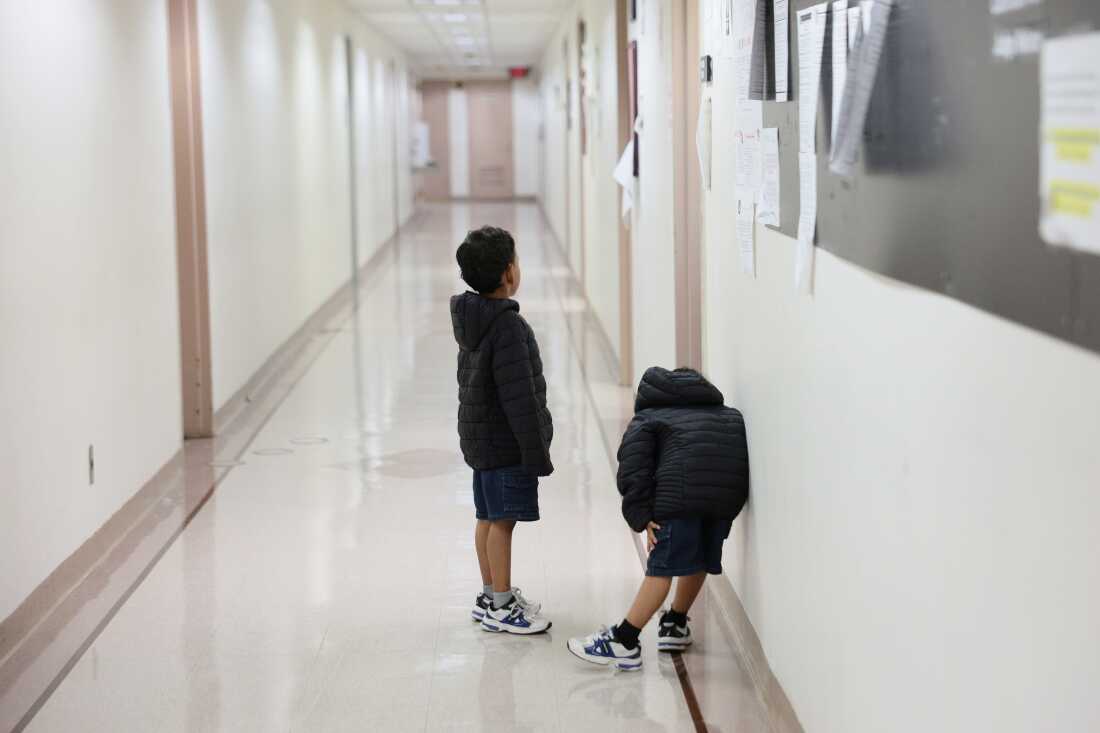
Children wait outside of an immigration court at the Jacob K. Javits Federal Building on July 31, 2026 in New York City. More than 1,400 migrant children across New York, including more than 700 in New York City, are set to lose legal representation as a $200 million federal contract with the Acacia Center for Justice expires. The nonprofit oversees legal services for unaccompanied migrant children and estimates the funding loss will affect more than 24,000 children nationwide. (Photo by Michael M. Santiago/Getty Images)

Children wait outside of an immigration court at the Jacob K. Javits Federal Building on July 31, 2026 in New York City.

Michael M. Santiago/Getty Images North America

An estimated 26,000 children who entered the U.S. without parents or guardians are expected to be left without independent legal representation as soon as Monday, according to lawyers who help represent them.

For more than two decades, the U.S. has been required by law to protect children who cross the border alone, because of fears that they could be easily exploited, abused or trafficked. After children cross the border unaccompanied, they are typically transferred to the Office of Refugee Resettlement (ORR). A network of nearly 100 legal groups helps provide children who arrive in ORR custody with legal services, funded by Congress.

But in November, ORR stopped paying for those legal services, after lawyers declined to provide the agency with confidential information it had requested about the children. The attorneys say that information is covered by attorney-client privilege.
"The government is withholding payment for work that has already been performed in order to extract confidential information about kids, information the government has no right to," Acacia Center for Justice, the nonprofit that manages the legal services contract with ORR, said in a statement on Thursday.

ORR did not renew the contract with the network of legal providers, which expired Friday.

Alexa Sendukas, an attorney at the Galveston-Houston Immigrant Representation Project, one of the organizations that provides legal help to migrant children, said that come Monday, the children may have to represent themselves in court and that most who would have to do that would likely end up being deported.

"We know that without a lawyer, unaccompanied children win the right to stay in the United States less than 1% of the time," said Sendukas. "And they've come to the United States seeking safety and protection. And what this administration is asking us to do now is to turn our backs on them completely. And they will undoubtedly be sent to harmful, dangerous situations. And I worry some will be killed if they lose their lawyers."

A group of legal nonprofits filed a lawsuit last year asking a judge to order the government to pay them for what it is owed — some $65 million — and continue paying them for more services. After going more than eight months without pay from ORR, some legal service providers have had to reduce their staff.

"Due to the loss of funding for children's immigration work, ProBAR laid off more than 20% of its staff this week," Lauren Fisher Flores, the legal director of ProBAR, a project of the American Bar Association that provides legal services to children in ORR care, said in an emailed statement on July 31.

On July 29, Acacia received notice from the federal government that ORR was considering a new contract, potentially with different legal providers. But ORR did not share much more information.

"It is not clear who the new contractor will be. They have not answered the questions that we have put to them," said Bettina Rodriguez Schlegel of Acacia, in response to a question from NPR. "And so there remains a lot of uncertainty and a great deal of concern."

Neither ORR nor the White House responded to NPR's requests for comment about this story.

Almost 1,800 children were in ORR custody in June, according to agency data. ORR has a legal obligation based on a 2008 law to promptly match children with guardians, or "sponsors," in the U.S. who can take care of them. Those children were held in custody for an average of 194 days before being released to sponsors, which lawyers who represent the children say is unusually long and has been detrimental to the health and safety of the children.

For years, lawyers from the network have given presentations for children arriving in ORR care to inform them of their rights and screen them to determine which legal services they are eligible for. Children who are victims of trafficking or abuse, for example, are entitled to special protections. Some of the network's lawyers told NPR they will no longer be able to provide some of those services.

But some of the attorneys say they won't simply abandon the children, even though the contract has not been renewed and they have not been paid by ORR.

"We have an ethical responsibility. We can't just drop a case. If you have a hearing tomorrow, we can't just not show up because the government decided to stop paying us," said Mickey Donovan, the director of legal services at Immigrant Defenders Law Center. "So we'll be there in court on Monday, to introduce ourselves to kids and try to do what we can to prevent their deportation."


 

Judge denies request by Elon Musk’s xAI to pause Minnesota nudification ban


Judge denies request by Elon Musk’s xAI to pause Minnesota nudification ban

https://www.nbcnews.com/tech/elon-musk/judge-denies-request-elon-musks-xai-block-mn-nudification-ban-rcna589993 

Judge denies request by Elon Musk’s xAI to pause Minnesota nudification ban

The ruling clears the way for the first-in-the-nation law to go into effect on Saturday.
Listen to this article
00:0007:25
GERMANY-ECONOMY-AUTOMOBILE-TESLA
Elon Musk, CEO of xAI, in Berlin in 2022.Patrick Pleul / AFP via Getty Images

A federal judge on Friday denied a request from Elon Musk’s artificial intelligence company xAI to block a Minnesota law that will be the first in the nation to ban nudification technology.

U.S. District Judge Donovan Frank ruled that there was little risk of immediate harm from the law going into effect as scheduled on Saturday, despite a lawsuit this week from xAI claiming that the law violates the First Amendment’s guarantee of free speech.

“xAI filed the motion on July 29, 2026, nearly three months after the law was signed, and only three days before the law is set to take effect. Such a delay in bringing the action and the motion suggests that harm is not immediate,” the judge wrote in a two-page order, denying xAI’s request for a pause to the law.

2024 Democratic National Convention: Day 3
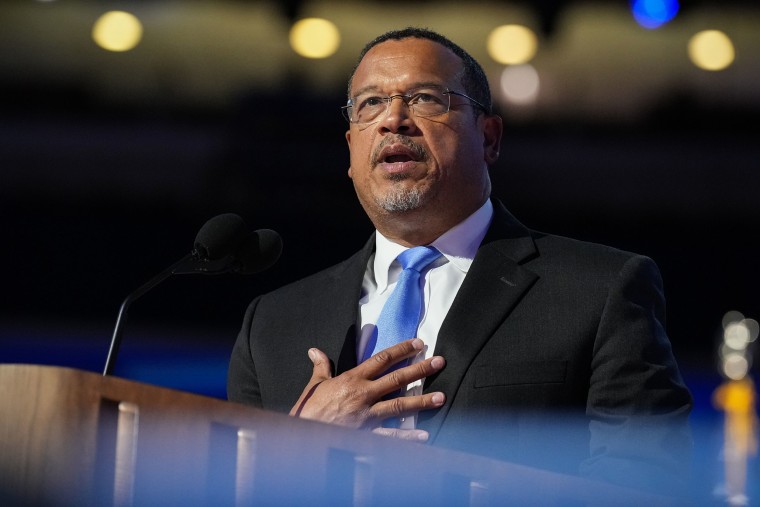
Minnesota Attorney General Keith Ellison in Chicago in 2024.Andrew Harnik / Getty Images file

The court could still pause the law at a later time. The judge wrote that he’ll hold a hearing on Aug. 19 on whether to grant a preliminary injunction.

The law, which was signed by Democratic Gov. Tim Walz in May, prohibits a person who owns or controls a website, application or software to allow their users to “nudify” images of others. It also prohibits anyone from advertising nudification capabilities.

In its lawsuit filed Monday, Musk’s company did not dispute Minnesota’s interest in banning nudification websites and apps, but said: “The law is overinclusive and there are far less restrictive alternatives that function to achieve the same ends.”

Grok, one of xAI’s products, has faced severe scrutiny for its “Imagine” feature, which uses AI to generate and edit images and videos of users. After the release of a December model, Grok began producing sexualized deepfakes of people with less clothing at the request of users on a massive scale, prompting worldwide outcry and investigations in several jurisdictions. In January, Apple threatened to remove Grok from its app store unless it made changes.

As recently as April, Grok was continuing to generate sexualized images of people without their consent, as users tried to break through restrictions that xAI put in place in January.

Minnesota’s law defines a “nudified” image or video as something that has been “altered or generated to depict an intimate part not depicted in an original unaltered image or video of an identifiable individual.”

The law applies only when “the altered or generated image or video is so realistic that a reasonable person would believe that the intimate part belongs to the identifiable individual.”

In response to the lawsuit, Walz posted on X Tuesday, “See you in court, creep.”

Violating Minnesota’s law could result in a civil penalty of up to $500,000 “for each unlawful access, download or use,” in addition to civil penalties for mental anguish, punitive damages, attorney’s fees or “other relief the court deems just and equitable.” The law says the state’s attorney general may enforce it and that victims may sue on their own. The law does not include criminal penalties.

Keith Ellison, the attorney general of Minnesota, filed a response to xAI’s lawsuit on Friday, urging the court to deny xAI’s request for a temporary restraining order, to convert it into a preliminary injunction motion, and proceed from there. Ellison argued that xAI waited too long — three months after the law was passed — to file an emergency delay, and that its “voluntary delay should not create a manufactured emergency for the Attorney General or the Court.”

xAI’s criticism of the law is drawing support from some free-speech advocates including the American Civil Liberties Union of Minnesota, which supported passage of the law in an earlier form in February but has since turned against it.

“While we believe that creating the technology to alter or ‘nudify’ photos of identifiable people is protected by the First Amendment, we also recognize that the non-consensual creation and dissemination of such material can inflict damage on people appearing in those images,” the ACLU of Minnesota said in a statement Friday.

“In engaging with lawmakers on this issue, we hoped to strike an appropriate balance between First Amendment rights and the ability of people harmed to seek remedial measures, not unlike the remedies available to people harmed by defamation. The final version of the bill does not strike that balance,” the organization said.

xAI argued that it already prohibits users “from generating nude or sexualized images of people without their consent.”

SpaceX, xAI’s parent company, faces class action lawsuits from plaintiffs who claim Grok’s AI chatbot created or shared nude deepfakes of them as children or as adults. The lawsuits also say that xAI failed to alert authorities to the alleged perpetrators who used the tool to create their nude deepfakes.

Minnesota’s law was passed amid wider efforts to regulate AI platforms that can generate deepfakes. In July, San Francisco City Attorney David Chiu sent Apple and Google cease-and-desist letters demanding they remove nudification apps from their app stores.

xAI’s lawsuit argued that creating images and videos using Grok Imagine is a protected First Amendment activity, and that Minnesota’s law did not provide a “safe harbor for good-faith efforts” by companies to avoid nudification efforts.

“Liability attaches even if the depicted persons consented — or created the image themselves — and even if the image is never shared,” xAI’s lawsuit said. “Liability also attaches even if the image has artistic, scientific, political, satirical, educational, medical, or religious value, and (again) even if the company has deployed near-perfect, state-of the-art technical controls to prevent the generation of nude images.”

The lawsuit included several examples of screenshots that it said would be banned under Minnesota’s law including one image shared by President Donald Trump showing him and other lawmakers floating shirtless in the Reflecting Pool at the National Mall.

The Foundation for Individual Rights and Expression, a free speech group, said it agreed that the state law is overly broad.

“Minnesota’s law is supposed to stop AI-generated nude images, but it’s written so broadly that it could end up covering benign political memes too, like President Trump in a bikini or former President Obama in hotpants,” John Coleman, legislative council for AI and free expression at the foundation, said in a statement. “That goes far beyond prohibiting unlawful content like child sexual abuse material, which is already illegal. Instead, it sweeps in ordinary political speech and satire that Americans create and share online every day.”

“Americans have a First Amendment right to joke about, criticize, and parody public figures. A law that reaches that expression deserves to be struck down by the courts,” Coleman said.