Trump touts "historic" agreement to disarm Hamas, rebuild Gaza
https://www.axios.com/2026/07/30/hamas-weapons-gaza-deal-israel-board-peace
Trump touts "historic" agreement to disarm Hamas, rebuild Gaza

Add Axios as your preferred source to
see more of our stories on Google.
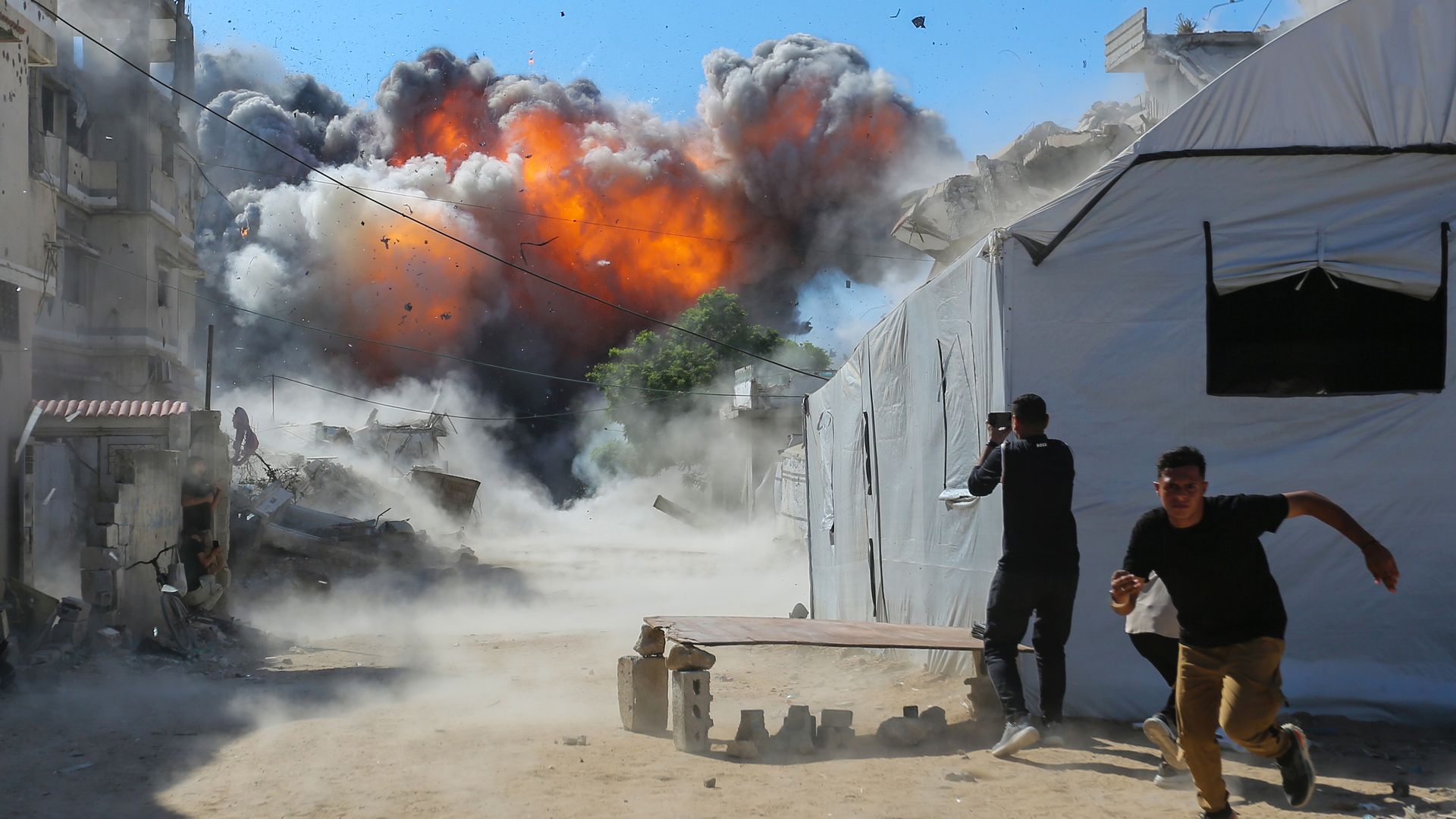
Smoke rises and Palestinians flee after an Israeli strike in Gaza City on July 12. Photo: Ahmad Hasaballah/Getty Images
President Trump announced Thursday that his Board of Peace had reached an agreement with Hamas to disarm and transfer civilian and security control of Gaza to a new Palestinian technocratic government.
Why it matters: If implemented, the agreement would represent a dramatic breakthrough in Trump's 20-point Gaza peace plan and clear the way for reconstruction of the devastated enclave.
- But the deal requires Hamas and Israel to complete a complicated series of reciprocal and independently verified steps over roughly seven to eight months.
- Israeli officials remain deeply skeptical that Hamas will surrender its weapons, while comments from a senior Hamas official suggest the sequencing of disarmament and Israel's withdrawal could still be contested.
What they're saying: "Today, the Board of Peace reached a HISTORIC agreement for the COMPLETE DISARMAMENT of Hamas and all other armed groups in Gaza," Trump wrote Thursday evening on Truth Social.
- "This is a monumental step toward lasting PEACE and SECURITY," he added.
State of play: Two U.S. officials said Hamas had agreed to the terms of the deal after months of what one senior administration official described as "very delicate" negotiations with mediators Qatar, Turkey and Egypt.
- Implementation is expected to begin in the coming weeks, the senior U.S. official said.
- A Board of Peace official said this is the first time Hamas and the other Palestinian factions in Gaza have agreed to demilitarize the enclave and transfer responsibility for security and civilian services to a technocratic government.
Under the agreement, Hamas would relinquish any role in governing Gaza. The new National Committee for the Administration of Gaza (NCAG) would serve as an alternative to Hamas and the Palestinian Authority.
- "It will work for the people of Gaza," the senior U.S. official said.
Reality check: Hamas official Ghazi Hamad confirmed to Al Jazeera that "difficult" negotiations had produced an agreement, but his description raised immediate questions about its implementation.
- "We will not take any steps regarding disarmament before Israel withdraws from the Gaza Strip," Hamad said. He added that the NCAG would carry out disarmament without Israeli involvement.
- That appears to differ from Trump's description of a "carefully structured" and phased process in which Israeli forces withdraw as disarmament is completed.
- U.S. and Board of Peace officials said implementation would proceed through reciprocal, independently verified steps, while acknowledging that the timetable for Israel's withdrawal is still being finalized.
The big picture: Large parts of Gaza were destroyed during the war, and most of its 2 million residents continue to live in tents or makeshift shelters.
- Food and other aid are entering Gaza in large quantities, but the humanitarian situation remains dire.
- The Hamas-controlled Gaza Health Ministry says nearly 1,200 Palestinians have been killed since the Oct. 10, 2025, ceasefire. Some were Hamas militants, while many others were civilians, including children.
Zoom in: The agreement is based on the principle that Gaza will have one government, one legal system and one legitimate security authority. The demilitarization process is expected to take between 200 and 250 days and to proceed through one part of Gaza at a time.
- Hamas' civilian police would first transfer their weapons to a new Palestinian police force under the technocratic government.
- Hamas' heavy weapons would then be decommissioned and placed in secure storage, while its tunnels and weapons factories would be dismantled.
- Small arms would be collected in accordance with Palestinian law.
- All other militias in Gaza, including anti-Hamas factions armed by Israel during the war, would also be required to surrender their weapons.
The NCAG would assume authority over each area only after a monitoring mechanism verified that the relevant commitments had been fulfilled.
- At the end of the process, the technocratic government and its police force would have a monopoly on weapons in Gaza, the Board of Peace official said.
How it works: Under the agreement, an international stabilization force would help train the new Palestinian police, assist with weapons collection, and deploy between Palestinian-controlled areas and Israeli forces.
- A Board of Peace official said the agreement was designed around "zero trust" because Hamas and Israel each made clear from the outset that they did not trust the other side.
- The process would not advance from one stage to the next until monitors verified that both sides had met their obligations.
- The goal is to avoid a situation in which the technocratic government controls Gaza during the day while armed factions retain power at night, the official said.
The other side: Israel's withdrawal would proceed gradually under a timetable that is still being finalized.
- Trump said Israeli forces would withdraw as disarmament was completed and the international force and new Palestinian police assumed responsibility for security.
- Israel would also halt military operations and targeted killings in Gaza, except in cases involving an imminent threat.
- "All military activity in Gaza will have to cease — both from Israel and Hamas," the Board of Peace official said.
Inside the room: The senior U.S. official said the Trump administration coordinated closely with Israel throughout the negotiations.
- The administration also intends to ensure Israel fulfills its commitments under the agreement, despite Israel's skepticism that Hamas will disarm.
- "We are not asking Israel for anything other than to implement their commitments under the 20-point plan," the official said.
- "If they do not do that, President Trump will be very disappointed. I do not think the Israelis would want to escalate things with us right now."
Behind the scenes: Egypt, Qatar and Turkey exerted intense pressure on Hamas to accept the agreement, according to two sources familiar with the negotiations.
- A key figure was Egyptian intelligence chief Hassan Rashad, who hosted the talks and has a close relationship with Hamas political leader Khalil al-Hayya, U.S. officials and others familiar with the negotiations said.
The intrigue: During a recent visit to Iran for the funeral of former Supreme Leader Ali Khamenei, a Hamas delegation met with senior Islamic Revolutionary Guard Corps officials, according to a source with knowledge of the meeting.
- The IRGC officials urged Hamas not to rush into signing the agreement and to play for time, the source said.
- A senior U.S. official also claimed Iran tried to convince Hamas not to sign the deal, but said the group chose not to listen.
Editor's note: This story has been updated with additional details throughout.


No comments:
Post a Comment