Conservatives Perfected the Ideal Legal Tactic. It’s Time for Liberals to Use It.
https://slate.com/news-and-politics/2026/08/supreme-court-analysis-liberal-antonin-scalia-guns.html
Conservatives Perfected the Ideal Legal Tactic. It’s Time for Liberals to Use It.
This is part of Amicus and Slate’s “By the People” series, which explores how the American people can reclaim the Constitution—and the law—from this monarchical Supreme Court.
In 1991, former Chief Justice Warren Burger renounced the then-nascent push to reinterpret the Second Amendment as an individual right to bear arms. Appearing on PBS NewsHour, the conservative jurist condemned this campaign as “one of the greatest pieces of fraud, I repeat the word fraud, on the American people by special interest groups that I have ever seen in my lifetime.” Burger, a Richard Nixon appointee, was no outlier: Across the partisan spectrum, leading constitutional lawyers agreed that the Constitution did not create a personal right to possess guns. A year earlier, Erwin Griswold, solicitor general for Presidents Lyndon B. Johnson and Richard Nixon, said that the pro-gun argument “exceeds the limits of principled advocacy.” Shortly before that, the far-right Judge Robert Bork—formerly Nixon’s solicitor general and attorney general—said that the Second Amendment protects state militias, not individuals. Bork, whose own nomination for the Supreme Court was famously defeated over his extreme right-wing views, deemed all state gun restrictions “probably constitutional.”
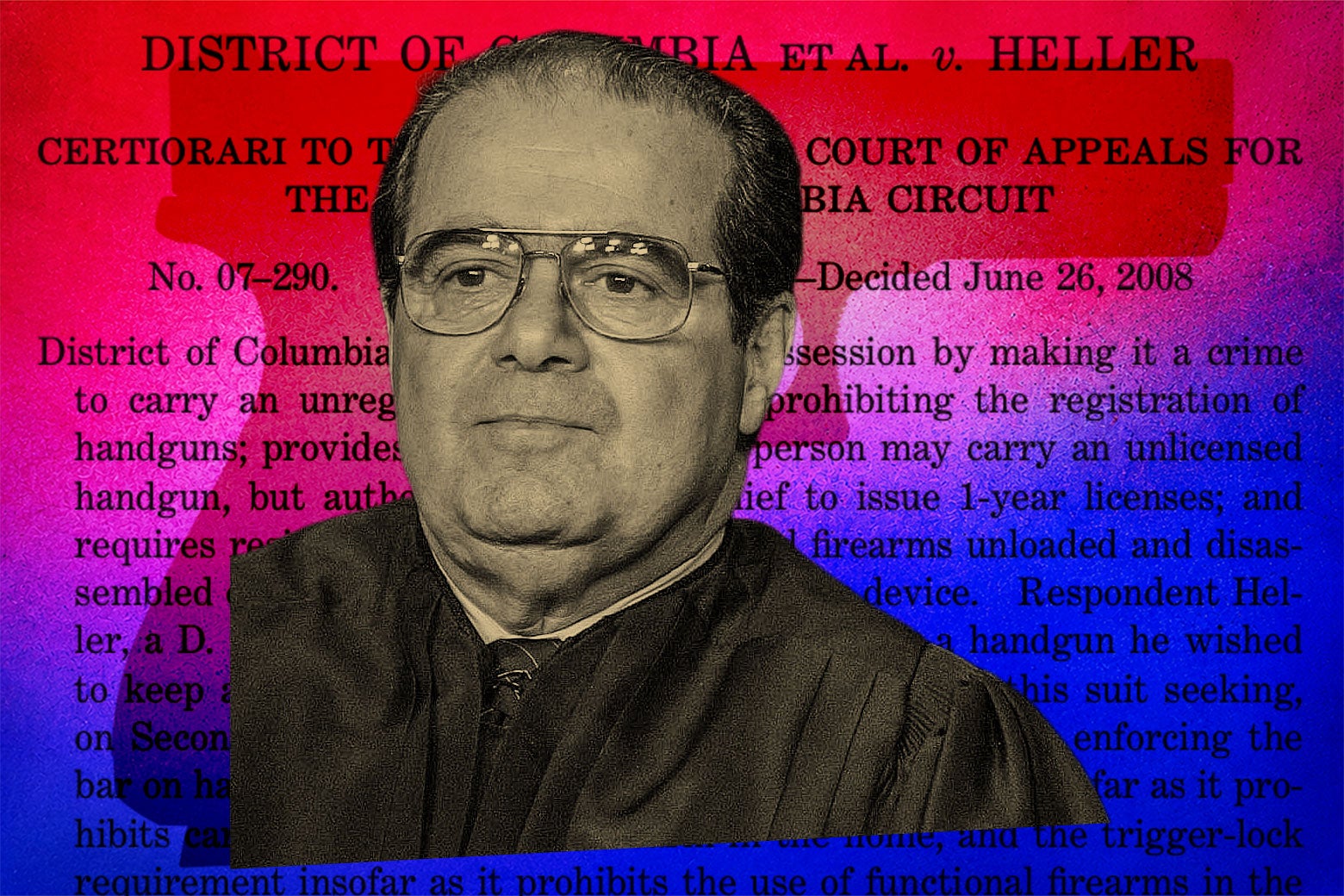
Less than 20 years later, the Supreme Court announced in D.C. v. Heller that Burger, Bork, and their contemporaries had it all wrong: The Second Amendment had guaranteed an individual right to bear arms the whole time. Of course, the constitutional text remained the same. What changed was the nation’s understanding of it. Over decades, gun rights activists transformed a position dismissed by Burger and Bork into a cornerstone of conservative constitutional identity. They built a political movement around their ahistorical, atextual interpretation. Buoyed by lavish funding from the industries that stood to benefit, these activists elected lawmakers who embraced their view, then elevated judges who would translate it into law. By the time Heller reached the Supreme Court, the individual-right theory did not appear radical to the conservative majority. It looked inevitable.
Second Amendment advocates like to frame Heller as a triumph of originalism, and SCOTUS certainly sold it that way. But in truth, it is popular constitutionalism all the way down. Yale Law professor Reva Siegel laid out this fact in a renowned law review article months after the decision came down, and her observation has only grown more prescient with time. The Republican-appointed supermajority has spent the past four years steadily expanding the right it created in 2008, to the point that it now deems all restrictions on “armed self-defense” to be “presumptively unconstitutional.” Under Heller and its progeny, courts have struck down state laws that ban guns from zoos, libraries, and museums; that prohibit the removal of serial numbers from weapons; and that outlaw machine guns. SCOTUS has struggled to keep pace with the revolution that it unleashed and has sometimes seemed embarrassed by the consequences of its own rulings.
The modern Second Amendment has thus become both a paragon of popular constitutionalism and its own dark mirror. Gun rights advocates followed much of the popcon playbook, but never truly built majority support for their broader aims: Many of their legal demands today—like unlicensed public carry and easy access to assault weapons—are unpopular with the broader public. It seems fair to say that the average American who wants to keep a handgun at home did not sign up for unpermitted open carry of an AR-15 at the zoo. Heller is not just a case study in popular constitutionalism; it is also a warning that industry-backed interest groups can mimic a mass movement, then leverage it to create a constitutional right that extends far beyond anything the citizenry ever demanded.
Siegel’s early account of the Second Amendment’s rise remains unimpeachable as a straightforward chronicle of how moneyed interests can manufacture constitutional meaning. Beginning in the 1970s, insurgents within the National Rifle Association transformed the former sporting organization into an aggressive political machine. The reconstituted NRA began proclaiming that the Constitution bestowed a personal right to possess firearms, a notion that the Supreme Court had never come close to endorsing. It cultivated a disciplined cadre of activists who mobilized to warn “law-abiding citizens” that they needed a gun to defend their families against criminals. And it pushed lawmakers to dismantle firearms restrictions while punishing politicians who strayed from the cause.
At the same time, the gun lobby forced its way into the emerging “New Right” coalition. Conservative lawmakers commissioned dubious historical reports declaring that the framers had enshrined an individual right to bear arms. Republican presidents elevated sympathetic judges to the bench. All the while, NRA-backed advocates seeded the legal academy with bogus scholarship that supplied the movement with an originalist pedigree. Arguments that Burger and Bork dismissed as fringe advocacy became orthodox within conservative legal circles. Through these tactics, the gun movement fused with the Republican Party, and allegiance to an expansive Second Amendment became a litmus test for both the legal and political arms of the GOP.
By the time Heller reached the Supreme Court, then, the gun lobby had positioned every piece for checkmate. So many states had repealed so many firearm regulations that the District of Columbia’s stringent handgun ban looked like a true outlier. Public support for a total ban on handguns in the home had plummeted. Justice Antonin Scalia was able to frame his majority opinion as the vindication of a right so obvious that virtually the entire country already recognized it to some degree. He relied upon NRA-backed pseudo-scholarship to disregard the Second Amendment’s first clause (which links it to state militia service) then recast the right “to keep and bear arms” as a core component of personal liberty. And he rooted his holding in the alleged “original meaning” of the amendment through analysis that appeared to be steeped in historical texts.
In fact, many of Scalia’s historical claims in Heller have since been debunked by real historians. But even in 2008, any keen observer could see that the Supreme Court was not actually uncovering a right buried since 1791; it was ratifying a constitutional forgery that decades of well-funded lobbying had passed off as an ancient truth. It would be a mistake, however, to dismiss Heller as nothing more than an astroturfed simulation of popular constitutionalism. By the time it came down, Gallup found that 3 in 4 Americans believed that the Second Amendment bestowed an individual right to own a firearm. They overwhelmingly opposed total handgun bans—even though a supermajority of Americans wanted such bans in 1960. The gun lobby really had built public support for its revisionist reading of the Constitution. It had, in every sense, changed constitutional meaning through popular ratification.
But the limits of this consensus were already beginning to show. The same Gallup poll that showed supermajority support for handgun ownership found that 49 percent of Americans favored stricter gun laws, while just 11 percent preferred looser ones. Heller marked the culmination of one campaign that most of the country had rallied behind, but the beginning of another that it largely opposed: a broader legal assault on all manner of gun safety legislation. Most Americans, for instance, still favor stricter gun laws overall, including assault weapon bans, a higher minimum age for ownership, waiting periods between purchases, and states’ authority to require a special need before granting a public-carry permit. In recent years, federal courts have struck down all of these policies (though some were reversed on appeal). These rulings carried Heller way beyond public consensus, shedding the skin of popular constitutionalism to reveal a project of minority rule by judicial fiat.
What lesson should progressive proponents of popcon take from this trajectory? The most obvious takeaway is that, even if they refuse to admit it, conservatives relied on the same tried-and-true strategies as history’s great civil rights movements to elevate their conception of the Second Amendment into constitutional law. They did so because those strategies work. Defenders of Heller simply have no standing to mock the left for building constitutional meaning through mass mobilization when their own movement perfected the art.
The deeper lesson, though, is that a constitutional right’s popular origins do not guarantee a democratic afterlife. While Heller was built on phony history, it reflected a genuine, hard-fought shift in public understanding. But once an unelected judiciary took up the cause, the citizenry lost its power to define and limit the Second Amendment through the usual machinery of representative self-government. It became a weapon for the juristocracy to wield against communities seeking to protect themselves from the bloody epidemic of gun violence.
The hazard exposed by Heller is not merely that conservatives can practice popular constitutionalism, too; it’s that judges can capture popcon’s victories and weaponize them against democracy itself. An idea that mutates from a “fraud” to a precedent in less than two decades can metastasize into something much more dangerous than the public ever supported. Progressives must remember that the fight for constitutional meaning cannot end the moment a movement secures five votes at the Supreme Court. A whole new battle begins when the court claims the victory as its own.

No comments:
Post a Comment