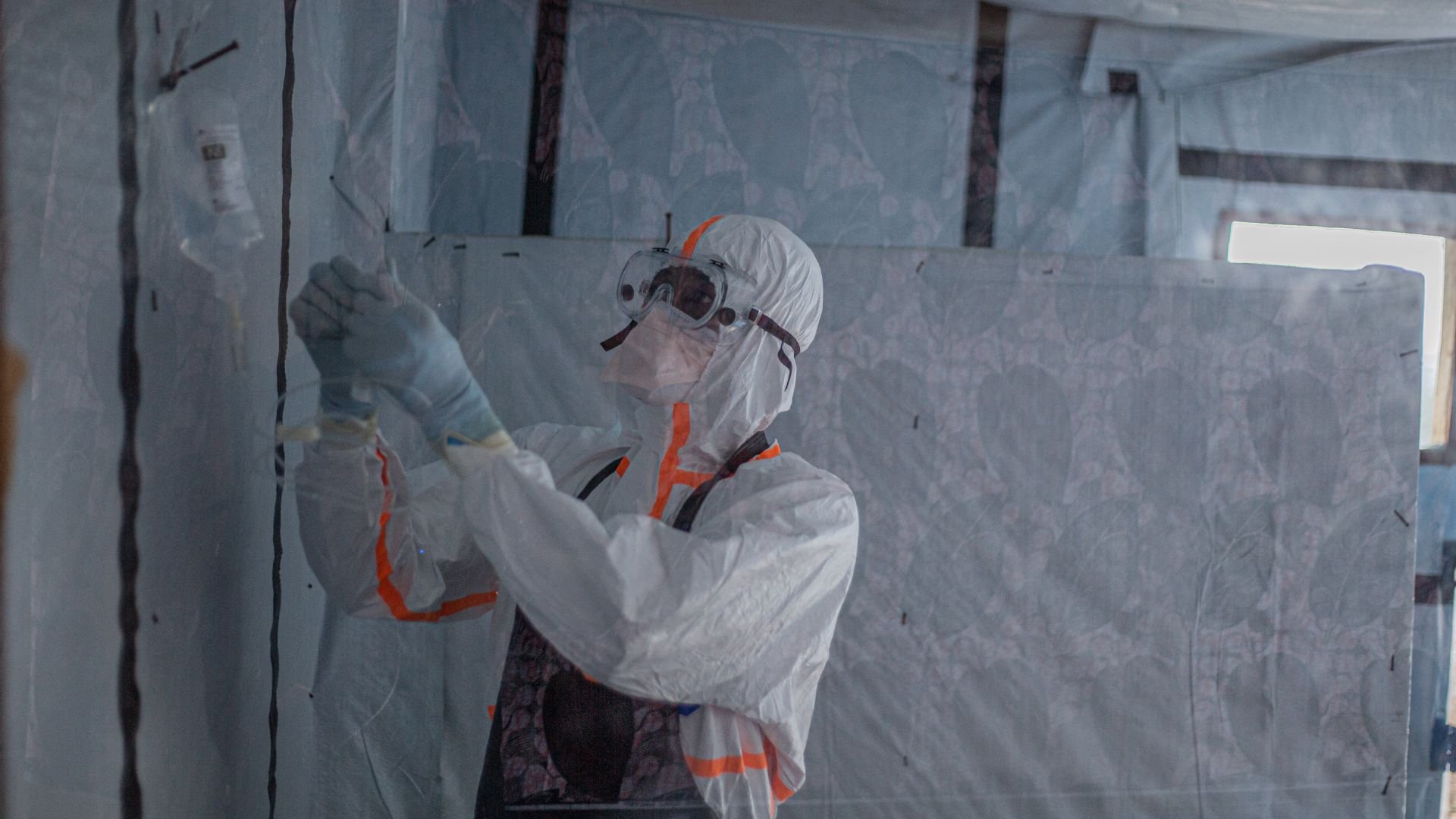
Ebola outbreak ‘growing faster, wider’ as DRC death toll passes 2,500: UN
Epidemic in DR Congo remains out of control amid conflict, funding shortages and attacks on health workers and facilities.
Red
Cross volunteers in the Democratic Republic of the Congo carry the body
of an Ebola victim from the morgue before loading it into a vehicle for
transfer to a cemetery. The measures are part of safe and dignified
burial operations aimed at preventing the spread of the virus. [File:
AFP]
Sounding
the alarm that the outbreak is “spreading faster and wider” than ever
before, the UN’s Senior Ebola Coordinator Julien Harneis reported that
more than 2,500 people have now died.
The
official called for more funds to be put to work to try to control the
spread, noting that the existing pool of money will run out within
weeks.
Efforts to stem the epidemic since the outbreak began in May have faced several challenges.
Conflict
and a lack of government control and infrastructure in the eastern DRC
have disrupted the effort. Where health workers – many of whom have died
after contracting the virus – and facilities are able to operate, they
have come under attack by frustrated and frightened locals, Harneis
said.
More than 260 attacks on health workers have been reported
in the past six months, and eight health workers have been killed. More
than 160 healthcare workers have fallen ill, with 43 dying.
Aid
workers have said many locals believe conspiracy theories that the
outbreak is a hoax, and have reacted angrily when health restrictions
prevent them from personally burying loved ones.
Efforts to
control the outbreak have also been complicated by the lack of a vaccine
for the rare Bundibugyo strain of the Ebola virus, which causes severe
haemorrhagic fever.
Existing security concerns are also hampering the battle to stop the spread.
“All
of this is happening in an area that has had three decades of
conflict and is generating huge humanitarian needs,” Harneis said.
The
UN official warned the epidemic could spread to neighbouring countries
without a ramped-up response, and urged more staffing and resources to
reach remote areas.
2:20
Now Playing
02:20
Worst Ebola outbreak in DR Congo’s history spreads fast amid chaos
Next
02:51
Weddings in Gaza offer rare moments of joy amid genocide
ProPublica is a nonprofit, investigative newsroom that exposes
corruption. We report in all 50 states and partner with local newsrooms. Our work spurs real-world impact and has received numerous awards, including nine Pulitzer Prizes.
Senators Criticize Trump Administration’s Demands to Access Health Data as a Condition for Lifesaving Aid
Citing ProPublica’s reporting, eight senators wrote a letter to
Secretary of State Marco Rubio questioning the administration’s approach
to foreign health data. They said it could set an “alarming precedent.”
What Happened: Citing reporting by ProPublica, eight
Democratic U.S. senators have criticized the Trump administration’s
demands to access the health data of millions of people as a condition
of giving lifesaving aid to other countries. In a letter to Secretary of State Marco Rubio,
the senators, including minority leader Chuck Schumer, said the U.S.
demands were “unprecedented and at odds with U.S. policy concerning the
data of American citizens.”
The inquiry into the administration’s approach to foreign health data referred to a ProPublica story published in June about agreements the U.S. struck with African countries
— and the risks they posed to people there. Experts told ProPublica
that the deals are vague and lack language used in most data-sharing
agreements to adequately limit what information is collected and how it
can be used. As a result, they said, there is an increased risk that
individuals’ personal data could be exposed, misused or commercialized
without their consent.
The senators — who include Tim Kaine of Virginia; Chris Van Hollen of
Maryland; Brian Schatz of Hawaii; Amy Klobuchar of Minnesota;
Christopher Coons of Delaware; Jeff Merkley of Oregon and Raphael
Warnock of Georgia, who led the effort — requested a briefing on the
healthcare agreements’ data requirements. They also asked Rubio to
respond in writing to a list of questions by the end of August.
What They Said: In the letter, which was sent last
week, the senators expressed concern that the requirement to access
foreign health data might reverberate beyond the countries where the aid
agreements were struck and “set international precedents that
ultimately harm Americans.” They noted that the demands for data appear
to be at odds with the Trump administration’s National Cyber Strategy, which emphasizes the right to privacy for Americans and their data.
“These new demands set an alarming precedent that is seemingly
contrary to the Administration’s longstanding support for the privacy of
U.S. citizens’ data,” they wrote.
The senators also laid out the details of a data-sharing agreement
between the U.S. and Uganda that were first reported by ProPublica. The
deal demanded that Uganda provide the U.S. — and its contractors — with
logins “or other secure access mechanisms” to directly enter the
nation’s health data systems.
“While global health programs have historically included data sharing
components,” the senators wrote, “they have never required direct
access to privileged electronic systems for U.S. government
representatives.”
The letter ends with more than a dozen questions for Rubio, including
why the State Department has not made the health care agreements
public, as federal law requires, and whether any of the data will be
shared with “U.S.-based third parties for any commercial purpose,
including to train any artificial intelligence models.”
The senators also asked what privacy rights foreign citizens will
have over data that is transferred to the U.S. and how those rights will
be enforced in the case of a data breach or another unethical use of
their personal information.
Background: After the Trump administration dismantled the U.S. Agency for International Development
and drastically reduced funding for international health work done by
the Centers for Disease Control and Prevention, Congress required the
executive branch to continue providing foreign aid. The State Department
has since faced the challenge of finding new ways to get the funding to
countries, ensure that it was being spent wisely and address potential
pandemics. The task has been especially challenging because the
administration cut ties with most of the international partners and
fired staff the government had previously relied on to carry out this
complex work.
In the past, PEPFAR, the
U.S. program that provides aid for treating and preventing HIV around
the world, built its own systems to handle anonymized data, separate
from foreign government health records. In contrast, the Ugandan
agreement provides the U.S. with direct access to the government’s own
health data systems.
Through separate agreements, the U.S. has also arranged for countries
to provide it with specimens of pathogens that could cause pandemics,
along with related information.
The effort to establish these new aid arrangements was led by Brad
Smith, an entrepreneur who founded three healthcare companies, one of
which sold for a reported $2.7 billion. Before joining the State
Department, Smith led the government efficiency panel that would become the Department of Government Efficiency and oversaw some $67 billion in cuts to the Department of Health and Human Services.
The U.S. agreement with Uganda provides up to $1.7 billion in aid for
HIV, tuberculosis and malaria, among other diseases. As a condition,
the deal calls for the sharing of aggregated data with all personally
identifiable information removed and specifies that the information
should be used for delivering and auditing healthcare services. But
experts told ProPublica that it is possible to reverse-engineer data
that has been anonymized.
The shift in the approach to health data is part of the America First Global Health Strategy, which is intended to make America “more prosperous” and “promote American health innovations.” Rubio explained in September
that under this new strategy, aid will be given “in a way that directly
benefits the American people and directly promotes our national
interest.”
Why It Matters: Privacy experts say that, if health
data is mishandled under the agreements, it could have serious
consequences. Revealing healthcare histories, including whether someone
has had an abortion, a mental health condition, substance-use treatment
or a sexually transmitted disease can be devastating anywhere. In
Africa, research has shown it can lead to discrimination and violence.
In the age of artificial intelligence, health data has become
especially valuable. But the agreements reviewed by ProPublica provide
no guarantee that Africans subject to them will have a say in how their
data is used or whether they would receive any potential financial
benefits.
Response: The State Department declined to answer
specific questions about the senators’ letter, saying that it does not
respond to questions about congressional correspondence. In a statement
sent to ProPublica, a State Department spokesperson defended the data
requirements in the health agreements.
“Neither the U.S. government nor any private American companies
receive or review any personally identifiable information (PII) under
these data sharing agreements,” the statement said, going on to note
that the new deals “share only the same kinds of aggregated,
de-identified data that has been shared and used for years in the fight
against HIV/AIDS, malaria, tuberculosis, and other diseases. All data
sharing is consistent with each country’s laws and approvals.” The
spokesperson also said no country has been coerced to sign the
agreements with the U.S.
ProPublica is a nonprofit, investigative newsroom that exposes
corruption. We report in all 50 states and partner with local newsrooms. Our work spurs real-world impact and has received numerous awards, including nine Pulitzer Prizes.
Hospitals set up special testing sites to prevent measles patients
from spreading the disease in waiting rooms. The virus can linger in the
air for up to two hours after an infected person leaves.
Jan Sonnenmair/Getty Images
Measles Used to Be in Our Rearview Mirror. Now Cases Are Reaching Record Highs.
In other parts of the world that have let their guard down to
vaccine-preventable diseases, long-forgotten scourges have roared back
and killed and disabled children.
The U.S. recently reached a grim milestone: As of July 23, more
measles cases have been reported to the Centers for Disease Control and
Prevention than in any year since 1991. It took less than seven months
to blow past the three-decade high recorded last year.
This potentially deadly disease is easily prevented. Shots are widely
available and, in many cases, free. Still, since the beginning of last
year, more than 4,850 people here have been infected, and three have
died. Among them were two unvaccinated girls in West Texas whose deaths
made national headlines.
It may feel like the continuous stream of cases is just the way
things are now. But it is dangerous to shrug off the resurgence of
measles. In a story I reported earlier this year, I showed what’s
happened in parts of the world that have let their guard down to
vaccine-preventable diseases. My reporting found that long-forgotten
scourges roared back, killing and disabling children. Even countries
that made what seemed like subtle changes to immunization policies
suffered disastrous consequences years later.
Babies were born blind, deaf and with intellectual disabilities
because their mothers caught rubella in the early weeks of pregnancy.
Parents saw why diphtheria used to be known as “the strangling angel of
children.” Doctors told me they couldn’t undo the damage when these
horrors returned. Modern medicine can do a lot of things, but it can’t
reverse paralysis from polio.
The story also showed how Robert F. Kennedy Jr., the nation’s top
health official, and President Donald Trump have been transforming a
government that for decades promoted the lifesaving benefits of shots
into one that sows doubts about their safety. Last week, the president
issued another executive order that’s sure to fuel further hesitancy about the shot that has protected children from measles, mumps and rubella for decades.
It’s a sharp departure for a government that, since the 1960s and
with bipartisan support, built vaccination programs that shielded kids
from deadly and disabling diseases. Federal and state health leaders
strengthened those policies based on lessons learned from measles
outbreaks. That’s because measles, among the most contagious diseases in
history, is almost always the first vaccine-preventable disease to
strike when immunization rates fall.
Some U.S. schools have set up vaccination clinics as immunization rates have dropped in many parts of the country.Sarah L. Voisin/The Washington Post via Getty Images
In my many months of reporting for that story, I learned that measles
is like the bright dye that plumbers flush through pipes to find leaks
in a complex system. The continued appearance of the virus’ telltale
rash in state after state since last year warns of cracks in our
once-solid protection, leaving communities vulnerable to other deadly
contagions.
My reporting also found that access to vaccines may be in peril:
Since last year, Kennedy has been considering changes to an obscure but
crucial government program that could prompt the few companies that make
vaccines for American kids to flee the U.S. market. If that were to
happen, even parents who still want vaccines for their kids wouldn’t be
able to get them.
A spokesperson for the Department of Health and Human Services said
the agency has not limited access to vaccines. In an email, the
spokesperson wrote, “Secretary Kennedy believes that trust is rebuilt
through an open review of safety data, the willingness to ask the hard
questions, and ensuring the American people have all emerging
information as soon as we know it.”
Several dozen people who’ve worked on U.S. government vaccination
programs here and around the world conveyed to me a sense of foreboding
about America. They fear that children will wind up fighting for their
lives against infections that have long been preventable.
“I think there always was a worst-case scenario,” said Dr. Melinda
Wharton, who retired last September after more than three decades
leading CDC immunization programs. “I don’t think I imagined it could or
would be this bad.”
Doctors I spoke to told me they had seen images of those diseases in
textbooks, but these were problems medicine had solved long ago. They
never thought they’d see an actual patient until an unvaccinated child
lay before them, gravely ill with one of these ancient scourges.
I’ll never forget what one German doctor, whose hospital treated an
unvaccinated boy who later died of diphtheria, told me of the infection:
“It was taught as history,” he said.
Here in the U.S., measles was taught as history, too. Now it isn’t.
We’ve been covering public health and vaccine policies for years. Let
me walk you through reporting from my colleagues and me that helps show
how we ended up here and where we might go.
In 2020, I reported with my colleagues on how the world’s greatest
public health organization was brought to its knees by COVID-19, the
president and the capitulation of its own leaders. And we also
foreshadowed how the government’s response to COVID-19 led to a loss of
trust in public health institutions — a lingering resentment that RFK
Jr. has tapped into. (The CDC and the White House declined to comment on
this story.)
At the beginning of the second Trump administration, I learned that
CDC leaders ordered staff not to release their experts’ assessment that
found the risk of catching measles was high in areas near outbreaks
where vaccination rates were lagging.
In an aborted plan to roll out the news, the agency would have
emphasized the importance of vaccinating people against the disease that
had then infected fewer than 500 people in 19 states, the records show.
(At the time, the CDC told us that the agency decided against releasing
the assessment “because it does not say anything that the public
doesn’t already know” and that the agency continued to recommend
vaccines as “the best way to protect against measles.”)
Not long after I broke the news about the buried measles forecast, I
learned more about a vaccine program that RFK Jr. plans to overhaul, one
that’s vital to Americans’ access to immunizations. I showed how
dramatic changes to this little-known program — which offers payouts for
people who suffer rare side effects from shots without having to prove
that drugmakers were negligent — could prompt vaccine makers to stop selling them here.
(HHS declined to answer detailed questions about Kennedy’s plans.
Previously, an HHS spokesperson had said that Kennedy is “not
anti-vaccine — he is pro-safety.”)
That story laid bare how surprisingly fragile the nation’s vaccine system is. Kennedy still hasn’t revealed what he plans to do.
Two Stanford epidemiologists had modeled the scenario. My colleague
Lucas Waldron created a chilling visualization that allowed us to depict
how many people could die or be disabled in 25 years if vaccines for polio, measles, rubella or diphtheria were no longer available.
ProPublica shared the key findings of that scenario with HHS. An
agency spokesperson didn’t address the modeling but said “HHS has not
limited access or insurance coverage to any FDA-approved vaccines” and
routinely recommends the shots for children.
As measles cases continued to rise, a team at the CDC was
investigating whether the disease has become endemic in this country
again. In June, my colleague Nat Lash and I showed how hard it will be
for them to prove that it isn’t, after what Nat found when he analyzed the genetic code of cases around the country.
A CDC spokesperson told ProPublica that the agency was conducting a
more comprehensive investigation and that genetic sequences “alone
cannot determine whether” measles is endemic.