Iran war live: Oil prices soar past $100, new supreme leader says Strait of Hormuz should stay closed
https://www.reuters.com/world/iran-war-live-six-tankers-attacked-gulf-strait-hormuz-2026-03-12/
Iran war live: Oil prices soar past $100, new supreme leader says Strait of Hormuz should stay closed

What's happening?
-Iran steps up attacks on oil and transport facilities
-New Supreme Leader Mojtaba Khamenei issues first statement
-At least six tankers hit in Gulf and Strait of Hormuz
-Brent oil rises back to around $100 a barrel
-President Donald Trump says US needs to 'finish the job'
-IEA says war has caused biggest disruption to global energy supplies in history
-If you can’t see the content of video posts, please adjust your cookie settings

'Nowhere to hide' in this market, investor says
Reuters spoke to Kevin Nicholson, the global fixed income chief investment officer at RiverFront Investment Group.
Wall Street ends sharply lower
U.S. stocks fell, with the S&P 500 notching its biggest three-day percentage drop in a month.
All three major U.S. stock indexes slid more than 1% in a broad selloff, with everything but energy and some defensive stocks suffering steep percentage losses.
Front month WTI crude futures settled up 9.7% on the day, while Brent settled up 9.2%, touching $100 per barrel.
"There’s a realization that a resolution to the Middle East conflict is being pushed further out," said Ryan Detrick, chief market strategist at Carson Group in Omaha. "It’s a sell first, ask questions later type of mentality. There hasn't been a safe sector outside of energy."
Preliminary data showed the S&P 500 lost 103.99 points, or 1.53%, to end at 6,671.81 points.
The Nasdaq Composite lost 406.33 points, or 1.79%, to 22,309.81.
The Dow Jones Industrial Average fell 745.55 points, or 1.57%, to 46,671.72.
'Everyone is on edge,' Tehran resident tells Reuters
One resident in Tehran told Reuters "everyone is on edge" after nearly two weeks of relentless bombardment but that people were going about their normal daily lives.
Another said the future looks “bright” and that he trusts the Iranian regime.
Netanyahu: We can create conditions for regime change in Iran
Israeli Prime Minister Benjamin Netanyahu said Israel can create conditions for regime change but it is up to Iran's people to take to the streets.
Asked about what actions Israel might take against Iran's new Ayatollah Mojtaba Khamenei and Hezbollah chief Naim Qassem, Netanyahu said:
"I wouldn’t issue life insurance policies on any of the leaders of the terrorist organization ... I don't intend to give an exact message here about what we are planning or what we are going to do."
He also said Israel is aiming to stop Iran from moving nuclear and ballistic projects underground.
Netanyahu says Iran 'no longer the same'
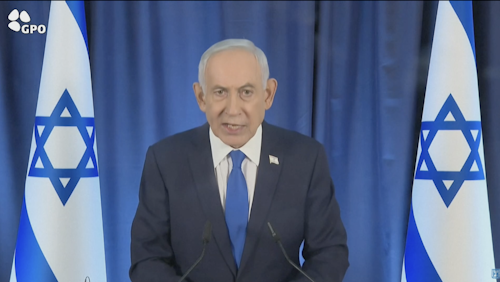
Screengrab from a Reuters live feed, March 12, 2026. Source: Israel's Government Press Office (GPO)
In his first press conference since the start of the war, Israeli Prime Minister Benjamin Netanyahu said Iran was "no longer the same" after nearly two weeks of joint U.S.-Israeli attacks and had suffered blows to its elite forces.
Netanyahu said he spoke with Trump nearly every day and that the two men spoke "openly."
He also said Hezbollah will pay a heavy price for its aggression.
Israeli military says it has begun wide wave of attacks in Tehran
Ships must coordinate with Iran to pass through Strait, spokesperson says

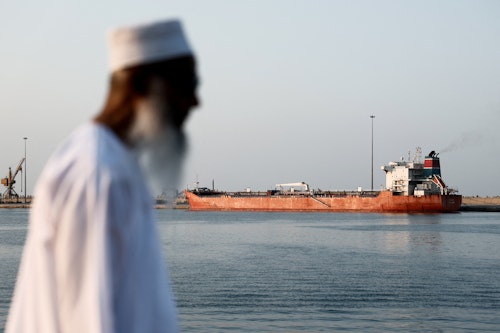
The Callisto tanker sits anchored in Port Sultan Qaboos, in Muscat, Oman, March 12, 2026. REUTERS/Benoit Tessier
Ships must coordinate with Iran to pass through the Strait of Hormuz, Iranian Foreign Ministry spokesperson Esmaeil Baghaei said.
"Ships must coordinate with the Iranian navy when passing through the Strait so that maritime security is maintained," Baghaei said in comments carried by Mehr news agency.
In his first comments since the start of the war, Iranian Supreme Leader Mojtaba Khamenei said that the Strait of Hormuz should remain closed as a tool of pressure.
Iran's retaliation to the Israeli and U.S. attacks has included strikes on ships in the strait and energy infrastructure across the Middle East.
Israeli Prime Minister Benjamin Netanyahu expected to speak
It will be his first press conference since the start of the war.
You'll be able to watch his remarks right on this page. Stick with us as we continue to bring you the latest.
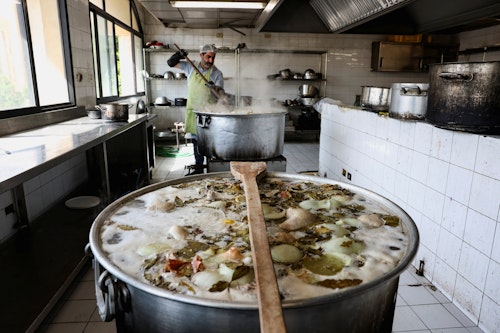
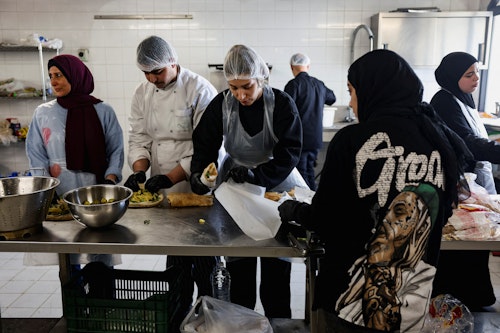
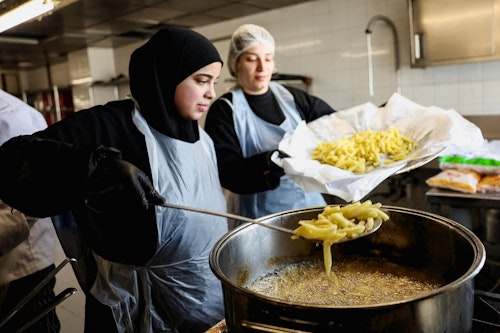
Volunteers prepare food for the displaced in Beirut
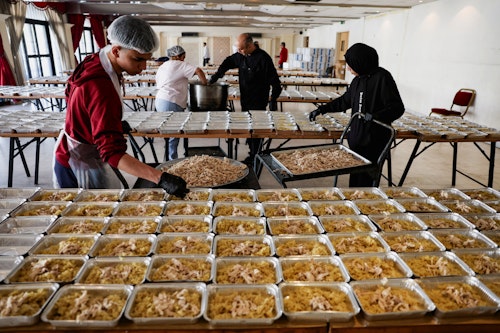
Volunteers prepare food packages at a school-turned shelter, March 12, 2026. REUTERS/Mohamed Azakir
REUTERS/Mohamed Azakir
REUTERS/Mohamed Azakir
REUTERS/Mohamed Azakir
Why Gulf fury is aimed at Tehran, not Washington

Nearly two weeks into the conflict, a war-modified, anxiety-riddled version of daily life is emerging in the Gulf.
But public fury at Washington is notably scarce across the Gulf states, even as they absorb some of the heaviest shocks of a regional war they had urged the United States to avoid.
With few exceptions, senior Gulf figures have steered clear of publicly blaming Washington for its decision to confront Iran.
Gulf capitals are reserving the language of betrayal for Tehran, even as American actions helped set the conflict in motion.
After years of slow rapprochement — and assurances from Gulf Arab states that their territory would not be used to launch attacks on Iran — many expected Tehran to acknowledge those efforts.
Instead, Iran struck Gulf Arab territory on day one and has rattled Gulf capitals ever since.
Qatar’s Prime Minister called Iran’s moves a “betrayal,” saying they were preplanned and unleashed despite Gulf guarantees of neutrality.
This is an excerpt of the Reuters Gulf Currents newsletter, which is published every Wednesday.
Sign up here to receive a weekly breakdown of the geopolitical and financial forces reshaping a region at a crossroads. Additionally, get the Reuters Iran Briefing for latest coverage from the war.
Bombed Iranian school had yearslong online presence
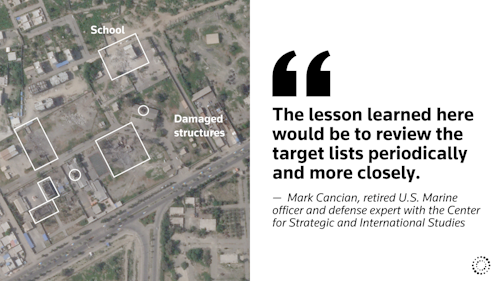
A girls school in Iran that was destroyed by a strike on the first day of the war was separated from an adjacent military base by walls painted with bright murals. The colored walls were visible in satellite images, the school’s colorful website – and a video of the explosion’s aftermath.
American investigators believe U.S. forces were likely responsible. The Pentagon referred questions from Reuters to the U.S. military’s Central Command, whose spokesperson, Captain Timothy Hawkins, said: “It would be inappropriate to comment given the incident is under investigation.”
Here's our visual investigation with additional reporting by Parisa Hafezi, Edward James Carron, Stephanie Burnett and Idrees Ali.
Israeli military says it struck Basij checkpoints in Tehran
The Israeli military said its aircraft struck Basij checkpoints in Tehran.
"The IDF (Israel Defence forces) recently identified that soldiers of the Basij Unit had established roadblocks in several locations across Tehran. After identifying the deployment, over the past day, the Israeli Air Force, acting on IDF intelligence, has targeted the Basij roadblocks and operatives," the military said.
The Basij militia is a paramilitary force under the Revolutionary Guards' control.
US has arranged nearly 50 charter flights from Middle East


FILE PHOTO: A woman awaits the arrival of relatives via U.S. government chartered flight, in New York City, U.S., March 5, 2026. REUTERS/Eduardo Munoz
The Trump administration has organized nearly 50 flights to return U.S. citizens from the Middle East since the war began, a State Department official said.
"By the end of today, we'll have completed approximately four dozen flights and safely evacuated thousands of Americans from the Middle East on those flights," said the official, who briefed reporters on condition of anonymity.
Officials said demand for the flights has declined.
The State Department was criticized in the days after the conflict began for its late preparations to relocate diplomats and offer assistance to citizens as Iran's strikes led to airspace closures and flight cancellations across the region.
Read more here.
White House says FBI alert on possible Iran retaliation based on unverified tip

An FBI alert to law enforcement agencies last month warning of the possibility that Tehran might try to retaliate for any U.S. strikes on Iran by launching drone attacks in California was based on a single unverified tip, White House press secretary Karoline Leavitt said on Thursday.
"TO BE CLEAR: No such threat from Iran to our homeland exists, and it never did," Leavitt wrote on X.
The confidential alert surfaced publicly on Wednesday.
The alert cited FBI information that, as of early February, Iran "allegedly aspired to conduct a surprise attack using unmanned aerial vehicles" launched from a sea vessel against targets in California "in the event that the U.S. conducted strikes against Iran."
Read more here.
Recap: Iran's state TV reads message from new supreme leader

Earlier we brought you some key quotes from new Supreme Leader Mojtaba Khamenei's first message since his selection on Sunday.
The supreme leader himself did not appear. His message was read out by a newsreader on state television.
You can watch some of that broadcast below:
DP World sees more traffic for Red Sea ports
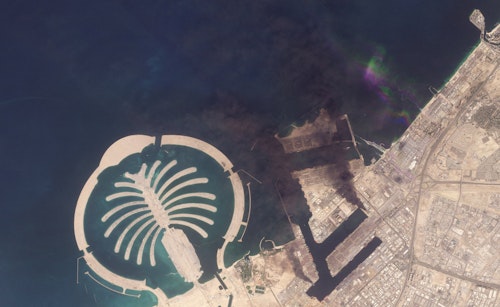
FILE PHOTO: A satellite image of Jebel Ali Port, after one of the berths caught fire, in Dubai, UAE, March 1, 2026. 2026 Planet Labs PBC/Handout via REUTERS
Global ports operator DP World expects rising volumes at its Red Sea terminals, its CEO said.
Most major Gulf ports are reachable only via the narrow Strait of Hormuz waterway.
One of the births at Dubai's Jebel Ali Port, DP World's flagship hub, caught fire because of debris resulting from an aerial interception early in the conflict but operations resumed on March 2.
Jebel Ali remains fully operational with no infrastructure damage but is seeing lower inbound vessel traffic, CEO Yuvraj Narayan said.
UAE ports outside the strait have limited capacity.
Narayan said DP World was deploying measures to maintain supply chain continuity.
Its Red Sea ports, including Jeddah in Saudi Arabia and Sokhna in Egypt, were likely to see an increase in traffic as a result of the crisis, he added, without specifying what extra volumes or types of cargo they might handle.
But logistical and security risks remain high.
Read more here.
Iran tells Trump: 'We will not relent'
Iran's top security official Ali Larijani posted on X:
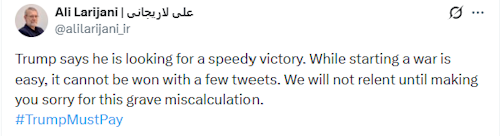
Source: @alilarijani_ir on X
On Wednesday, Trump told a campaign-style rally in Hebron, Kentucky, that the U.S. had won.
"You never like to say too early you won. We won," he said. "In the first hour it was over."
But he added: "We don't want to leave early, do we? We got to finish the job."
Trump administration may loosen US shipping rules

White House press secretary Karoline Leavitt told Reuters the U.S. was considering lifting the century-old Jones Act governing domestic shipping for a limited period of time.
Waiving the rule temporarily would allow foreign ships to carry fuel between U.S. ports, potentially lowering shipping costs and speeding deliveries.
Under the Jones Act, goods shipped between U.S. ports must be carried on vessels that are U.S.-built, U.S.-flagged and mostly U.S.-owned. The requirement sharply limits the number of tankers available for domestic shipments.
Leavitt said the action had not been finalized.
Read more here.
Our Standards: The Thomson Reuters Trust Principles., opens new tab

Thomson Reuters
Vanessa Balintec is a Live Page Journalist based in Toronto, Ontario. She helps create and curate multimedia posts for Reuters’ Live Pages — a scrolling feed of multimedia posts for some of the biggest stories of the day. She previously worked at various bureaus for CBC News. Contact: vanessa.balintec@thomsonreuters.com
Iran's new supreme leader vows to keep Hormuz shut in defiant first remarks
Middle Eastcategory · · 18 hours agoIran will fight on and keep the Strait of Hormuz shut as leverage against the United States and Israel, new Supreme Leader Mojtaba Khamenei said on Thursday in the first comments attributed to him since he succeeded his slain father.


No comments:
Post a Comment