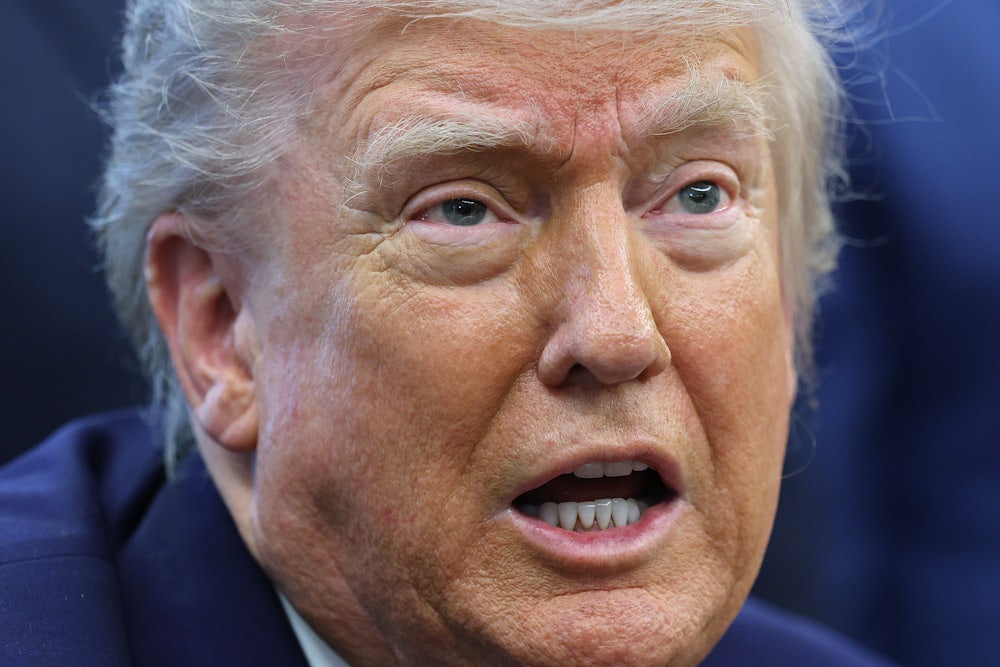
President Donald Trump holds up the $5 million gold card
as he speaks to reporters while in flight on board Air Force One, en
route to Miami, Thursday, April 3, 2025.
Pool via AP/AP
Lawyers' phones are ringing with wealthy foreigners wanting to
know more about how to score a "Gold Card" – a glorified green card that
would allow them to live and work in the U.S. without going through the
usual hassle or red tape. Apparently, the card's $5 million price tag
is not scaring off the jet-setters looking to make the U.S. home. Or at
least one of their homes.
"$5 million to these people is jet
fuel cost. It means nothing to them," says Matthew Kolken, an
immigration lawyer from Buffalo, NY, who has Canadian clients asking
about the Gold Card. The clients declined to comment, but Kolken says he
thinks the Gold Card is underpriced, if anything, considering the time
and hassle it would save foreign multi-millionaires.
"It allows them to potentially buy their way into the United
States," says Kolken. "They would just be able to throw down their Amex
Black Card."
And plenty are interested.
"I have one
from India, one from Pakistan, and two from Egypt. And a colleague who
has a few [clients] from Russia," says immigration attorney Mona Shah.
Most are drawn to the offer of an express lane to permanent residency,
plus more favorable tax implications; foreign nationals living in the
U.S. on a Gold Card would only be taxed on their U.S. earnings.
Shah
says the security — and the status — of being able to flash that "Gold
Card" to get waved into the U. S. is also a big draw, as well as what
Trump has described as "privileges - plus." The president hasn't
elaborated on what that means, but Shah says clients are imagining VIP
perks that range from easy loans to a special fast-track lane through
Customs at U.S. airports.
"They seem to believe that this is
going to be some kind of separating first class from economy class, and
that this is some kind of 'red carpet' visa and they will be treated
like a VIP everywhere," says Shah.
But whether any such perks – or obligations – will come with the
Gold Card remains far from clear, and the administration is not offering
any more details some three months after President Donald Trump first
started hyping the idea.
"It's a great thing, the Gold Card.
Remember the words 'the Gold Card!'" he proclaimed to reporters in the
Oval Office in February. "Wealthy people will be coming into our country
by buying this card. They'll be wealthy and they'll be successful and
they'll be spending a lot of money and paying a lot of taxes and
employing a lot of people. And we think it's going to be extremely
successful, never been done before anything like this."
Trump
added that he'd be happy to call it the "Trump Gold Card." In fact
officials say a government website is now using the name TrumpCard.gov, and Trump has since revealed a sample card with a picture of his face on the front.
Trump
has said the proceeds of the Gold Card would go to help pay down the
budget deficit, and possibly even chip away at the massive $36.2
trillion national debt.
"We'll be able to sell maybe a million
of these cards, maybe more than that," Trump said. "A million cards
would be worth $5 trillion. And if you sell 10 million of the cards,
that's a total of $50 trillion. We have $35 trillion in debt. That'd be
nice."
But most immigration experts and attorneys see that figure as wildly unrealistic. They expect sales to be in the low thousands.
Immigration
lawyer Darren Silver says he's received a flurry of calls about the
Gold Card, but interest wanes as soon as he explains this program is not
like the existing EB-5 visa program, which requires an investment of
something closer to $1 million in a business that creates jobs or
$800,000 for investments in a lower-income 'targeted employment area.'
Silver says his clients are surprised when he tells them the Gold
Card is not an investment that might offer any returns. It's effectively
just a donation.
"I had to explain to them, 'you're gifting
the U.S. government $5 million. That's all you're doing.'" says Silver.
"And once I explain that to them, they're out."
Similar
programs offering residency or citizenship in exchange for investments
have been tried in multiple other countries, including Malta, Greece,
Portugal, New Zealand, the United Arab Emirates. Many of those countries
have faced challenges and a number have recently ended their programs.
In April, Malta's "Golden Visa" program was deemed to be in violation of EU law and ordered shut down.
Spain's program was terminated after it was blamed for driving up
housing prices. A UK program shut down in 2022 amid issues involving
national security, illicit funds and money laundering. Similar concerns ended programs in Cyprus, Ireland, Bulgaria.
"We've
seen that these programs attract unsavory characters," says Kate
Hooper, senior policy analyst with the non-partisan Migration Policy
Institute. "Time and again, the issue has been that these programs
aren't very good at tracing who investors actually are and where their
money comes from. Those are real challenges to running effective,
investor visa programs and we're seeing more of these programs fold."
Trump
has said Gold Card applicants will be "very carefully" vetted. But he
didn't do much to allay concerns when a reporter asked if Russian
oligarchs, for example, would be eligible for gold cards.
"Yeah possibly," Trump replied. "I know some Russian oligarchs that are very nice people."
The
Trump administration will also face other challenges, including
managing the optics of rolling out the red carpet to welcome
uber-wealthy and privileged foreigners at the very same time that the
administration is actively detaining and deporting large numbers of immigrants of lesser means, for a variety of reasons.
"The Gold card is straight out capitalism at its height," says
attorney Shah. "I think the founding fathers might roll over in their
graves if they knew we were selling residency in this manner."
But supporters say opening up a special new lane for wealthy immigrants ultimately helps everyone.
"We're
really short on money right now in the U.S. Treasury and this would
seem to be a better way to get money than to raise taxes on American
citizens," says Stephen Moore, a former Trump economic advisor and a
senior fellow at the Heritage Foundation. "We can take the huddled
masses, and we can take the people who are very wealthy, they're not mutually exclusive."
John
Lettieri, CEO of the Economic Innovation Group, a bipartisan think
tank, agrees. He sees the Gold Card as a good step toward creating a
more merit-based immigration system.
"Right now, we grant visas
on a lottery basis that's totally random and blind to attracting and
retaining the best and brightest people from around the world, and we
need to be more conducive to that kind of talent if we want to maintain
the [competitive] edge that we have right now," he says. "The Gold Card
is not a handout. We're getting something very substantial in return,
and it can be a very significant way to offset the cost of other very
important programs that Americans depend on."
A whole separate
question is whether Trump can legally do what he's proposing without
approval from congress. Immigration lawyers, some Democrats
as well as some Republican lawmakers and conservative immigration
experts say he cannot. But Trump insists it's "totally legal" since he's
offering only permanent residency, and is stopping short of offering
citizenship.
Meantime, while the wealthy wait and ponder the
risks and benefits of a Gold Card, late-night comedy shows and the
internet are having some fun with the Gold Card idea. In one post on X, a
woman offered to beat Trump's offer, with what she called a $1 million
dollar "discount." For just $4 million, she posted, she would help an
uber-rich foreigner come to America by marrying him.