Las Vegas is home to a lot that might raise a pair of eyebrows, but a
new art installation depicting Donald Trump as a naked, 43-foot-tall
marionette might raise them right off your face.
Made of foam over rebar and weighing approximately 6,000 pounds, the
gigantic naked Trump will travel the United States as part of the
“Crooked and Obscene Tour” but first, you can see it in person and in
the wild at 13460 Apex Harbor Ln in Las Vegas right now.
Per the tour’s organizers, portraying Trump in the nude “is
intentional, serving as a bold statement on transparency, vulnerability,
and the public personas of political figures.”
They also aim to spark conversation about “transparency—or lack
thereof—in politics, challenging viewers to think critically about
political influence,” according to press materials.
Those who can’t make it to Las Vegas will have opportunity to see it
on tour stops at other locations across the United States. Dates and
cities for the tour have not yet been announced. We’ll keep you posted.
Enjoy — or ‘enjoy’ — some photos of the project below:
Via “Crooked and Obscene”Via “Crooked and Obscene”Via “Crooked and Obscene”Via “Crooked and Obscene”Via “Crooked and Obscene”Via “Crooked and Obscene”Via “Crooked and Obscene”
This isn’t the first time a nude statute of Trump has appeared in
public, though it certainly dwarfs its predecessor. In 2016 Joshua
“Ginger” Monroe was hired at the art collective INDECLINE to create five life-size naked statues of the former president as part of a project called “The Emperor Has No Balls.”
The statues were put up without permits at locations in Seattle, New
York City, Cleveland, Los Angeles and San Francisco; naturally they were
soon removed by police.
Donald Trump and his defense secretary Pete Hegseth
are mounting an aggressive push to politicise the top ranks of the US
military – a push that smacks of Stalinism and could take years to
repair, the former infantry chief who trained troops to invade Iraq has warned.
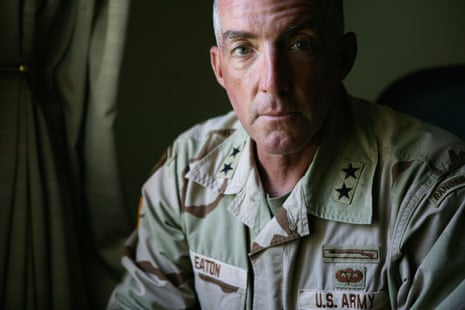
Maj
Gen Paul Eaton has sounded the alarm, saying in an interview with the
Guardian that the effort to bend the higher echelons of the military to
the US president’s will was unparalleled in recent history and could
have long-term dire consequences. He warned that both the reputation and
efficiency of the world’s most powerful fighting force was in the
balance.
“There is an active effort to
politicise the armed forces,” Eaton said. “Once you infect the body, the
cure may be very difficult and painful for presidents downstream.”
He
added that the actions of Trump and his chosen head of the Pentagon
were putting the standing of the military as an independent entity, free
from party politics, at risk. “As the phrase goes, reputation is built a
drop at a time and emptied in buckets.”
Eaton,
75, has spent his entire life in military circles, including 37 years
in active service. His father was an air force pilot whose B-57 bomber
was shot down over Laos in 1969, when Eaton was 18.
Air Force Col Norman Eaton’s remains were found and identified in 2006.
Eaton himself trained at West Point, the US military academy in New York that trains commissioned officers,graduating
soon after the end of the Vietnam war. He rose through the ranks of the
US army to infantry chief and then, after the initial invasion of Iraq
in 2003 was completed, was sent to that country to rebuild the Iraqi
armed forces.
In recent years Eaton has been a sharp critic of Trump’s manipulation of military structures. In the summer of 2024 he participated in war games conducted by the Brennan Center for Justicethinktank,
that sought to anticipate the then Republican nominee Trump’s most
dangerous authoritarian moves were he to return to the White House.
Many
of the actions predicted in those tabletop exercises – including
politicisation of the military and other key government institutions,
and deployment of the national guard into Democratic-controlled cities – have already come to pass under Trump’s second presidency.
In Eaton’s analysis, Trump’s first step towards compromising military independence was the act of appointing Hegseth
as secretary of defense. The former Fox & Friends host had been an
adviser to Trump and had supported his first presidential run in 2016.
“Hegseth
not only swears loyalty to Trump, he swears fealty to Trump – whereas
the military swears an oath to the constitution,” Eaton said.
Soon after Hegseth was ensconced in the Pentagon the firings began. Within a week of Trump’s inauguration the military inspector general who acted as an independent watchdog was dismissed, followed by the top military lawyers (judge advocates general) who advise on the laws of armed conflict.
Out, too, went the top officers. Charles Brown, chairman of the joint chiefs of staff, was ousted
in February and replaced by Lt Gen Dan Caine who Trump claimed had
express his love for the president and would “kill for him” (Caine
denied ever saying such things). The top officers in the navy and air force were ditched in quick succession.
The
Pentagon purge sent a clear and chilling message that reverberated
throughout the military services, Eaton said. “Toe the line, or we will
fire you. You’re in a different world now. This is Trump’s world, and by
God, this is what we’re going to do.”
The
dismissals also sowed doubt throughout the ranks. Would senior officers
kowtow to Trump and his defense secretary? Or would they stand up for
following the military rules of engagement?
Eaton
said the effect reminded him of Joseph Stalin’s 1940s purges of the top
officers in Soviet forces. “Stalin killed a lot of the best and
brightest of the military leadership, and then inserted political
commissars into the units. The doubt that swept the armed forces of the
Soviet Union is reminiscent of today – they are not killing these men
and women, but they are removing them from positions of authority with
similar impact.”
The end result, Eaton said, was that “you’ve got a 1940s Stalin problem inside the American military right now”.
The furor over the lethal US military strikes on boats in Latin American waters is for Eaton a sign of the damage that is being wrought. The administration claims
the strikes have been targeted on “narco-terrorists” who are in “armed
conflict” with the US by bringing illegal drugs into the country.
The first of more than 20 strikes that have occurred took place on 2 September. It involved a controversial second strike that killed two survivors who had been clinging to the bombed wreck of the boat.
The Washington Post revealed that Hegseth had given an order to “kill everybody”. Under the Department of Defense manual on the laws of war, it is forbidden to order that every combatant must be killed irrespective of whether they pose a threat.
Eaton
has no doubts about the illegality of the 2 September second strike.
“It was either a war crime or a murder. So we have a real problem here.
This decision looks a whole lot like a U-boat commander machine gunning
victims in the water during world war two.”
Hegseth
sought to drive home the new way of doing things in a bizarre summit in
September in which he gathered military commanders to Quantico in
Virginia. He berated them about so-called wokeness, liberal thinking,
and the presence of “fat generals and admirals in the halls of the
Pentagon”.
For
Eaton, the meeting was “disgusting” and “antithetical to the US
military. The senior leadership of our armed forces are sober people who
do not speak in terms of fatness or ‘kill them all’ or ‘the gloves are
off’.”
Looking ahead to 2026, Eaton is
profoundly concerned that the violations of rules of war that have
arguably been committed by the Pentagon outside US territory might soon
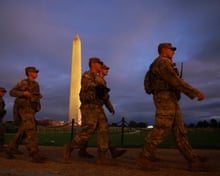
become a reality domestically. The Trump administration
has federalised national guard troops and sent them into numerous
cities against the wishes of Democratic mayors and state governors.
The presence of national guard soldiers in Los Angeles, Washington DC, the Chicago area and other locations has been challenged in federal courts, where cases continue to play out.
In
October Eaton took part in a delegation that included the organisation
Vote Vets, to which he acts as an adviser, to see the Democratic
governor of Illinois, JB Pritzker. The retired two-star general said
they counseled Pritzker to stand firm in countering troop deployment to
Chicago.
“We told him: you have a requirement to protect your citizens from federal assault.”
Eaton’s
biggest fear is at some point a dramatic clash of forces might take
place, with the federalised national guard facing off against state and
local police. He conjured up the imaginary scenario of the Texas
national guard being federalised – ie ordered out of state control into
national control – and imported into Baltimore, Maryland, contrary to
the city and state’s wishes.
“What could go
wrong?” Eaton said. “You can very easily see an escalation in which both
sides think they are right, obeying orders that they believe were given
legally.”
Sooner or later, he warned, a
“memorable event” was likely to take place. “There are going to be
people getting hurt who really don’t need to get hurt.”
You've read 37 articles in the last year
Article count
We
know. You’ve seen these notes to support us – 37 times so far this year
– but you haven’t responded. It’s a little awkward for both of us. But
wait:
In our experience, it’s not
a lack of enthusiasm that stops frequent Guardian readers like you from
supporting our journalism – it’s how long you imagine it’s going to
take.
So we timed it, and on
average it takes just 37 seconds. (Yes, you need your credit card, but
it’s over there in your wallet – or you might already have the details
saved on this device?)
But did
you also know that, as a thank you for your support, you get access to
exclusive extras (including seeing far fewer fundraising messages like
this one)?
If
you can, please support us on a monthly basis. It takes less than a
minute to set up, and you can rest assured that you’re making a big
impact every single month in support of fearless, independent
journalism. Thank you.
President
Donald Trump struggled to offer much sympathy for the families of about
100 Americans—many of them U.S. military veterans—who have died
fighting in Ukraine.
An estimated several
thousand Americans have volunteered to fight for Ukraine since Russian
dictator Vladimir Putin launched a full-scale invasion in 2022, with at
least 92 Americans killed as of September, The New York Times reported.
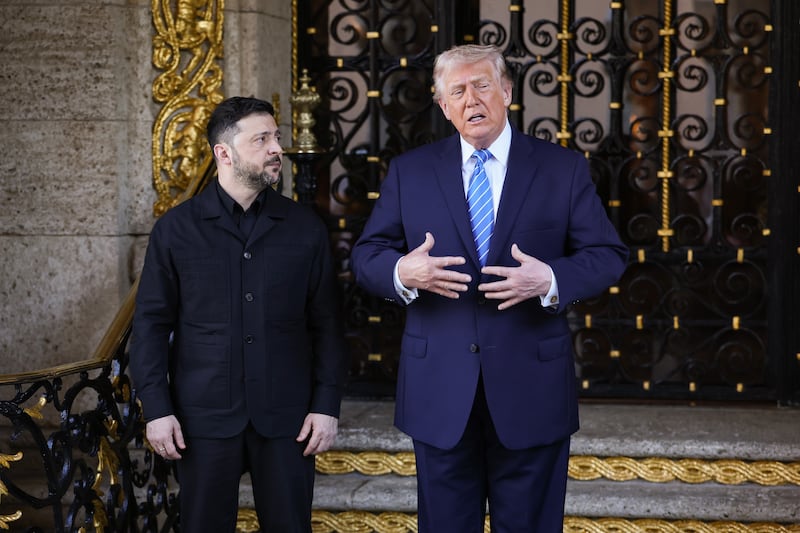
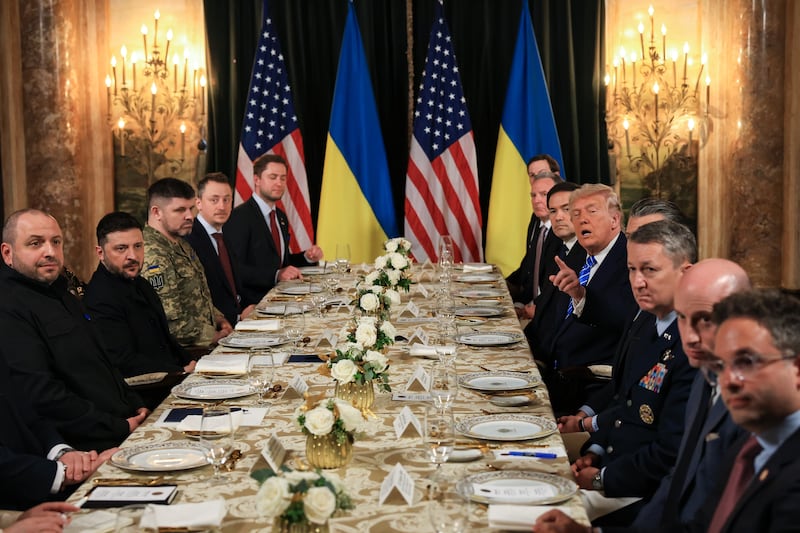
Following a meeting
with Ukrainian President Volodymyr Zelensky at Mar-a-Lago on Sunday to
discuss a peace deal to end the war, Trump was asked about his message
to the families of the fallen Americans.
“The
message is so obvious,” he replied. “What a shame. They died in a
foreign country. And some are celebrated people, they’re very
celebrated. But it’s so sad that a thing like that would happen.”
President Trump offered few condolences for the families of Americans who died fighting for Ukraine. Joe Raedle/Getty Images
He then immediately moved on to the next question.
Social media users quickly noted
that the president hadn’t thanked the fallen for their sacrifice,
praised their commitment to freedom and democracy, or even offered his
personal condolences.
Many of the Americans who have died in Ukraine were U.S. military veterans.
Mike
Meoli, 71, was a retired Navy Seal and firefighter who traveled to
Ukraine to train medics on the front lines. He was killed in November
2024, ABC 10 News San Diego reported.
Nicholas
Maimer, 45, was an Army Special Forces veteran and Idaho native who
helped train Ukrainian officers. He was killed in May 2023 in an
artillery barrage, according to Military.com.
Ian
Frank Tortorici, 32, was a retired corporal with the U.S. Marines who
fought on the front lines. He died in July 2023 after a Russian missile
hit a restaurant where he was eating while on leave, Task and Purpose reported.
Both sides said that progress was made during Sunday's talks, but neither suggested a peace deal was imminent. Joe Raedle/Getty Images
The
U.S. government has declined to provide aid to American fighters to
avoid any suggestion of a direct clash with Russia, which is a nuclear
power, the Times reported in September.
But some social media users argued that Trump’s barely-there compassion for their families wasn’t measured diplomacy—it was reminiscent of the president’s previous comments about Americans who died in combat being “suckers” and “losers.”
During
a trip to France in 2018, the president said American soldiers who died
on French soil during World War I were “losers,” and that U.S. Marines
who helped halt the 1918 German advance toward Paris were “suckers” for
dying at the hands of the enemy.
The White
House denied reports of the comments, which were revealed by The
Atlantic magazine in 2020, but they’re just one example of the president
disparaging military veterans and their families.
He
has mocked the late Sen. John McCain’s war injuries, publicly insulted
the parents of a 27-year-old soldier who died in a car bombing in Iraq,
and privately raged about the funeral costs for a female soldier who was murdered by a male soldier at Fort Hood.
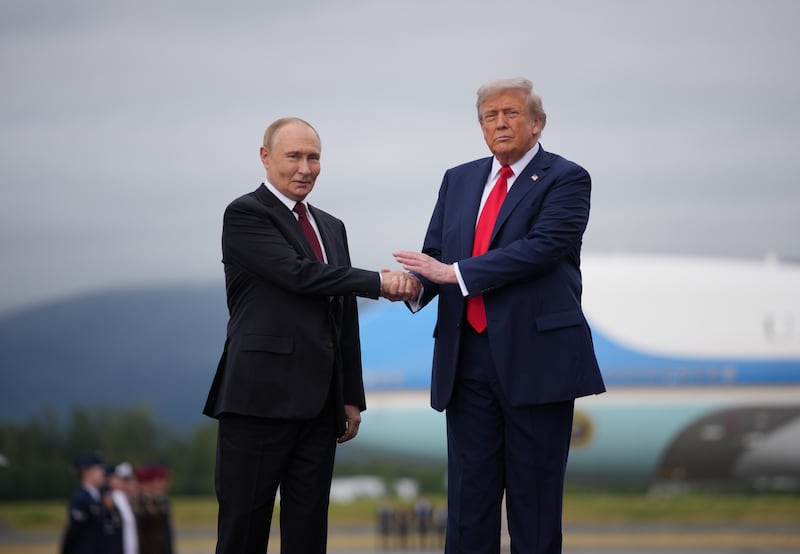
President
Trump said Sunday he was on the side of peace, but heaped praise on the
man who started the war—Russia's Vladimir Putin. Andrew Harnik/Getty Images
Although
he failed to offer much comfort Sunday to the families of Americans who
have died fighting Russia, Trump did manage to heap praise on the man
who started the war.
“Russia wants to see
Ukraine succeed,” Trump said, prompting Zelensky to raise an eyebrow. “I
was explaining to the president [Zelensky], President Putin was very
generous in his feeling toward Ukraine succeeding.”
He also said he “understands” Putin’s refusal to agree to a ceasefire while a longer-term agreement is being hashed out.
“He
feels that look, you know, they’re fighting and to stop, and if they
have to start again, which is a possibility, he doesn’t want to be in
that position—I understand that position,” Trump said.
Putin bombarded Ukraine with over 100 drones on Christmas Eve and early Christmas Day, killing at least seven civilians.
Sunday’s
talks were intended to address security guarantees and possible
territorial concessions, and while both sides said progress had been
made, neither gave any indication that a deal was within reach.
The Daily Beast has reached out to the White House for comment.