https://www.theguardian.com/us-news/2026/feb/03/criminalizing-protest-dissent-history
The criminalizing of protest and dissent has a long history in America
Trump administration is accusing protesters of ‘domestic terrorism’ but this brazen tactic is as old as the country itself
When federal immigration agents shot and killed ICU nurse Alex Pretti in Minneapolis on 23 January, the homeland security secretary, Kristi Noem, wasted no time claiming to the press, without credible evidence, that Pretti had been engaged in “domestic terrorism”. Though the administration seems to be trying to soften that initial response after fierce backlash, it’s an accusation that members of the Trump administration have been leveling at wide swaths of people beyond Pretti – including Renee Nicole Good, another Minnesotan killed by ICE agents two and a half weeks prior, and Marimar Martinez, who survived being shot by ICE agents in Chicago in October – as part of an ongoing strategy to criminalize dissent.
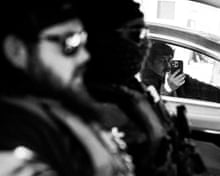
It’s a claim Immigration and Customs Enforcement (ICE) agents themselves have started to make directly in confrontations with citizens, seemingly to try and intimidate legal observers, sometimes known as ICE watchers. In one recent video from Portland, Maine, an ICE officer told an observer to stop recording him on her phone, and when she wouldn’t, he took her information down and said, “We have a nice little database … and now you’re considered a domestic terrorist.”
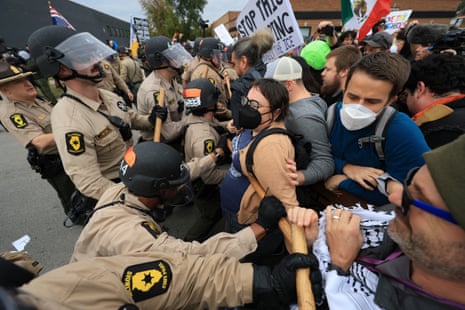
A common pattern has also emerged in courts: ICE or other federal agents will initiate a violent confrontation with a protester – pushing a 70-year-old veteran to the ground in Chicago outside the Broadway ICE facility, or shoving a US citizen at a protest in LA – then, the Department of Justice will press charges against the victim of that violence, rather than against the perpetrator. By one count, more than a hundred prosecutions relying on Section 111 of Title 18 of the US code, which deals with resisting federal employees, were filed in the second half of 2025.
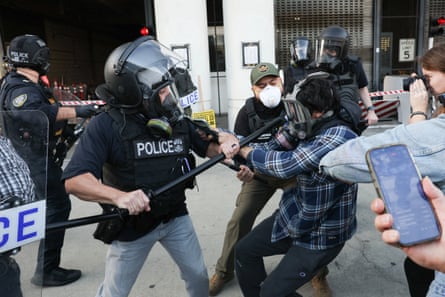
“It absolutely seems to be the case that federal agents have ramped up their repression of legal observers,” said Michelle Phelps, a sociology professor at the University of Minnesota and author of The Minneapolis Reckoning: Race, Violence, and the Politics of Policing in America.
Though the hasty labeling of anyone who records or protests ICE a “domestic terrorist” has become particularly brazen under the second Trump administration, the criminalization of protest and dissent in the US is nothing new – in fact, it’s as old as the country itself.
The history of criminalizing protest
Anti-protest bills proliferated around the country under both the Trump and Biden administrations, aimed at everything from expanding the definition of what counts as a “riot” to penalizing anyone who obstructs the flow of car traffic. Twenty-nine state and federal anti-protest bills passed during Trump’s first term and 25 passed under Biden.
According to the International Center for Not-for-Profit Law (ICNL), which has been operating a protest law tracker since January 2017, when Trump first took office, “these anti-protest bills are often introduced in response to prominent protest movements.” That’s likely why the number of proposed anti-protest bills jumped so high in 2021 (90 total bills proposed, though only 12 passed), the year after protests sprung up across the nation in the wake of George Floyd’s murder by a Minneapolis cop.
Other protest bills have emerged in response to other movements. In 2019, in the wake of the Dakota Access Pipeline protests and the ramping up of climate protests, US states began to introduce extreme penalties (like five years in prison, in the case of one Louisiana law) for interfering with pipeline construction or trespassing nearby. In 2025, a host of bills targeting student protesters and universities cropped up as a response to pro-Palestinian student encampments.
Other bills have seemed intent on making protest of any kind more dangerous to participants: an Iowa law passed in 2021 protects drivers who hit or kill protesters from liability, while a Florida law passed the same year protects people who injure or kill protesters from being sued, so long as the protester was participating in a “riot”. (What constitutes a “riot”, though, varies by state and in some places is defined in such a way that it can include “peaceful protesters who are simply part of a larger crowd where a few individuals engage in property destruction–even something as minor as kicking over a trash can”, said the ICNL.)
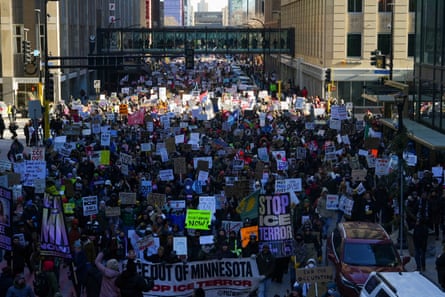
According to Gloria J Browne-Marshall, a professor of constitutional law at John Jay College of Criminal Justice (CUNY) and author of A Protest History of the United States, criminalization and violence against protestors has been “part and parcel” of this country for a long time. During the civil rights movement, for example, leaders were surveilled by the government and frequently jailed. If people see this moment as totally unprecedented, it might be because of the demographic being visibly impacted.
“What had been happening to immigrants and to African Americans… is now happening across the board to middle-class white people,” she said.
‘A war on solidarity’
According to Nick Estes, a historian at the University of Minnesota and enrolled member of the Lower Brule Sioux Tribe, who has written and co-edited multiple books on the Standing Rock protests against the Dakota Access Pipeline, the shooting and killing of white people on the streets of Minneapolis is “a war on solidarity”. “White supremacy is meant to control white people first and foremost,” he said. “So if they’re not complying with the status quo, and they’re trying to defend immigrant neighbors, I see this as retaliation [against them for that].”
He pointed to Jessica Reznicek, a Catholic worker and climate activist who was sentenced to eight years in prison, fined $3m, and labeled a domestic terrorist in 2021 for damaging the Dakota Access Pipeline using a pipe welder (no people were harmed). Meanwhile, “no January 6 protester got terrorism enhancement charges or sentencing”, Estes said, despite multiple fatalities resulting from the attack on the Capitol. “I think that largely has to do with the fact that [Reznicek] was in alliance with Indigenous water protectors.”
Regardless of who is being targeted, the criminalization of protest – and a belief in the importance of protest – have been present since the country’s founding, according to Browne-Marshall.
On the one hand, the Insurrection Act was “created to prevent people from protesting”; on the other, “the framers of the US constitution were very much afraid of the power of the government they had created,” she said. “There was always this fear of a charismatic leader who would somehow meld together these three branches of government that were supposed to be counters to one another – and that’s what we have right now.”
The goal of all this criminalization seems to be to further consolidate power and protect the Trump administration against dissent, she added.
The White House did not respond to the Guardian’s questions about what criteria is being used to designate someone a “domestic terrorist”, nor why that label is being applied by the White House before evidence has been presented or considered in a court of law. Instead, Abigail Jackson, White House spokesperson, fully defended ICE agents, saying: “ICE officers act heroically to enforce the law and protect American communities and local officials should work with them, not against them. Anyone pointing the finger at law enforcement officers instead of the criminals is simply doing the bidding of criminal illegal aliens.” Neither ICE nor the Department of Justice responded to the Guardian’s questions or requests for comment.
Insofar as criminalization is meant to scare people, it’s working to a degree, according to ACLU Minnesota organizer Paul Sullivan. Immigrants in the Twin Cities are increasingly staying indoors, relying on mutual aid efforts for food and other necessities, and many people of color, even if they’re citizens, are shrinking from public life as they look to avoid being racially profiled by ICE officers.
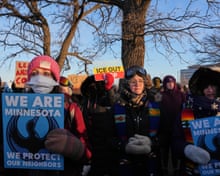
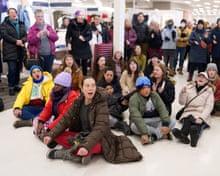
“But it’s also, frankly, had the opposite effect that I imagine that ICE and the Trump administration intended, which is that it has really, really activated and enraged a lot of our community,” Sullivan said. They described stories of ICE officers pulling up across from a cafe and 90% of the people inside coming out to shout at them and blow whistles. “It’s really become something that the community has coalesced around, and that is that determination to oppose the regime for what they’re doing,” Sullivan said.
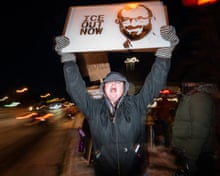
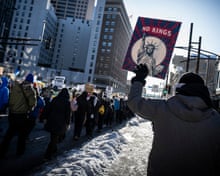
It’s not just Minnesota – in Chicago, posters declaring that ICE isn’t welcome have become nearly ubiquitous in many neighborhoods. In Oregon, protesters are doubling down on their right to protest and bringing gas masks to help them weather pepper spray and other attacks from federal agents.
Though the risks are high, continuing to show up is important, said Sullivan.
That can and is taking many different forms in cities that are being targeted, including delivering meals and covering rent for immigrants who are sheltering in place to avoid ICE, continuing to blow whistles and alert neighbors when ICE is spotted nearby, filming their activities, and pressuring local elected officials to push back against this federal overreach.
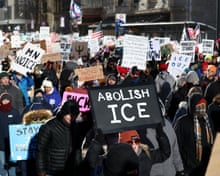
Browne-Marshall suggests that today’s organizers study the strategies of their forebears in the anti-Vietnam war and civil rights movements to learn what works, including tactics like pressuring corporations to stop cooperating with federal agents. In the longer term, Sullivan notes that it will be important to fight the securitization that the US government has been ramping up since 9/11 under the banner of anti-terrorism that allows for such easy and widespread surveillance of US citizens and everyone who sets foot in the country. Many others are calling for the US to abolish ICE.
Whatever the solution, one thing should be clear, said Estes: the law may be twisted such that the government can deem anyone it wants to punish – or even kill with impunity – a “domestic terrorist”.
But law and order are “actually supposed to be a reflection of the values of society”, he said. “What we’re seeing on the ground is people who are saying ‘this is not what we want; this is not something we agreed to; this is not something we asked for.’ To me, that shows that human solidarity is triumphing in the face of this really violent moment we’re living through.”
We know. You’ve seen these notes to support us – 44 times so far this year – but you haven’t responded. It’s a little awkward for both of us. But wait:
In our experience, it’s not a lack of enthusiasm that stops frequent Guardian readers like you from supporting our journalism – it’s how long you imagine it’s going to take.
So we timed it, and on average it takes just 37 seconds. (Yes, you need your credit card, but it’s over there in your wallet – or you might already have the details saved on this device?)
But did you also know that, as a thank you for your support, you get access to exclusive extras (including seeing far fewer fundraising messages like this one)?
If you can, please support us on a monthly basis. It takes less than a minute to set up, and you can rest assured that you’re making a big impact every single month in support of fearless, independent journalism. Thank you.