Video of an ICE shooting shattered the agency’s story. Will it usher in accountability?
https://www.theguardian.com/us-news/2026/apr/11/ice-shooting-dhs-accountability-minneapolis
Video of an ICE shooting shattered the agency’s story. Will it usher in accountability?
Video of an ICE shooting shattered the agency’s story. Will it usher in accountability?
The case against two Venezuelan men in Minneapolis is the latest to fall apart. Now agents could face repercussions, but questions linger over whether it signals a real shift
On 14 January, in the thick of Donald Trump’s massive anti-immigration crackdown in Minneapolis, two deportation officers from Immigration and Customs Enforcement (ICE) attempted to stop a car in traffic.
They had identified the owner as an unauthorized immigrant, according to an FBI affidavit. The driver, later identified as Alfredo Aljorna, a Venezuelan national, sped off, hitting speeds of 80mph and eventually crashing into a parked car. He then took off running toward an apartment building where his roommate, Julio Sosa Celis, stood at the entrance holding a broad-bladed snow shovel.
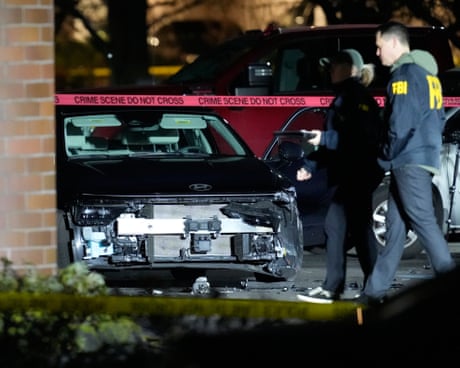
In the agency’s telling, what ensued next was a violent altercation in which ICE agents said they were attacked, and eventually fired at Sosa Celis. Both men were later charged with assaulting a federal officer. But the prosecution crumbled weeks later, as the evidence to support the claims of a violent altercation fell apart.
And this week, newly released surveillance camera footage publicly undermined the agents’ accounts, casting fresh scrutiny on an agency that has gained a reputation for a toxic combination of excessive force and dishonesty.
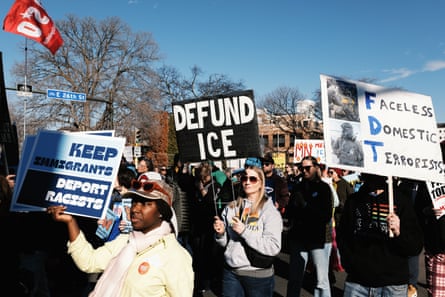
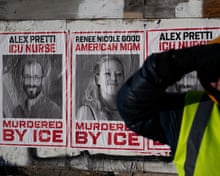
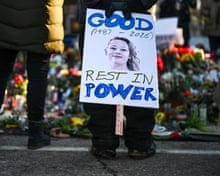
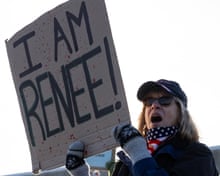
It was the latest case to fall apart in a string of prosecutions against people accused of assaulting ICE officers. It was also the third time video evidence had undermined ICE’s attempt to describe an officer-involved shooting in Minneapolis as the result of self-defense. Federal immigration agents’ fatal shootings of Renee Nicole Good and Alex Pretti in Minneapolis, both of which were captured on cellphone videos by bystanders, appear so egregiously excessive they prompted the White House to reorganize the leadership of the Department of Homeland Security in the face of the mass deportation campaign’s plummeting popularity.
“In the long arc of our immigration enforcement history, Minnesota will be the major inflection point,” Muzaffar Chishti, a senior fellow with the non-partisan Migration Policy Institute, told the Guardian. “Accountability, at least the beginning of accountability, started in Minnesota after the death of Pretti.”
Now, the reckoning over ICE’s shooting of Sosa Celis has marked a stark shift for the agency. Instead of applauding the officers as heroes in the face of clear evidence casting doubt on their statements, as Kristi Noem, the recently ousted homeland security secretary, used to do, Todd Lyons, the ICE director, has said the officers involved were put on administrative leave and may face dismissal or criminal prosecution themselves for making false statements.
“Lying under oath is a serious federal offense,” an ICE spokesperson said in an emailed statement to the Guardian. “The US attorney’s office is actively investigating these false statements. Upon conclusion of the investigation, the officers may face termination of employment, as well as potential criminal prosecution.”
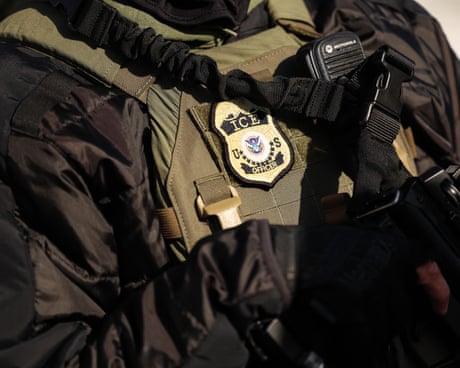
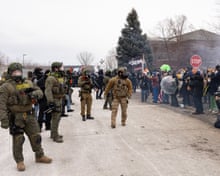
The shift has cast a spotlight on accountability at an agency that gained notoriety for its recklessness and impunity over a year-long campaign targeting Democratic-led cities including Minneapolis, Los Angeles and Chicago.
“I would characterize it as baby steps and symbolic oversight, at least so far,” said Gabe Sanchez, a researcher at the Brookings Institution. “But it would appear that there is some movement toward accountability. We’re moving in the right direction.”
The question now hanging over the agency is whether those changes will signal a real shift toward greater accountability and transparency, or simply a softer tone coupled with goodwill gestures.
A case that fell apart
That the prosecution made it as far as it did highlights how little pushback ICE officers received from other agencies that investigated – and later brought charges – over the incident.
An account offered by an unnamed ICE agent, and described in the FBI affidavit, said Aljorna slipped a few feet from the door to the apartment building, allowing the officer to grab him. Sosa Celis then repeatedly struck the ICE officer in the face with a broom. The officer said a third, unidentified man then attacked him with a shovel. The fight lasted for about three minutes, according to the officer. When the officer drew his service pistol, the men tossed their broom and shovel and ran to the apartment building. The officer fired a single round as they fled, hitting Sosa Celis in the thigh.
But in Sosa Celis’s account, also described in the affidavit, no one attacked the ICE officer with the shovel. Sosa Celis acknowledged holding it when Aljorna arrived, but said he didn’t use it to strike the officer. Aljorna briefly scuffled with an ICE officer, perhaps hitting him with a broom. Sosa Celis pulled his friend away. As they fled, the ICE officer shot Sosa Celis in the leg.
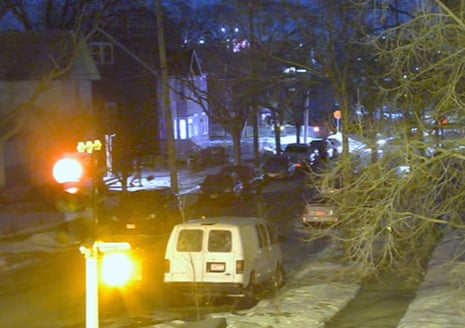
The newly released surveillance video that captured the scene supports key details of Sosa Celis’s story, showing that there was no three-minute tussle in which either man repeatedly battered an ICE officer with a shovel or broomsticks. The overall confrontation appears to last around 12 seconds.
Jacob Frey, the Minneapolis mayor, said after the footage’s release: “The video makes it crystal clear that, just like in other situations during Operation Metro Surge, the federal government’s account of what happened simply does not match the facts.”
Timothy Schanz, an FBI special agent who interviewed the ICE officers and the two immigrants, mentioned viewing the CCTV footage in the affidavit he submitted in support of the federal criminal complaint against Sosa Celis and Aljorna. The affidavit says nothing about the video evidence contradicting the deportation officer’s story. The US attorney’s office for the district of Minnesota had the footage in its possession, but appeared to file criminal charges against Sosa Celis and Aljorna before reviewing it.
After prosecutors saw the footage, they took the unusual step of moving to dismiss their own case with prejudice in February, closing it permanently.
Prosecutions against federal law enforcement officers are exceedingly rare. US law sharply limits people from suing federal law enforcement officers for civil damages when their rights are violated. ICE is currently facing a lawsuit from the state of Minnesota for refusing to share evidence in all three of the agency’s officer-involved shootings.
ICE has not made it clear whether the officers on administrative leave were suspended with or without pay. The agency did not respond to a question from the Guardian.
Calls for accountability
Democrats have waged a pitched battle for months to avoid funding homeland security until securing more ways to hold ICE officers accountable, including requiring body cameras. But given how few checks homeland security agencies have on their power, the most potent way to bring accountability to ICE officers would be to remove their qualified immunity from prosecution for civil rights violations, said Mike Fox, a legal fellow at the Cato Institute.
“ICE and border patrol should get zero dollars in perpetuity, unless and until there’s a way to hold agents accountable,” Fox said. “A statute that allows federal officials to be sued in their personal capacity and individually liable when they violate people’s rights, and absent that we don’t fund these agencies at all. That should be the choice.”
If the officers involved in the Sosa Celis shooting did, in fact, lie about why one of them opened fire, prosecutors should consider charges more serious than making false statements, Fox said. Violating someone’s civil rights under the color of law is a federal crime punishable by up to 10 years if the action results in bodily harm.
ICE’s statements have not discussed whether a civil rights investigation would be warranted in this case. And the Trump administration has gutted the justice department’s civil rights division, whose job it would be to prosecute a case like that.
“I can’t say they committed a crime, but I also can’t say they didn’t,” Fox said of the officers involved in the Sosa Celis shooting. “You know who should get to decide in this case? A jury.”
At this unsettling time
We hope you appreciated this article. Before you close this tab, we want to ask if you could support the Guardian at this crucial time for journalism in the US.
In his first presidency, Donald Trump called journalists the enemy; a year into his second term, it’s clear that this time around, he’s treating us like one.
From Hungary to Russia, authoritarian regimes have made silencing independent media one of their defining moves. Sometimes outright censorship isn’t even required to achieve this goal. In the United States, we have seen the administration apply various forms of pressure on news outlets in the year since Trump returned to office. One of our great disappointments is how quickly some of the most storied US media organizations have folded when faced with the mere specter of hostility from the administration – long before their hand was forced.
While private news organizations can choose how to respond to this government’s threats, insults and lawsuits, public media has been powerless to stop the defunding of federally supported television and radio. This has been devastating for local and rural communities, who stand to lose not only their primary source of local news and cultural programming, but health and public safety information, including emergency alerts.
While we cannot make up for this loss, the Guardian is proud to make our fact-based work available for free to all, especially when the internet is increasingly flooded with slanted reporting, misinformation and algorithmic drivel.
Being free from billionaire and corporate ownership means the Guardian will never compromise our independence – but it also means we rely on support from readers who understand how essential it is to have news sources that are immune to intimidation from the powerful.
We know our requests for support are not as welcome as our reporting, but without them, it’s simple: our reporting wouldn’t exist. Of course, we understand that some readers are not in a position to support us, and if that is you, we value your readership no less.
But if you are able, please support us today. All gifts are gratefully received, but a recurring contribution is most impactful, helping sustain our work throughout the year ahead (and among the great benefits, we’ll show you far fewer fundraising requests like this). It takes just 37 seconds to give. Thank you for protecting the free press.








No comments:
Post a Comment