Marc Elias: The Stakes in November
https://newrepublic.com/article/211759/marc-elias-stakes-november
Marc Elias: The Stakes in November
The famed election lawyer sizes up where we stand.
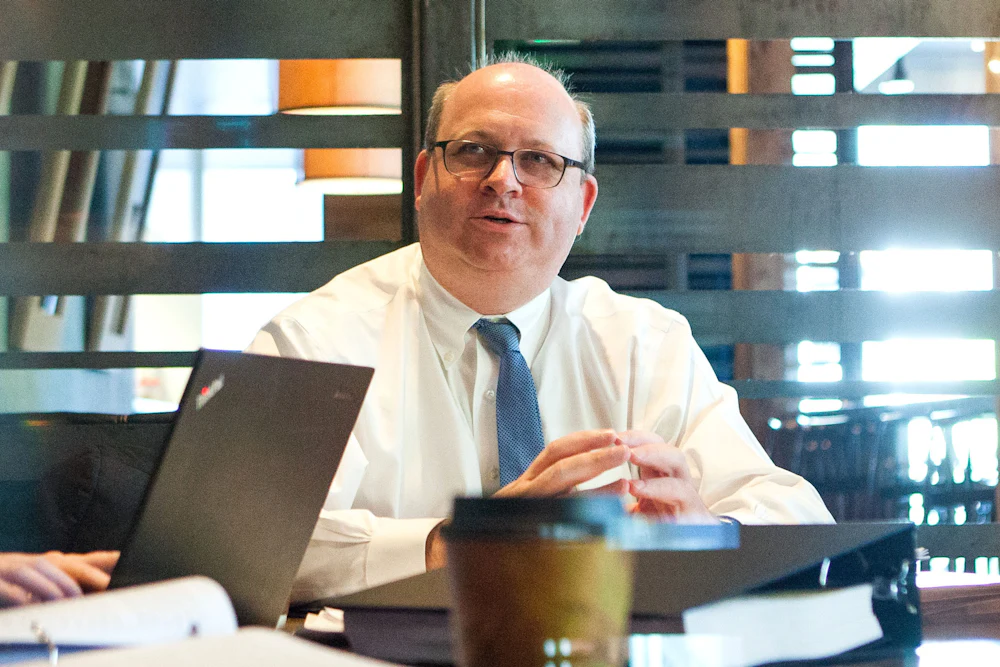
An expanded transcript of the interview on which this article is based is available here.
So, Marc Elias, what are you most worried about Donald Trump getting up to between now and Election Day?
“What we’ve seen from Donald Trump in the past is that he starts with lies, then he increases the rhetoric behind the lies, then you see the legal process,” Elias told me and my wife, Carol Butler, in an interview this spring. “And then when he fails in the legal process, we have violence. And I think that we are on that progression. He has lied about voting, he has now upped the rhetoric for all of the SAVE Act, which began as a proof-of-citizenship law. It’s now become a voter suppression, voter purge, ban on mail-in voting, trans-targeting law, right? So when he loses in court in the cases I referenced, and he’s not able to pass this law through Congress, as we’ve discussed, I think he’s going to escalate further.”
Elias, of course, is the indefatigable Democratic election lawyer and founder of the website Democracy Docket, which tracks voting litigation in the United States. Elias is the right person to be tracking voting litigation, for the simple reason that he’s directly involved in most of it. He explained: “The Department of Justice is suing to get access, essentially, to the unredacted voter rolls in all 50 states. And they’re suing 30 of those states, and we have intervened to oppose them in all of those states.” He’s won so far in Oregon, California, and Michigan. He and his team await verdicts in the other states. And he noted, on the downside, that as many as 17 states, including Texas and Florida, quickly complied with Justice’s request. (On June 22, a federal judge ruled that the Trump administration could not pool data with states to verify voters’ citizenship, noting that states like Texas were already “actively” using it to check voter registrations and had flagged eligible voters for removal.) “It’s just gonna be a knife fight from here to the end,” Elias said.
A knife fight, he predicted, that will almost surely find its way to the Supreme Court in some form. One likely form: In March, the court heard arguments in Watson v. Republican National Committee, in which it will rule on the constitutionality of a post–Election Day grace period for mail-in ballots. Mississippi is one of 15 states that provides for such a period. The RNC cites an 1845 law defining Election Day as one specific day. A decision is expected this term, by late June.
“The argument broke down into two predictable camps,” Elias said. “You had the three most conservative justices that seem likely to rule for the RNC. You had three liberals who are not going to. And then the question is, What are [Brett] Kavanaugh, [Amy Coney] Barrett and the chief justice going to do? And I think they are hard to read.” The decision could affect thousands of votes, and in close elections, that could matter.
This brings us back to Trump and his plans and the possibility of violence. If Trump tries to send ICE agents to the polls, Elias said his group would fight it. He also thinks ICE’s techniques might be more subtle: “Let’s assume that they’re not at the polling place, but rather, they are occupying all the parking lots, and they are closing off the streets.… You’re now being told you’re going to have to park a mile away and walk to the polls, right? So don’t underestimate the amount of voter suppression they can impose, simply through their chaos and contrived inconvenience.”
And finally, Carol asked, while you and other insiders are working to stop Trump from stealing the election, what can regular citizens do?
“I always say this to every audience I speak to,” he said. “There are things that lawyers can do which are unique to lawyers. There are things that elected officials can do that are unique to elected officials. There are things that philanthropy can do that are unique to philanthropy, but everyone, no matter who they are, no matter what their job, no matter how much they have or don’t have, they do have a town square that they can stand out in and speak out.
“Now, some people have really big town squares. You know, they own major media publications. Other people have smaller town squares. It may be just their social media feed, it may be their dinner table, it may be their bridge club or the bowling league they belong to, but everybody’s got some place where they can speak out and be heard. And what everyone needs to do is to use that town square to call out what Donald Trump is up to and what is happening to our democracy. And No Kings Day is a great opportunity for people to do that, but it is only one day out of a year. And so my ask for everyone is for them to use every opportunity they have to speak out on the issues of democracy and free and fair elections.”
Because if we don’t have free and fair elections, he concluded, nothing else good can happen—none of the other crises that confront us, from climate to reproductive rights to you name it, can be addressed.
“Because I think if we have free and fair elections,” Elias said, “Democrats are going to take control of the House and the Senate, and they’ll do quite well downballot, but if Donald Trump is able to, in the darkness of the night, rig the elections through unfair districts or suppress the vote through executive orders that go unchallenged, or make it impossible for people who have hourly jobs to be able to vote because there are long lines or because the streets are closed off, then he will have won. All of us can become ambassadors for access to voting by posting on social media, calling their friends, or texting their text chain with their college roommates. And so that’s the thing that I ask everyone to do.”


No comments:
Post a Comment