Dear (Juris)Prudence: It Was One of the Biggest Scandals of the First Trump Term and It’s Even Worse Now. Where Did It Go?
https://slate.com/news-and-politics/2026/08/biggest-donald-trump-scandals-emoluments-fail.html
Dear (Juris)Prudence: It Was One of the Biggest Scandals of the First Trump Term and It’s Even Worse Now. Where Did It Go?
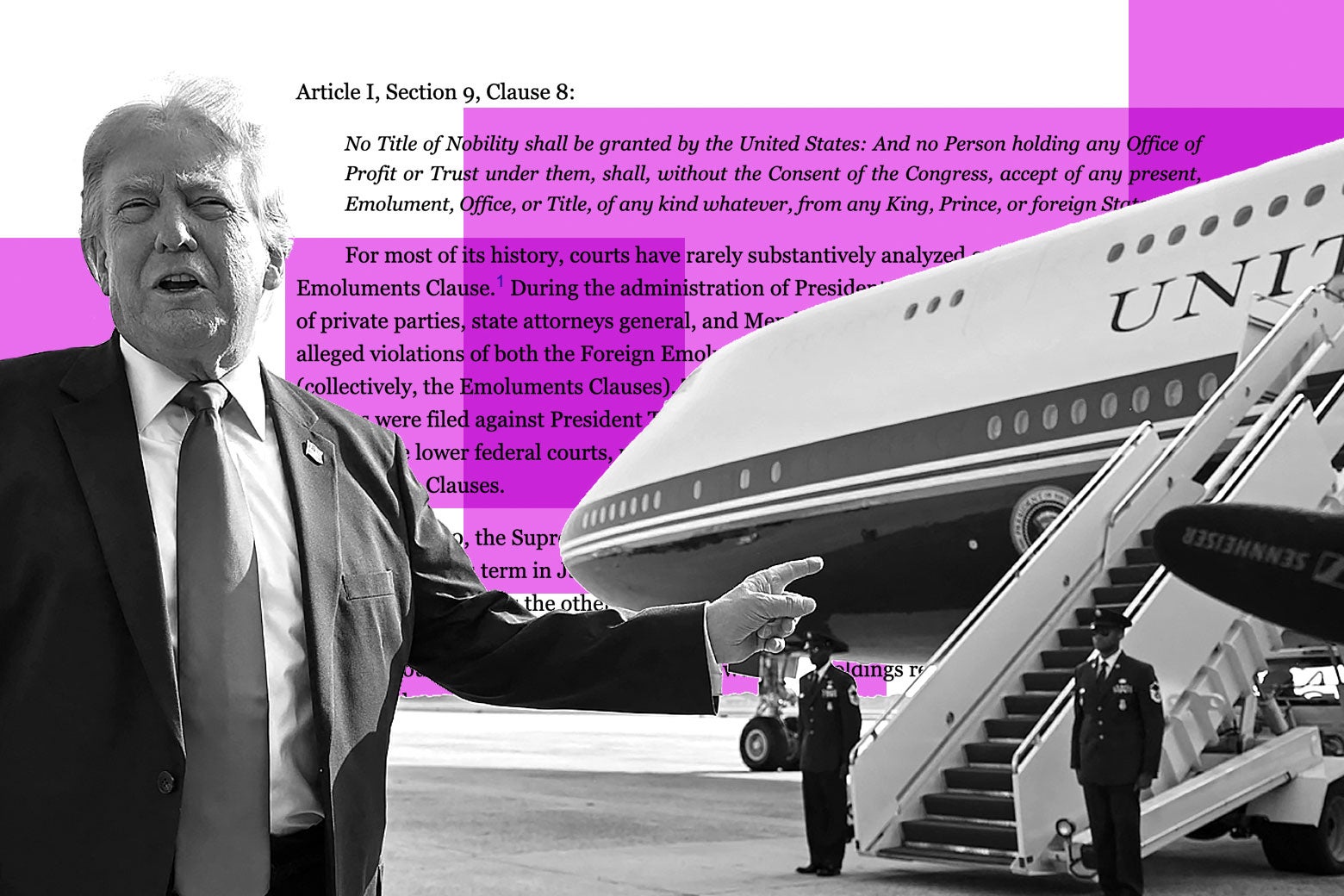
Last week’s episode of Amicus
included a mailbag special in which Dahlia Lithwick and Mark Joseph
Stern answered listeners’ burning questions about the law. Amicus
listeners have a lot of smart questions, so we’re running an occasional
“Dear (Juris)Prudence” series in which we share your questions and Mark
and Dahlia’s answers. Write to amicus@slate.com to pose a question to Dahlia and Mark. This transcript has been edited and condensed for clarity.
Dear (Juris)Prudence,
I’m a retired lawyer and a longtime Plusketeer who loves your podcast. I keep wondering whether Trump’s crypto, airplane, and other grifts violate the Emoluments Clause of the Constitution. More generally, I am not sure what constitutes an emolument. I would love to hear your opinions on this.
—Deborah Porter
Dahlia Lithwick: I love this question because it reminds us how far we’ve come from the robust discussions we used to have in 2017 about emoluments, where that was the only game in town, and now it’s, in some ways, like the trailing toilet paper on the shoe, it’s almost so trivial compared to so many other things. Yet, it’s in the Constitution, not one place, but two places.
And it’s still the law. When you start googling about the emoluments clause, the first thing that keeps coming up is “What ever happened to the emoluments clause,” as though it was excised from the Constitution. No, friends, there’s two emoluments clauses! They really are totally uncontroversial, and both clauses were seen as, like, these original anti-corruption, anti-grifting prohibitions, and were largely just observed.
The foreign emoluments clause prevents the president and other federal officers from accepting “Any present, emolument, office or title of any kind whatever from any king, prince, or foreign state.” And it requires the consent of Congress to do so, and it’s introduced at the Constitutional Convention by Charles Pinckney of South Carolina. There’s a culture at the time of lavish gift-giving to diplomats and foreign officials, and he’s just terrified that officers of the United States will be beholden and influenced by foreigners. And the convention approves this unanimously without noted debate because it’s so freaking obvious, right? That you don’t want to be accepting fancy pens or, like, gorgeous gold earrings or an airplane, which wasn’t invented yet. So that’s the foreign emoluments clause. The domestic emoluments clause provides for the president to receive a fixed salary and bars him from receiving “Any other emolument from the United States or any of them.” Again, this is designed to keep the president from being beholden to or pressured by Congress or any individual state, right?
They are both still in the document. And in addition to that, it’s very, very clear what it means. There’s not a lot of doctrine about this because, as I said, it was self-enforced by presidents historically, and the Justice Department is very clear the guidance provides that the clauses prohibit receipt of profits, advantages, or benefits from a foreign government without the consent of Congress, or from any U.S. state.
None of this is in dispute, and here’s the bitch of it: The Constitution doesn’t have an enforcement mechanism, and because it was voluntarily complied with and presidents historically erred on the side of caution, we literally don’t have a magic red emoluments button to press when presidents start to violate it, and when presidents are close to the line, right? Barack Obama seeks formal legal guidance when he’s trying to decide whether he can accept the cash prize that comes along with his Nobel Peace Prize. But generally, presidents were very, very good about asking their lawyers, or as the foreign emoluments provision says, asking Congress.
And I guess what’s so depressing about this question is that we learned that what we thought was another enforceable, immutable rule was just a convention and a norm, because when Trump first takes office in 2017, he wouldn’t separate himself from his business holdings, right? His hotels, which he wouldn’t separate himself from, were teeming with foreign actors who learned that they could buy influence there.
And there were a bunch of lawsuits that were filed at the time and some really interesting rulings from lower courts around the country, and the whole bunch of it is dismissed in 2021 when the Supreme Court just kicks away two cases on procedural grounds. Why? Because Trump has left office.
So, they had an opportunity to say, “Hey, future presidents who want to accept gifts and grifts, there’s some law here,” but they didn’t. Fine. But what it meant was that an emboldened Trump comes back into office and is like, Huh, there’s no law here. And he goes on to, as the question suggests, accept and construct horrifying grifts, right?
We’ve got the World Liberty financial trading platform. We’ve got the memecoins. We’ve got this $400 million luxury plane, right? And this is all presumably OK. So I just want to end by noting that, of course, there’s a role for Congress here. We have been talking in the last couple of weeks about popular constitutionalism. We could lean on Congress and say: “Once upon a time in 1966, Congress established the statutory protection for handling gifts.” This was the Foreign Gifts and Decorations Act. Congress can do lots more. It could pass legislation right now that guarantees that there’s a right to sue so that we know who has standing under the emoluments clauses to clarify what counts as an emolument.
There’s a lot of stuff here that Congress can do, and they’re not going to do it. Although I should note that Jamie Raskin just introduced two resolutions seeking enforcement mechanisms for the emoluments clauses. So I just want to note that this is sitting around on the table doing nothing. And it’s doing nothing in part because I think the American public conversation has moved on, in part because Congress is going to do nothing about it until and unless Congress changes, but in part because we the people failed to press Congress to say, “If we really think it’s hinky AF to get $400 million planes, there are mechanisms to do something about it.” And so I want to really end on this note of: Waiting around for someone else to do something about the enforcement of the emoluments clause hasn’t really worked thus far, and to the extent it might work, it’s going to work because we make them do something about it.
Mark Joseph Stern: This idea of republican virtue, lowercase r, civic virtue, the Framers were obsessed with it. And so, you noted, they put this in the Constitution twice because they were deeply concerned about corruption, and they felt that corrupt leaders—and here corrupt presidents—would corrupt an entire nation and forever destroy the American Republic. So these are not just sort of weird random afterthoughts or vestiges. These are actually important provisions of the Constitution.
For much of history, presidents adhered to them, including by seeking approval from Congress before accepting gifts from foreign states and foreign leaders. We actually had a system where presidents would follow the Constitution, go to Congress, say, “May I receive these?,” and Congress would take an up or down vote. Trump hasn’t even tried to do that, right? So he’s not even pretending to comply with these clauses, even though they’re vital anti-corruption protections in the Constitution.
The courts have sort of bounced this. The Supreme Court said, Well, he’s out of office, so it doesn’t matter anymore. The cases against him in his first term about emoluments were sort of slow-walked, right? And the Supreme Court clearly didn’t want to touch them.
Query why emoluments get the backhand, and this clause is sort of forgotten and maybe implicitly deemed as this backwater. As compared to something like the Second Amendment, which also doesn’t have a judicial enforcement mechanism, right? There’s certainly nothing that says, “The Supreme Court shall have the power to strike down laws that violate this amendment,” and also doesn’t actually guarantee an individual right by its plain text. Why is that a favored constitutional provision while this stuff all gets shoved to the side?
Finally, I guess I’ll just say I think that the expansion of executive power is a huge part of what has allowed Trump to violate the emoluments clauses with such abandon, right? Because even when Congress tried to investigate this stuff in the first term, and there was a case—part of one of the sort of financial investigation cases at the Supreme Court was about the emoluments clause and Congress’ attempt to enforce it and pass legislation to enforce it. And the Supreme Court came in with this decision saying, Well, we need to protect executive power and the separation of powers and executive prerogative, and we’re worried about Congress entrenching on executive power. So we’re going to make it harder for Congress to investigate the president’s acceptance of emoluments.
That is backwards from what the Framers would have wanted. And Trump’s ever-expanding ability to do whatever he wants and say, “Courts can’t review it. Congress can’t interfere with it,” citing the immunity decision, now citing Slaughter, citing all of this stuff that the Supreme Court has made up to give Trump unlimited power, he is able to kind of smuggle emoluments through those loopholes.
So this is just another case of an imperial president constructed out of whole cloth by a Supreme Court that is not following the original meaning or plain text of the Constitution.

No comments:
Post a Comment