Trump faces calls for windfall tax on big oil’s profits from Iran war
https://www.theguardian.com/us-news/2026/aug/07/trump-windfall-tax-big-oil-iran-war
Trump faces calls for windfall tax on big oil’s profits from Iran war
US president’s complaint industry ‘making too much money’ comes after his policies boosted corporations
“Trump’s declaration that big oil is ‘making too much money’ belies his
accommodation and giveaways to the industry that have enabled its
price-gouging – not to mention his disaster of a war of choice against
Iran,” said Tyson Slocum, energy program director at the consumer
advocacy non-profit Public Citizen. “But like a broken clock that’s
correct twice a day, the president is right that oil companies are
‘making too much money’, which means Trump should endorse a windfall
profits tax.”
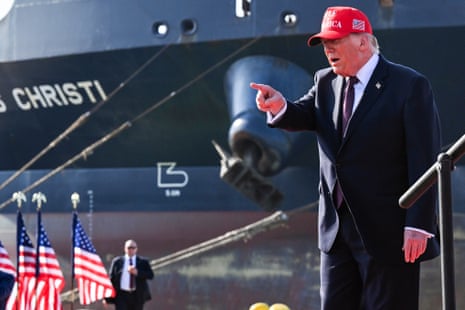
ExxonMobil and Chevron on Friday both reported windfall profits for the second quarter of the year. Chevron said its earnings soared nearly 400% to $12bn, while Exxon’s profits more than doubled to $14.5bn. On Monday evening, Trump took aim at those gains, saying the companies “ought to give some of that back to the public”.
“They’re making too much money based on a shortage,” he told reporters at the White House. “I don’t like it.”
Not long ago, however, Trump was celebrating the fact that the war on Iran, which he launched with Israel in February, has pushed up gas prices. “When oil prices go up, we make a lot of money,” he said on social media in March.
Earlier that month, Trump claimed that Iran’s shutdown of the major shipping route the strait of Hormuz “doesn’t really affect” the US the way it does “other countries” because it is the top global crude producer, and because just a small portion of the country’s oil imports comes from the Persian Gulf. But oil prices are influenced by global markets and supply chains, experts have noted.
Trump has also relentlessly boosted oil and gas interests while in office. In 2024, he reportedly met with more than 20 oil bosses, seeking $1bn in campaign donations from their industry and promising if elected to remove dozens of environmental regulations.
While he did not manage to get to that $1bn figure, he did obtain record contributions from the sector. Since re-entering the White House last year he has eased dozens of restrictions and regulations on fossil fuel expansion, exempted fossil fuel producers from environmental rules, and signed an executive order last year directing the attorney general to prioritize blocking climate lawsuits targeting oil majors.
“We shouldn’t be surprised that the same companies that struck a $1bn quid pro quo to help elect Trump in exchange for delivering on their policy wishlist are now cashing in on his anti-consumer agenda,” said Lena Moffitt, executive director of climate advocacy group Evergreen Action.
Trump has also personally invested in major oil companies. According to his 2025 financial disclosure, he increased his personal energy portfolio last year, placing between $3m and $12m in ExxonMobil stock and between $1.25m and $6m in Chevron stock, Politico first reported, indicating he may be benefiting from the two companies’ windfall profits.
As oil companies have reaped billions from the Iran war’s impact on fossil fuel prices, the Rhode Island senator Sheldon Whitehouse and California congressman Ro Khanna have proposed taxing big oil’s windfall profits from the Iran war-fueled crisis, saying proceeds from that tax should go to American families who are paying more for fuel.
Reached for comment, a White House spokesperson, Taylor Rogers, said: “President Trump’s energy dominance agenda is successfully unleashing reliable, affordable, and secure energy sources.
“The President’s main priority has been and always will be lowering gas prices for Americans,” Rogers added. “Allowing the oil and gas industry to ‘DRILL, BABY, DRILL’ is imperative to driving down prices.”
American families have paid more than $78bn more at the pump since the start of the Iran war, according to a Brown University tracker. And a recent analysis from the environmental advocacy group Climate Power and liberal thinktank Center for American Progress Action Fund found that Trump’s policies have cost the average American family $285 more at the pump.
In addition to supporting a windfall profits tax, Trump should work to limit fossil fuel exports “as they contribute to higher prices for Americans and fatter profits for industry”, said Slocum. Khanna in April introduced legislation aimed at banning the export of gasoline during price spikes.
But Trump officials say they have no intention of considering restrictions on fossil fuel exports.
“While the President and his entire energy team have taken several actions to mitigate temporary disruptions to the energy market, the Administration has been quite clear: there is no plan to implement restrictions on oil and gas exports,” said Rogers.
Earlier this week, dozens of US advocacy groups led by environmental organization Food and Water Watch called on congressional leaders to ban on fossil fuel exports and impose a windfall profits tax on oil majors.
“There are concrete ways to fight back against the fossil fuel industry and their insatiable profiteering,” the letter says.
At this dangerous time
We hope you appreciated this article. Before you close this tab, we want to ask if you could support the Guardian at this dangerous time for journalism in the US. Until August 9th, you can get 50% off our most impactful monthly support options.
According to a leading global watchdog, American democracy is now more imperiled than at any point since the 1960s, marked by a precipitous decline in press freedom – driven by mounting pressure from the Trump administration in the form of threats, criminal investigations, politicized regulation, frivolous lawsuits and, for public media, catastrophic funding cuts.
Meanwhile, organizations that are supposed to be independent like the FBI and the FCC, our radio and television regulator, have also been targeting press freedom under Trump-aligned leadership, with the FBI raiding a reporter’s home and the FCC threatening ABC’s TV licenses after Jimmy Kimmel made a joke about Melania Trump.
The response from some ultra-wealthy and corporate media owners, keen to appease the president, has been chilling: CBS News has been taken over by a Trump ally; CNN may be taken over by the same billionaire; Jeff Bezos has continued to impose cuts and editorial interventions at the Washington Post; and multiple outlets have settled multimillion-dollar lawsuits from the administration to protect their business interests.
Democracy is best served by a robust, thriving free press. But when that freedom is under attack, it falls to a determined few news organizations to ensure the full truth still reaches the public. Owned neither by a billionaire nor a corporation, the Guardian remains dedicated to covering this administration with uncompromising moral and factual clarity – and to keeping trustworthy journalism paywall-free for the world.
Despite the risks of maintaining our fierce independence, what sustains us – and fills us with deep gratitude – is the unwavering support we’ve seen from readers. It is no exaggeration to say that we are here because of you: a majority of our funding comes directly from people like you responding to messages like this. Your support not only powers our work, but more importantly, it safeguards the financial independence that underpins our editorial freedom and courage.
We know our requests for support are not as welcome as our reporting, but without them, it’s simple: our reporting wouldn’t exist. Of course, we understand that some readers are not in a position to support us, and if that is you, we value your readership no less.
But if you are able, please support us today. All gifts are gratefully received, but until August 9th, we are offering a 50% discount for six months off our most impactful monthly support options. (Among the great benefits you get in return: you’ll see far fewer annoying fundraising messages like this.) It takes just 37 seconds to set up. Thank you for considering.














No comments:
Post a Comment