July 23 (UPI) -- A man allegedly armed
with a knife was fatally shot by police in the middle of a Madison
intersection, authorities said, sparking protests and igniting public
anger.
The incident occurred early Wednesday afternoon in Madison's Marquette neighborhood.
He said officers had been called to Marquette at about noon over reports of a man inspecting parked cars.
On arrival, officers attempted to contact the man, who allegedly fled
the scene on a bicycle, Patterson said. Officers encountered him again
at about 1:30 p.m. at the intersection of Baldwin and Williamson
streets, where the man either fell or was removed from the bicycle by
police.
Ask UPI
"That's still being determined," Patterson said.
What Patterson described as a "physical struggle" ensued, during
which the man allegedly pulled a knife, injuring one of four officers
who were attempting to conduct an arrest.
One officer deployed a Taser to no effect, he said. The injured
officer then fired his service weapon, striking the man, according to
Patterson, who said the man was transported to an area hospital "where
he tragically passed away from his injuries."
Video of the incident shot by a bystander and posted online shows
three officers attempting to restrain the man as he is on his knees in
the middle of the intersection. A fourth officer runs to the scene, and
yells "Taser" three times before seemingly deploying the less-lethal
weapon. The man momentarily stands before the three officers pull him to
the ground. As the man is on his side on the ground, one officer shoots
him at close range. Three gunshots are heard.
Patterson said police are aware of the video.
"I ask the community to recognize that there is other video that they
have not seen, that's not circulating online, that will be reviewed as
part of this investigation," he said. "So to the extent that we can as
we all navigate this trauma together we try to remain calm and remember
that not all perspectives are online right now."
He said none of the officers were equipped with body cameras. A
second officer was also injured during the incident, but Patterson said
it was unclear how. The severity of either police officer's injuries was
not immediately clear.
The four officers involved have been placed on administrative leave,
he said, while describing the male officer who fired on the man as a
"veteran" of the force.
He said the man's family had been notified of his death.
The Wisconsin Department of Justice Division of Criminal
Investigation will be investigating, Madison Mayor Satya Rhodes-Conway
said in a statement, while stating she is "angered and saddened" by the shooting.
"There is real pain in our city right now. It's an absolute tragedy
when a member of our community is killed by anyone, but especially by
the police," she said.
"I understand the anger, grief and fear people are feeling -- because
I am feeling that, too. As a city, as a community, we need to do
better."
She added that the fatal shooting with be "rigorously investigated."
State Rep. Francesca Hong, a Democrat who is running for governor,
said the police officer had "shot and killed a Black man" blocks from
her campaign office and near where a Madison police officer killed Tony Robinson, an unarmed Black 19-year-old, in March 2015.
"This was an execution, and it never should have happened," she said in a statement.
"Madison police must immediately preserve and release all
body-camera, dash-camera and surveillance footage. Officials must answer
the public about what officers knew, why they were unable to
de-escalate the situation safely and why an officer used deadly force
against a man who was surrounded and appeared to be restrained."
"Yet another Black family has lost a son to police violence. How many
more must suffer before we stop it? His life mattered. He deserves
justice."
Protesters gathered Wednesday evening on Williamson Street and at Capitol Square.
The Wisconsin Chamber Orchestra, which was to perform at Capitol Square, canceled its Wednesday night performance.
Jerry Rodriguez appeared to be a
deeply aggrieved man—the victim of a scheme orchestrated by his
girlfriend’s domineering ex-partner to “murder” not one, but two, of his
“unborn children.” In a lawsuit
filed in Galveston, Texas, last summer on behalf of “all current and
future fathers… in the United States,” Rodriguez was portrayed as a
devoted boyfriend who accompanied his girlfriend to ultrasound
appointments and, eventually, pleaded with her not to go through with
abortions that her ex was trying to force her to have.
Weirdly, the villain in this anguished narrative story wasn’t the
girlfriend’s estranged husband, but a California-based provider named
Dr. Rémy Coeytaux whom Rodriquez accused of “wrongful death” for
allegedly supplying the abortion pills used to terminate her
pregnancies.
Demanding justice on Rodriguez’s behalf was anti-abortion legal mastermind Jonathan F. Mitchell,
who was seeking an injunction to stop Coeytaux—and all other medical
providers—from sending pills to Texas, where abortion is banned. This
winter, Mitchell amended the lawsuit to incorporate a new Texas law, House Bill 7, that allows private “bounty hunters” to sue abortion-pill providers for at least $100,000 per violation.
The suit was part of a larger legal strategy
by Mitchell, a former Texas solicitor general who has helped craft some
of the most radical and punitive anti-abortion laws in the country,
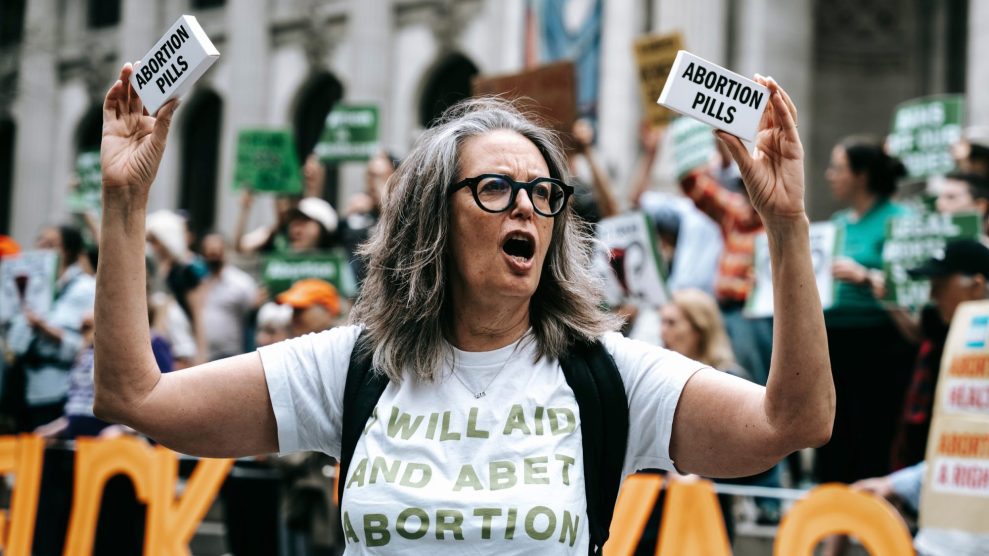
including Senate Bill 8, a six-week ban enacted in 2021, and HB 7 itself. Four years after the end of Roe v. Wade, abortion pills have become so widely available that the number of abortions across the US has actually risen, with medication now accounting for 63 percent of the total. Mitchell is trying to use the courts to resurrect the Comstock Act,
a Victorian-era anti-obscenity, anti-abortion law that has been dormant
for decades. If Comstock is revived, it would outlaw the mailing of
abortion pills nationwide, amounting to a federal ban.
Sympathetic-sounding plaintiffs like Rodriguez are an essential part
of Mitchell’s strategy. But a few months after the case was filed,
Rodriguez’s story has fallen apart, highlighting just how ineffective
Mitchell and his allies have been—so far—in using such lawsuits to push
their sweeping anti-abortion agenda.
According to an investigation by the San Francisco Chronicle,
at the same time that Mitchell was promoting his client as a symbol of
aggrieved fathers-to-be, the Galveston man was evading a felony arrest
warrant for allegedly beating up the girlfriend whose abortions he
claimed to mourn. In October 2024—a few months before filing his
lawsuit—Rodriguez had a violent altercation with his girlfriend at a
motel. He allegedly grabbed the woman’s neck as if he was trying to
“crush” it, the article detailed, to the point where she “believed she
was going to die.” She told police the attack was the eighth time in
five months that Rodriguez assaulted her. He then proceeded to slam her
to the floor, climb on top of her, and punch and slap her until she
finally broke free and escaped, the Chronicle said.
It wasn’t Rodriguez’s only alleged incident of domestic abuse.
According to police records, he pleaded guilty to assaulting a woman he
lived with in 2006 and to harassment for threatening to kill a different
woman in 2009, spending a total of two days in jail.
“The decision to have
an abortion is a personal, intimate choice. Who would have the gall to
file a lawsuit over someone’s decision like that and splash it all over
the papers, except for someone who intends to further abuse?”
Now attorneys for Coeytaux have asked a judge to dismiss the lawsuit,
in part due to Rodriguez’s abusive history. As it turns out, HB 7 specifically excludes
anyone who has committed a “family violence” offense from suing under
the state law, making Rodriguez ineligible to be a plaintiff. In a 43-page motion
filed last Thursday evening, lawyers at the Center for Reproductive
Rights offer a list of other arguments for why they thinks the suit
should be thrown out—including the fact that all the allegations
Rodriguez raised against Coeytaux occurred more than a year before
HB 7 took effect. The law is not retroactive. The attorneys also argue
HB 7 has “serious constitutional defects” that violate both the Texas
and US Constitutions.
Mitchell did not respond to requests for comment from Mother Jones.
Marc Hearron, a senior counsel at CRR who is representing Coeytaux in
the case, draws parallels between Rodriguez’s alleged violence and his
lawsuit. “The decision to have an abortion is a personal, intimate
choice,” Hearron says. “Who would have the gall to file a lawsuit over
someone’s decision like that and splash it all over the papers, except
for someone who intends to further abuse? This is not something an
average person would ever do.”
Other legal experts were perplexed at the suit’s apparent conflicts
with a law—HB 7—that Mitchell helped write. “The retroactivity part
seems quite obvious,” says David Cohen, a law professor at Drexel
University and expert in abortion rights.
Perhaps the most striking aspect of the Rodriguez lawsuit is that it’s part of a pattern. In 2023, for example, a Mitchell client named Marcus Silva sued
two friends of his ex-wife for wrongful death and $1 million in damages
for allegedly helping her obtain medication to end her pregnancy. Then
Silva was revealed to have a history of what a Texas Supreme Court
justice called “disgracefully vicious”
harassment and emotionally abusive behavior—including threatening to
drag his wife to court if she did not have sex with him. The friends countersued,
alleging that Silva knew about the abortion and, hypocritically, didn’t
do anything to stop it. Silva eventually dropped the case.
Mitchell is coming up against similar issues in yet another wrongful death lawsuit,
this one against international abortion provider Aid Access and its
founder, Rebecca Gomperts. Last summer, a Corpus Christi woman named
Liana Davis accused her ex-boyfriend, Christopher Cooprider, of spiking
her cocoa with abortion drugs from Aid Access. Davis says she became
pregnant in early 2025 but Cooprider “wanted the baby dead.” In text
messages included in court documents, Cooprider insisted that the two
were not an item and that it would be “messed up” for them to bring a
child into the world. Cooprider, a Marine pilot in training, is now countersuing Davis for $100 million, alleging she framed him and lied about multiple pregnancies and miscarriages.
“These cases range from messy to downright wild,” says Mary Ziegler,
an abortion historian and law professor at the University of California,
Davis. “It’s kind of a PR disaster.” The underlying issue, she says, is
that Mitchell’s main goal isn’t to win justice for individuals claiming
to have been harmed by abortion pills. It’s to use the courts to try to
stop the flow of pills nationwide.
To find plaintiffs who can bring such cases, Mitchell—along with the
state’s largest anti-abortion activist group, Texas Right to Life—have been working with religious ministries, crisis pregnancy centers, men’s rights groups
and so-called “abortion recovery groups.” But these organizations tend
to attract publicity seekers, grudge-bearers, and ideologues—“basically,
people who have enough of an axe to grind to overcome the usual reasons
that others might hesitate before opening themselves to this kind of
exposure,” Ziegler says. And so the plaintiffs “end up being
controlling, abusive, or dysfunctional themselves.”
The underlying issue,
Ziegler says, is that Mitchell’s main goal isn’t to win justice for
individuals claiming to have been harmed by abortion pills. It’s to use
the courts to try to stop the flow of pills nationwide.
Another weakness of the cases, says University of Texas law professor
Rachel Rebouché, is that they seek to place the bulk of the blame for
abortions on out-of-state pill providers, rather than on the actions of
individuals who may have manipulated a woman into getting an abortion.
“It’s pretty novel to go after a third party—the pill
providers—rather than the person who allegedly coerced you or your
partner into ending the pregnancy,” Rebouché says. “There’s a causation
issue here, and it’s not clear to me that it’s going to be an easy
argument to make to a judge.”
What’s more, the remedy Mitchell is seeking for his wrongful death
lawsuits—asking courts to stop abortion-pill providers around the
country from sending any more pills through the mail—is wildly
overbroad, Rebouché says. “It’s like filing a physician negligence claim
where you ask the court to never allow any doctor to be negligent ever
again,” she says. “It makes no sense.”
Rebouché sees these wrongful death cases as experiments, akin to
other efforts by anti-abortion lawyers and lawmakers around the country
to find ways to stop the flow of abortion pills. “Mitchell is known for
testing out a lot of different strategies and theories,” she says. “He’s
not afraid to try something new and see what works.”
In Ziegler view, Mitchell’s goal may not necessarily be for his clients to win.
Rather, his main objective seems to be to elevate the Comstock issue,
in hopes of using the courts to force a nationwide abortion ban that the
Trump administration—so far at least—has not been willing to put in place.
Mitchell has strategically filed his recent wrongful death cases in
federal court, where some ultraconservative Trump appointees—notably US
District Judge Matthew Kacsmaryk in Amarillo—have shown themselves willing to issue sweeping national rulings. The Galveston federal judge
hearing the Rodriguez case is also a Trump appointee. Mitchell’s
ultimate goal is to get a case to the US Supreme Court, where the
conservative supermajority might well agree that Comstock is the law of
the land.
“Mitchell may not actually care about what the public thinks about
his plaintiffs,” Ziegler says. “And no hole in the case may be too
gaping with the right audience of like-minded judges.”
Cohen, however, is doubtful the strategy will work. “Mitchell has
been wildly unsuccessful in various attempts to get [courts] to pay
attention to the Comstock Act,” he says. “There’s no reason to believe
yet another misguided attempt of his will succeed this time.”
Not to be outdone, Texas Attorney
General Ken Paxton—an anti-abortion ideologue who is running for the US
Senate—has filed a handful of lawsuits also taking aim at out-of-state
abortion providers, including Aid Access and Coeytaux. “Radicals sending abortion-inducing drugs into our state will be held accountable for ending innocent life,” Paxton said in a statement this January. “My office will defend the lives of the unborn and relentlessly enforce our state’s pro-life laws.”
While Mitchell’s cases lean more heavily on wrongful death and the
Comstock Act as avenues to cut off abortion pills, Paxton is targeting
shield laws—statutes that make it possible for abortion providers and
helpers in blue states to safely care for patients living in places
where abortion is illegal. Telehealth care under shield laws now accounts for 27 percent of abortions nationwide, according to the Society of Family Planning’s most recent data.
However, Paxton’s suits face their own problems. For instance, his office’s cases against Aid Access and another provider, Her Safe Harbor, run by a nurse practitioner in Delaware, are based on either the organization’s advertisements or news media reports,
rather than relying on any tangible proof of patients in Texas actually
receiving or using pills. These groups are a “notorious part of a
growing network of out-of-state abortion traffickers that deliberately
target Texas residents,” the state claims.
“The Texas attorney general’s case against Her Safe Harbor doesn’t
seem to be based on any real investigation or actual evidence,” says
Autumn Katz, interim director of US litigation at the Center for
Reproductive Rights. She pointed to another Paxton case filed last year
against Texas midwife Maria Rojas, which also involved what turned she
called a “shoddy investigation.” “This seems to be a pattern,” Katz says.
“Each case is weak factually for different reasons. But all face the same problem—shield laws that protect the provider.”
Paxton’s first attack on an out-of-state provider ended with a strong rebuke: In October, a New York judge dismissed
Texas’ effort to enforce a $100,000 civil fine against Dr. Margaret
Carpenter, a telemedicine doctor whom Paxton accused of prescribing
abortion pills to a Dallas-area woman. Carpenter’s medical services fall
“squarely within the definition of ‘legally protected health
activity’” under New York’s shield law,
the judge found. The Carpenter case was yet another example of a
disgruntled man seeking revenge on a woman’s reproductive choices: The
patient was turned in by her ex, who found her abortion pill bottles at
her home.
“Each case is weak factually for different reasons,” Cohen says. “But
all face the same problem—shield laws that protect the provider.” And
given that none of the cases involves a woman injured by the pills
seeking compensation for that injury, he adds, “the shield law will hold
up and prevent any judgment from being enforced in another state.”
The Paxton cases are similar to others in Louisiana, where Attorney General Liz Murill has sought to extradite
both Carpenter and Coeytaux for sending pills to patients in the state.
To Brittany Fonteno, president of the National Abortion Federation,
these cases all highlight the hypocrisy of abortion opponents who claim
that telehealth and mail-order pills enable “reproductive
coercion”—which they define as disgruntled ex-boyfriends and other bad
actors forcing women to get abortions they don’t want. Anti-abortion
groups have even created legal resources, like the Justice Foundation’s Center Against Forced Abortions, to reinforce and promote this larger, national narrative.
But ample research
shows that women aren’t being coerced in large numbers to have
abortions; far more often they are forced to continue pregnancies they
don’t want. Meanwhile, survivors of domestic abuse and sexual assault
frequently report that abortion pills are the very thing that makes it
possible to escape their controlling and abusive partners.
“Access to abortion, including medication abortion, is critical to
the safety and autonomy [of such patients],” Fonteno says. She cites
patients like Alissa, a 21-year-old from Texas who was assaulted by her
partner. “My husband raped me when I asked for a divorce and impregnated
me in an attempt to get me to stay,” she told NAF. Abortion pills, she
said, were her only option, since he also controls her finances.
“This type of freedom—particularly for women and marginalized
communities—is empowering,” Fonteno says. But to anti-abortion
extremists, she adds, it’s “terrifying.”