Silicon Valley Dreams of Authoritarianism
https://slate.com/culture/2026/08/tech-silicon-valley-elon-musk-peter-thiel-trump-politics-fascism-gil-duran.html
Silicon Valley Dreams of Authoritarianism
Gil Durán’s new book, The Nerd Reich, catalogs how tech oligarchs like Peter Thiel took over America.
Sign up for the Slatest to get the most insightful analysis, criticism, and advice out there, delivered to your inbox daily.
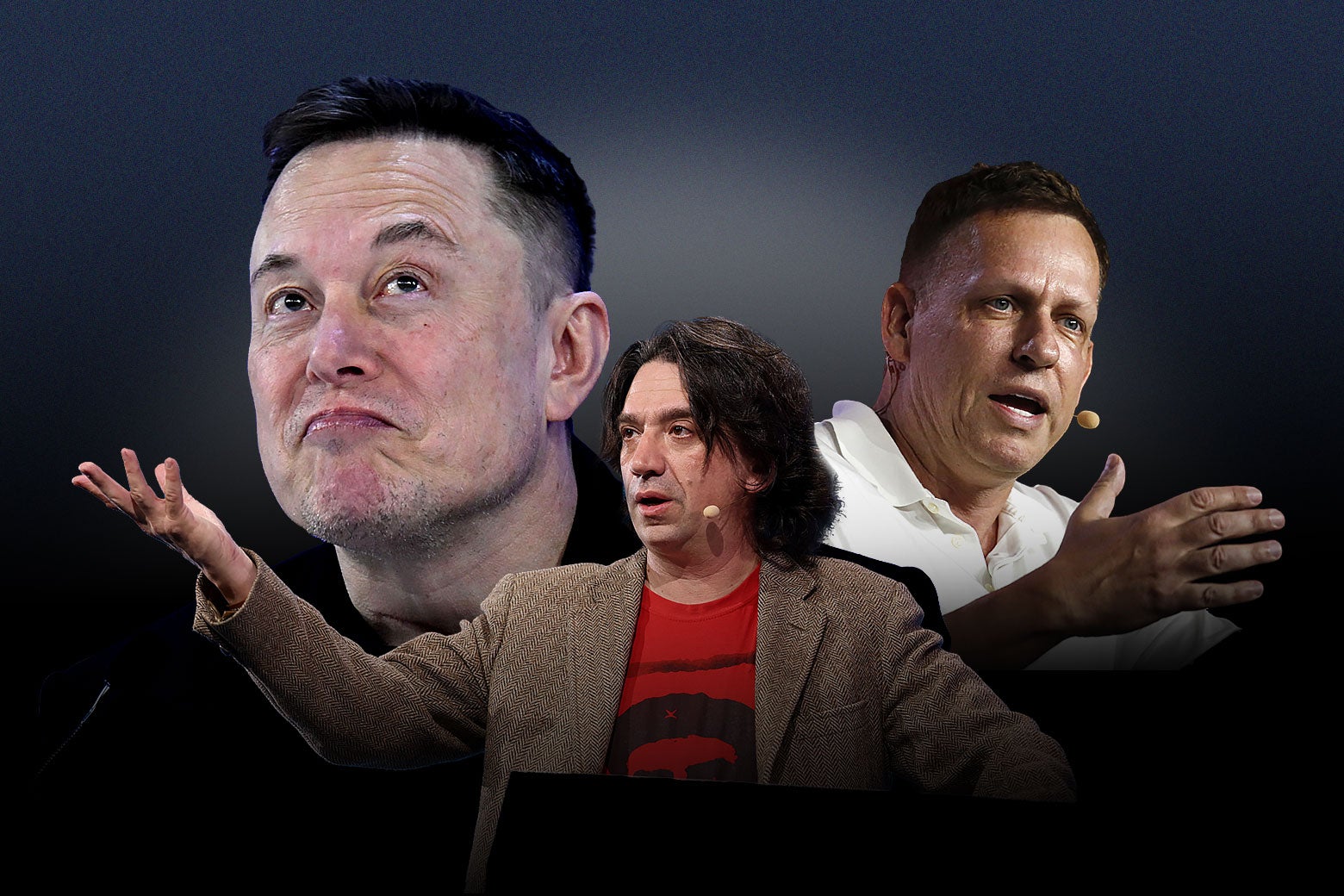
You could not ask for a more complete and hair-raising compendium of the insane things that Silicon Valley moguls have said and advocated for than journalist Gil Durán’s new book, The Nerd Reich. The book, based on a fiery newsletter Durán publishes about technology and the San Francisco Bay Area, identifies such billionaires as venture capitalist Marc Andreessen and Peter Thiel as the spiders at the center of a web of “philosophers,” tech evangelists, start-up founders, and—most disturbingly—politicians who subscribe to a set of authoritarian ideas and plans for the future based on half-baked theories and an incomplete understanding of how the world works.
There’s not a lot of original reporting in The Nerd Reich, but Durán assembles relevant info from scores of journalists and scholars, as well as providing a valuable dive into the fringy sources for some of the Valley’s most menacing ideas. Thiel, the supervillain in this story, was profoundly shaped by a 1997 book by James Dale Davidson and Lord William Rees-Mogg, The Sovereign Individual. One of the countless titles published every year predicting some form of imminent social or economic collapse and offering advice on how to survive it, The Sovereign Individual struck Thiel as prescient, a prophecy of the coming invention of both cryptocurrency and A.I., the subsequent downfall of nation-states, and the rise of individuals as complete masters of their own fates—or, at least, those individuals smart, and therefore rich, enough to command such power.
Through a network of protégés and via his own vast wealth and the influence of his venture capital firm, Thiel has spread these and a hodgepodge of other often incoherent ideas throughout both industry and government. “The most important thing to understand about J.D. Vance,” Durán writes of the vice president, “is that he is almost entirely a creation of Peter Thiel.” In this light, some of the more baffling obsessions of the current administration—such as its desire to acquire Greenland—become more intelligible as manifestations of Silicon Valley ambitions and lobbying. A key element of what Durán refers to as TESCREALism—after an acronym coined by computer scientist Timnit Gebru and philosopher Émile P. Torres—is a plan to set up “network cities,” independent and regulation-free polities in which the supermen of Big Tech will be allowed to do whatever they like. Several such projects are currently in the works in locations ranging from Honduras to Sonoma County, though they have mostly encountered the strenuous opposition of the locals. Many advocates of network cities have their eye on Greenland, with its rich lodes of minerals and rare earth materials, as a potential site.
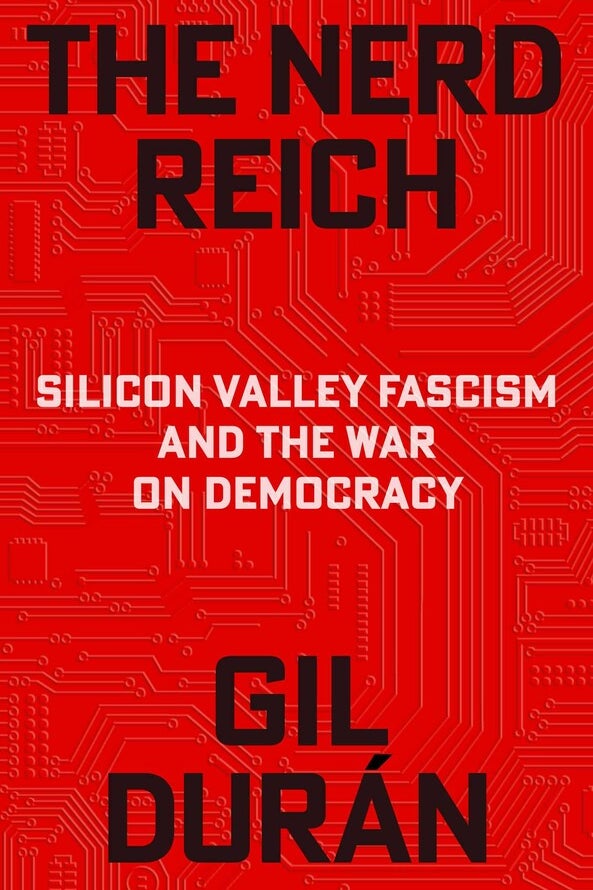
The Nerd Reich: Silicon Valley Fascism and the War on Democracy
By Gil Durán. Avid Reader Press/Simon & Schuster.
Slate receives a commission when you purchase items using the links on this page. Thank you for your support.
TESCREAL, Durán writes, stands for a conglomeration of “seven overlapping ideological movements: transhumanism, extropianism, singularitarianism, cosmism, rationalism, effective altruism, and longtermism.” Transhumanists believe that emerging technologies will transform people into “post-human robots” with superior physical and cognitive abilities. Extropians believe that technology will improve the human condition until we attain immortality. Singularitarians believe that the moment when humanity merges with machines, “the singularity,” will arrive at any moment. Cosmists want to revive the project of settling in outer space. Rationalism “attracts tech workers who believe human reasoning can be systematically debugged and improved through logic, rigorous thinking, and purported cognitive hacks.” Effective altruism, which emerged from rationalism, advocates using “evidence and reason to pursue an impartial analysis of how to pursue the greatest good for humanity.” And longtermism, a subset of effective altruism, insists that present decisionmaking should prioritize the welfare of future, unborn generations over those currently alive. “Of all the TESCREAL ideologies,” Durán writes, “longtermism is perhaps the most important because it provides tech elites with a moral justification for just about any action.”
By Durán’s account, most of these elites already seem to believe that any action of theirs can be justified by their superior intelligence. Balaji Srinivasan, an entrepreneur and investor who is a major proponent of the network state concept, made a speech at a conference in 2023 in which he described a San Francisco divided into tribes: blue and red, according to our current monikers for Democrats and Republicans, but also “grays,” tech workers who must team up with the reds to crush the blues and take over such cities as San Francisco, creating tech-controlled gray “zones” where blues would be banned.
As dystopian as this scenario sounds, Srinivasan genuinely seems to view it as appealing, reflecting similar if not identical extremism in the Trump administration. Much of the TESCREAL ideological complex comes across as the overheated product of too much time spent with machines and online, a fertile breeding ground for such bizarre spinoffs as the Zizians, a former rationalist splinter group allegedly involved in the deaths of six people. California, after all, is notorious for such kookiness. But the massive wealth of the tech overlords who often subscribe to versions of these beliefs gives them a frightening influence over politics, as Durán warns in his recounting of their efforts to sway elections in both San Francisco and, in 2024, the entire U.S. Curtis Yarvin, an alt-right thinker whose beliefs are prominent in Silicon Valley, advocates a measure he calls RAGE—“retire all government employees”—which was manifested as DOGE in 2025.
The Valley’s increasing involvement in politics is especially disturbing given the popularity in tech circles of Yarvin, who calls for eliminating the democratic process and installing a monarchical CEO as the head of the United States. Yarvin comes across as a possibly mentally ill eccentric, yet he nevertheless has the ear of such tech barons as Thiel, who has already stated that he no longer believes “that freedom and democracy are compatible.” Thiel, who also claims to be a Christian and has taken to making speeches about the advent of the Antichrist, subscribes to a set of beliefs so muddled and risible that even in a 2025 interview with the essentially sympathetic conservative commentator Ross Douthat, Thiel stumbled over his response to the question of whether he thought the human race should survive.
As Durán points out, this mishmash of ideas tends to collapse under scrutiny. (He quotes an astrophysicist dismissing Elon Musk’s cosmist fantasy of a Mars settlement by remarking “There’s no air—and the dirt is made of poison. You would just die.”) These ideologies are embraced as items more of faith than of their adherents’ much-touted reason. “TESCREAL,” Durán writes, “remakes religion for the age of A.I. It requires faith in an all-powerful being (superintelligence) that will engineer immortality (eternal life) and enable a perfect abundance in the stars (heaven), providing a promise of transcendence that contradicts known science.” It also exalts a priestly caste of the so-called cognitive elite, whose superiority entitles them to exploit everyone else. Yarvin once proposed that citizens deemed by this ruling class to be “not productive” could be converted into biofuel to power public transportation. Later, he would claim that he was joking about what he considered the very real problem of coming up with “a humane alternative to genocide.”
How does someone get this stupid? Surely the media, specifically the business and tech media, deserves plenty of blame for valorizing Silicon Valley entrepreneurs over several decades, exalting them as epochal geniuses. Sequestered in an enclave—complete with its own deeply complicit university—the tech sector held a flattering mirror up to itself, compounding its own myopia. The American propensity for worshipping the rich and equating their wealth with both intelligence and virtue supplied plenty of reinforcement for their hubris. And rich people, as any normal person who has dealings with them can attest, are frequently out of touch with the realities beyond the comfy buffer of their money. As a result, we get idiocies like Musk’s notorious 2018 tweet in which he proposed creating a “urban loop system [that] would have 1000’s of small stations the size of a single parking space that take you very close to your destination & blend seamlessly into the fabric of a city, rather than a small number of big stations like a subway.” To which many replied that bus stops already exist.
Durán gives perhaps too much credence to the viability of Silicon Valley’s most authoritarian dreams. He points to recall elections in San Francisco as ominous examples of the Valley flexing its financial power without acknowledging that the targeted politicians (particularly some school board members) were already very unpopular with voters as a result of their actual policies. And while Musk’s millions undoubtedly helped get Trump reelected in 2024, he utterly failed to buy his desired result in a Wisconsin state Supreme Court election the following year. It helps to offer voters a genuinely decent alternative. Nevertheless, The Nerd Reich is still a much-needed aid in a very necessary task: tearing down the golden calf Americans have built in Palo Alto before it devours us all.
