During
Monday’s remarks on the House floor, Rep. Marcy Kaptur (D-OH) spoke
about cuts to federal food programs.
Fuel your success with Forbes. Gain unlimited access to premium
journalism, including breaking news, groundbreaking in-depth reported
stories, daily digests and more. Plus, members get a front-row seat at
members-only events with leading thinkers and doers, access to premium
video that can help you get ahead, an ad-light experience, early access
to select products including NFT drops and more:
https://account.forbes.com/membership...
Stay Connected
Forbes on Facebook: http://fb.com/forbes
Forbes Video on Twitter: / forbes
Forbes Video on Instagram: / forbes
More From Forbes: http://forbes.com
Transcript
Follow along using the transcript.
0:01
without objection the gentleoman is
0:03
recognized for one minute
0:16
mr speaker yesterday I stood with food
0:19
pantry leaders from across northwest
0:21
Ohio at the Seagate Food Bank we share
0:24
deep concerns about rising unemployment
0:26
rising food prices and federal cuts to
0:29
food programs by the Trump
0:31
administration this is creating greater
0:33
hardship across the region I represent
0:36
the burden of tariffs and irresponsible
0:38
federal food cuts are negatively
0:40
affecting food banks they are a lifeline
0:43
to our families this coming Saturday May
0:46
10th the National Association of Postal
0:48
Workers Branch 100 in Northwest Ohio and
0:51
Postal Workers Nationwide will be
0:53
holding their annual Stamp Out Hunger
0:56
food drive they will head out on their
0:58
routes this Saturday morning i'm urging
1:01
all Americans please find an empty paper
1:04
bag put in it protein peanut butter
1:09
canned tuna canned chicken canned beef
1:13
green beans canned fruit since launching
1:16
their program in 1993 this has become
1:19
the largest food drive in America and
1:21
believe me senior
citizens need this our
1:23
families with children need it our
1:25
unemployed workers our disabled people
1:27
really need this i encourage all who
1:29
want to help put the food out this
1:31
Saturday morning after 10:00 may God
1:34
bless America and Americans who care
1:38
thank you Mr speaker i yield back
‘A Lifeline To Our Families’: Marcy Kaptur Slams Trump Admin’s ‘Irresponsible’ Federal Food Cuts
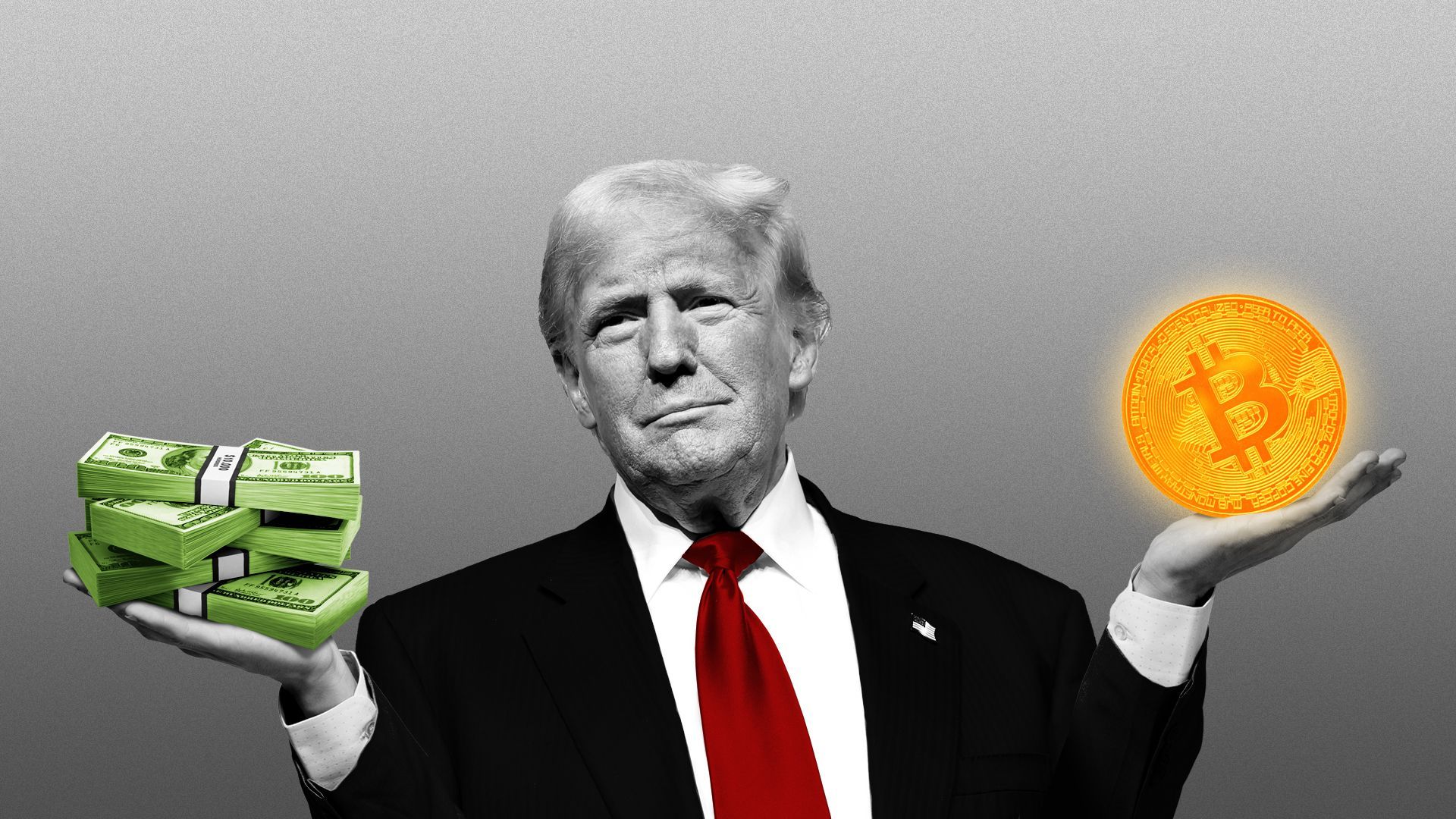
Why it matters: Democrats see the potential forgob-smacking corruption in Trump's lucrative crypto projects, which they consider to be the clearest conflicts of interest in a sea of new business ventures launched by the president and his inner circle.
The
Trump family's crypto dealings could now jeopardize legislation that
the crypto industry has aggressively lobbied for as a way to gain
legitimacy and legal clarity in the U.S.
What's happening: Senate
Democrats unveiled a sweeping new proposal Tuesday to ban presidents,
lawmakers and their families from issuing, endorsing or sponsoring
crypto assets, Axios' Stephen Neukam scooped.
The new bill comes days after Senate Democrats suddenly voiced opposition to the GENIUS Act — landmark bipartisan legislation that would create the first-ever regulatory framework for stablecoins.
Sen. Chris Murphy (D-Conn.) and Rep. Sam Liccardo (D-Calif.) introduced bills
targeting Trump's multibillion-dollar meme coin, which Murphy called
"the single most corrupt act ever committed by a president."
Over in the House, Rep. Maxine Waters (D-Calif.) led a Democratic walkout
of a joint hearing on crypto regulation, plunging the session into
chaos in hopes of drawing new attention to Trump's alleged "corruption."
Between the lines: Democrats
have long accused Trump and his family of profiting from the
presidency. But on two particularly brazen crypto projects, Trumpworld
may have flown too close to the sun.
The official website for Trump's meme coin invited its top 220 investors
to an "intimate private dinner" with the president later this month,
with a "VIP White House Tour" offered to the top 25 holders. References
to the White House were later scrubbed from the website.
World Liberty Financial, the Trump family's crypto venture, announced that an Emirati state-backed venture fund would use World Liberty's new stablecoin to complete a $2 billion investment in crypto exchange Binance.
What they're saying: Trump has denied profiting from the presidency, telling NBC's "Meet the Press" that he started his crypto venture "long before the election."
"I haven't even looked," Trump claimed.
"Stablecoin
legislation should be passed on a bipartisan basis. President Trump is
dedicated to making America the crypto capital of the world and
revolutionizing our digital financial technology. His assets are in a
trust managed by his children, and there are no conflicts of interest,"
White House spokeswoman Anna Kelly told Axios.
Zoom out: Democrats
erupted over news of the foreign deal, demanding an investigation by
the Office of Government Ethics and warning of a "quid pro quo that
could endanger national security."
At a closed-door meeting
last week, Senate Democratic Leader Chuck Schumer (D-N.Y.) told his
caucus to withhold support for the GENIUS Act so Democrats could force
changes to the legislation.
Sen. Elizabeth Warren (D-Mass.)
argued the stablecoin bill "will make it easier for the president and
his family to line their own pockets," warning: "This is corruption and
no senator should support it."
The bottom line:
The crypto world was thrilled to see Trump take up the mantle of
advocate-in-chief, especially after years of perceived hostility from
the Biden administration.
But t
he Trump family's aggressive business tactics may end up costing the industry the very legitimacy it's been chasing.
Transcript: Trump’s Tariff Tirade Reveals How Badly He’s Screwing MAGA
As
a confluence of Trump policies is set to clobber rural America, a
veteran Democratic organizer talks about whether his party has a new
opening to win over rural voters.
Saul Loeb/AFP via Getty Images
The following is a lightly edited transcript of the May 7 episode of the Daily Blast podcast. Listen to it here.
Greg Sargent: This is The Daily Blast from The New Republic, produced and presented by the DSR network. I’m your host, Greg Sargent.
Thanks
to President Trump’s policies, a confluence of events is about to
unfold that will absolutely clobber rural America. First, there’s
Trump’s trade war. On Tuesday, Trump unleashed a bizarre rambling rant that indicated he’s absolutely fine with letting it drag on forever, our exporters be damned. Meanwhile, there are new indications that farmers in Trump country are already getting hammered by these tariffs. On top of that, the House GOP’s planned cuts to Medicaid are very likely to be a massive problem
for rural hospitals. And big GOP cuts to food stamps will also inflict
pain on rural areas. So is there an opening here for Democrats to win
back some ground in these places? Today we’re talking about all this
with Matt Hildreth, executive director of RuralOrganizing.org and a veteran Democratic operative in rural areas. Matt, great to have you on.
Matt Hildreth: Thank you for having me on the show. I’m a big fan.
Sargent: Thanks,
Matt. Let’s start with what Trump said on Tuesday. He was talking about
how he hasn’t yet made any deals with other countries to dial down
tariffs. Listen to this.
Donald Trump (audio voiceover): Just to finish, we also have a situation because everyone says, When? When? When are you going to sign deals?
We don’t have to sign deals. We can sign 25 deals right now, Howard, if
we want it. We don’t have to sign deals. They have to sign deals with
us. They want a piece of our market. We don’t want a piece of their
market. We don’t care about their market. They want a piece of our market. We’re going to sit down and we’re going to put very fair numbers down and we’re going to say, Here’s what this country [wants], what we want, and, Congratulations, we have a deal. And they’ll either say, Great, and they’ll start shopping, or they’ll say, Not good. We’re not going to do it. And I’ll say, That’s OK. You don’t have to shop.
Sargent: Matt, the quote that jumps out at me is, “We don’t care about their market.” Here he’s clearly saying, We may never make deals that will dial down the trade war. What do you think farmers who rely on exporting food to international markets are going to make of that?
Hildreth: Yeah,
I think that that’s a really good point. When you talk to folks in
small towns and rural communities, they’re paying attention to markets.
That’s something that you learn when you’re a farmer and you study
things like ag economics: It’s all about understanding the markets. And I
think sometimes there’s a lot of stereotypes about farmers—that they’re
just dumb hayseeds, simple people that sit on tractors all
day. Farming is pretty sophisticated. Whether you’re a farm worker
working out for the growers in the fields or you’re sitting in a
combine, there’s a ton of science and there’s a ton of economics. It’s
all economics.
And
I actually think Donald Trump probably really doesn’t care about the
markets. He’s more focused on his favorability. He’s more focused on his
vengeance. But farmers absolutely care about their
markets. It takes years to establish relationships in international
markets for farmers, especially when it comes to farmers in the Midwest
with corn and especially soybeans. Farmers have been dedicating tons and
tons of time and resources to establishing those relationships. And
many farmers are seeing those evaporate overnight.
Sargent: Well, The New York Times has a new piece
confirming this, reporting that farmers in Iowa are already getting
hammered economically and the local economies are slowing down. The Times reports
on Monona County where Trump got 72 percent of the vote, quotes a
farmer there saying the trade war is going to hit hard. A lot of this is
due to China’s tariffs and retaliation against Trump’s tariffs. Matt,
you spent a lot of time in rural America. Let’s talk about how important
Chinese markets in particular are for farmers in the places that you
organize.
Hildreth: Yeah, absolutely. In fact, RuralOrganizing.org started in Northwest Iowa in Steve King’s congressional district, so
agriculture is something that we hear about all the time—and especially
when it comes to soybeans. That’s something that I think people might
not recognize if you’re not from a farm family: Soybeans are an
absolutely critical component of many Iowa farms and have a big impact
on rural economies. And so when you lose that foreign Chinese market
with your soybeans, that’s a huge hit. I’ve heard things like one in
three rows of soybeans is going to China. So when you think about all
those rows of soybeans when you drive across Interstate 90
or Interstate 80, it’s just a huge export out to China. The farmers in
Iowa, Minnesota, Illinois, the Dakotas are going to be hit especially
hard.
Sargent: So
Matt, to what degree do you think these farmers are going to blame
Trump’s policies, his trade war with China for their inability to sell
to those markets? Are they going to say to themselves, Well, the president has asked me as a patriot to swallow all the pain and it’s going to really make things better later in some vague sense for the whole country?
Or do they just not really get snowed by that? You’re telling me that
the farmers you organize among are pretty shrewd people a lot of the
time. You’d think they’d see through the folly of the trade war if
that’s the case. Do they?
Hildreth: Yeah, I
think there’s three components to the answer to your question. One is
that one thing we see overwhelmingly in our work is that when good
things happen in rural America, many rural voters just assume it was
Republicans. We saw that going back to the stimulus checks that the
Biden administration sent out. People loved those checks. They loved the
child tax credits. They love things like that, and they assume it’s
just Republicans doing it because Democrats are not present in the
communities. And so much of the way the Biden Build Back
Better projects were administered were through local and state
Republicans. So when good things happen, people assume it’s Republicans.
And when bad things happen, their bias just makes them assume it’s
Democrats. Because Republicans control the House and the Senate and the
White House and the Supreme Court, and because Donald Trump has set
himself up as the authority, it’s really hard for them to
blame Democrats right now—especially because he’s gone so far out on a
limb on trade. So that’s the first piece.
The other
two, I think, are a little bit harder. One is farmers are very stubborn
in their position on Trump. I think that’s something that we all know.
For many of us that have worked in small towns and rural communities,
farmers have supported Trump for a very long time. And a lot of them
just did not believe what was in Project 2025. There was so much that
we’re seeing now that was outlined in Project 2025. And when we would talk about it, people would say, Yeah, that’s just politics. Trump’s not going to actually do it. So there is that stubbornness.
The
last piece of this, though—the third piece that I think is really
important—is most rural Americans are not farmers. And when you look at
where the trade wars are hitting, it’s far beyond the corn and soybean
fields. I was just in Home Depot yesterday getting some wood for our
chicken coop. A man in a Punisher T-shirt with an American flag walked
up and he was standing next to me, and he just goes, Fuck, screws are so expensive right now. So
there are so many places where the tariffs are going up and people are
seeing prices increase. And some of that might be directly related to
tariffs like the situation with the screws, but things are going up for
many different reasons right now. And I think Trump has actually
positioned himself to be blamed across the board. People are going to
make a lot of excuses for him for the next couple of weeks, but if things continue, I think there’s going to be a real softening that we haven’t seen in a while.
Sargent: A recent Marist poll found
that Trump’s support in rural America has pretty much collapsed. It’s
now at parity, 46 to 45, which is really surprising given that Trump
carried rural America overwhelmingly in 2024. I’ve got to ask Matt, how
seriously should we take that though? Is it a superficial expression of,
Oh, the screws are expensive, which you overheard
from a rural voter just the other day, something that won’t actually
sink its claws into rural America in any real way? Or is there an actual
chance that this will alienate a fraction of these voters enough so
that they can get peeled away? How real is it that that disapproval of
Trump is actually pretty high in rural areas?
Hildreth: I’m
feeling that the disapproval is as high as I’ve ever seen it. In my
day-to-day life, I live in a small town, I live outside of small town.
I’m feeling it. My family back in South Dakota is feeling it. Something
is happening. So I think that the movement that we’re seeing in the
polls, and that poll specifically, is real. I’ve dug into some of the
numbers to really try and understand where that movement is happening.
It really seems like it has to do with the people who are tuning in to
the networks.
We’re
not moving voters when it comes to Fox News. We’re not moving voters
when it comes to right-wing media. But for the people who are still
getting their news from the nightly news, that seems to be where the
support is softening the most. And it is setting up an opportunity for
Democrats to step into that space. But the numbers reflect what I’m
seeing in my day-to-day life. And I think there’s some big
questions, though, about what we do with it. Can we sustain it? Is this
just a bad week versus is this a real shift in the momentum?
Sargent: Well,
I want to ask you about the information environment, which you just
brought up. It’s overwhelmingly clear. You spend any time in rural
America, you can immediately see that there’s this immense information
vacuum—that a lot of people in rural America are hearing just one side
of the story, just the Republican message, just the Trump message. They
never hear mainstream media. They never hear what Democrats have to
say. But it sounds like there’s at least some percentage of rural
Americans that you think are getting their news from networks and from
more neutral sources. Can you talk a bit about that?
Hildreth: Yeah,
absolutely. So in rural America, the local news is always the most
trusted news. When we do surveys on “Who do you really trust for your
news?” it’s the local papers, it’s the local radio; if
there’s TV, it’s the local TV. And when you look at the numbers, Donald
Trump won over 90 percent of news deserts across the country. These are
communities that don’t have a local source of news on local issues. So
they don’t have a local newspaper. They don’t have a local news source
through their radios or on television. And that’s where Donald Trump is
really succeeding.
When
the conversation is about national issues and about national politics,
it’s very easy for that Fox News talking point to carry the day. But
when you have to compare what you’re hearing on Fox News or right-wing
media to what you’re seeing in your local news, it really changes the
dynamic quite a bit. So that’s why I think in these places where we do
still have some really strong local newspapers—places like Iowa; Iowa
has amazing small-town papers—that’s where I think you’re seeing some of
this support softening up.
And then also amongst the
viewers, the people at home that get their news from PBS—PBS is still a
huge source of news in small towns and rural communities—or the evening
news, that’s where I think we are seeing people move. It’s not huge.
It’s like 3 to 5 percentage points right now, but I still think that’s a
significant amount of people. And that’s where we really need to focus:
the people that are getting their news from places other than Fox News.
Yes, most people are getting their news in rural
America from Fox News, but it’s not everybody. There’s quite a bit of
those independent voters that are getting it from other sources.
Sargent: And
the margins are what matter here. I feel like a perennial thing we hear
from Democrats is that they’re always about to regain some ground in
rural areas thanks to GOP budget cuts decimating rural hospitals, but it
just doesn’t seem to happen. Now we have another test of this. The GOP
budget is expected to cut Medicaid by hundreds of billions of dollars. Rural hospital officials recently toldThe Washington Post
that these cuts are going to really erode health care availability in
these places. Is there any prospect for that to matter this time around?
Hildreth: Yeah,
I think so. And you mentioned the margins. One of the things that we
say all the time—it started as a joke, and it’s become kind of an
organizational slogan—is “lose less.” So in a lot of places, we’re not
actually looking to win even at the city or at the county
level. But if we can just move the margins by 3 or 4 percentage points
in rural communities across the state, that can have a major impact on
statewide elections. So there’s places in Wisconsin where I think we are
seeing Democrats at the state level doing a lot better because they are
cutting margins in rural areas. We’re seeing that in Georgia. We’re
seeing that in North Carolina.
I think oftentimes it’s not translating to the top of the ticket. And a lot of that has to do with how the
presidential campaigns are run; [they] run on national issues, not on
local issues. But I think there are very specific examples in places,
especially North Carolina, where you have rural hospitals closing and
you have people getting pretty pissed off about it. Now, do they know
how to translate their local hospital closure to policies that the
Republicans support, specifically not expanding Medicaid? Maybe not. And
that’s where we really run into problems in the local news deserts
where there’s no source of local information. But for the
places where Democrats can get in and can connect the dots between their
hospital closing and the policy supported by the governor, I think we
are seeing movement.
Sargent: Well, there’s one
other area for Dems to exploit as well: cuts to food stamps. That’s
something that can also hit rural areas pretty hard. You’ve actually got
some vulnerable House Republicans from rural districts like Derrick Van
Orden in Wisconsin and Don Bacon in Nebraska making noise about
opposing these cuts. But House Democrats just put forward this
discharge petition—which could theoretically pass without the GOP
leadership supporting it—that would protect Medicaid and food stamps
from GOP cuts. You’d only need a few Republicans to support that for it
to pass—but let’s face it, that won’t happen. No Republicans will get
onto it. Is there any way for Democrats to use that to inflict political pain on Republicans among rural voters?
Hildreth: Yeah, absolutely. And we’re in the middle of launching a new campaign that
we’re calling the “Campaign for Rural Prosperity.” It’s all about
protecting and strengthening rural services like Social Security,
[which] is a huge source of income in rural America. Medicaid is an
absolutely critical piece of the equation. And then SNAP, or food
stamps, is the other piece of it.
Food stamps or
SNAP, those impact rural communities on two fronts. One, rural Americans
are more likely to use those benefits just because the poverty levels
are higher in a lot of small towns and rural communities. But also,
those benefits are going to farmers. So it’s not just about benefits to
people who are hungry; it’s also about creating higher demand for
farmers. And that’s why you see it impacting in places like Wisconsin
and Iowa and a number of these congressional districts. We don’t need to
flip a ton of congressional districts to have a massive impact on our
politics right now. And when it comes to Medicaid, there’s between six
and 10 Republicans at any moment that are really feeling
that pressure. Piling on with SNAP and piling on with the Elon Musk
conversation about cutting Social Security, I think that’s all really
good for Democrats right now.
Sargent: I’m
really glad you mentioned Musk because it really feels to me like we’re
seeing this confluence of things all gunning straight for rural America
metaphorically in a way that I’m not sure we’ve seen in a long time.
There’s the trade war; there’s the Medicaid cuts; and then
there’s DOGE. Elon Musk is a big looming presence behind all this. I
can’t imagine he plays very well in rural America. Is there a confluence
here in some kind of new way, or are we just going to get disappointed
again?
Hildreth: Well,
the question about whether or not we’re going to get disappointed again
is, I think, a very real question. That’s the thing that keeps me up at
night, and that’s the whole focus of our organization. But
there is ... It is a special moment right now. And something that those
of us from small towns and rural communities that are engaged in
politics and policy know well is that the federal government is actually
absolutely critical for small towns and rural communities. Everybody
thinks [about] Ronald Reagan’s [saying], “The worst thing you can say is
I’m from the government and I’m here to help.” They think that’s
something that just resonates with people in rural America—and it does from a bumper sticker point of view. But the fact is that rural Americans are very connected to the federal government through employment.
All
of the national park rangers, they are federal employees. The people
working at extension offices telling people how to grow their tomatoes,
they get federal funding. The connection between rural America and the
federal government is strong; it’s been strong since FDR. And Elon
Musk has gone through the United States Department of Agriculture, or
USDA, with a chainsaw and cut critical programs for rural development,
critical programs from the Farm Service Administration. I think he was
cutting things that he didn’t even understand. He was unplugging parts
of the Agriculture Department that he didn’t even know what they did.
Those were felt immediately in small towns and rural communities. And
it’s creating a new appreciation for the services that are coming from
the federal government.
And so much of the federal government services
in rural communities have a local brand. So you might not know the USDA
at the national level, but you know the local guy who you go to when
your tomatoes aren’t growing. And once those people start telling you, Hey, these cuts are having an impact, I might get fired, that’s really, I think, waking people up in small towns and rural communities.
Sargent: But Matt, are these voters going to connect this stuff to Donald Trump and the Republican Party—the national Republican Party? That’s the big question.
Hildreth: Right.
The question is: Are they going to connect it to the Republican Party?
And are Democrats going to be able to take advantage of it if they do? I
think a lot of that is still out for debate, but right now, it doesn’t
really matter what Fox News is telling you when you go to the hardware
store and screws have gone up 100 percent. Something is off. And across
the battleground states, Donald Trump had signs that said, “Donald
Trump means lower prices, Kamala Harris means higher prices.” And
people know that’s not happening right now. That’s a pretty simple and
pretty effective message, and it’s actually backfiring on him right now
because things are going up so dramatically.
And when
people said that they were willing to put up with a little pain for a
long-term game, they were overwhelmingly talking about a couple of
percentage points in the increase in their food or in the increase in
their groceries for a couple of weeks. They were not talking about what
we’re hearing in this quote that you played at the top
about indefinite tariffs, 145 percent. So I do think people are going to
connect it to Donald Trump, but I do think that Democrats need to step
into the space. We’re seeing a lot of that momentum already, and I think
it’s not about winning every single rural voter. It’s about cutting the
margins by 4 to 7 percent.
Sargent: Well,
we should probably have another pod soon to talk about whether
Democrats are actually stepping into that space, which is a very big
topic. Matt Hildreth, thanks so much for coming on, man.
Hildreth: Yeah, thanks for having me.
Sargent: You’ve been listening to The Daily Blast with me, your host, Greg Sargent. The Daily Blast is a New Republic podcast and is produced by Riley Fessler and the DSR Network.