Tuesday, February 3, 2026

Amnesty demands Israel drop death penalty bills ‘entrenching apartheid’

 https://www.aljazeera.com/news/2026/2/3/amnesty-demands-israel-drop-death-penalty-bills-entrenching-apartheid


Amnesty demands Israel drop death penalty bills ‘entrenching apartheid’

Amnesty International says legislation would mean ‘punishment is being reserved for, and weaponised against, Palestinians’.

FILE PHOTO: Israeli National Security Minister Itamar Ben-Gvir gives a statement to members of the press in Jerusalem, January 16, 2025. REUTERS/Oren Ben Hakoon ISRAEL OUT. NO COMMERCIAL OR EDITORIAL SALES IN ISRAEL/File Photo
Israeli National Security Minister Itamar Ben-Gvir has been pushing for the expansion of Israel's death penalty laws [File: Oren Ben Hakoon/Reuters]

Amnesty International has called on Israel to abandon legislation that would expand the use of the death penalty, warning that the measures would violate international law and “further entrench Israel’s apartheid system” against Palestinians.

In a statement on Tuesday, the human rights group said two bills under discussion in the Knesset would mark a major reversal of Israel’s longstanding opposition to capital punishment and would disproportionately target Palestinians.

Recommended Stories

list of 4 itemsend of list

The proposals, championed by government figures, including far-right National Security Minister Itamar Ben-Gvir, would make the death penalty “another discriminatory tool in Israel’s system of apartheid”, Amnesty International said.

“These amendments mean that the most extreme and irrevocable punishment is being reserved for, and weaponised against, Palestinians,” it said.

“If adopted, these bills would distance Israel from the vast majority of states which have rejected the death penalty in law or in practice, while further entrenching its cruel system of apartheid against all Palestinians whose rights Israel controls.”

Israeli authorities have defended the measures, which are moving to committee stages for debate, as a necessary deterrent against deadly attacks.

But legal experts said their scope and application would violate international legal norms and result in the unjust treatment of Palestinians.

The legislation is being considered during Israel’s genocidal war against Palestinians in the Gaza Strip and a surge in Israeli military and settler violence against Palestinians in the occupied West Bank.

‘Reviving’ capital punishment

Israel abolished the death penalty for “ordinary crimes”, including murder, in 1954 and has not carried out an execution since 1962.

While it retains the death penalty for exceptional offences, such as genocide and treason, Amnesty International said the proposed legislation would “revive its implementation in Israel and the occupied Palestinian Territory” while weakening safeguards designed to prevent miscarriages of justice.

Get instant alerts and updates based on your interests. Be the first to know when big stories happen.

The bills include one that would allow for the application of the death penalty by amending the Israeli Penal Law and the Defence Regulations that Israel applies to the West Bank, the group said.

A second would introduce special provisions and an ad hoc military court to prosecute those accused of involvement in the Hamas-led attacks on southern Israel on October 7, 2023.

The rights group said proposed amendments to military laws applicable in the West Bank that would allow the death penalty would in effect apply only to Palestinians because they would explicitly exclude residents of Israeli settlements, which are illegal under international law.

Other changes, such as an amendment applying to those accused of intentionally causing “the death of a person with the purpose of harming an Israeli citizen or resident” or relating to violations connected with the October 7 attacks, were also likely to only impact Palestinians, it said.

Trump escalates feud with Ilhan Omar, appears to suggest she is linked to ISIS


Trump escalates feud with Ilhan Omar, appears to suggest she is linked to ISIS

The president has previously called for Omar, the first Somali American elected to Congress, to be deported.

Rep. Ilhan Omar speaks during a press conference.

President Donald Trump has repeatedly accused Minnesota Rep. Ilhan Omar of profiting off of a widespread fraud investigation in her home state without providing any evidence. | Francis Chung/POLITICO

By Cheyanne M. Daniels


President Donald Trump on Tuesday escalated his ongoing feud with progressive Rep. Ilhan Omar, appearing to suggest baselessly the Minnesota Democrat is aligned with ISIS leaders in her birth country of Somalia.

In a post to Truth Social, Trump linked to a news report about U.S. forces striking ISIS-Somalia leaders in Somalian caves. He captioned the post, “Was Ilhan Omar there to protect her corrupt ‘homeland?’”

Omar, 43, is a Somalian-born Muslim and the first Somali American elected to Congress. She and her family fled the country when she was 8 years old and, after spending four years in a Kenyan refugee camp, the family moved to America. She became a U.S. citizen in 2000.

The progressive legislator has drawn the president’s ire for years.

Trump has repeatedly accused Omar of profiting off of a widespread fraud investigation in her home state without providing any evidence; called her “garbage”; and insisted she be jailed and deported back to Somalia. He has previously mocked her hijab and recently announced the Justice Department will be investigating the congresswoman after Omar’s net worth skyrocketed.

A spokesperson for Omar previously told POLITICO she has not received anything from the DOJ about an investigation. Her office did not immediately respond to a request for comment on Tuesday, though Omar had previously said Trump is “obsessed” with her.

A White House spokesperson pointed back to the president’s social media post when asked for comment.

Tensions between Trump and Omar have only increased as the White House’s immigration crackdown has escalated in Minnesota.

Omar has repeatedly issued calls to abolish Immigration and Customs Enforcement. She has also called Trump and his administration “liars” for calling Renee Good “a domestic terrorist” after she was fatally shot by an ICE agent in Minneapolis last month.

Then, after a man charged at Omar and sprayed her with what was later identified as water and apple cider vinegar during a town hall, she accused Trump of spewing “reprehensible rhetoric” that allows “right-wing grifters” to “terrorize our community.” Trump later said Omar “probably had herself sprayed.” The man was arrested and ultimately charged with assaulting or impeding a federal employee.

The U.S. military has launched a series of strikes targeting ISIS facilities in Somalia, according to the United States Africa Command. The latest strike occurred near the Golis Mountains.


'Record number of missiles' hit Ukraine leaving thousands with no heating in -20C

 https://www.bbc.com/news/articles/cpwng25114ro

'Record number of missiles' hit Ukraine leaving thousands with no heating in -20C

Sarah RainsfordEastern and Southern Europe correspondent in Kyiv
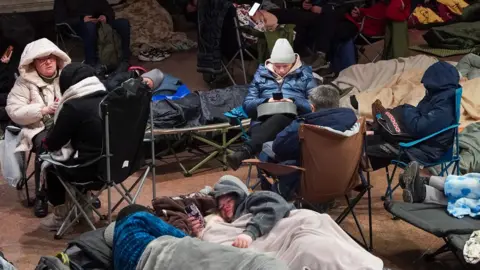
AFP via Getty Images People take shelter at a metro station during a Russian air attack, in Kyiv, on early February 3, 2026.AFP via Getty Images
Kyiv residents shelter at a train station during Russian air raids

Russia has used a record number of ballistic missiles to target Ukraine's energy sector, President Volodymyr Zelensky has said.

The combined missile and drone strikes hit power plants and infrastructure in Kyiv and multiple locations causing "the most powerful blow" so far this year, according to private energy company DTEK.

The strikes were launched as temperatures dropped to -20C (-4F) and left more than 1,000 tower blocks in the capital without heating once again and damaged a power plant in the eastern city of Kharkiv beyond repair.

Zelensky said Russia was "choosing terror and escalation" rather than diplomacy to end this war and called for "maximum pressure" on Moscow from Ukraine's allies.

The attack comes after a so-called "energy truce" agreed by Donald Trump with Vladimir Putin expired at the weekend.

Ukraine's president suggested that Russia had simply used the time to stock up on missiles and prepare for the next attack.

It also came on the day Nato Secretary-General Mark Rutte was in Kyiv to meet President Zelensky and to address the national parliament.

Donald Trump's initiative was meant to give diplomacy a chance. Negotiators from Russia and Ukraine are due to meet in Abu Dhabi for another round of talks co-ordinated by the US later this week.

It is clear that Russia has other ideas.

And in fact, there is always a gap between Russia's massive strikes which makes Ukrainians doubt there was ever any real pause at all.

We heard the first explosions in Kyiv soon after midnight and the air raid lasted more than seven hours. There were several subsequent blasts.

Residents spent the night sheltering in metro stations, with some pitching tents on the platforms to protect them from the freezing cold.

President Zelensky has said more than 70 ballistic and cruise missiles were fired - significantly more than usual - together with 450 drones which are used to overwhelm Ukraine's air defences.

Ukraine's Air Force said it had intercepted only 38 of the missiles, which means many reached their target.

Officials here have complained repeatedly of a shortage of missiles to protect the skies. Ukraine relies on US-made Patriot missiles, in particular.

"Timely delivery of missiles for air defense systems and the protection of normal life are our priority," Zelenksy wrote on X this morning. "Without pressure on Russia, there will be no end to this war."

In response, Nato's secretary-general said he was urging member countries to "dig deep in their stockpiles" and provide the missiles Ukraine needs.

"I know that more is urgently needed," he said. "We are working to ensure that more comes quickly."

Rutte also said Nato was standing by Ukraine as it made tough decisions during peace talks and that the alliance would provide the "hard power" to back up any eventual deal.

But the Nato chief agreed with Zelensky that Russia's overnight attack did not "signal seriousness about peace".

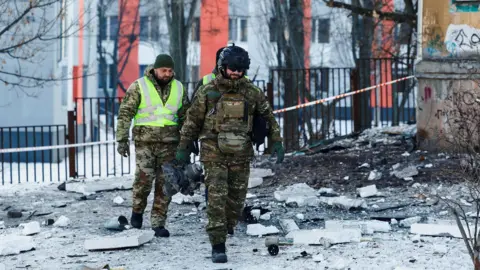
Reuters The ground is covered in snow. The police officer is wearing military clothing and there is another man behind him. the building behinf them is cordened off with tape.Reuters
Police officer carries a part of a Russian drone at the site of a residential building in Kyiv on 3 February, 2026

Volodymyr Zelensky has accused Moscow of using the coldest days of winter to "terrorise people".

DTEK has confirmed that two of its own power plants were hit again overnight, including in Odesa, in what it says was the ninth massive attack on the sector since October.

State-run facilities were hit in Kyiv, Dnipro and elsewhere, adding to serious damage caused by a series of previous targeted attacks.

DTEK says some of the plants targeted were providing heating only, not electricity, which means they were exclusively for civilian use. The Geneva Convention makes clear that targeting civilian infrastructure is a potential war crime.

Each time makes it harder to carry out repairs and leaves the system more fragile, and prone to blackouts.

Teams of engineers have been working through the night for weeks to fix things - drafted in from all over the country and hailed as heroes.

But there are not enough workers to keep up with demand.

We have met residents who have had no heating in their homes for days, in some cases weeks. They sleep in hats and coats, and under piles of blankets, but it is still bitterly cold.

Many use soup kitchens to get free hot meals because there are also power cuts here for hours on end.

People believe these attacks are intended to turn them against the authorities in Kyiv, to make their lives so miserable they submit to Russia's demands - including to hand over land in the eastern Donbas region that Moscow currently does not control.

Instead, there is a lot of anger here at Russia for attempting to freeze civilians in their homes as well as resistance to any form of compromise with Moscow.

"Russia won't get what it wants," Vera told the BBC this weekend, as she queued for a bowl of stew served by volunteers. "We are stronger than them in any case."

Volodymyr said he planned to sleep in a local school for a few days, which has a generator to keep it warm. "In the daytime you move around a bit," he said. "But at night it's really cold."

He was furious with Russia. "They are bombing civilians. They want us to freeze and die," he said.

Several residential buildings were damaged in the latest attack and set on fire by falling debris as Ukraine shot down missiles and drones. Several people were injured.