Democratic candidate for governor in California, Xavier
Becerra, speaks to supporters during his election night gathering at La
Plaza de Cultura y Artes on June 2 in Los Angeles, Calif.
Mario Tama/Getty Images
SAN FRANCISCO — Democrat Xavier Becerra
will advance to the November election for California governor,
according to a race call by The Associated Press. After days of counting
ballots, it remains unclear who will claim the second spot in the fall.
In
California's unusual primary system, all candidates, regardless of
party, appear on a single ballot open to any registered voter. The top two candidates
then move on to the general election. An estimated 3.5 million
uncounted ballots remain. The state also counts mail-in ballots that
arrive up to seven days after Election Day, as long as they are
postmarked by Election Day.
The state hasn't had a wide-open primary like this one since the
late 1990s. The winner in November will lead the country's most populous
state, facing a large deficit and other obstacles, including the
state's high cost of living, homelessness and wildfire risk. Incumbent
Gov. Gavin Newsom, a Democrat, is term limited and is widely thought to
be running for president in 2028.
Becerra, former Health and
Human Services secretary under President Joe Biden, has staged one of
the most surprising comebacks in recent state political history. As
recently as April, polls were showing Becerra — also a former member of
Congress and California attorney general — languishing in single digits
in a crowded field.
"The people of the great state of
California, in the greatest nation on earth, have spoken — loudly and
proudly," Becerra said in a written statement. "We will not be bought.
We will not be bullied. And we are never backing down. November, here we
come."
For second place, Republican businessman Steve Hilton
still has an edge over billionaire Democratic activist Tom Steyer, but
Steyer has been gaining ground as ballots continue to be counted.
Hilton
was endorsed by President Trump in April, and in later polls, he pulled
ahead of Riverside County Sheriff Chad Bianco, the other major
Republican in the race. British-born Hilton is a former Fox News
commentator who also served as a political adviser to former British
Prime Minister David Cameron. He has campaigned for change in California
after 16 years under total Democratic control.
A Hilton win would set Becerra on a glidepath to victory. Winning
statewide would be an uphill battle for any Republican in a state where
there are nearly twice as many Democrats as Republicans, and no GOP
candidate has won statewide in 20 years.
Steyer would present a
rockier road for Becerra. If the billionaire former hedge fund manager
makes the runoff, it will set up a costly intraparty fight. Steyer has
spent more than $213 million of his own money to boost his candidacy,
making the race the most expensive gubernatorial election in California.
It's
already been an election season of unexpected developments. Some of the
state's most high-profile Democrats — former Vice President Kamala
Harris, U.S. Sen. Alex Padilla and California Attorney General Rob Bonta
— all stayed out of the race from the beginning.
In April, the race was disrupted when then-U.S. Rep. Eric Swalwell's campaign for governor imploded amid allegations of sexual assault and harassment. Swalwell resigned from Congress shortly after the accusations surfaced and has denied assault allegations.
Swalwell had been gaining in polls and racking up high-profile endorsements and his exit seemed to primarily benefit Becerra.
The
narrowing field also quieted Democrats' fears of splitting their vote
to the extent that Bianco and Hilton would win the top spots in the June
primary. That would have resulted in a guaranteed Republican governor
in a state where Democrats outnumber GOP voters 2 to 1. Instead, though,
Becerra surged. He has been aided by political groups operating
independently of his campaign.
There
are many ways to interrupt the Trump administration’s brutal
deportation campaign. Just look at what’s happening around Delaney Hall
in New Jersey.
Spencer Platt/Getty Images
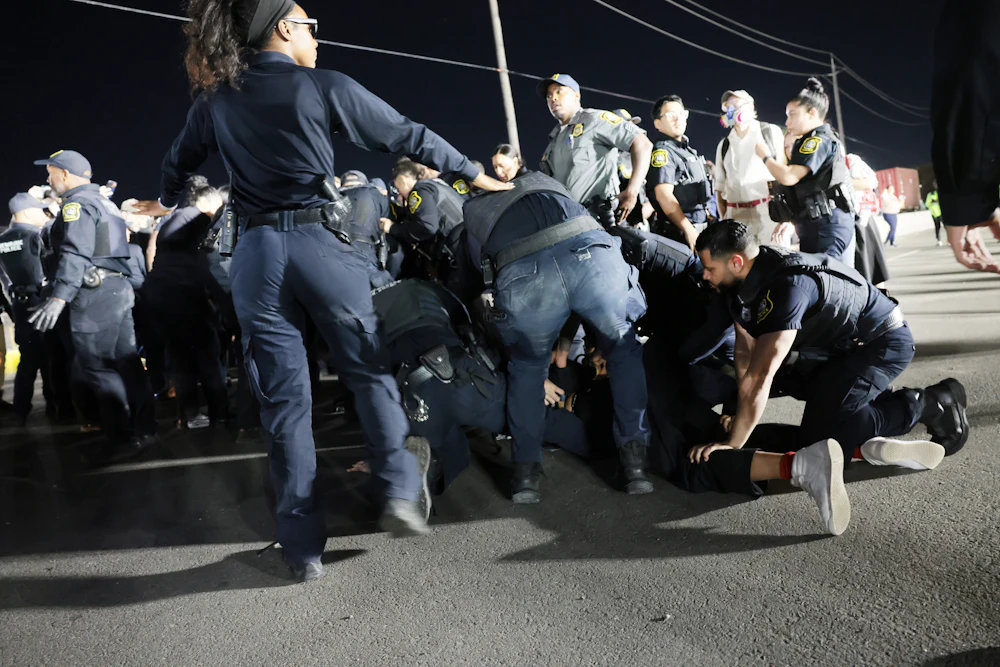
On June 3, police arrested a woman outside Delaney Hall in Newark, New Jersey.
For
more than two weeks, around 300 immigrants locked up at Delaney Hall,
an immigrant detention camp in Newark, New Jersey, have been on a hunger
and labor strike, refusing to eat and refusing to work maintaining the prison
for its operators, the GEO Group. They are not alone: Outside the
camp’s chain-link fence, in an industrial area, their family members,
loved ones, and a broader community of supporters have gathered and
remained despite violence from ICE and the New Jersey State Police. As
Gabriela Soto, whose husband was detained at Delaney Hall, told
reporters a few days into the hunger and labor strike, their demands are to “close Delaney Hall and free every person in there.”
Since
the strike began, immigrants inside have shared four letters, published
by Cosecha, an immigrants’ rights organization. “We feel vulnerable, in
a way, kidnapped or detained without justification,” the prisoners wrote in one letter. They have reported being denied medications (one woman said staff told her that pain medication was “cosmetic”), being fed spoiled food, and being forced
to endure outbreaks of illness across the facility, which has poor
ventilation and does not have adequate medical treatment or emergency
responders.
Another letter, released
on Wednesday, describes the opening days of the strike, when Delaney
Hall administrators demanded to speak to its leader. “They were upset
when we told them there was no leader and that the strike was a
collective effort,” the letter recounts. In response, the letter
continues, administrators retaliated against one person who had helped
with translation, trying “to take him away in handcuffs, which all of
us, seeing the injustice, wanted to prevent by peacefully blocking their
path with our hands raised so that they wouldn’t take him away.” Next
came “beatings, pepper spray, and from ‘ICE,’ a riot squad came up
spraying pepper spray throughout the facility, causing many people to be
rushed to the hospital.” That was on May 25. “To this day, we haven’t
heard anything about those people.” Despite the violence, the strike has
continued, as have similar strikes in GEO Group–run detention facilities in California, Michigan, and Pennsylvania.
The
conditions inside Delaney Hall, which are appalling, dangerous, and a
violation of the rights of those detained, are entirely in keeping with
how other such “detention centers” are run across the country; a recent
AP investigation found hundreds of immigrant detainees reporting medical neglect in lawsuits across 33 states. The solidarity shared by people
trapped in these camps, as evidenced by the multiple simultaneous
strikes, makes sense; it has extended outside the camps, as well, with local groups
working to shut down ICE facilities offering their support. The
resulting crackdown on both striking detainees and their supporters
tracks with all the other times Immigration and Customs Enforcement has harmed
witnesses and protesters in the course of the agency’s carrying out
Trump’s signature campaign of mass deportations. People coming together
is treated as a threat by those running the camps because it is
precisely the thing the camps are meant to break.
“The opposite of a camp is community,” journalist and
translator John Washington writes. He uses “immigration camp” to more
clearly describe the dangers posed by the “hundreds of ‘detention
centers,’ ‘processing centers,’ ‘holding facilities,’ as well as leased
local jail and prison cells in every state of America.” He argues in his
forthcoming book, How to Close a Camp: Dispatches From the Fight Against Immigrant Detention
(out in July), that the camp shapes our politics and our ways of making
community. “A camp warps and degrades reality,” he writes, “both for
those in fear of ending up in one and for those living alongside them.”
But for as long as there have been such camps, there has been resistance
to them, including by those caged within. Camps are, after all, not
abstract systems but the products of people’s decisions. “A camp is a
long series of choices that need frequent reaffirmation,” Washington
observes, and each choice is an opportunity to end, or at least slow,
the camp’s operations.
For one thing, camps need approval
from myriad city, county, and state authorities; all stages of approval
can be contested. As an example, Washington offers a site in Adelanto,
California, where immigrants began a hunger strike earlier this month. The camp’s opening required sign-off from agencies such as the state’s Environmental
Health Department, CAL FIRE, and the Native American Heritage
Commission, among many, many others. That camp also needed permits for
everything from native vegetation removal to signage to pollution
discharge. As Washington added at the end of this list, each of the
people who signed off “could have said no.”
That
work—researching, locating, and challenging each of these
decision-makers—has been undertaken over decades by groups such as
Detention Watch Network, which has identified points of intervention at each stage of immigration camp operation and expansion. Its tool kit
on how to challenge ICE’s warehouse expansion details specific permits
and ordinances required; venues in which those can be fought; and tools
available to the public, such as zoning
codes, environmental review, and litigation. As Trump’s mass
deportations campaign took off, some national progressive groups have
also taken up the fight against immigrant detention, such as Indivisible. Newer efforts have also joined, such as Project Salt Box, which uses public records to map out possible new camps and the money behind them. Detention Watch Network maintains a mapdetailing
Trump’s camp expansion plan; few states are untouched. If you want to
put a stop to immigrant detention, it is likely happening near you,
whether in a private-run facility like Delaney Hall, a purpose-built
camp like the one in the Florida Everglades, or more quietly, in a county or town jail leasing space to ICE.
Among the many tragedies of Delaney Hall is the fact that it had already been shut down once before. GEO Group ran it as an ICE detention center from 2011 to 2017. It then sat dormant until GEO Group got a billion-dollar contract (over 15 years) to reopen in 2025. Not long after the camp took its first prisoners in May 2025, Newark Mayor Ras Baraka challenged it in court, in part on the grounds that it was operating without required permits or safeguards; after one attempted inspection, the city left a court summons on the camp’s chain-link gate. In response, GEO Group accused the mayor of engaging in
“a politicized campaign by sanctuary city and open borders politicians
in New Jersey,” that was meant to “interfere with the federal
government’s efforts to arrest, detain, and deport dangerous criminal
illegal aliens in accordance with established federal law.” At the time Baraka
tried to inspect Delaney Hall, alongside three Democratic members of
Congress, an event DHS characterized as the elected officials having “stormed the gate” of the camp, when video evidence shows clearly that ICE had let Baraka inside before forcing him out. Baraka was charged with federal trespassing charges, which were ultimately dismissed.
Now, in this second round of working to close Delaney Hall, organizers are using some similar
strategies as before. People have tried to stand in the way of ICE
vehicles. Lawmakers have demanded site visits. Lawsuits have been filed,
most recently by the state attorney general against GEO Group. If that company has “nothing to hide,” New Jersey Governor Mikie Sherrill said
in a statement, “and the conditions inside Delaney Hall are as safe and
as sanitary as this private corporation and the Trump Administration
claim, then there is no legitimate reason why my health inspectors are
being kept from full access throughout the building.” She added, “I will
continue using all the power of this office to advocate for the
detainees and their families.” Mayor Baraka said
this week that he would “expand” his existing lawsuit against GEO
Group; he wants a judge to order the camp closed. But of all these
efforts, the strike and the public support it has garnered seem the most
disruptive to the operations of the facility. Last week, DHS issued a statement claiming that detainees’ reports of abuse and dangerous conditions are a “hoax,” and on X the agency denied that there even is a strike underway.
But
this is not a simple story of local officials defending their community
against violent ICE agents and the private prison camp. Governor
Sherrill—who, despite her statements to use “all the power” of her
office, has not returned to Delaney Hall—last week declared
the area a “peaceful protected protest zone.” This pushed people away
from the facility, effectively negating their efforts to block ICE
traffic, as independent journalist Talia Ben-Ora noted.
Press access was likewise restricted, and had been challenged even
before the zone was declared, with photojournalists seemingly singled
out by officers; the U.S. Press Freedom tracker recorded 30 assaults
on journalists by law enforcement in one week outside Delaney Hall. The
governor has yet to meaningfully respond to these threats to both press
and protest freedoms, which, arguably, she amplified. The governor also
put New Jersey state police in charge of policing the protests. “I will
not give ICE the pretext to expand operations in our state,” Governor
Sherrill said when announcing these plans. “The state police were just ushers for ICE,” said
one organizer at a rally in the New Jersey State House this week that
was intended to push Sherrill to do more in defense of immigrants. After
the launch of her “protest zone,” dozens of people were arrested. Press on the scene documented flash-bangs and tear gas used against protesters and themselves.
These
last two weeks of concentrated attention aside, people have been
outside Delaney Hall for months now, offering support for those inside.
They have welcomed and comforted family members who stood outside the
facility in long lines in the frigid cold and in punishing heat
for the chance to visit those inside. As people inside met repression
when protesting conditions, mutual aid groups outside have too.
Community media, such as Radio Jornalera NJ, have been reporting what’s happening nearly live in some cases, capturing in Instagram Reels people trying to make family visits, the aftermath of police violence, and moments
when people are released. Their reporters have been there throughout
the strike, witnessing, giving people outside a chance to share what
they hear about people inside. The chain-link fences remain, but they
have not severed the community gathered on both sides.
President Donald Trump speaks at an event about coal on Thursday in the Oval Office.
A version of the below article first appeared in David Corn’s newsletter, Our Land.
The newsletter comes out twice a week (most of the time) and provides
behind-the-scenes stories and articles about politics, media, and
culture. Subscribing costs just $5 a month—but you can sign up for a free 30-day trial.
There has justifiably been
much attention paid to Donald Trump’s personal corruption: cutting
sleazy crypto deals, trading stocks in companies affected by his
administration’s decisions, doling out pardons to fraudsters who make
hefty donations to his political organizations, and so much more. But
what’s even more significant is how Trump is perverting the federal
government to allow wealthy individuals and corporations engaged in
crooked conduct to escape scrutiny, prosecution, and punishment.
Corporate scumbags and felonious plutocrats have never had it so good.
The Trump
administration has taken steps to make sure that the United States is a
safe space for money launderers, drug cartels, and international
financial rogues.
At the Securities and Exchange Commission, enforcement actions have fallen precipitously,
and the commission ended several high-profile cryptocurrency inquires
that involved Binance, Coinbase, and other firms. The workforce for the
SEC’s enforcement division was cut by a fifth last
year, with many experienced attorneys and accountants given the boot.
The IRS, too, has been hammered by layoffs, and the number of audits of
people with $10 million or more in income dropped by two-thirds from
6,786 in 2025 to 2,264 in 2026. With new priorities established at the
Justice Department—such as essentially shutting down the pursuit of
cases under the Foreign Corrupt Practices Act—the number of white-collar
prosecutions has fallen to its lowest level in at least 40 years, according to the Financial Times.
But beyond this, the Trump administration
has taken steps to make sure that the United States is a safe space for
money launderers, drug cartels, and international financial rogues. Who
says so? The US Government Accountability Office. It recently released a
report assessing Trump’s decision to loosen reporting requirements for
shell companies. These are corporations that can have legitimate uses
but are also set up so people or entitites can evade taxes, launder
money, hide assets, and obscure the true beneficiaries of financial
transactions. For instance, a sanctioned Russian oligarch might be able
to use a shell company—or a string of them—to buy real estate in the
United States and keep secret his ownership of the property.
The Corporate Transparency Act, a
bipartisan bill passed in 2021, required most US firms to disclose to
the Treasury Department’s Financial Crimes Enforcement Network (FinCEN)
their “beneficial owners”—that is, the real people who control or own
them. (In many instances, shell companies do not have to reveal their
true owners and are registered in the name of others.) The aim of the
legislation was to create a registry of owners and impede illegal
financial activities, such as money laundering. An estimated 32 million businesses would
have to register and note their real owners. (Several categories of
business were exempted because disclosure requirements already applied
to them—such as banks, credit unions, and securities dealers.)
But one month into Trump’s second term,
his administration essentially eviscerated this reporting requirement,
when FinCEN issued rules exempting domestic companies and Americans from
this disclosure. As the GAO put it, this new exemption applied “to over
99 percent of entities that were previously targeted.”
The GAO report—in exceedingly dry language—notes this exemption is a boon for assorted malfeasants:
U.S.-based shell companies, often
structured as LLCs or corporations, can pose significant risks of
illicit finance activity. Treasury’s 2026 National Money Laundering Risk
Assessment identified several cases in which shell companies were used
to facilitate financial crimes, including laundering the proceeds of
drug trafficking, cybercrime, and fraud, among others, indicating the
continued risk posed by shell companies. The 2025 domestic reporting
company exemption may perpetuate these risks.
Sen. Elizabeth Warren of Massachusetts,
the senior Democrat on the Senate Banking, Housing, and Urban Affairs
Committee, quickly jumped on the GAO report and cited it as evidence
Trump is on the side of the bad guys:
The Trump Administration continues to put
cartels and criminals ahead of law enforcement, opening the door for
them to move millions of dollars through our financial system. Today’s
GAO report confirms that Treasury gutted a bipartisan law designed to
crack down on the abuse of shell companies, exempted 99 percent of the
entities previously required to report, and has failed to address the
“significant risks” this rollback created. Law enforcement groups have
warned that it will be harder to go after drug traffickers, sanctions
evaders, and major criminal enterprises.
Warren noted that one of the main forces
behind passage of the Corporate Transparency Act was a former senator
named Marco Rubio. In 2020, he tweeted,
“My ‘Corporate Transparency Act’ [is] the most significant
anti-corruption and money-laundering legislation in decades [and] forces
anonymous shell companies to disclose their true owners.”
“There is growing
evidence that [Chinese money laundering networks] are taking advantage
of shell companies to help cartels move billions through the U.S.
financial system.”
Republican and Democratic senators have
opposed the Trump administration’s wipeout of the Corporate Transparency
Act, as have law enforcement organizations, business groups, and
national security–minded think tanks of the right and left. The hawkish
and neocon-ish Foundation for Defense of Democracies issued a statement last
year that said, “Anonymous U.S. shell companies are not a theoretical
vulnerability—they are a proven vehicle for illicit finance, sanctions
evasion, corruption, terrorism, and transnational crime…FinCEN’s
decision to exempt domestic entities would allow these practices to
continue unchecked.”
Last year, Warren, Sen. Chris Van Hollen (D-Md.), and other Democratic senators wrote the Treasury to complain about the weakening of this requirement, noting,
“There is growing evidence that [Chinese money laundering networks] are
taking advantage of shell companies to help cartels move billions
through the U.S. financial system.”
The Trump administration claims this
disclosure obligation was too onerous for businesses, but it entailed
minimal effort for the corporations compelled to register. So why kill
this requirement? Warren and other legislators suspect Elon Musk had
something to do with this. In a separate letter sent
to Treasury Secretary Scott Bessent in April 2025, she and 18 other
congressional Democrats asserted the Trump administration’s decision to
neuter the Corporate Transparency Act was “seemingly triggered by a
single Elon Musk social media comment.”
They pointed out that Musk, who at that
time was a key adviser to Trump and engaged in a reckless dismantling of
various government agencies, might have been “benefiting from foreign
investments made through legal entities designed to hide the identities
of the foreign investors.” They cited the Financial Times:
“Wealthy Chinese investors are quietly funneling tens of millions of
dollars into private companies controlled by Elon Musk” through “opaque
structures” and “an arrangement that shields their identities from
public view.”
During the 2020
presidential race, Trump’s campaign, according to the Campaign Legal
Center, deployed an LLC to launder “$170 million in spending to conceal
payments to people close to the Trump family and campaign.”
Responding to the recent GAO report,
Warren asserted that this disclosure requirement would be beneficial for
efforts to combat transnational crime, drug trafficking (including
fentanyl smuggling), sex trafficking, the evasion of sanctions imposed
on Iran, the theft of US technology by China and others, and fraud that
targets US government programs. (The criminals that stole federal funds
in Minnesota relied on shell companies.)
This may well be a personal issue for
Trump. His Trump Organization is a collection of hundreds of shell
companies. (Such entities are commonly used for real estate
transactions.) And during the 2020 presidential race, Trump’s campaign, according to the Campaign Legal Center, deployed an LLC to launder “$170 million in spending to conceal payments to people close to the Trump family and campaign.”
Corporate reporting rules may seem like a
wonkish topic. It certainly is not as visceral as Trump selling pardons
or pocketing billions in crypto grift. But it may be more important, for
Trump’s decision to protect the secrecy of shell companies—perhaps at
the urging of Musk—has more far-ranging consequences than his own
sticky-fingers corruption. It’s another way Trump is making America
great for plutocrats, oligarchs, fraudsters, and scoundrels.