They Stood Their Ground in Florida. They’re Charged With Murder. Guess Their Race.
https://slate.com/news-and-politics/2026/08/stand-your-ground-florida-murder-racism-kkk-history.html
They Stood Their Ground in Florida. They’re Charged With Murder. Guess Their Race.
Sign up for Executive Dysfunction, a newsletter that highlights one under-the-radar story each week about how Trump is changing the law—or how the law is pushing back. You’ll also receive updates on the latest from Slate’s Jurisprudence team.
On June 26, 2025, longtime friends Jamarian Byrd and Travis Roberts Jr. were standing outside 504 Quail Lane in Macclenny, Florida. Around 7:45 p.m., two white teens approached them carrying firearms. One of them, 19-year-old Devin “D.J.” Powers, pointed his single-shot shotgun at 22-year-old Byrd and 24-year-old Roberts. A shot rang out and—fearing for their lives—Byrd and Roberts fired back. Twenty-six seconds later, according to a neighbor’s home-surveillance video, Powers lay bleeding on his own porch steps, shot once through the neck. He died three days later. His 14-year-old companion survived a shot to his leg.
Byrd and Roberts did not know their attackers. Earlier that day, however, witnesses testified that Powers had argued with a mutual acquaintance of Byrd and Roberts named Bud. The two tussled over a gun that Powers allegedly pointed at Bud, at which point Bud grabbed the firearm and slapped him. Family members shared that Powers returned home, grabbed another weapon, and was eager to settle the score. Although they tried to persuade him to remain indoors, he and the younger teen left the house two times, armed and ready for a fight.
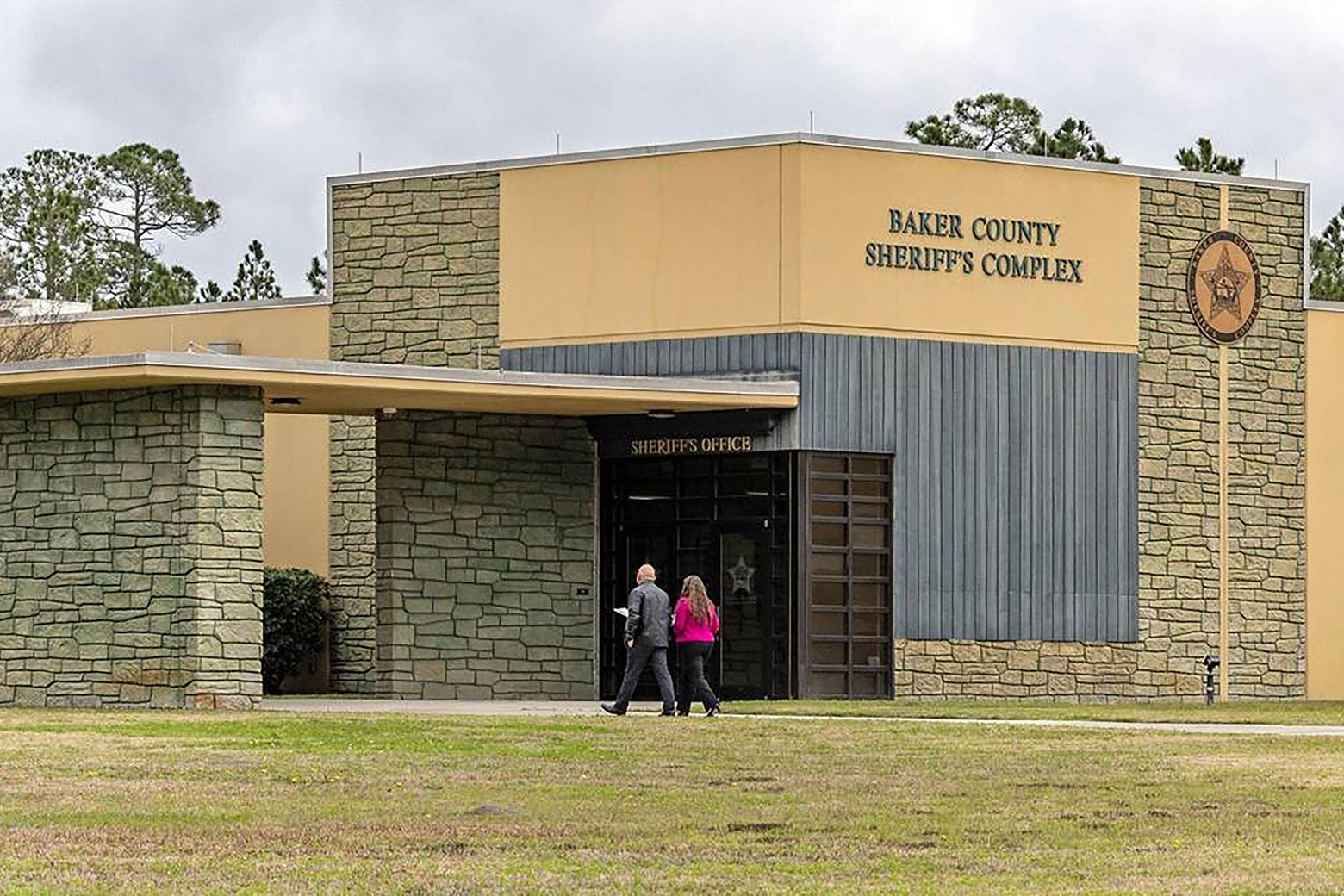
It was on this second outing that the teens encountered Byrd and Roberts. According to Baker County Sheriff Scotty Rhoden, Byrd and Roberts acted lawfully: “At that point their lives are in fear, that is self-defense.” Eleven days later, though, both men were charged with first-degree murder and additional charges authorities tied to the incident. They have been imprisoned at the Baker County Detention Center and denied bail ever since.
Byrd and Roberts have consistently asserted their innocence under Florida’s “Stand Your Ground” law, which allows the use of force if the person “reasonably believes that using or threatening to use such force is necessary to prevent imminent death or great bodily harm to himself or herself or another.” On its face, the law is designed to protect people who defend themselves against a threat. Yet on June 17, 2026, Judge Denise Ferrero denied them immunity.
According to Judge Ferrero, Byrd and Roberts initially had a right to defend themselves, but that right evaporated once their attacker began retreating—while he still held his shotgun—and they moved toward him. The judge also claimed that Byrd and Roberts “outnumbered” Powers, failing to note that his 14-year-old companion was present and—according to witness testimony—armed during the confrontation. The 14-year-old, whose name is being withheld because he is a minor, reportedly told police to “go get them n—s” when they arrived on the scene.
The same legal system that routinely exonerates white aggression thus concluded that Byrd and Roberts went from lawful self-defense to criminal premeditation in the span of 26 seconds.
Premeditation appears to be an elastic concept in Baker County. Eight years earlier, in February 2018, just a few miles from where Powers and his friend initiated their confrontation, 31-year-old Dominic Jerome “D.J.” Broadus was shot to death by his former lover, a white man named Gardner Fraser. The medical examiner found that Fraser’s first two shots struck Broadus in the face while he was standing; the third and fourth were fired at short range into the side of his neck after he had fallen to the ground. There were no witnesses. Fraser waited 21 minutes before calling 911. First he called his cousin, then his father, a retired Baker County sheriff’s deputy, and one other family member. Afterward, he told the 911 dispatcher, “some Black male attacked me in my yard.”
Fraser was arrested in May 2019, not for killing Broadus but for tampering with evidence. Broadus’ body had been moved, and his cellphone was never recovered. Fraser had deleted texts from his own phone to conceal his relationship with Broadus. Digital forensics nonetheless recovered the messages—plus hundreds more, including explicit photographs—exchanged over seven months. Broadus’ texts from earlier in the day he was killed reveal that the two had texted about plans to meet at Fraser’s home.
Faced with that evidence, Fraser pleaded no contest to the tampering charge and was sentenced to one year in the Baker County Jail. He served only nine months. “I don’t know how this guy gets away with not being charged with murder,” Broadus’ father told reporters after the sentencing.
Fraser never had to defend himself against a homicide charge because no one in authority seriously questioned his claim that he acted in self-defense, despite the forensic sequence—two shots to the face while Broadus was standing, two more to his neck while he lay bleeding on the ground—and the chain of texts confirming Broadus’ visit, which Fraser had lied about.
Placed beside each other, the two Baker County cases reflect the funhouse-mirror properties of self-defense law. The bullet that hit D.J. Powers in the neck has been used to deny two young Black men a self-defense claim, even though the deceased instigated the confrontation and remained armed throughout. Yet the two bullets fired into an unarmed man’s neck while he lay on the ground at his former lover’s feet were not sufficient to support a homicide charge.
The legal system treated Fraser as a victim, a man simply defending himself from an unprovoked attack. Powers, likewise, has been framed as a victim in the official narrative, even though witnesses testified that he initiated the confrontation, had consumed drugs and alcohol earlier that evening, and was intent on settling a score with Bud, a different Black man with whom he had fought earlier.
The investigations themselves also produced an uneven accumulation of evidence: After Fraser killed Broadus, friendly officers calmed him down at the scene and told him to stop talking, but Byrd and Roberts received no such guidance and—believing they had nothing to hide—voluntarily detailed the chain of events. Neither of the teenagers who initiated the shooting was swabbed for gunshot residue, Powers’ clothing was destroyed by hospital staff before it could be collected, and investigators didn’t seek a warrant to search his home or formally interview the family members who had tried to stop the teens from venturing into the street with loaded guns.
In under half a minute, the state’s theory asserts, Byrd and Roberts went from perceiving a genuine threat and returning fire to pursuing someone who no longer posed a danger. The charges presume that two young men with no criminal records calmly decided to keep shooting at a retreating teenager while chasing him down a residential street. The judge’s order claims that Byrd and Roberts “sprayed the neighborhood with at least 47 bullets.” But 47 bullets in half a minute sounds less like a carefully considered plan than sheer panic and fear.
“Premeditated” is supposed to capture a decision made with time to reflect. What if we apply Judge Ferrero’s understanding of premeditation to Fraser’s sequence of actions: texting with Broadus, waiting for him to arrive, then shooting him four times, twice while he lay on the ground bleeding. Premeditation might extend over a week, days, an hour, or even several minutes. In Byrd and Roberts’ case, the state insists it arose in seconds, during the same chaotic burst of gunfire that even the judge agrees began as lawful self-defense.
Self-defense cases in the original “Stand Your Ground” state turn on complex and often subjective questions: What or who is it reasonable to fear, and in what timeframe may one reasonably respond to that fear, especially when seconds can mean the difference between life and death? Whatever standard Baker County is using to measure those seconds, it is not being applied consistently. D.J. Powers and D.J. Broadus are both dead from gunshot wounds. The circumstances under which they received those wounds—and the state’s radically different treatment of their shooters—expose deep fissures in any claim to equal justice.
Byrd and Roberts can still ask the First District Court of Appeal to review the denial of their Stand Your Ground motion before trial, through a petition for a writ of prohibition. If that appeal fails, the case will proceed to trial at the Baker County courthouse in Macclenny, just a few miles from where D.J. Broadus and D.J. Powers took their last breaths.
In the courthouse lobby, a hand-painted mural celebrates the county’s history. At the top, near the painting’s center, three Ku Klux Klan members on horseback traverse the landscape. The residues of that history are not confined to old paint. They live on in a legal system that continues to decide whose fear counts—and whose lives are expendable—to preserve white supremacy at all costs.