Dems Must Talk Seriously About Supreme Court Expansion
https://newrepublic.com/post/212399/supreme-court-expansion-democrats-proposal
Dems Must Talk Seriously About Supreme Court Expansion
The smart and totally justified way to do it: Increase the number of judicial circuits.
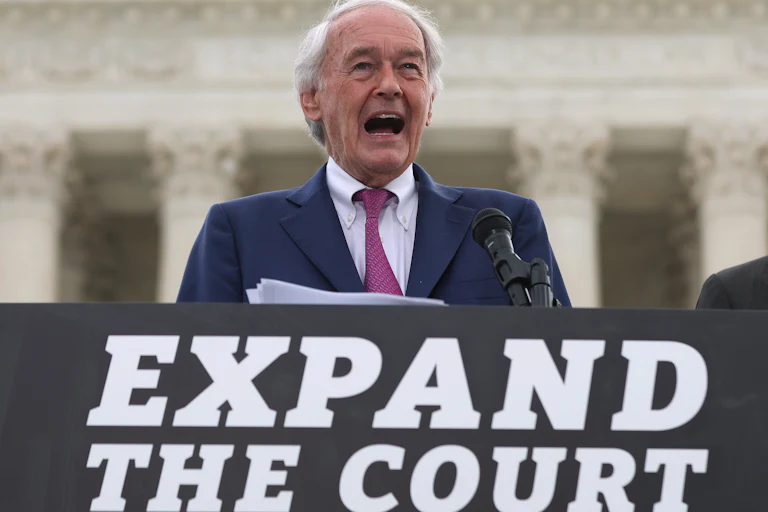
Was Thursday among the darkest days in the history of the Supreme Court? You could make a case. First, a majority cleared the way for a pesticide manufacturer to get thousands of lawsuits off its books from farmers who’d used its product and gotten cancer. Next, it ruled that the administration could turn away asylum-seekers at the border. And then it held that gun owners could now freely carry their weapons into private establishments that serve the public.
Let’s pause over that one for a paragraph. Here’s a good description of the particulars of the gun case and the legal arguments on both sides. But the upshot is this: Everywhere in America, gun owners will presumably be able to take their guns to shops, stores, malls, movie theaters, restaurants, bars, amusement parks, Baby Gaps, you name it. Does any rational person think that the Founders, who simply wanted men to have muskets to protect themselves from invaders, would want someone to be able to take a military-style semiautomatic rifle and 600 rounds of ammo into a Chuck E. Cheese?
But the worst of Thursday’s big four decisions was Mullin v. Doe, which will allow the Trump administration to begin deporting Haitians and Syrians who were granted Temporary Protected Status by the Obama administration in 2010 and 2012, respectively. My colleague Matt Ford shredded the decision in his piece, writing that the court “effectively blessed Trump’s bigotry toward Haitians and dealt potentially catastrophic damage to federal civil rights laws.”
The cases combine to give the executive branch more power. They turn several lower court decisions on their head (as The New York Times notes today, immigration hard-liners had lost case after case on TPS until yesterday). And in the case of Mullin, in particular, the highest legal authority in the land—namely, Samuel Alito, writing for the majority—pretends that Donald Trump’s blatant racism toward Haitians doesn’t exist; that there was nothing “overtly racial” in Trump’s many disgusting and false comments about the Haitian community of Springfield, Ohio, and beyond.
This conservative court is out of control—blatantly partisan and ideological, the six-member majority scarcely even pretends otherwise anymore.
Some major decisions about executive power—Trump’s power—are yet to be handed down this term, involving the firing of Fed Governor Lisa Cook, the removal of Democratic appointees from independent agencies, and of course the birthright citizenship case. If the court rules predictably on two of these three, or certainly on all three, it will have completed a term—with the aforementioned four decisions already on the books, as well as Callais v. Louisiana, which did away with Section 2 of the Voting Rights Act—that might well be the most reactionary in its history. And all this is on top of the earlier reversal of a 49-year-old precedent in 1973’s Roe v. Wade and the handing to Trump of sweeping immunity for all “official” acts.
It’s now unavoidable: This has to be a front-and-center issue in 2028. Democratic presidential contenders will have to answer the question: What do you plan to do about the Supreme Court?
Many of them will be afraid to dip a foot into these waters. They shouldn’t be. Poll after poll shows us that majorities disapprove of the court and think of its decisions as being more political than jurisprudential. According to Gallup, disapproval of the court topped 50 percent five years ago and has stayed there ever since (in contrast, that number was just 29 percent as recently as 2010). So the public—not just the progressive base of the party—is ready to hear ideas.
Terms limits, the most common idea bruited, are fine. But imposing term limits won’t really change the makeup of the court for years; maybe decades. How many more rights will they strip away before then? How much more power will they give to the uber-rich to buy political campaigns and candidates? How much more immunity will they grant to corporations? How many new ways will they find to weaken protections for workers and litigants against corporate power? And perhaps most of all, how will they figure out how to allow the executive branch to undermine the laws passed by Congress and refuse to write regulations and enforce the laws Congress has passed?
No—terms limits are no longer enough. It’s time to talk seriously about court expansion. And I think there’s a smart and totally constitutionally defensible way to do it.
The United States has 13 federal circuit courts. That number, naturally, grew over the course of the country’s history, as the number of states grew and as the population expanded. This is relevant here because each Supreme Court justice is responsible for overseeing a certain number of circuits. Historically, Congress has expanded the number of justices as it simultaneously increased the number of circuits.
Admittedly, all this happened a very long time ago. But still, it’s precedent. The court was established in 1789 at six justices. In 1807, Congress expanded the number of federal circuits to seven, and added a justice to match. In 1837, Congress created nine circuits and nine justices. In 1863—even while the United States of America had lost the 11 states of the Confederacy—Congress created 10 circuits and 10 justices. The current nine-justice format was set in 1869.
Later expansions in the number of circuits did not simultaneously add justices. But why not revive that thought? The country has had today’s 13 circuits since 1982. The population of the country in 1982 was 230 million. Today, it’s around 345 million. That’s a lot more people. And the courts are horribly backlogged.
That could be solved by just adding judges. But it’s also a justification for increasing the number of circuits. From there, a case can clearly be made that increasing the number of circuits requires increasing the number of high court justices. Or at the very least, Democrats can pursue a hybrid solution that would keep the number of circuits at 13 and add a large number of judges within those circuits—while increasing the size of the Supreme Court to 13. Democratic Congressman Hank Johnson of Georgia, a leader on these issues, introduced such a bill in 2023, and it had around 60 co-sponsors.
It would all be completely constitutional and completely legal. Which is more than can be said for a lot of the things Trump and the Republicans are getting up to, as they try to find new and blatantly illegal ways to stop mail-in voting and otherwise take the franchise away from citizens.
But the big door-opener here by Trump and the GOP is their rancidly unconstitutional mid-decade redistricting move. The Constitution clearly and plainly states that districts will be redrawn every 10 years, after the decennial census. What Trump and his party are doing with this redistricting is completely lawless.
Once they’ve done that, all bets are off. Democrats should do whatever they need to do to rebalance power. But—they should stay within the law. What I’m talking about here, what Johnson’s bill would accomplish, would be entirely within the law. Congress can set the size of the Supreme Court. And I believe that a smart Democrat, framing the argument the right way, can take that case to the American people and win it. He or she can convince the voters that far from destroying the court, such an action would constitute saving it from its own extremism—and saving the rights we cherish that these ideologues are stripping away.
If Obama Had Done What Trump Just Did on Iran, He’d Be Crucified
The United States just unambiguously lost a war that it started for no good reason. A sane country would remove the imbecile who did this immediately.

When I read history, I often wonder what it must have felt like to live those events in real time, as I’m sure you do. Did it seem an ominous moment in June 1914 when Gavrilo Princip shot Archduke Franz-Ferdinand? If I were a Briton in September 1938, would I have had an uneasy sense of foreboding watching the newsreel of Neville Chamberlain stepping off that plane from Munich?
I think such thoughts this week because I have no doubt that future historians and readers of history will surely wonder what the ever-living fuck we were all thinking when Donald Trump both started and then lost his immoral and pointless war with Iran. What we have just witnessed is almost beyond belief, and would be beyond belief if we didn’t all know going in that Trump is such an aggressively and willfully stupid human being, utterly impervious to knowledge and facts, serenely cocooned in his carapace of ignorance, surrounded by flatterers who patronize him as one does a child and who scream at Americans about his nonexistent genius, courage, and virility. They exist in a fantasyland.
But we live in the real world, and in the real world, this war was a disaster in every imaginable sense. Let’s tally up the damage:
- First of all, there was already a diplomatic agreement with Iran that was working; the International Atomic Energy Agency reported repeatedly that Iran was abiding by the Obama-era JCPOA deal. There was no need for Donald Trump to do anything.
- But of course, the deal was the handiwork of Barack Obama—the Kenyan Marxist who made a few jokes at Trump’s expense at a dinner one time; so Trump tore it to pieces.
- Almost instantly, Iran started enriching uranium at levels well above the 3.67 percent limit set by the JCPOA. And why not? Trump broke the agreement. Of course they started enriching uranium at high levels again.
- In other words: The fact that Iran once again became a nuclear threat is entirely Donald Trump’s fault.
- With respect to its capability to build a nuclear weapon, Iran’s “breakout time,” in the preferred parlance of diplomacy, went from 12 months to seven days. That is not a typo.
- So Trump discovers this one day. Maybe Benjamin Netanyahu explained it to him. We’ll learn that whole story at some future point. In any case, out of nowhere on the last day of February, with no warning, no prep, no nothing, Trump starts a war. Within hours, we bomb a school, killing around 120 children.
- From a purely military standpoint, the war goes fine. We suffer few casualties, although we do kill 3,500 or more people. But Iran counters by doing the thing that every expert in the world knew Iran would do if it was ever attacked: It asserts its control over the Strait of Hormuz. If you want to come through, you have to pay to play. Up go the gas prices.
- Now Trump is trapped. And he’s starting to get bored because the regime didn’t collapse in two weeks like he thought it would. He wants out. So he sends his corrupt son-in-law, in bed with the Saudis and in the middle of trying to humiliate Albania for no good reason, to sort things out.
- That brings us to this week: the outlines of a deal that looks for all the world like a complete surrender. The United States of America, for only the second time in its 237 years on this earth, has unambiguously lost a war.
People can debate the above. I’m counting Vietnam, obviously; there’s no doubt about that one. I reckon the War of 1812 and the Korean War as stalemates. Under the Treaty of Ghent, the United States and Britain just agreed to go back to the way things were before the war, and with respect to Korea, the line was the 38th parallel pre-bellum and postbellum.
Some will say Iraq was a loss, but I rate it, too, as kind of a draw. It sure wasn’t a win of the sort Dick Cheney and Paul Wolfowitz told us to expect. It cost many trillions of dollars and killed hundreds of thousands. To a mixed result: Today, Iraq is a democracy, of a sort, but it’s a long way from being free. But I perhaps charitably call it a draw because the U.S. did achieve the core stated aim: It deposed Saddam Hussein.
Here, though, we have not achieved any of Trump’s shifting stated claims. There’s no regime change—or, to the extent that Trump has managed to change the regime, it’s even more hard-line and more powerful in the region than it was before the war!
And that’s before we and other nations fork over the infamous $300 billion, just a mind-boggling figure. Conservatives wanted Barack Obama impeached over the money he agreed to pay Iran (which was Iran’s money, frozen in U.S. banks), which was $1.7 billion. Trump is going to hand Iran 176 times that amount. And it’s going to end up being more, because the $300 billion is separate from whatever frozen assets Trump decides to unfreeze. Word around the campfire is that we are talking about another $25 billion or so.
Some perspective on how much $325 billion is. The total U.S. foreign aid budget for 2025 was about $60 billion. More pointedly: Estimates vary, but it seems that Iran spends around $1 billion a year propping up Hezbollah. Imagine how much they’ll be able to spend when their Trumpy ship comes in!
The one slender thread on which the Trump administration is now hanging its hopes is that in the coming negotiations, it’ll get Iran to surrender its current stockpile of enriched uranium. That, admittedly, would be something that the JCPOA didn’t do. If they pull that off, even I will say good for them.
But for Iran, of course, this is a nearly inconceivable concession. What seems more likely to happen is that the two sides will agree to terms calling for Iran to dilute its highly enriched uranium under international supervision. Trump will sell this as a great victory. But this “down-blending,” as it’s called, was also in the JCPOA!
Above, I called this war immoral and pointless. The pointless part speaks for itself. It has accomplished nothing except making Iran stronger and the United States weaker. If Barack Obama or Joe Biden had done this, not only would they have been instantly impeached if the Republicans controlled the House, but the entire Democratic Party would have been discredited on foreign policy matters for a generation at least.
But the immoral part is worse. Trump started a war, killed a few thousand people, got tired of it, and surrendered to one of the most reactionary regimes on earth, which went on a gleeful killing spree of its own citizens earlier this year. Since the commencement of these hostilities in February, Iran has executed 44 more people and detained another 6,000. That’s the regime Donald Trump just strengthened and is about to hand many billions of dollars to. “Immoral” barely scratches the surface.
This is an epic failure. It’s not quite September 1938. But that’s only because Iran’s mullahs don’t have Hitler’s global ambitions. Morally, it’s a Neville Chamberlain moment of a sort the United States has never experienced. The icing on the cake would be Trump taking to Truth Social and boasting about “peace in our time.” A man who signed a treaty at Versailles is ignorant enough of history to not even know why that phrase resonates.
The Not-So-Secret Impulse Behind Trump’s Vulgar, Garish Birthday Party
In the real world, a weak and insecure Donald Trump is being humiliated by Iran. Ah, but Sunday night, he’ll be a manly man among manly men.

The president turns 80 on Sunday, and, as with everything pertaining to Donald Trump, his need to place himself at the center of our attention is pathological. He could not just have a dinner at the White House, or a party at Mar-a-Lago. No; he had to build a massive arena on real estate that belongs to the people of the United States to host a vulgar, garish event that is one of the most violent forms of spectacle available to the human race today. Trump will be sitting there like some Roman emperor at the Colosseum watching enslaved men try to stave off lions. The man who wanted law enforcement to shoot protesters “in the knees” is probably bummed he couldn’t just replicate that.
But if you can’t have lions, six UFC fights are the next best thing. Granted, UFC fighting is very popular in the United States and across the world. I’ve read various accounts this week contending that UFC fighting has supplanted hockey as the fourth-most-popular sport on television, behind the big three of football, baseball, and basketball. I’ve also read that its popularity may have peaked; here’s a 2025 piece by a sportswriter who has followed “combat sports” for 15 years, showing that the number of matches is in steep decline. “The United States, long the backbone of [mixed martial arts], has seen a sharp decline in activity,” wrote John S. Nash. “In 2009, more than 6,266 professional fights took place across the country. This would be the pinnacle for American MMA contests. By 2024, that number had dropped to just over 3,027—a 52 percent decrease.”
Still—it’s popular. Fine. But guess what’s strikingly, overwhelmingly not popular? The idea of hosting such fights at the White House, on grounds we tend to associate with understated, democratic solemnity. A poll released Thursday found that just … wait for it … 16 percent of Americans considered it appropriate to hold MMA cage matches on the White House grounds. Meanwhile, 46 percent opposed. Even among Republicans, only 31 percent considered it appropriate. Yet a narrow plurality of Republicans in the survey backed the event, by said 31 percent to 22 percent.
Democrats opposed it by huge margins, 75 to 5 percent. Independents were strongly against it too, by 45 to 11 percent. So once again, it’s Republicans—no; specifically, it’s MAGA Republicans, because they’re undoubtedly that 31 percent—who are way out of step with what real Americans think. Yet they—Trump, his lackeys, and all those Soviet-style propagandists on Fox and Newsmax and One America and elsewhere—will of course spend the entire weekend equating men beating each other to a pulpy mass on hallowed civic ground with “real” patriotism.
It’s sickening. Oh—and it’s also, as we’ve come to expect with Trump, deeply corrupt. First of all, the cost of constructing the arena is around $60 million. Supposedly UFC is picking up that check, but with Trump, who really knows? We taxpayers will undoubtedly be on the hook for something. Meanwhile, the chief sponsor—surprise, surprise!—is Crypto.com. There are in addition figurines of some of the featured fighters. There’s apparel—garish T-shirts running $40. Over at TrumpStore.com, somewhat to my surprise, I didn’t see any merch specifically tied to the event, but you have to believe that Trump’s short-fingered hand is dipping into some till or another here. A lawsuit filed by the group the Public Integrity Project to block the event from taking place (it’s pending as I write) states that UFC set up a for-profit entity to manage this event, which is selling seating packages that cost up to $1.5 million—and that Trump previously bought $50,000 worth of stock in TKO, UFC’s owner.
Out in the real world, Trump is being reduced to impotence by a bunch of dictators who are even more reactionary than he is. He’s about to cut a “deal” with Iran that sounds like it will be little more than an extended ceasefire. It will, many experts fear, compare unfavorably to Barack Obama’s 2015 accord, which Trump tore up in 2018. Trump may achieve what Obama achieved, in terms of getting Iran to agree not to enrich uranium at anywhere close to weapons-grade levels. But as I’ve noted several times, the thing to watch is how much money Trump agrees to transfer to Iran. Which in a sense is fine; it’s Iran’s frozen money. But when Obama agreed to give Iran $1.7 billion, right-wingers screamed that it was capitulation and even treasonous. Iran now wants up to $24 billion. We’ll see how Mr. Art of the Deal fares.
But even if he does strike a decent deal, he’s already done enormous damage to the U.S. economy, the global economy, and American prestige and power projection. To sane observers in the United States and across the world, he looks like exactly what he is: a weak and hollow and insecure man who started a needless and counterproductive war out of nowhere because it looked “tough.”
But inside his little MAGA cocoon on Sunday night, he’ll be a manly man, presiding over watching other manly men spill each other’s blood for the leader’s greater glory. It’s the most undemocratic pageant one could imagine, a fact that—given that scant 16 percent support—the people know in their bones. In fact, this is exactly what fascism is: grotesque, violent spectacle that repulses most of the population but drives the fervent worshippers to a frenzied state and tries to bully its way into being synonymous with what it means to be a real American.
It’s all made worse by the fact that Dear Leader will be embarking upon his ninth decade of life that night, and that six in 10 Americans believe he lacks the mental sharpness to serve as president. So that’s the not-so-secret meaning of this event. I just wonder if Vegas will establish odds on whether he’ll fall asleep.
MY NOVEL IS OUT!: Buy my new novel, Killing Baby Hitler, out this week from O/R Books. “Fabulous in every sense,” says Kurt Andersen. “Savagely funny,” says Molly Jong-Fast. They’re right!
Why The New York Times Is Wholly Responsible for Bari Weiss’s Rise
She was at The Wall Street Journal and should have spent her career there. But the Times decided she was … interesting. Why do liberals do this?

Everyone is up in arms, and rightly so, about what Bari Weiss is doing to CBS News in general and 60 Minutes in particular. The firing of Scott Pelley will reverberate in American journalism history as a symbolic execution of the single most groundbreaking and successful news program in the annals of U.S. broadcast television. Two of the program’s other prominent on-air correspondents were fired, as well, and we’ve seen countless news stories this week about the chaos and turmoil that have resulted. Three of the show’s remaining correspondents—Bill Whitaker, Lesley Stahl, and Jon Wertheim—reportedly huddled this week to discuss their next move; Stahl is currently out of contract.
This is a tempestuous time at one of the nation’s most staid journalistic institutions. But let’s back up a minute to appreciate how we got here. How did someone like Weiss, with no broadcast news experience, get put in charge of the network with the longest and proudest news tradition in the country? Well, we know the answer to that question. David Ellison, head of Paramount (which owned CBS), hired her last October, three months after the Trump administration approved the takeover of Paramount by Ellison’s company, Skydance. Before that, of course, Weiss had started up the very successful Free Press newsletter, devoted mainly to attacking left-wing wokery and cancel culture for dedicated subscribers.
But the pivotal moment, or actually moments, in her career came before that. The first was her hiring, in April 2017, by The New York Times. The second was her famous departure from that same paper, which she cynically and shamelessly used to get a bevy of wealthy, angry, rich men to stake her to the Free Press. You know that saying about how sometimes liberals are so open-minded that their brains start falling out their ears? Weiss’s ascent provides a lesson in how liberal institutions can sometimes place such value on proving that they’re open-minded that other liberal values, like standing for actual liberal things in the world, get tossed aside.
On April 12, 2017, as the nation’s most important newspaper was settling into the first Trump era, the honchos of the Times made an announcement. They were hiring Bret Stephens away from The Wall Street Journal. Stephens was, of course, conservative in outlook. He made for the third conservative at the generally liberal op-ed page, after longtimer David Brooks and the comparatively youthful Ross Douthat.
Well … OK, then. Brooks had been at the paper since the 1990s; Douthat since 2009. One could maybe, possibly justify adding a third after Trump’s election, to “understand” the conservative mind and the sentiment apparently flowing across this great land (even though that sentiment won 2.8 million fewer votes than liberal sentiment, but never mind that). Mind you, though, that it sure isn’t as if The Wall Street Journal and The Washington Times and the New York Post started making an effort to understand the liberal mind after Barack Obama won. The Journal has one nonconservative columnist, William Galston of the Brookings Institution, who is a friend of mine and can fairly be described as liberal-centrist. The Washington Times and the New York Post, from what I can see, have zero.
But fine. Stephens. One might have thought that would have been enough. But no! A mere two days later, on April 14, came the beaming announcement that the Grey Lady was nabbing its second Journal opinionista of the week and hiring Weiss: “It is with great excitement today that we announce that we’ll be expanding the desk’s range, voice, and reach with the hiring of Bari Weiss.” The announcement explained that Weiss would be “commissioning the kinds of quick, off-the-news pieces that are such a critical part” of our yadda-yadda-yadda and would be doing so with the “signature verve and humor” so evident in her Journal oeuvre.
That’s one of those eye-of-the-beholder questions. Here is her Journal corpus, at least the written part of it. Look, we’re all predictable to some extent, your humble servant included. I wouldn’t deny it for a second. But Weiss’s Journal pieces were predictable in a specific way that allows us reasonably to question precisely what the nation’s, nay the world’s, most important liberal opinion page found so alluring in them. Just sample these headlines: “The PC Police Outlaw Make-Believe”; “Is That Libidinous Latina Taco Gay or Bi?”; “Camille Paglia: a Feminist Defense of Masculine Virtues.”
A representative piece, from June 2015, called “Love Among the Ruins,” chides those celebrating the Supreme Court’s decision that legalized gay marriage. Oh, don’t misunderstand—Weiss supported the decision, of course! But she found it troubling that the messages “blowing up” her phone were wholly focused on Obergefell v. Hodges with not one person taking time to decry the recent mass shooting in Tunisia or the terrorist attack in France.
In other words: “The left” is so obsessed with its narrow, woke agenda that it doesn’t care about mass shootings or terrorism. It’s gibberish. Obviously, people can celebrate something they support without feeling some overwhelming, Dostoyevskian guilt about suffering on the other side of the world. Besides, I am 100 percent certain that if she’d bothered to look, she could have found quotes from Democratic politicians and human rights groups and other wokesters denouncing those tragic events. But the key to writing a column like that is not bothering to look. Smart liberals know that conservative trick and know not to indulge it.
But anyway. They hired Weiss. You would have thought that would have been enough. But no! Two years later, the Times hired a young conservative firebrand named Adam Rubenstein, who also had The Wall Street Journal on his résumé.
Nothing unusual happened for a while. Then, in the wake of George Floyd’s murder in the summer of 2020, the Times ran the instantly infamous op-ed by GOP Senator Tom Cotton arguing that it was time for the military to restore order. That contention, when put that way, is controversial but not necessarily objectionable. But many of Cotton’s particular assertions were extreme. To take one example, addressed by the Times in a later editor’s note: “For example, the published piece presents as facts assertions about the role of ‘cadres of left-wing radicals like antifa’; in fact, those allegations have not been substantiated and have been widely questioned. Editors should have sought further corroboration of those assertions, or removed them from the piece.”
Editors also should have done more to square the case he made in his op-ed with the rhetoric he’d previously deployed to make the same case, in which he called for the invocation of the Insurrection Act (which the piece cited) and further recommended that “no quarter” be given to targeted demonstrators. As David French pointed out, “no quarter”—which mean enemies should be killed on the battlefield rather than be taken prisoner—“has been a war crime since Abraham Lincoln signed the Lieber Code in 1863.” By not forcing Cotton to reconcile the position in his op-ed with the more incendiary ideas that inspired it, the Times editors laundered his original demand for violent extremism into erasure.
Rubenstein edited the piece, encouraging the inclusion of photos of federal troops protecting Black students in the 1960s South, as if people protesting the violent, nine-minute murder of a citizen were analogous to racist hordes denying rights to other citizens. A huge controversy ensued.
Weiss apparently had nothing to do with the piece, but she cynically seized on the opportunity the fracas presented to resign, citing a deeply inhospitable workplace. She announced her decision on her website, in a roughly 1,500-word letter to the Times’ publisher, rebuking him for allowing other Times employees to say rude (and admittedly sometimes quite vicious, if her account was accurate) things about her.
The letter went into several details that in most workplaces, probably including The New York Times, are typically thought and assumed to be private and confidential. But naturally, to some, revealing these behind-the-curtain anecdotes marked Weiss as a truth-teller and a martyr. And this, along with her general profile of alerting the elites to the latest lunacy at the Dalton School (and her rabidly pro-Israel stance), is what made her a hero to men like David Ellison. She started a Substack originally called “Common Sense,” which morphed into the Free Press after she raised capital from people like Marc Andreessen, David Sacks, Bobby Kotick, and Howard Schultz. The first three are all Republicans (Andreessen was once a Democrat), and Schultz is an independent.
For her own part, Weiss always used to call herself a centrist-liberal or a sane liberal or some such thing. That may have been true at some point, to some extent. But now, it’s quite clear that she is not just conservative, she’s MAGA. Maybe not in her heart, but overwhelmingly in her actions, and it’s actions that matter. She was placed at CBS by Ellison to crush the left and advance Donald Trump’s agenda, so it’s no surprise that that is precisely what she’s doing. And no matter her level of incompetence, she’ll stay there as long as she’s doing that—and as long as she’s not killing the stock price.
And it all can be traced back to that week in April 2017, when The New York Times decided it had to be broad-minded in the wake of the election of the most narrow-minded man to occupy the White House since Andrew Johnson—or maybe ever. And now the chief beneficiary of the paper’s broad-mindedness is advancing that narrow-minded man’s agenda while destroying the country’s most venerated television news operation.
Oh, and Adam Rubenstein? Whatever became of him? He shared Weiss’s sharp instinct for self-promotion. He quit the Times six months later and took to the website of The Atlantic to write a self-pitying piece about the brouhaha that his own sloppy editing caused.
And today? Well, the day after Ellison named Weiss head of CBS, CBS announced the hiring of Rubenstein as deputy editor, where he is reportedly part of Weiss’s “inner circle.” Take that, Walter Cronkite.
The Real—and Deeply Corrupt—Reason Trump Is After E. Jean Carroll
Actually, it’s not reason, singular. It’s reasons, plural. And there are 88.3 million of them.

Holy Damage Control, Batman: CNN originally reported late in the day Wednesday that the Justice Department was opening a probe into whether E. Jean Carroll, the New York woman who successfully sued Donald Trump and won $88.3 million in damages for sexual abuse and defamation, lied during the legal proceedings against Trump, and that Andrew Boutros, the U.S. attorney for the Northern District of Illinois, would be leading the investigation. Then, on Thursday, Boutros said, Hey, not me!, categorically denying that he was investigating Carroll.
This is extraordinary on so many levels. First and foremost, it’s shocking and disgusting that the Trump administration would even contemplate doing this.
It’s important to dip briefly into the facts here. Yes, in a 2022 deposition, Carroll misrepresented the fact that Democratic billionaire Reid Hoffman donated to her defense fund. Her lawyer, Roberta Kaplan, has said that Carroll recalled later, sometime in 2023—it seems worth bearing in mind that she was in her late seventies at the time—that she had received some outside donations and that she told Kaplan, and Kaplan immediately told Trump’s lawyers. Those lawyers tried to pounce on this new information to cast doubt on Carroll’s credibility, but the judge barred Trump’s lawyers from using it at trial. Two juries subsequently found Trump liable for both sexual assault and defamation.
That’s the background. Here’s the important part, as detailed by Lisa Rubin in a recent MS NOW column: Trump appealed, twice, trying to get appellate courts to agree that Carroll was lying, and he lost both times. First, a three-judge appellate panel upheld Trump’s conviction and believed that Carroll just forgot: “Ms. Carroll plausibly represented that she had forgotten about the limited outside funding,” the panel wrote. Second, eight of 10 active judges on an appellate panel in June 2025 denied a request for rehearing by Trump’s lawyers. (And even just last month, a third appellate panel denied a rehearing of the defamation case.)
If you look at that June 2025 ruling I linked to above, you’ll see an interesting name listed as counsel for “defendant-appellant”: Todd Blanche.
This, of course, is the same Todd Blanche who is running the Department of Justice today. When Trump fired Pam Bondi as attorney general and stories came out that Trump had been displeased with her lack of zeal about going after his enemies, you, like me, probably wondered how anybody could possibly be more of an unethical, corrupt, cowardly lickspittle than Bondi was. She brought—or tried to bring—prosecutions against Trump antagonists Letitia James, James Comey, John Brennan, Fani Willis, and more. When career prosecutors declined to bring those cases, she fired them and brought in incompetent hacks to do Trump’s bidding. In some cases, federal judges found these hacks to have been installed illegally.
Bondi was venally corrupt, on an absolutely Wagnerian level. Just this week, in fact, a retired chief justice of the Florida Supreme Court, backed by 120 judges, attorneys, and law professors, brought a blistering ethics complaint against Bondi demanding that she be investigated and disbarred. That complaint is mostly about her handling of the Epstein files because, remember, she behaved indefensibly there too.
So how could anyone be more corrupt than that? I’ll tell you exactly how, through Trump’s eyes: They could succeed where Bondi failed. That was her crime. Not obviously and serially violating departmental ethical canons. Her crime was not doing it well.
Hence, Blanche. The fact that his name was on that appellate denial—that he was one of Trump’s lawyers in the Carroll proceedings—means he has personal skin in this game, which in turn means that there’s no way on earth this should be happening on his watch. And indeed, he is said to have “recused” himself on the matter of the Carroll investigation. So it was tossed to Boutros, in Chicago.
But Boutros, as I noted above, says he’s not investigating Carroll. He maintains that he’s only investigating Hoffman’s nonprofit, American Future Republic. It’s based in Chicago, you see, so there’s the veneer of justification. But this just raises the question: What has American Future Republic done wrong? It’s allowed to donate money to a legal defense fund. It’s a 501(c)4, not a (c)3, the basic difference being that a (c)4 is allowed to be more directly political (also that donations to a (c)4 are generally not deductible as charitable contributions).
GuideStar records show that the group did donate $7 million to Kaplan’s former law firm in 2020. That is by far its largest single donation. But even so, so what? The material question here isn’t whether Hoffman partly or even wholly paid for Carroll’s defense. The question is whether she lied about it. Three different panels of judges believe she did not.
What’s really going on with this investigation, one sniffs, is this. Trump is running out of appeals here. As Lisa Rubin wrote in the column I cited above: “In other words, Trump is facing down the increasingly real possibility of paying Carroll more than $88 million, before interest, with only the Supreme Court to potentially rescue him.” So he and his current lawyers are trying to resuscitate the issue that a judge prevented them from using at the original 2023 trial.
That’s not necessarily a crazy, last-ditch legal strategy for a person faced with writing that kind of check. The problem, though, is that the person is the sitting president of the United States, and “his current lawyers” are the U.S. Department of Justice, which he has corrupted. And by the way, if you want to know more about this Boutros fellow, just read Michelle Goldberg’s column today about his ghastly attempt to prosecute six people, including onetime Democratic congressional candidate Kat Abughazaleh, on felony conspiracy charges. The case fell apart last week after prosecutors admitted to misconduct before the grand jury. As Goldberg put it, “If Trump didn’t manufacture scandals on such an industrial scale, the case that collapsed last week in Chicago would have been a huge story.”
So many things would have been huge stories under any other presidency. Trump’s purchase of Dell stock and the awarding of a large Pentagon contract to the company. White House intervention to get a $620 million contract funneled to a company affiliated with Don Jr. The ongoing ICE scandals, with Democratic pols being prevented from being able to inspect horrid conditions at ICE’s detention camps. The new homeland security secretary vowing to cancel international flights to certain liberal cities. The plainly illegal effort to put Trump’s face on a new $250 bill. Any one of those, in normal times, would be a major scandal. And those were just this week.
I pondered writing about each of those. I chose the Carroll matter because it’s not only obviously corrupt but another cannon blast at the rule of law and the independence and integrity of the Justice Department. And because it’s something new: Are investigations into liberal nonprofits to become a regular thing now? So far, Trump has used the DOJ completely unethically, but he’s used it just to go after a handful of personal enemies. If he and Blanche open up the gates to start harassing liberal groups on a much wider basis, then we’re truly in tinpot dictator territory. It can, and will, get worse.
There’s One Thing All Democrats Must Agree On, or They’re Dead in 2028
The DNC’s 2024 autopsy is a waste of your time. The answer to the party’s woes lies deep in a New York Times poll released the same day.

I started reading the Democratic autopsy of their 2024 loss that was belatedly released Thursday, but I stopped on page eight, when I got to this sentence: “In 1989, after losing three straight presidential campaigns, our party refocused the conversation around policy and purpose to reclaim the vital center of American discourse.” The second I saw that indefensible sentence, I clicked away.
Why? I’ve written this a few times, but I’ll write it again: There is no comparison whatsoever to be made between the Democrats’ situation after the 1988 election and their situation now, post-2024. In 1989, the Democrats had been absolutely pasted in three elections in a row. In 1980, Jimmy Carter lost to Ronald Reagan by nearly 10 points and 440 electoral votes; in 1984, Walter Mondale lost to Reagan by 18 points and 512 electoral votes; in 1988, Michael Dukakis lost to George H.W. Bush by 8 points and 315 electoral votes.
Meanwhile, the last three presidential elections have been decided by razor-thin margins. Hillary Clinton lost narrowly, though she won the popular vote by a fairly substantial margin (2.8 million); Joe Biden won; and Kamala Harris lost by a combined 230,000 votes in three states. There is no parallel to 1989.
So why would someone write this? I can think of only two reasons. The first is a combination of historical ignorance and allowing emotion to push aside facts. Democrats were so crushed by 2024 that it kinda felt like 1988. But feeling that without looking at the actual numbers is either dumb or lazy.
The second reason someone might write that sentence is ideological. That is, they are firmly committed to the view that the Democratic Party needs to “move to the center” or even “to the right,” and so they invoke the anemic ghost of 1988 to help them make their case. And if they did happen to stop and look at the numbers from the 1980s and wrote the sentence anyway, well, that would make the writing of it a deeply cynical exercise as well, because the writer would know there’s no truth to the analogy.
That “someone,” by the way, was Democratic consultant Paul Rivera. The Democratic National Committee hired him on a pro bono, part-time basis to conduct the autopsy even though he hadn’t worked on a presidential campaign in more than two decades. Apparently, he never finished the job, as the document released on Thursday was shockingly incomplete. “For full transparency, I am releasing the report as we received it, in its entirety, unedited and unabridged,” DNC chair Ken Martin said. “It does not meet my standards, and it won’t meet your standards, but I am doing this because people need to be able to trust the Democratic Party and trust our word.”
No wonder I couldn’t read it any further. Lazy and inapt historical analogies, and indeed carrying on a detailed argument about why Harris lost, is irrelevant to what’s needed most in this moment: a discussion of how the Democrats can win in 2028. But before doing that, let me quickly offer three broad reasons why Harris lost:
1. Joe Biden didn’t exit the race in time.
2. Harris didn’t do an adequate job of reminding voters of Trump’s incompetence on a range of fronts in his first term (this is a point the autopsy apparently does make, in fairness).
3. Harris didn’t make a compelling or aggressive enough economic case.
Always in presidential campaigns, there are dozens of factors, but I would hope about 97 percent of us can agree that if Biden had exited in the spring and the Harris campaign had done a better job of 2 and 3, she’d likely have won those 230,000 votes in Michigan, Pennsylvania, and Wisconsin, and more. OK? And that’s all the autopsy that’s really needed. (There are separate questions of the ground game and spending and things like that, but those topics are for insiders only.)
The same day the autopsy was released, The New York Times published a poll looking at Democrats’ beliefs and attitudes right now. The poll does say that in some ways, Democrats and “potential Democratic supporters” want the party to move to the center; 52 percent said the party should nominate a centrist in 2028, and 25 percent said it should nominate a more progressive candidate. Respondents thought Democrats should moderate their positions on immigration (specifically the border) and crime. And I think it’s clear to most people, for example, that the 2028 Democratic standard bearer does have to take a pretty stern line on border security. It’s the one promise Donald Trump made that he’s actually delivered on, and the only issue on which he’s above water in polls (this does not include, mind you, wanton deportations by ICE thugs—just the actual border).
So there were things, surprise surprise, that Democrats disagree on. But there was one thing they seemed to agree on: “Still, the economic populism pushed by a growing number of Democratic midterm candidates has found a receptive audience. More than 80 percent of the party’s backers thought the political and economic system should be torn down entirely or needed major changes, and nearly 90 percent called the economic system unfair.”
That’s the secret sauce, right there. That’s the answer. There was one question in the poll that to me was more important than all the others. It was wordy, so bear with me: “Now I’m going to describe two hypothetical Democrats. Tell me which of the two you would be more likely to support in the next Democratic primary for president. A candidate who promises to lower prices by going after corporate monopolies and price gouging. [Or] a candidate who promises to lower prices by making it easier to build housing and expand energy production.”
I’m not quite sure why housing and energy were considered the opposite of monopoly power and price gouging, but hey, I didn’t write it. Anyway: Going after monopolies and price gougers won 67 to 30 percent. It won massive majorities from every category in the cross-tabs. Young people, 75 percent; old people, 68 percent. Men, 65 percent; women, 69 percent. Whites, 70 percent; nonwhites, 65 percent.
Oh. And among which subcategory was the result most lopsided? White noncollege, by 76 to 22 percent. In other words, those magic white working-class voters the Democrats have hemorrhaged, and the media can never stop talking and writing about. The result among nonwhite noncollege respondents was not as extreme as that, but was still a whopping 64 to 34 percent.
The lesson here is obvious. Democrats have to make it crystal clear, unmissably clear, that they are on the side of working people struggling to get by and getting nickel-and-dimed by shifty corporations every day of their lives. That means taking certain policy positions, but it means much more.
“Positions” are close to worthless in campaigns today. What’s needed today is to create emotionally gripping narratives and make them go viral. On this issue, that means calling out the bad actors by name. It means naming villains. It means educating the American public about why they’re paying higher prices for prescription drugs and other forms of medical care, and who’s responsible. Watch this five-minute clip of Alexandria Ocasio-Cortez just ever so deftly ripping the eyeballs out of David Joyner, the CEO of CVS Health, earlier this year. Much more of that, please, Democrats.
In the superficial lexicon the political media uses, I suppose this means “moving to the left” on economics. Fine. So be it. But I’d argue it isn’t even “to the left.” It’s moving to where the people are. The people are furious about getting ripped off by corporate actors whom a rigged system will never hold to account. If virtually every demographic in that poll prefers a nominee who goes after monopolists and price gougers by 30-plus points, well, polling doesn’t ever get any clearer than that.
There’s this endless and often boring debate about whether to energize the base or reach out to moderates. As the above poll numbers show, a populist economics that targets bad actors can energize both. It’s only elite moderates who are against this, because they accept money from those sources for their campaigns or their organizations. They don’t actually represent anybody, or they represent a share of the electorate that is shrinking at a lightning pace. They, too, need to get with the program. This is where the people are.
So autopsy, schmautopsy. Stop arguing about 2024, Democrats. Talk about the future. And talk about the bad guys who are making working people’s lives harder. That’s where today’s “vital center” is—they’re sick and tired of getting screwed—and that way lies victory.
How Do We Know the China Summit Was a Failure? Because Trump Did It.
Everything he does on the world stage is disastrous, and the U.S. is reviled globally. How much longer will some idiots believe this “Art of the Deal” garbage?

Donald Trump says China agreed to buy 200 jets from Boeing. He crowed about it on Fox News Thursday night. But funny thing: A spokesman for China’s Ministry of Foreign Affairs was asked specifically about the jet deal after Trump spoke, and he said nothing about any such agreement. Wanna take bets on whether it actually happened?
Three points here. First of all, we should stop quickly to note that it’s sad that it’s come to pass that we just automatically believe a foreign government—and China’s no less—over the president of the United States (sad about him, that is, not us). Second, let’s remember that Boeing is an American company in a deep and sustained crisis that was brought on by basic greed: As David Goldstein explained in Democracy journal in 2024, after its acquisition of McDonnell-Douglas in 1997, the historically proud engineering culture at Boeing was destroyed as the company became more anti-union and outsourced more of its production.
And third, assuming that Trump is lying or at least exaggerating, well, we’ve just learned again for the jillionth time that Mr. Art of the Deal is a total fraud. Let’s review.
- Remember how, in his first term, Trump was going to bring North Korea to its knees? Remember how he consistently heaped praise on Kim Jong Un and his “beautiful vision for his country”? Well, it’s not a “beautiful country” to the people who live there, and meanwhile, its nuclear progress has been steady over the last decade—during most of which, of course, Mr. Art of the Deal has been the president of the United States. Experts think the nation has assembled about 50 warheads.
- Remember also that he was going to solve the Russia-Ukraine war on his first day back in office? In late March, a UN expert testified that the violence was “worse than ever.” We—that is, most decent people—are heartened by Ukraine’s resilience and wowed by its innovative drone technology. But that “we” doesn’t include the president of the United States, who obviously is cheering for his pal Putin—over whom he has zero leverage.
- The 2025 tariff war on China totally backfired. China responded to Trump’s tariffs by limiting exports of rare-earth metals, and Trump backed down. Today, U.S. soybean exports to China are down (they peaked during Sleepy Joe’s “disastrous” presidency), as are auto exports. The first Chinese EVs are landing in Canada even as we speak. These are ultra-luxury cars that sell for $10,000 or even $20,000 less than their American equivalents.
- Speaking of Canada, why isn’t it the 51st state yet? And speaking of Northern annexation, why isn’t Greenland part of the United States yet?
- How’s that world-class Gaza resort coming along?
- U.S. relations with Europe are at an all-time low. And it isn’t because of anything Europe did. Last December, the Trump administration released a security strategy paper calling Europe a bigger threat to the United States than Russia or China because of its progressive social and immigration policies, which threatened the continent with “civilizational erasure.”
- And finally, of course, there is Iran. The economic impact of the closure of the Strait of Hormuz will be felt for months ahead. The latest wrinkle? In India, where they apparently lap up Diet Coke, there’s a shortage of the beloved elixir because there’s an aluminum shortage (Diet Coke is sold only in cans there). The Middle East accounts for 98 percent of the global aluminum supply. Stock up on that Reynolds Wrap. Joking aside: There are and will be dozens of such shortages, some far more serious than Diet Coke. A UN official told AFP in Paris this week that up to 45 million people in the developing world could face hunger or even starvation because of the global fertilizer shortage.
All the above adds up to this rather grim reality, contained in a survey conducted by the Alliance of Democracies Foundations and unveiled last week. The United States ranked 128th in how it is viewed by survey respondents across 85 countries. We netted out at -16. That’s behind Russia, Syria, and Myanmar, to name a few notables. But hey, we’re ahead of Iran! By a point.
Trump can fool himself, if he wants to, that Xi Jinping was talking about the Biden years when he referred to America’s decline and the suddenly famous “Thucydides Trap.” But everyone knows the truth. He was talking about the United States in general, under both parties—a country that is by now pretty much owned lock, stock, and barrel by a handful of greedy Robber Barons whom the GOP worships and the Democrats haven’t had the stones to stop.
And he was talking about the United States under Trump specifically. Xi may be a ruthlessly immoral tyrant. But one thing he isn’t is dumb. He sees very clearly what the United States is doing to itself, having reelected a low-I.Q. kleptocrat, adjudicated sex offender, and psychologically damaged sociopath who spends the wee hours firing off batshit tweets and obsessing about a ballroom the way the Sun King did over Versailles. That man, not Joe Biden, is why China now tops the United States in global approval ratings.
The United States always led China in those kinds of polls because at the end of the day we could say well, at least we’re a democracy. The way things are going, we’re not even going to be able to say that soon. But hey, he’s a great dealmaker, right?
This Is the Issue That Must Unite Democrats—and It Isn’t Donald Trump
It’s a problem that’s far more enduring than Trump. And any Democrat who isn’t serious about reining it in deserves zero 2028 consideration.

The self-pity of some people knows no bounds. Steven Roth, the CEO of Vornado Realty Trust, said this week that the phrase “tax the rich” is hate speech on a par with other well-known slurs. “I must say that I consider the phrase ‘tax the rich’—quote, tax the rich—when spit out with anger and contempt by politicians both here and across the country, to be just as hateful as some disgusting racial slurs and even the phrase, ‘from the river to the sea,’” Mr. Roth said on an earnings call Tuesday, as reported by The New York Times.
Roth was peeved because Mayor Zohran Mamdani filmed a video celebrating Governor Kathy Hochul’s embrace of a tax on pricey second homes in New York in front of a building (developed by Vornado) containing a penthouse owned by hedge-fund billionaire Kenneth Griffin. Griffin bought it in 2019 for (sit down) $238 million, which made it at the time by far the most expensive single residence ever bought in New York.
I could maybe see an argument against Mamdani specifically singling out one person in that video. Griffin himself was quick to point out that Hizzoner “seems to have forgotten that the C.E.O. of another American company was assassinated just blocks from where I live in New York,” referring to Brian Thompson of United Healthcare. There are a lot of wackos out there. Although if God forbid someone shot Griffin tomorrow, it would not be Mamdani’s “fault,” any more than right-wing anti-government rhetoric was responsible for Justin Mohn shooting and then decapitating his federal-worker father in 2024. Only killers pull triggers. You’d think the people who preach at us constantly about personal responsibility would agree with that.
But let’s get back to Roth. What a crybaby. What he refuses to understand, or at least to admit, is: Nobody hates him personally. (a) Nobody cares enough about him to hate him personally, and (b) odds are he’s a relatively nice man and a good father and all that. This has nothing to do with hatred of individuals.
What millions of Americans hate is the extreme concentration of wealth and political power in the United States. Back in March, a New York Times analysis of donations in the 2024 election campaign found that just 300 billionaires and their families made a staggering 19 percent of all contributions to federal campaigns. That was more than $3 billion all told, either directly or through political action committees. The money helped elect Donald Trump, of course, but also new senators like Montana’s Tim Sheehy, who raked in $47 million from billionaires in his win over Democrat Jon Tester.
This is sick. This is not democracy. These people have no sense of limits, no sense that democracy requires that restrictions be placed on their power. Or maybe they do recognize that fact and have contempt for it, in which case it makes them opponents of democracy.
“I have the right to spend whatever I choose to promote what I believe,” David Koch once wrote, criticizing the landmark 1974 law that sought to impose caps on campaign expenditures. Fuck you. No you don’t. I mean, you do, right now, under the current laws of the United States, where the Supreme Court has held that money is speech and as such needs to be as “free” as speech is. You may think I’m referring to the infamous Citizens United decision of 2010, but actually the court initially made this holding in 1976’s Buckley v. Valeo, which came long before campaigns were so awash in lucre. That year, the average Senate race cost $595,000. Adjusted for inflation, that would be around $3.8 million now. In 2020, Senate races averaged around $30 million.
Koch is wrong. Money isn’t speech. Money is money. The difference is easily provable with the observation that all of us can speak equally but we cannot spend equally. If Koch and I are standing in the town square advocating for opposing candidates for mayor, I can speak on behalf of my candidate as endlessly as he can. That’s speech. But his ability to hand his preferred candidate $100 bills is rather more infinite than mine. That isn’t speech. It’s money. It corrupts the process. Someday, this will be obvious to a different Supreme Court.
You’d think these people would be satisfied with the way things are, so heavily stacked in their favor. But they aren’t. They want more. They always want more. This year, billionaires who want to keep AI free of any restrictions or regulations are pouring eye-popping sums into the midterms: Leading the Future, a pro-AI super PAC founded by venture capitalist Marc Andreesson and OpenAI president Greg Brockman, has amassed a war chest of $140 million. Their goal is to defeat candidates like Alex Bores in New York, who vows to lead a charge to regulate AI if he gets to Congress, and to promote candidates who’ll lie back and let them do what they want.
Why are they so hot on AI? Well, it’s pretty simple, isn’t? More AI means fewer human employees, with their oh-so-burdensome salaries and benefits and occasional illnesses. Claude Anthropic can’t agitate for a union. More AI means they get richer. The millions who lose work? Well, that’s progress. If they lose work, it’s what they deserved for not keeping up with the times. (Fancifully, some AI evangelists claim to support universal basic income as a solution to the mass immiseration their products will cause. But we know exactly which side they’ll be on if Congress ever takes up such a measure.)
These people have to be stopped. They need to be taxed at higher rates, of course. And their political power has to be curbed. In fact, that has to be a defining issue in the 2028 Democratic presidential primary race.
Every Democratic candidate needs to be asked: What will you do to rein in the political power of the billionaires? They may not be able to do as much as we’d like, given the Supreme Court, but how they talk about it—whether they’re angry or sanguine, whether they convey alarm or spew out a bunch of stupid happy talk about being able to work with everyone—will tell us a lot about their character and their worldview.
It’s kind of a “price of entry” issue. That is, the price of being taken seriously as a candidate, whatever their other positions, is that they recognize this state of affairs for the five-alarm fire it is. If something isn’t done about this, by 2030, those 300 billionaires will account for 40 percent of all federal campaign spending. Or 50. And what remains of this democracy will be dead.
By the way, the other “price of entry” issue? It’s that the candidates will use every ounce of political capital they have to kill the Senate filibuster if they win control of Washington in 2028. Not reform it. Kill it. The filibuster in any form means continued paralysis, dysfunction, and a certain drubbing in the 2030 midterms that will return control of one or both houses of Congress to the GOP. No filibuster means passing 10 or 15 or 20 bills that make people’s lives better and stop monopolies from being able to rip people off the way they can now. It has the potential to revolutionize politics. Any Democrat who doesn’t see this at this point can’t possibly be taken seriously.
Kvetch away, Steven Roth. But maybe in the meantime, pause and give a little thought to what is required for a healthy democracy to function. Reflect, perhaps, on the fact that this country experienced its greatest growth, its golden era, when a third of the workforce was unionized, when the top marginal tax rate was 90 percent, and when corporations generally understood that they had a commitment not only to shareholders but to community stakeholders.
Finally, as you reflect with justifiable pride on your own success, devote at least a few moments to the elements of public infrastructure—the roads, the rails, the computer networks that were all initially developed by the government—that helped make you so rich. If you and your class don’t want to be hated, stop doing things people hate.
John Roberts Is Either Dumb or Racially Obtuse. And He’s Not Dumb.
After the Supreme Court struck down school integration, guess what happened in the schools? The same thing that’s about to happen with congressional districts.

If Chief Justice John Roberts has uttered two quotable sentences in his career that will likely appear high up in his New York Times obituary, they are these. The first comes from his 2005 confirmation hearing: “My job is to call balls and strikes and not to pitch or bat.” The line was meant to convey to senators and America that he would be a neutral arbiter of constitutional interpretation, sans ideological agenda. It was later picked up by the entire conservative legal movement and repeated by numerous other right-wing judicial nominees at their confirmation hearings.
It was a lie. He was there, as we have subsequently learned many times, to bat. And not to spray dinky little singles—to swing for the fences. You may recall Jeffrey Toobin’s stunning 2012 article in The New Yorker detailing how painstakingly the chief justice orchestrated the 2010 Citizens United decision to make sure that it went as far as possible in removing limits on the financing of campaigns. The John Roberts of that article was no umpire. He was Mark McGwire juiced up on steroids, trying to smash the ball out onto Clark Avenue.
The subsequent 16 years have shown us the consequences of that decision, which will go down in U.S. history as one of the most corrosive and reactionary holdings of all time—if not right up there with Plessy and Lochner, then awfully close. It has handed our democracy on a silver platter to men who have nothing but contempt for it (Peter Thiel, Elon Musk, etc.).
The other quote is one that I suspect many people will remember, although they may forget the context: “The way to stop discrimination on the basis of race is to stop discriminating on the basis of race.” Ring a bell? He said it early in his tenure, when the Roberts court handed down one of its first major decisions, concerning public school integration efforts in Seattle and Louisville.
The court had already restricted forced integration efforts in a 1991 ruling. Then, in 2007, in two joined cases emanating from the above-named cities, the court went further: It ruled that even voluntary desegregation efforts were out the window. Roberts uttered his famous line while reading his 5–4 majority opinion from the bench.
I remember well the predictions in the decision’s wake. Liberals warned that the public schools would likely resegregate. Conservatives said, Oh pshaw, you delicate little flowers; we’re such a different country from 1954, the year of Brown v. Board of Education. Things will be just fine.
Well, guess what happened? In the 19 years since that ruling, the public schools have resegregated. Not to a mild degree. Not to a “concerning” degree. They have resegregated to a shocking degree.
In 2024, Axios published an article based on two recent academic studies and its own review of official data from 1988 to 2022. In the former year, about 7.4 percent of the nation’s schools were “intensely segregated,” meaning at least 90 percent white. By the latter year, that figure had vaulted to 19.8 percent. In addition, Axios’s Russell Contreras wrote at the time, “several states saw about a 20-percentage point or more increase in intensely segregated schools, from 1988 to 2021.”
Mind you, this happened while the racial demography of the United States went from 67 percent white to 58 percent white. In other words, you might have thought that in an increasingly diverse country, the schools would also become increasingly diverse. Instead, the opposite happened.
Now, fast-forward to this week’s Louisiana v. Callais decision on gerrymandering. Justice Samuel Alito, writing for the 6–3 majority, assures us that there’s nothing to worry about in the evisceration of Section 2 of the Voting Rights Act. We’re a different country. We don’t need it anymore. “Vast social change has occurred throughout the country and particularly in the South,” Alito wrote.
The country has changed for the better in a number of ways, no doubt about that. But has it changed enough that laws to protect minority representation aren’t needed? We’re about to find out.
Consider the following statistics. Mississippi today has a Black population of 38 percent. One of its four congressional districts is majority-minority, for a representation rate of 25 percent. Black Mississippians are ergo underrepresented in Congress. In South Carolina, Blacks make up 25 percent of the population, and one of seven congressional districts was cut for Black representation. That’s 14 percent. So Blacks are underrepresented in that state, as well. And in Tennessee, Blacks are 17 percent of the population but hold zero seats in Congress (0 percent, obviously).
In some other states of the old Confederacy, Black representation is more on par. In Alabama, Blacks are 27 percent of the population and hold two of the state’s seven congressional seats (28 percent). In Louisiana, those population-representation figures are 33 percent and 33 percent (two out of six seats). In North Carolina, they are 21 percent and 21 percent (three out of 14 seats).
Hooray for those three states, I guess. But the question is this: What will those numbers be come 2029, or 2031? It’s hardly going out on a limb to guess that Alabama, Louisiana, and North Carolina will reduce or even possibly eliminate their majority-minority seats. They probably can’t quite get away with that right now in North Carolina, where there’s a Democratic governor. But Alabama and Louisiana, where the GOP controls the governor’s mansion and dominates both legislatures? Louisiana is already licking its chops: After this week’s SCOTUS ruling, its governor announced he was suspending the House primaries on May 16 so the legislature can redraw districts more favorable to the Republicans. It’s hard to believe they’d really have the gall to cut them down to zero. Then again, a lot of things have been happening lately in this country that once seemed hard to believe.
Speaking of which, I find it kind of hard to believe that Roberts, Alito, and other conservative justices this week did not think back to the aftermath of their fateful 2007 decision on school integration. Can they possibly be unaware that schools aggressively resegregated in the wake of that ruling? That seems impossible. And if I’m right, that leaves only one explanation for this week’s decision. They understand the potential consequences quite fully. They just don’t care. Mark McGwire has hit another one, and the bleak outcome, similar to the one liberals predicted in 2007, awaits us.
This article previously misstated the percentage of North Carolina congresspeople who are Black, the number its congressional seats, and which party controls the state Senate.
Let’s Hope America’s Dumbest War Doesn’t Become Its Most Tragic
Almost nine weeks in, let’s remind ourselves: Trump strengthened Iran and then came back and told us Iran was too strong!

As we barrel toward the ninth week of this two- or three-week war, virtually all of the reporting and most of the commentary is focused on the strategery of the moment: who really controls the Strait of Hormuz, when the ceasefire might actually end, what Donald Trump might do next. That’s all understandable. But it also means that this is a good time to take a step back and summarize exactly what Trump has done here, because if we look at it from 30,000 feet, we see exactly what so many of us knew was dangerous about putting this unstable and petty and frankly stupid man back in the Oval Office.
To put it in a phrase: He and he alone created the conditions that made war possible. He and he alone created the chaos that, he then told the American people and the world, made war necessary. Imagine the mayor of a town where there were acute ethnic or racial tensions taking office and inheriting a fragile but holding truce between the antagonistic parties. He then annuls that truce, calling it weak and fraudulent. Tensions, predictably, flare up again. And the mayor sends in armed agents to disarm the minority. And while he’s doing it, he threatens to destroy their entire culture and compares himself to Jesus, while the man in charge of the military operations constantly invokes God and Jesus as being on his side.
That’s what has happened here. Trump backed out of the Joint Comprehensive Plan of Action that Barack Obama and five other nations had negotiated with Iran. Was it perfect? Of course not. It was a compromise, with an enemy that hates the United States. But it capped uranium enrichment at 3.67 percent—far, far short of the level required to make nuclear arms—until 2030. Most provisions expired in 10 years (2025). Still, that’s not nothing. Experts agreed that it was working, and Iran was abiding by its terms, and it left it for a future administration to pick up the baton.
Trump, far from picking the baton up, threw it in the incinerator. The JCPOA ran to around 160 pages. The chance that Trump actually read it is zero. In fact, the agreement, minus the annexes, was only 18 pages. And still, we know to a 99.55 percent certainty that the chance Trump read even those 18 pages is zero. Those 18 pages were agreed to by Obama. That was all Trump needed to know. So he withdrew from the agreement in May 2018. He imposed stricter sanctions and announced a policy of “maximum pressure.” Oooh, tough! Amurka, baby!
But what happened? The other signatory nations tried to hold things together, but without the United States, everyone knew that was a joke. Iran very quickly increased its enrichment. By 2020, outlets were reporting that “Iran is now enriching more uranium than it did before it agreed to the landmark nuclear deal with world powers in 2015, President Hassan Rouhani said Thursday.” It went from 3.67 percent to 60 percent.
In other words: Trump made this problem. Entirely and solely. By pulling out of the JCPOA in 2018, he ensured that Iran would start breaking the terms of the deal. He’s the one who made Iran strong. Then, eight years later, he comes back to us and says, Bad Iran! They broke the terms of the deal! They’re too strong. We must invade them.
But it’s actually even worse than that. Because we didn’t invade Iran because they broke the terms of the deal. We invaded Iran because Trump, having conquered (in his mind) America, needed to conquer farther reaches. Venezuela got him thinking, Hey, this war stuff is kinda fun. So he figured he’d be the guy who toppled the hated regime. A few bombs. Easy-peasy.
It was only when it became clear that it wasn’t easy that Trump settled on his current rationale for the war (that Iran must not be allowed to have a nuclear weapon). Because at first, the rationale was regime change. And we took out the supreme leader, and Trump probably thought well, that was that. But that just handed everything to the supreme leader’s son, who is more radical, and whose father, wife, and son were killed by U.S. bombs. So when it became clear even to Trump that the regime wasn’t going to change, he settled on the rationale about nuclear weapons. And he’s actually been reasonably consistent about it over the last, oh, three weeks or so; shown far more discipline on this one point than he’s ever shown on anything.
It’s a fine rationale. I agree with it, in fact. But there’s a little problem with it. Namely, that Iran is today a hell of a lot closer to nuclear weapons than it was in 2015, after Obama’s deal. So Trump, who created this problem, now tells us that he may have to solve it by eliminating Persian civilization, one of the great civilizations in the history of humanity (these last 47 years, not even a blink of an eye in human history, notwithstanding).
The United States has fought a lot of dumb and unnecessary wars. And it’s fought a lot of wars that cost more lives than this one has so far. But this one has to be the most unnecessary war of all. And now here we sit, the whole world nervously watching the president of the United States, whom everyone in every capital around the globe knows to be impulsive and ignorant and concerned mainly with his vanity, wondering what he’ll do next—hoping that America’s most unnecessary war doesn’t also become its most tragic.
