Over 4 million people are no longer receiving food aid amid sweeping changes to SNAP
https://www.npr.org/2026/08/03/nx-s1-5906797/snap-food-stamp-federal-changes-what-to-know
Over 4 million people are no longer receiving food aid amid sweeping changes to SNAP

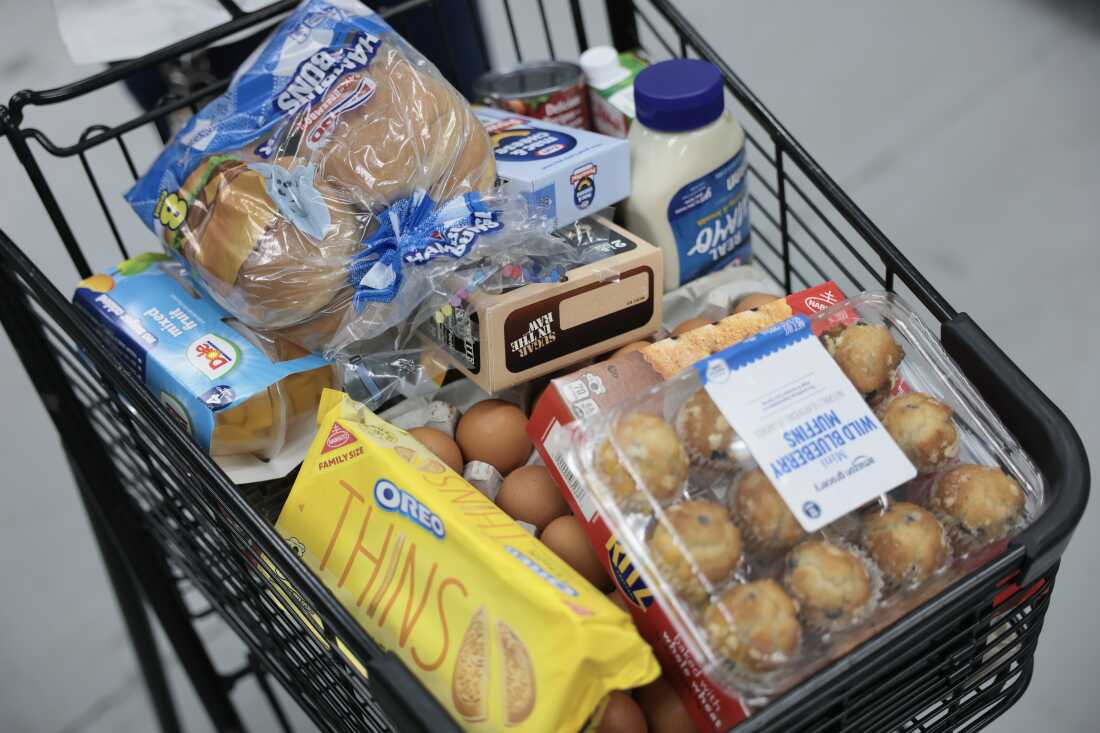
A grocery cart is full of food items as a person shops at the Feeding South Florida food pantry on July 8 in Pembroke Park, Fla.
The largest food assistance program in the U.S. is undergoing a massive overhaul. But even before the most drastic changes take effect, more than 4 million people are estimated to have already lost the critical food aid between last July and April — many of whom are children.
The Supplemental Nutrition Assistance Program, also known as SNAP or food stamps, has seen a rapid and consistent decline in participation since last July, the same month that a sweeping Republican tax and spending package became law. The One Big Beautiful Bill Act included major changes to the food assistance program. At the time, the White House called SNAP "bloated" and said it was failing its mission to serve as "temporary help for those who encounter tough times."
Starsky Wilson, the president of the Children's Defense Fund, a child advocacy group, says he has been alarmed by the speed of the tax law's impact.
"We're upset about how quickly this has happened," he says. "There are some supports that are still staged to go away later this year. So there could be an even greater sense of desperation among children and their families as we come to the end of this year."
The food assistance program has already begun tightening eligibility. But the biggest shift, the restructuring of SNAP's funding model, starts in October. Each state will soon have to pay millions in additional costs to keep the program going. Food policy experts warn that these new costs could drive states to scale back or withdraw from SNAP. If that happens, neither food banks nor existing government programs would have the capacity to fill the gap, according to Wilson from the Children's Defense Fund.
" There's no replacement for SNAP if a state gets rid of it," he says.
Here's how the program works, where things stand and what's changed.
Changes in eligibility
Under the One Big Beautiful Bill Act, more adults need to prove they work or volunteer for at least 80 hours a month to access food benefits. These work requirements now apply to veterans, homeless individuals, young adults aging out of foster care, parents with a child between 14 and 17, and people between 55 and 64.
Changes to work requirements alone are expected to reduce SNAP participation by 2.4 million people in an average month over the 2025-2034 period, according to the Congressional Budget Office.
Last summer's tax law also cut food stamp eligibility for certain immigrants. While almost all recipients are either native-born or naturalized citizens, a tiny fraction are noncitizens, according to federal data. Members of that small group — refugees, people seeking asylum and victims of domestic abuse or trafficking — are now no longer eligible for federal food aid.

The current fallout
Last year, an average of 42 million people received food stamps to use toward groceries each month. That's about 1 in 8 Americans. As of April, the total is now 37 million people, according to preliminary data from the Agriculture Department.
Nationally, SNAP participation is down by 11% between last July and April, according to the Center on Budget and Policy Priorities (CBPP), a left-leaning think tank. So far, the biggest impact has been in Arizona, where SNAP enrollment is about half the size it was a year ago, or over 400,000 fewer participants. For the first time, there are more Arizonans visiting food banks each month than enrolled in food stamps, according to the Arizona Food Bank Network.
"We think of ourselves as the canary in the coal mine," says Natalie Jayroe, the CEO of the Community Food Bank of Southern Arizona. "We are showing the rest of the country a really scary scenario."
Alongside Arizona, some of the steepest declines took place in Louisiana, Florida and Oklahoma. The CBPP also reviewed data from 19 states that provided numbers of children on SNAP and found that in those states alone, over 1 million kids have lost food benefits since last July.
What's driving the decline
In a July statement, the Agriculture Department told NPR that participation for food benefits tends to fluctuate and the drop isn't representative of any one policy. Back in late April, Agriculture Secretary Brooke Rollins also spoke about the decline, adding that it's possibly a good sign.
"A lot of it is people taking the program that shouldn't have been, and then a lot of it is just a better economy," she said on Fox Business.
Katie Bergh, a senior policy analyst at CBPP, is skeptical of this assessment. She points out that over the past year, unemployment has largely stayed flat while food prices continue to go up.
" What that's telling us is that this is not happening because fewer people need help affording groceries. It's the result of these policy changes," she says.

According to Bergh, part of the issue is that many state agencies are struggling with staffing pressures and paperwork backlogs, especially amid efforts to prevent errors on food aid applications and avoid new federal penalties.
"People are calling and calling, and they can't get through to anyone," she says. "Or they're being asked for more and more and more documentation of every aspect of their lives, and maybe they don't have a way to document everything."
That's in line with a survey conducted by the Urban Institute and the American Public Human Services Association (APHSA). Out of 39 states that responded to the survey, 15 states said they were prioritizing payment accuracy over benefit timeliness.
More drastic changes to come
One of the most consequential changes from last year's tax law is the upcoming cost burden on states.
Before, the federal government split the bill 50-50 with states to cover administrative expenses, such as paying and training staff at state agencies. But starting in October, the federal government will only pay 25% of those costs while states will have to shoulder the remaining 75% of operational expenses.
Furthermore, in October 2027, the federal government will no longer cover the full cost of food benefits. States will also need to chip in if their error rate — a measure of overpayments and underpayments — is at or above 6%. Almost half of states may each owe $100 million or more because of penalties tied to their error rate, according to the think tank CBPP.
The Agriculture Department has argued that improper payments totaled $10 billion last year. It's important to note that an error rate largely reflects unintentional mistakes by state agencies or food stamp recipients, according to CBPP's Bergh.
"It largely reflects unintentional mistakes by state eligibility workers and participating families," she says. " So someone made a typo or a state worker misapplied a policy or a family didn't understand what information they needed to report and when."
SNAP experts say it takes time to lower those rates, which is why some local officials are urging the federal government to delay the new penalties.

Through all of these changes, the Georgetown Center on Poverty and Inequality estimates that on average, states will need to spend two to three times more on SNAP to keep the food assistance program running — which could result in higher taxes or other state budget cuts.
In the same survey conducted by the Urban Institute and the APHSA, 29% of states said they may consider further narrowing eligibility for food assistance, while 11% said they may need to withdraw or pause the program altogether if the new costs become too burdensome.
" There's really an existential crisis in the future of SNAP," says Lexie Kuznick, the director of policy and government relations for APHSA.
Changes to SNAP have ripple effects — not only on low-income Americans, but also across food banks and grocery stores, according to Kuznick. The National Grocers Association estimates that the drop in shoppers receiving food aid will reduce grocery store sales by nearly $88 billion nationwide through 2034.
"Groceries are a significant cost in the lives of low-income families, and it truly is a lifeline for them to be able to meet their family's needs," Kuznick says. "We also know how critical the benefits are for entire communities."