Wednesday, June 24, 2026

Power outages in France as Europe bakes in record heat

Power outages in France as Europe bakes in record heat

https://www.aljazeera.com/news/2026/6/24/power-outage-in-france-as-europe-bakes-in-record-heat 

Power outages in France as Europe bakes in record heat

France and UK declare record-breaking temperatures as WHO says Europe heatwave putting people’s ‘health at risk’. 

A woman walks and uses a handfan on a bridge over the Seine river in central Paris
A woman walks and uses a handfan on a bridge over the Seine River in central Paris, as France experiences a heatwave, on June 21, 2026 [Arnaud Finistre/AFP]

Much of Western Europe is in the grip of a sweltering heatwave that has smashed temperature records in many countries and left tens of thousands of people without power in France.

France on Wednesday experienced its hottest day since measurements began in 1947, the national weather agency said, breaking a record set just a day earlier.

Recommended Stories

list of 4 itemsend of list

The national temperature indicator – an average of daytime and nighttime temperatures across 30 stations – reached 30 degrees Celsius (86 degrees Fahrenheit), Meteo-France said, citing provisional data, a day after a record 29.8C (85.64F) was measured on Tuesday.

The extreme weather is being driven by atmospheric and circulation patterns that keep hot air trapped in place for days, causing the mercury to slowly rise, as global warming exacerbates these factors, experts said.

France’s heatwave is expected to continue this weekend, with temperatures forecast to reach around 40 to 42C (104-107.6F), Meteo-France announced on Wednesday.

The heatwave caused the country’s first major power outage of this latest bout of extreme weather after a heat-related incident with a transformer left about 68,000 households on Wednesday without electricity in the northwestern department of Finistere, authorities said.

While teams worked through the night to fix the issue, which took place late on Tuesday, power is not expected to be fully restored until the end of Wednesday at the earliest.

Up to 106,000 clients of the French power network were left without power by late Tuesday as the scorching temperatures strained infrastructure built before man-driven climate change made heatwaves longer, more frequent and more intense, according to scientists.

Sales of fans and air conditioners, meanwhile, skyrocketed in a country where most buildings are not designed to deal with extreme heat.

Added to the 31 departments currently on orange alert, more than 90 percent of the French population is exposed to extreme heat with temperatures between 39C and 41C (102.2F-105.8F) expected on Wednesday from Brittany to Paris and in much of the southwest.

1:42
  • Now Playing
    01:42
    Deadly heatwave grips Europe as temperatures soar across continent

    Deadly heatwave grips Europe as temperatures soar across continent

  • Next
    02:24
    More than $300bn needed to rebuild Iran after US and Israeli strikes

    More than $300bn needed to rebuild Iran after US and Israeli strikes


At least 48 people have died in France from drowning as they attempted to seek respite from the crippling heat, while two young children were killed by heat in a car, authorities said.

The World Health Organization (WHO) warned that the heatwave hitting Europe was putting people’s “health at risk”.

“We cannot afford further delay. Leaders must prioritise investment in climate-resilient health systems, while also accelerating climate action and mitigating the drivers of the climate crisis,” said Tedros Adhanom Ghebreyesus, the head of the WHO.

UK: ‘Hottest’ June day

In the United Kingdom, the Met Office weather agency said it had recorded the UK’s hottest June day on record, with a provisional temperature of 35.7C (96.2F) on Wednesday, breaking the previous record from the summer of 1976.

The office issued a “red” heat health alert for Wednesday and Thursday for much of central and southern England, as well as Wales. This is only the second such warning ever issued by UK authorities. The first was in July 2022, when temperatures exceeded 40C (104F).

The peak of the heatwave is now forecast for Wednesday and Thursday, when highs could reach 39C (102.2F) in London and southern England.

“Red warnings are reserved for the most severe events, and we’re expecting severe and significant impacts from this heatwave, with health impacts likely for many, even beyond those who are normally more vulnerable to the heat,” said Mark Sidaway, deputy chief forecaster for the UK Met Office.

Conditions are expected to ease by Friday, the Met Office said.

Some schools in England are closed due to the heat and many train services have been cancelled, with passengers urged to avoid nonessential travel in areas covered by the red warning.

Eurostar said it cancelled four trains planned between London and Paris on Wednesday and Thursday “due to expected adverse weather”.

2:24
France records hottest-ever night as 40 drown trying to escape heatwave

No quick relief for Western Europe

Italy’s Ministry of Health declared a red heatwave alert in 16 cities on Wednesday, including Milan and Rome.

In mainland Spain, the national weather agency AEMET said that the highest daily average temperatures in June since at least 1950 were recorded on Monday and Tuesday.

Monday’s figure of 28.08C was followed by 28.17C on Tuesday, breaking the previous record of 28.01C on June 30, 2025, AEMET said in a statement on Wednesday.

Two elderly people died of heatstroke in Spain, which has experienced extreme temperatures since the weekend, exceeding 40C.

Some relief could start to come in Spain on Wednesday when the country’s State Meteorological Agency said temperatures would drop in most of the country.

By Wednesday afternoon, only parts of the Basque Country in the north will still be marked red, and on Thursday, no part of Spain will be rated either red or orange.

But no quick relief is in sight across the rest of Western Europe.

From Wednesday until at least Friday, the central and southern Netherlands will be under a code orange for extreme heat, while Belgium has placed the entire country under an orange heat alert starting on Thursday as a record-breaking heatwave looms, according to the newspaper Le Soir.

Eastern Europe to be hit next

In the coming days, the heatwave is expected to extend into Eastern Europe.

Poland’s weather service issued high-level heat warnings for the western part of the country from Thursday to Saturday, predicting that temperatures could break the record of 40.2C (104.4F) set in 1921.

Croatia’s popular Adriatic coast was also put under red alert for Friday and Saturday.

Hungary, already under a second-level heat alert, said it was raising that to the maximum level from Saturday to Tuesday as temperatures continued to rise.



Republicans brace for Trump SAVE Act showdown

Republicans brace for Trump SAVE Act showdown

https://www.axios.com/2026/06/23/trump-senate-republicans-save-act-thune 

16 hours ago - Politics & Policy

Republicans brace for Trump SAVE Act showdown


This is Donald Trump

Photo: Allison Robbert/The Washington Post/Bloomberg via Getty Images


Dems Celebrate Housing Bill: “We Finally Did Something”

Dems Celebrate Housing Bill: “We Finally Did Something” 

https://newrepublic.com/post/212265/bipartisan-housing-warren-steel-chassis

Democrats and outside experts say more is needed. But more might also require some key victories in November.

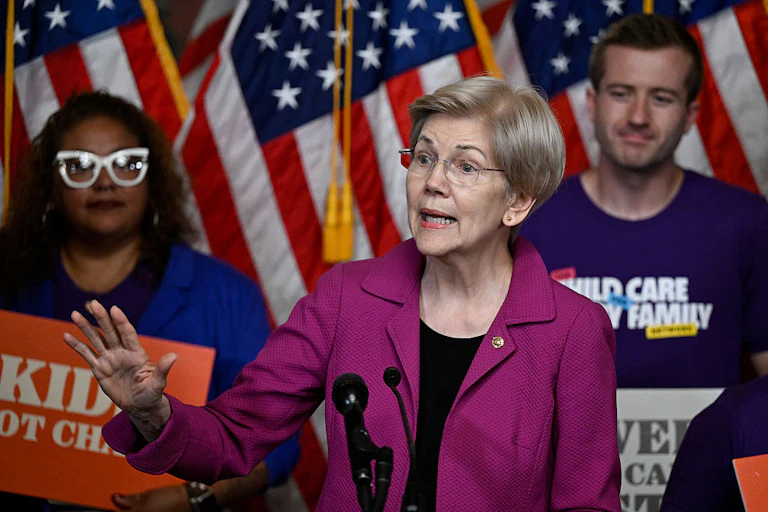
Elizabeth Warren gestures as people with signs stand behind her.
Daniel Heuer/Bloomberg/Getty Images
Senator Elizabeth Warren

The bipartisan housing bill the House and Senate passed this week doesn’t go far enough, Democratic leaders say. But it’s still one of the most significant pieces of housing legislation passed in decades. Further Democratic goals on housing might have to wait for a new Congress.

The 21st Century ROAD to Housing Act, which President Trump could sign as early as Wednesday, was a collaboration between Senate Banking Committee Chairman Tim Scott, a Republican from South Carolina, and ranking member Elizabeth Warren, a Democrat from Massachusetts. On Monday night, the bill passed the Senate handily with a vote of 85–5. On Tuesday, the House advanced it with a 358–32 vote.

“The biggest win is we finally did something,” said Senator Peter Welch, a Democrat from Vermont, gesturing at Congress’s usual partisan gridlock. “In this world, the fact that you’ve got Tim Scott and Elizabeth Warren and the entire U.S. Senate to support housing shows that we’re finally focusing on something that really matters to the American people. So I see it as a beginning.”

In terms of substantive victories, Warren emphasized a restriction on the purchase of new single-family homes by large institutional investors that own at least 350 single-family homes.

“For the first time ever, [we] tell private equity ‘no,’ they cannot mow through every neighborhood in America and turn us into a nation of renters,” she told The New Republic.

Warren also pointed to the bill’s efforts to increase housing supply, which housing policy expert Will Fischer of the Center on Budget and Policy Priorities called the “central theme” of the bill. The bill removes some regulatory barriers and streamlines environmental reviews to accelerate the construction of affordable housing—including the first federal guidelines on zoning reform. The bill also creates an “Innovation Fund” that rewards communities that successfully build more housing.

By removing the requirement that manufactured homes have a permanent steel chassis beneath them, the bill could bring down the cost of a new unit by up to $10,000, according to Warren’s office.

These provisions, Fischer said, are “part of what’s needed to address the housing crisis in the country to build more housing, but they are only a first step in order to really solve the affordable housing crisis.”

So what’s next? Fischer pointed to the need for more rental assistance programs that will help the lowest-income Americans afford a place to live. Increasing the supply of housing is critical, he said, but not sufficient to fix the issue. “No matter how much we build, that’s never going to be enough to make housing affordable to tens of millions of people with low incomes,” he said.

Rental assistance programs are a harder sell with Republicans, and the Trump administration has attempted to cut such programs through the Department of Housing and Urban Development. “It’s unlikely that the current Congress is going to take the kind of action that’s really needed to sharply reduce homelessness and evictions,” Fischer said.

Democrats echoed that sentiment in their public statements. “Our work is far from over and this is not the end of the conversation. It is the beginning of a renewed effort to tackle our housing affordability crisis and ensure every American has access to a safe, decent, and affordable place to call home,” said Representative Maxine Waters, a Democrat from California and the ranking member on the House Committee on Financial Services, in a statement.

Still, the message on Tuesday was one of optimism. “Let me put it this way,” Warren said. “The bill is not the one I would have written all by myself, but there are some really big wins here that made all the work and all the pain totally worthwhile.”

Inside the Massive AI Spending War in New York’s Primary

An OpenAI-affiliated PAC has spent over $7 million to defeat Alex Bores. An Anthropic-affiliated PAC has spent $10 million to boost Bores. What is going on?

Alex Bores stands in front of a crowd of supporters holding signs.
Michael Nagle/Bloomberg/Getty Images
New York State Assemblymember Alex Bores

As New Yorkers head to the polls on Tuesday, a crowded Democratic primary in the state’s 12th congressional district could serve as a referendum on tech money in politics. But why this race has drawn quite so much money is a little mysterious. To some, it’s an intra-industry disagreement about the best approach to regulation—or, more cynically, a fight about which companies will get to influence future law. To others, it’s a sign that certain pro-AI interests want to make an early and brutal example of anyone who stands against them.

AI industry political action committees have flooded this race with cash since it started. Leading the Future, a PAC funded in part by tech giants like Andreessen Horowitz and the co-founders of OpenAI and Palantir, has spent over $7 million against one particular candidate: two-term New York Assemblymember Alex Bores. Other PACs then jumped in on Bores’s behalf, including Public First Action PAC, which is supported in part by Anthropic and spent $10 million in Bores’s race.

Bores, a former Palantir employee himself, might seem like an oddly small-fish target for one of the country’s richest, most powerful industries. His troubles with the PACs started with the Responsible AI Safety and Education, or RAISE, Act, an AI regulation bill he co-sponsored last year in the state legislature.

The act, Bores’s own team acknowledges, is merely a “first step” toward robust AI regulation. Yet it’s also one of the strongest AI oversight laws currently on the books in the U.S.

The bill, which New York Governor Kathy Hochul signed into law in December 2025, is somewhat aligned with California’s Transparency in Frontier Artificial Intelligence Act, signed into law earlier that year. Both laws only apply to the largest AI companies, like OpenAI, Anthropic, and Meta. New York’s RAISE Act requires these large frontier developers to write and publish a yearly framework that explains how the company will assess risk, mitigate any safety threats, and comply with national and international standards. The law also requires these companies to disclose serious safety incidents within 72 hours of learning about them, and introduces an enforcement mechanism, empowering New York’s attorney general to bring civil actions against companies that fail to submit the required reporting or make false statements. Bores and State Senator Andrew Gounardes—the bill’s other champion—originally wanted the penalty for the first violation to be $10 million, with up to $30 million in fines for subsequent violations, but the lawmakers brought those fines down to $1 million and $3 million to better align with California’s law.

The bill was wildly popular with New Yorkers—84 percent of respondents supported it in a June 2025 poll—and it passed handily in both the state Senate and Assembly. But it quickly received pushback from the AI industry; Leading the Future announced its plans to target Bores in November 2025, before the bill had even been signed.

“They want to send a message to any member of Congress that the cost of trying to regulate the AI oligarchs is complete political destruction,” said Alyssa Cass, a communications strategist working with the Bores campaign.

The Trump administration also attempted to get out in front of the law, publishing an executive order on AI regulation just eight days before Hochul signed the RAISE Act. The executive order directed the Department of Justice to challenge “onerous” state AI laws that it believes conflict with a “minimally burdensome” national AI policy. In the order, the administration specifically said that state AI regulation hampers the country’s ability to “win” its “race with adversaries for supremacy” and called state laws “cumbersome.”

Asked about the PAC’s heavy spending against Bores, a Leading the Future spokesperson provided a statement arguing that “Anthropic and its allies” started the spending war: “Their network of outside groups has spent $21 million across 5 dark-money super PACs to prop up Alex Bores’s campaign. Leading the Future is proud to stand against that unprecedented effort and for a transparent, national AI framework that serves workers, families, and the country.” The statement added that “any claim that we oppose regulation is flat wrong.”

Public First Action explicitly markets itself as a pro-regulation PAC. One of its main principles is to support federal AI regulation, but ensure that it would not preempt state laws until the federal guidelines are robust enough to stand on their own. Anthropic, which has positioned itself as the safety-first tech company, gave $20 million to the PAC this February. The PAC’s other funders are less clear.

Asked about Public First’s involvement in Bores’s race, a spokesperson for Jobs and Democracy, a subsidiary of Public First Action, wrote that opposing PACs were trying to “end [Bores’s] political career” in retaliation for the RAISE Act. “We’re in this race because candidates who champion AI guardrails shouldn’t have to stand alone against Big Tech. The fact that this race has gone from a crowded primary to a two-way race between the author of the RAISE Act and a cosponsor is proof that Leading the Future’s plan has backfired.”

While Bores is betting that his strong stance on AI and public battle against AI PACs will win him the election, his opponents are focusing on other issues. Bores has three main competitors—State Assemblymember Micah Lasher, Jack Schlossberg of the Kennedy family, and the formerly Republican, anti-Trump crusader George Conway (once-husband of Trump 1.0 adviser Kellyanne Conway).

Lasher—who also supported the RAISE Act—has been described in the media as a “nerd” or “wonk,” and is running a strong if somewhat bland campaign. He was in the lead in one mid-May poll. Schlossberg’s campaign has reportedly been disorganized, and the candidate seems to be banking on his family legacy to overcome his relative lack of political experience. Conway has framed his campaign as an effort to impeach Trump.

If Bores loses, it may simply be because voters were drawn to the allure of a Kennedy or inclined to vote for a policy wonk. Then, too, some voters may remain put off by Bores’s former work for Palantir—a company whose AI software has reportedly been used to identify military targets. To his supporters, though, a Bores loss would show that the AI industry has a powerful grip on our elections, and can push out any candidate it doesn’t like. And if that message gets around, Cass said, it will be that much harder to get politicians to stand up to the industry.

“Members of Congress are rarely known for their acts of political bravery,” Cass said. “And there is a really limited window, given how fast this technology is moving, for regulation.”


Trump Humiliates Congress’ MAGA Toadies With Wild Tantrum

Trump Humiliates Congress’ MAGA Toadies With Wild Tantrum

https://www.thedailybeast.com/trump-humiliates-congress-maga-toadies-with-wild-tantrum/ 

Trump Humiliates Congress’ MAGA Toadies With Wild Tantrum

STABBED IN THE BACK
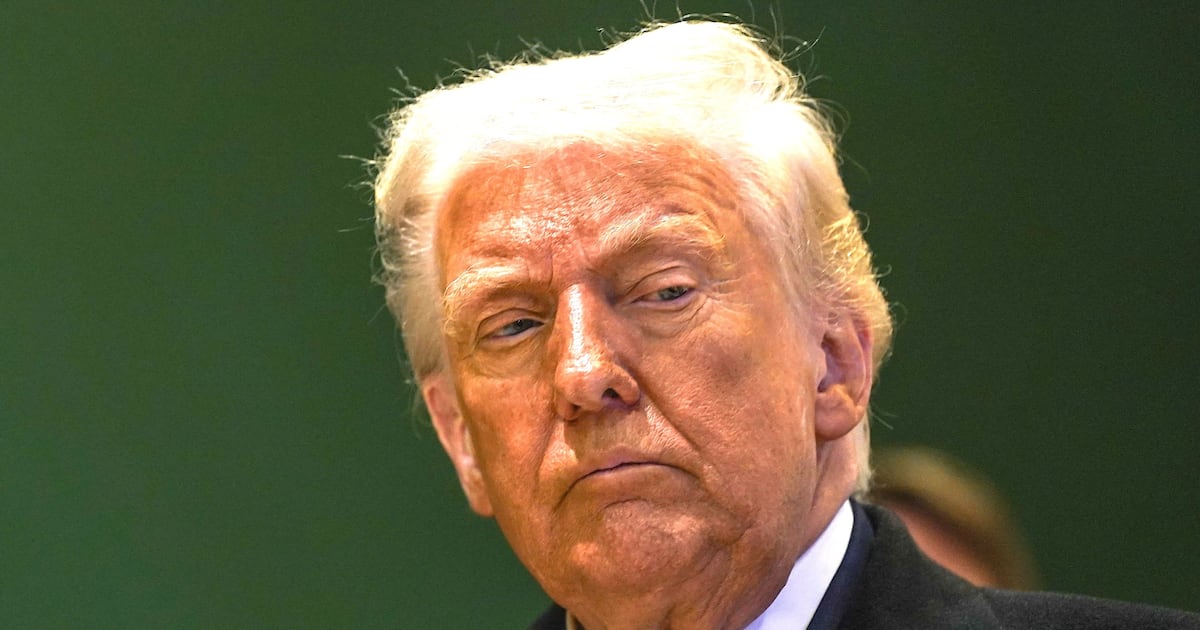
U.S. President Donald Trump checks his hair before sitting down for a podcast interview at the Varsity restaurant in Rome, Georgia, U.S., February 19, 2026.
Kevin Lamarque/Reuters

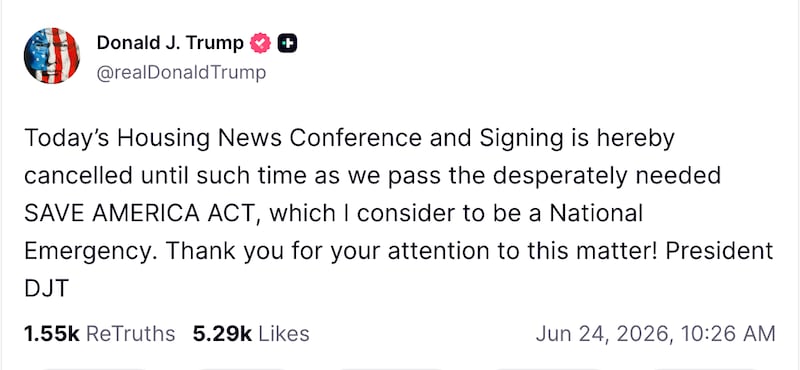
President Donald Trump threw a huge wrench into Republicans’ celebration of the passage of a key piece of legislation on Wednesday by abruptly canceling the bill signing.

“Today’s Housing News Conference and Signing is hereby cancelled until such time as we pass the desperately needed SAVE AMERICA ACT, which I consider to be a National Emergency,” Trump wrote.

The move shocked Republicans, who have been desperate for legislative victories to tout on the campaign trail as they head toward the midterms in November.

ADVERTISEMENT

Trump freaks out in post.
President Donald Trump abruptly canceled a bill signing on Wednesday, stunning Republicans. X

The president was set to sign the bill with Majority Leader John Thune and Speaker Mike Johnson at noon on Capitol Hill.

Thune offered a muted reaction when informed of the president’s abrupt cancellation.

ADVERTISEMENT

“I just heard that,” he said, according to Punchbowl News. “I guess I would say, at this point, I don’t have any observations about that.”

Republicans, who were in the middle of a news conference touting the housing bill and Trump’s support of it when he made his bombshell Truth Social post, were left stunned by the move.

A senior aide to a Republican senator told Punchbowl that it is as if Trump is trying to lose his Senate and House majorities in November.

“We saw glimpses of this during Trump’s first administration, but never in my lifetime have I seen a president so deliberately attempt to lose majorities for his own party,” the aide said.

This is a breaking story and will be updated...