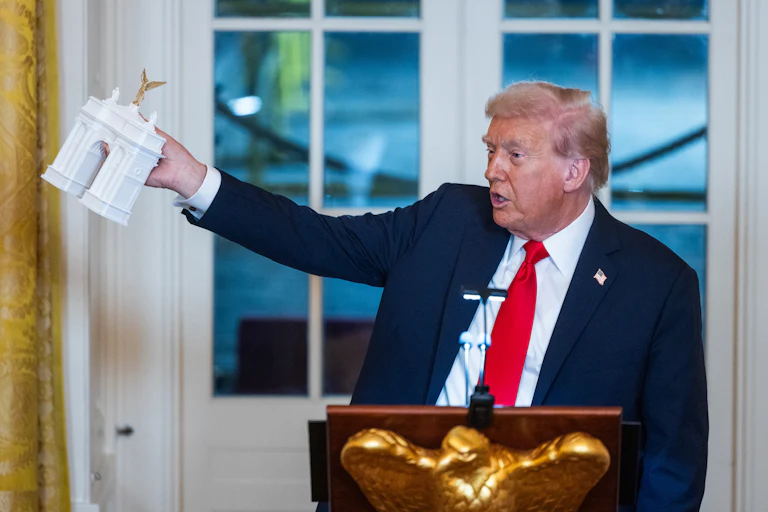
As a thin crowd made for the exits,
he also touched on the matter of state that’s consumed most of his time
lately: “The Reflecting Pool that you’ve heard so much about, which is
so incredible, it’s been gruesomely vandalized by thugs, bad people, but
soon will be looking as beautiful as it looked just two weeks ago,”
Trump said. “In fact, I looked at it just a little while ago. It looks
perfect already, but we’re fixing it.” As it happens, the Reflecting
Pool is still green, still peeling, and half-assedly stashed behind some chain-link fence. It may be a federal crime for me to report this, it’s not really clear.
All
of this is definitely a product of ego, but it’s also highly
reminiscent of Confederate kitsch. Trump’s drive to commemorate himself,
which has even run afoul of some of his fellow Republicans, is animated
by the same idea as the Lost Cause: to lend legitimacy to a period of
betrayal and to ensure this malevolent force lives on. Allowing the
Confederacy to commemorate itself was a profound failure on our part,
and it seeded the earth for the weakening of our democracy. As Trump
plans to sully the District of Columbia’s skyline with his triumphal
arch (now with more fist!), I can see history repeating: Trumpism as the new Lost Cause.
I am hardly the first to evoke this comparison. As The Atlantic’s David Graham wrote back in 2020,
Trump spent his Independence Day marinating in a variety of Lost Cause
grievances: the decision to remove the Confederate iconography from the
Mississippi state flag and NASCAR events, the renaming of the Washington
Redskins and Cleveland Indians, along with the usual suspects
(“the radical left, the Marxists, the anarchists, the agitators, the
looters, and people who, in many instances, have absolutely no clue what
they are doing”).