Events, Petitions, and Volunteer Opportunities
https://www.mobilize.us/?from_map=true&lat=37.0902&lon=-95.7129&zoom=2.5
Events, Petitions, and Volunteer Opportunities
Events and volunteer opportunities near map position
Want to stay in the loop?
songs poems and political musings, trumpmas, dada, drumpf, the 40 days of trumpmas, trump, election
If you can't see the content of video posts, please adjust your cookie settings

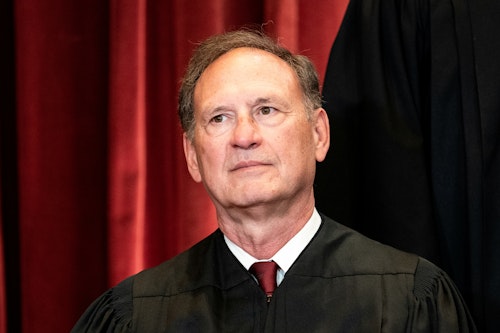
Alito in Washington, April 23, 2021. Erin Schaff/Pool via REUTERS
As we earlier mentioned, the dissenters are conservative Justices Clarence Thomas, Samuel Alito and Neil Gorsuch.
In a separate dissenting opinion, Alito called the birthright citizenship ruling "one of the most important decisions in the history of the Court," but said he believed the court had made a "serious mistake" with its ruling.
He said the decision will "confer citizenship on virtually everyone who happens to be born in this country, including the children of 'birth tourists,' women who come here solely for the purpose of giving birth to a child and then promptly return home."
"Careful analysis of the text of the Fourteenth Amendment and the process that led to its adoption shows that it does not degrade the concept of United States citizenship in this way," Alito wrote.
"Instead, the Fourteenth Amendment confers citizenship on only those children who, at birth, owe allegiance solely to this country."
He said that interpretation of the 14th Amendment "would not require uprooting the millions of children who were born here to mothers who entered or remained in this country illegally," as Congress could address their situation.
He said the Supreme Court "should not adopt an erroneous interpretation of the Fourteenth Amendment simply out of fear of the consequences of 'rocking the boat' or as a reaction to current immigration policy."

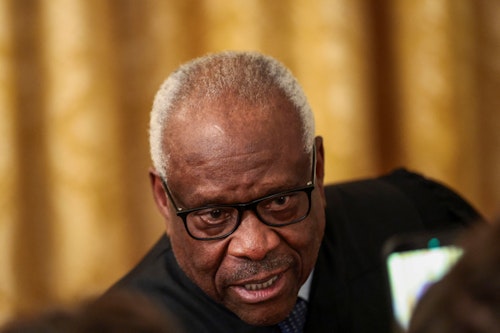
Thomas in Washington, D.C., May 22, 2026. REUTERS/Evelyn Hockstein
As we've been reporting, the ruling was a 6-3 majority decision. We can now bring you details from a dissenting opinion written by Justice Clarence Thomas and joined by his fellow conservative Justice Neil Gorsuch.
Thomas said the ruling widened the scope of the U.S. Constitution's 14th Amendment by extending to others a right originally being given only to previously enslaved Black people.
The freed Black people "were entitled to citizenship because they were Americans," with no other homeland or allegiance to any foreign powers, he wrote.
"The same could not be said for the children of foreign temporary visitors," Thomas wrote.
Justice Ketanji Brown Jackson responded in separate opinion joined by fellow liberal Justice Sonia Sotomayor, saying that despite Thomas' longstanding endorsement of a "colorblind" Constitution, he "now surprisingly suggests that the Citizenship Clause (the 14th Amendment) was a race-conscious remedial measure."
Jackson and Thomas are the only two Black justices serving on the Supreme Court.
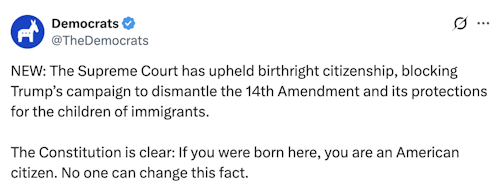
The Democratic Party welcomed Tuesday's decision in a post on X:

Source: @TheDemocrats on X
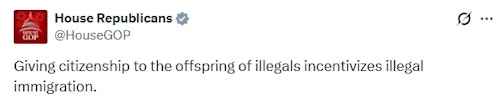
Also posting on X, House Republicans, who currently hold a narrow lead in the House of Representatives, said birthright citizenship "incentivizes illegal immigration."

Source: @HouseGOP on X
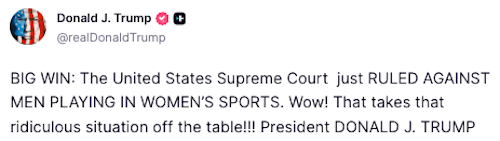
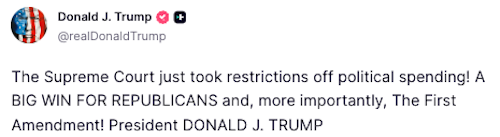
After the court released all three of its rulings, Trump posted his opinion of two of them on his Truth Social platform.
He celebrated the court clearing the way for transgender sports bans and striking down curbs on campaign spending:


Source: @realDonaldTrump on Truth Social
He has yet to comment on the birthright citizenship ruling.
However, ahead of the court's decision, he posted a link to a news article with the headline "Trump’s efforts to reverse birthright citizenship may succeed with or without SCOTUS."


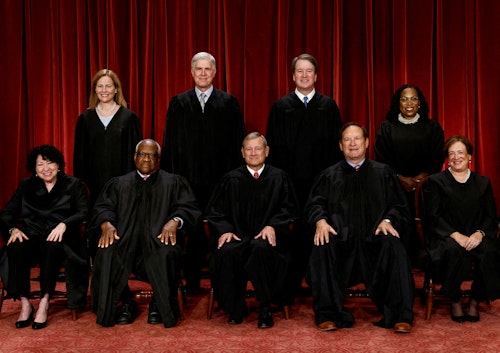
Sotomayor, Thomas, Roberts, Alito, Kagan (seated L-R), Barrett, Gorsuch, Kavanaugh and Jackson (standing L-R) at the Supreme Court, October 7, 2022. REUTERS/Evelyn Hockstein
The top judicial body in the U.S. is made up of nine presidentially appointed justices who serve life terms.
Since 2020, it has had a 6-3 conservative majority and has moved American law dramatically rightward.
John Roberts, 71, has served as chief justice for two decades, and often plays a pivotal role in deciding which way a ruling goes when the court is split.
Nominated to the court by George W. Bush, Roberts is one of the six conservatives.
The others are Clarence Thomas, 78, Samuel Alito, 76, Neil Gorsuch, 58, Brett Kavanaugh, 61, and Amy Coney Barrett, 54.
Like Roberts, Alito was nominated by George W. Bush, while Thomas, the court's longest-serving justice, was appointed by George H.W. Bush in 1991.
The other three conservatives were all appointed by Trump during his first term as president: Gorsuch in 2017, Kavanaugh in 2018 and Barrett in 2020.
The court's three liberals are Sonia Sotomayor, 72, Elena Kagan, 66, and Ketanji Brown Jackson, 55.
Sotomayor and Kagan were appointed by Barack Obama, and Jackson by Joe Biden.
We can now bring you some details on the positions of the individual justices on the birthright citizenship issue.
The court ruled 6-3 against Trump's order. The dissenters were Justices Clarence Thomas, Samuel Alito and Neil Gorsuch.
However, only five of the six who formed the majority — Chief Justice John Roberts, fellow conservative Justice Amy Coney Barrett, and the court's three liberal Justices Sonia Sotomayor, Elena Kagan, and Ketanji Brown Jackson — agreed that Trump's proposed directive was unconstitutional.
Conservative Justice Brett Kavanaugh concurred in the bottom-line result of the ruling, but had a different view on the reasoning.
He said Trump's order did not violate the U.S. Constitution but did run afoul of federal law first enacted in 1940 that provides that people born in the U.S. are citizens at birth.

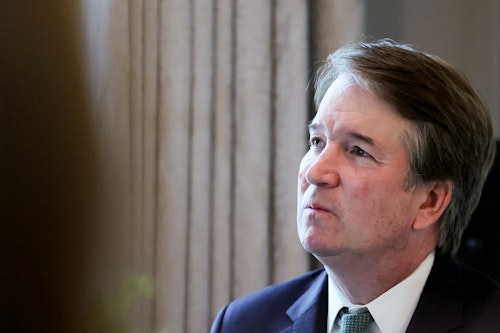
Kavanaugh in Washington, D.C., March 12, 2025. REUTERS/Leah Millis
He said the court's majority should have limited itself to ruling just on statutory grounds, which would allow Congress to enact new legislation establishing exceptions to birthright citizenship, if it chose to do so.
If Congress adopted a law along the lines of Trump's order, "such a statute, as I see it, would pass constitutional muster," Kavanaugh wrote.
Here's more from Chief Justice John Roberts.
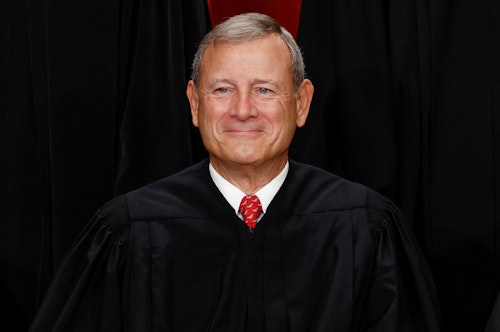
He said there was "scant evidence" to support the Trump administration's "dramatically revisionist view" of how to interpret the citizenship clause of the U.S. Constitution's 14th Amendment.
"If Congress intended to limit American citizenship to the children of those domiciled in the United States, nothing in the succinct language of the Citizenship Clause conveyed that design," Roberts wrote.
"Citizenship, then and now, was the right to have rights—to freely participate in our political community. The Framers of the Fourteenth Amendment extended that promise to 'every free-born person in this land,'" Roberts wrote. "We keep that promise today."

Roberts in Washington, D.C., October 7, 2022. REUTERS/Evelyn Hockstein
As we've just mentioned, the court decided in a 6-3 ruling to reject Trump's order limiting birthright citizenship.
Writing for the court, Chief Justice John Roberts pointed to a major Supreme Court ruling from 1898 in a case called United States v. Wong Kim Ark, which recognized that the 14th Amendment of the U.S. Constitution grants citizenship by birth on U.S. soil, including to the children of foreign nationals.
"Not surprisingly, then, in the 128 years since, we have repeatedly understood the rule of Wong Kim Ark to guarantee citizenship to all children born in the United States and subject to its power," Roberts wrote.
"We see no reason to depart from that view today."
The court has ruled against Trump's order limiting birthright citizenship, handing him a stinging defeat.
In a 6-3 ruling, the justices upheld a lower court's decision that blocked Trump's executive order directing U.S. agencies not to recognize the citizenship of children born in the U.S. if neither parent is an American citizen or legal permanent resident.
Trump, who has repeatedly tested the limits of presidential power in domestic and foreign policy, issued the order last year on his first day back in office as part of a suite of policies to crack down on legal and illegal immigration.
The decision marked the second time this year that the court has invalidated a major Trump initiative, following its February decision to strike down his sweeping global tariffs.
We now have the second of Tuesday's three expected rulings.
This one is on the issue of campaign finance.
The court has struck down campaign spending limits, this time rejecting federal restrictions on coordinated spending between political parties and their candidates on free speech grounds.
Siding with Vice President JD Vance and other Republican challengers, the court ruled 6-3 that a cap on the amount of money parties can spend on campaigns with input from candidates violates the U.S. Constitution's First Amendment protections against government abridgment of freedom of speech.
The ruling comes as major Republican committees head toward the November midterm elections with a significant cash advantage over their Democratic counterparts.
As we mentioned earlier, the court has not said in which order the rulings will be issued.
We are still waiting for the ones on birthright citizenship and on campaign finance limits.
We will bring you the rulings as we get them.
The Supreme Court has ruled in favor of laws banning transgender student athletes from female sports teams in West Virginia and Idaho.
The decision clears the way for other states to impose restrictions on transgender student athletes.
The justices overturned decisions by lower courts siding with transgender students who challenged the bans in the two states as violating the U.S. Constitution and a federal anti-discrimination law.
The Idaho and West Virginia laws designate sports teams at public schools including universities according to "biological sex" and bar "students of the male sex" from female teams.
Twenty-five other states have similar laws on the books.

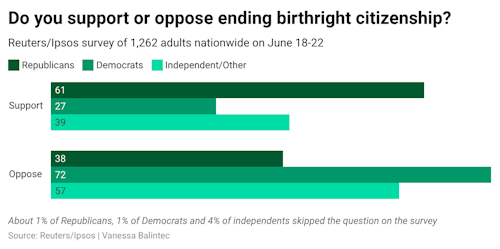
A majority of Americans oppose ending birthright citizenship, according to the latest Reuters/Ipsos poll.
The survey of U.S. adults found that overall, 55% of respondents support keeping the right, while 41% say it should be ended.
Views on the issue were polarized, with much stronger support for Trump's attempt to end birthright citizenship among Republicans than among Democrats or independents.

The poll also asked Americans if they thought Trump's war with Iran was worth its costs, and recorded his overall approval rating. You can read our full reporting on it here.
A protest outside the U.S. Supreme Court in Washington, D.C., May 15, 2025. REUTERS/Leah Millis
During the arguments, U.S. Solicitor General D. John Sauer, representing the administration, said the promise of citizenship for virtually any baby born on U.S. soil has spawned what he called a sprawling industry of "birth tourism."
Sauer said that "uncounted thousands of foreigners from potentially hostile nations have flocked to give birth in the United States in recent decades" to secure citizenship for their children.
Asked to explain how serious an issue "birth tourism" has become, Sauer primarily cited media reports and conceded that "no one knows for sure."

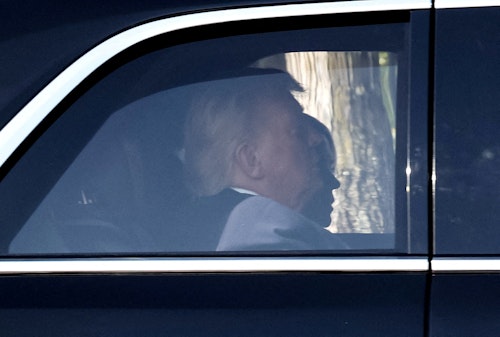
Trump and Bondi en route to the Supreme Court, April 1, 2026. REUTERS/Kevin Lamarque
In April, Trump made a historic visit to the Supreme Court to attend arguments over birthright citizenship.
The Republican president sat in the first row of the public section of seating in the ornate courtroom, but departed not long after the lawyer arguing for his administration completed his presentation and the attorney for the challengers began hers.
Trump left quietly, accompanied by Secret Service personnel.
He became the first sitting president to attend an oral argument at the Supreme Court, according to Clare Cushman, the resident historian at the Supreme Court Historical Society.
Trump was seated right next to White House Counsel David Warrington and in the same row as Commerce Secretary Howard Lutnick and then Attorney General Pam Bondi.
Read more here.

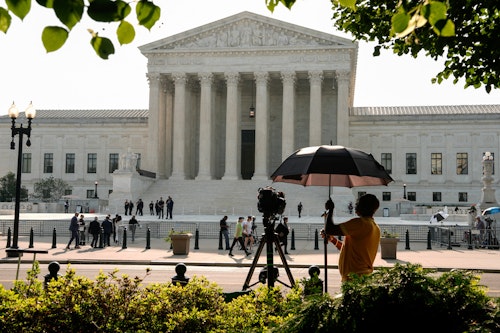
A media member in front of the Supreme Court, Washington, D.C., June 30, 2026. REUTERS/Cheney Orr
The court will start issuing Tuesday's three rulings at 10 a.m. in Washington (1400 GMT).
We do not know in which order they will come and it takes a few minutes to deliver each one.
On this occasion, as we've mentioned, we already know the issues being tackled are birthright citizenship, campaign finance limits and transgender sports.
That is only because this is the last set of rulings this term, and those three are the only ones still pending.
Usually, it's a guessing game as the court does not say which rulings will be issued on a given day.
The justices gather in the courtroom to read out summaries of their opinions. Cameras and electronic devices are not allowed there.
Most Supreme Court reporters listen to the rulings live on an audio feed piped to the court's public information office in order to quickly file their news reports as they are delivered.
Court staff also hand out physical copies of the rulings to reporters, but only once the justices have started announcing them orally.
Those copies are contained in boxes, typically with a maximum of two rulings per box, which gives the waiting journalists an idea of the number of rulings set to be issued.
For those who prefer to skip the ritual and work from the office, the rulings are posted on the court's website very shortly after they are announced.


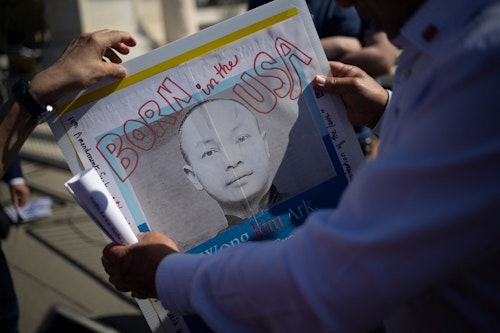
A picture of Wong Kim Ark, Washington, D.C., April 1, 2026. REUTERS/Carlos Barria
The birthright citizenship case implicates a Supreme Court ruling issued 128 years ago.
It involved a Chinese American man named Wong Kim Ark.
Amid a wave of fervent anti-Chinese sentiment in America at the time, the U.S. government sought to prevent Wong from re-entering the country upon returning to San Francisco by steamship from a trip to his parents' homeland of China.
The government authorities contended that, despite being born in the United States, Wong was not a citizen.
On March 28, 1898, the Supreme Court disagreed, recognizing that the U.S. Constitution's 14th Amendment grants citizenship by birth on U.S. soil, including to those like Wong whose parents were foreign nationals.
To hold otherwise, the court wrote, "would be to deny citizenship to thousands of persons of English, Scotch, Irish, German or other European parentage who have always been considered and treated as citizens of the United States."

The U.S. Constitution's 14th Amendment was ratified in 1868 in the aftermath of the Civil War of 1861-1865 that ended slavery in the United States.
It overturned a notorious Supreme Court decision from 1857 called Dred Scott v. Sandford, which had declared that people of African descent could never be U.S. citizens.
Trump wrote on social media last year: "Birthright Citizenship is about the babies of slaves."
Trump added: "It had nothing to do with Illegal Immigration for people wanting to SCAM our Country, from all parts of the World, which they have done for many years."


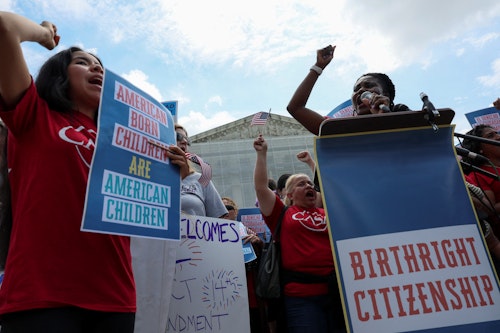
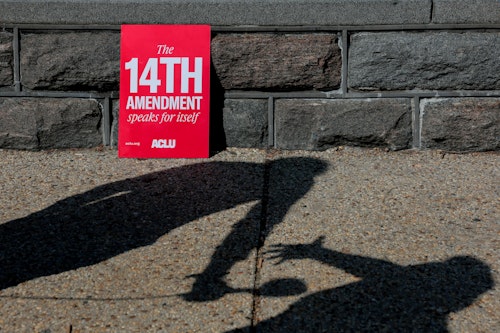
A placard during a demonstration outside the Supreme Court, April 1, 2026. REUTERS/Kylie Cooper
At issue in the case is the citizenship language of the Constitution's 14th Amendment.
The provision at issue, known as the Citizenship Clause, states: "All persons born or naturalized in the United States, and subject to the jurisdiction thereof, are citizens of the United States and of the state wherein they reside."
The administration has asserted that the phrase "subject to the jurisdiction thereof" means that being born in the United States is not enough for citizenship, and excludes the babies of immigrants who are in the country illegally or whose presence is lawful but temporary, such as university students or those on work visas.
Our Standards: The Thomson Reuters Trust Principles., opens new tab

Thomson Reuters
Estelle is a Senior Live Pages Journalist based in London, part of a team providing real-time multimedia coverage of the biggest news stories in the world. In her 25 years at Reuters, she has reported from Europe, Africa and the Middle East, covering everything from armed insurgency in the Niger Delta to Olympic beach volleyball.

Thomson Reuters
Vanessa Balintec is a Live Page Journalist based in Toronto, Ontario. She helps create and curate multimedia posts for Reuters’ Live Pages — a scrolling feed of multimedia posts for some of the biggest stories of the day. She previously worked at various bureaus for CBC News. Contact: vanessa.balintec@thomsonreuters.com
The U.S. Supreme Court handed President Donald Trump a stinging defeat on Tuesday by rejecting his move to restrict birthright citizenship on the final day of its momentous term, while also letting states ban transgender student athletes from women's sports teams and striking down more campaign finance limits.