Higher Grocery Costs Are Creating a Vicious Cycle of Household Debt
https://newrepublic.com/article/212952/high-grocery-costs-credit-card-debt
Higher Grocery Costs Are Creating a Vicious Cycle of Household Debt
As food prices tick up and more Americans turn to credit cards to make ends meet, the indirect effects of the war in Iran could lead to families losing their financial stability.
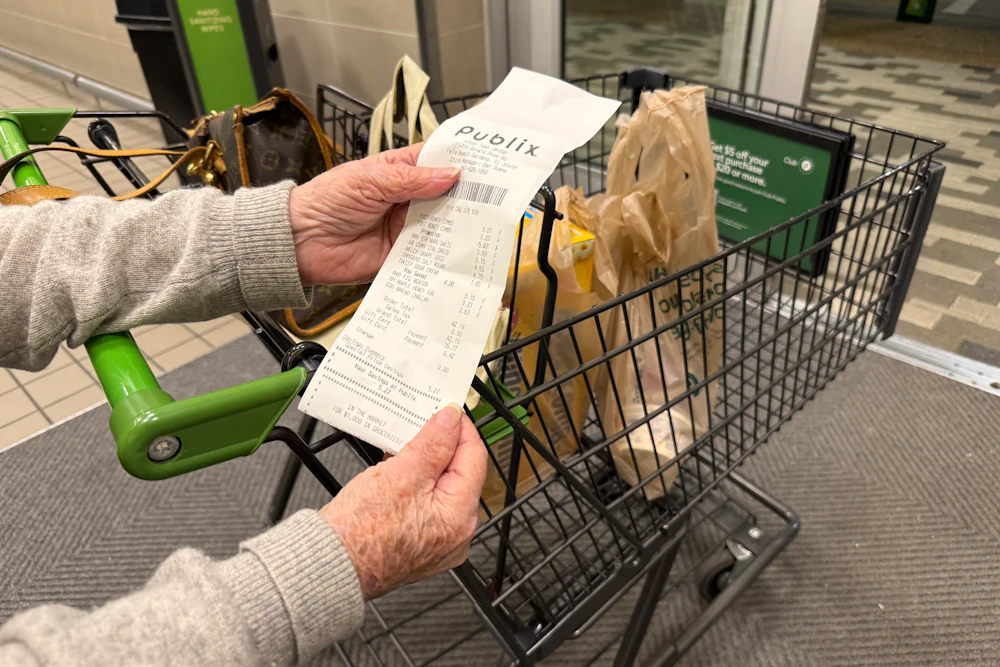
Higher grocery prices have plagued consumers for years, with President Donald Trump’s war in Iran exacerbating the spike in costs over the past several months. But what began with higher prices at the checkout counter has given rise to another worrisome trend: escalating household debt of the kind that can strain the credit of ordinary families, diminish their long-term financial stability—or leave them more vulnerable to future economic shocks.
Grocery and restaurant prices have ticked up since the coronavirus pandemic, due to exigent factors such as the war in Ukraine, Trump’s tariffs, and now the conflict in Iran. Repeated closures of the Strait of Hormuz, through which a large proportion of the world’s fuel and fertilizer is ferried, have resulted in higher operating costs for farmers, a trend that will indirectly affect grocery prices in the long term. According to recent data from the Bureau of Labor Statistics, prices for “food at home”—that is, the cost of groceries—increased by 2.7 percent between May 2025 and May 2026.
Although the price of eggs—a point of contention ahead of the 2024 presidential election—has decreased in the past year, other staples such as ground beef and sandwich bread have gone up. Mark Zandi, the chief economist at Moody’s Analytics, said that “almost everyone has a food item that they’re focused on. They buy regularly that they use as a benchmark for the cost of living and their financial situation.”
“The war is just exacerbating all the angst around,” said Zandi. “It’s a real problem financially, but also it’s being supercharged in the minds of people because people are really focused on the cost of food and groceries.”
Even if the Trump administration returned to its brief truce with Iran, the consequences of the conflict will be long lasting. Zandi predicted that the cost of oil will remain high for the next several years, even with producers seeking ways to bypass the Strait of Hormuz.
“There’s no going back on energy costs, at least not in the next couple, three, four years,” Zandi said. “I think we’re all going to be paying a lot more for energy, and that will translate into higher costs for everything, obviously including groceries and food more broadly.”
Higher grocery costs can lead to people using payment methods that threaten their financial stability down the line, such as relying on credit cards or cutting into hard-earned savings. A new report by the Urban Institute found that more than one in four working-age adults used credit cards to pay for groceries, and experienced difficulties with repayment. Moreover, between 2023 and 2025, there was an uptick in the share of adults between the ages of 18 and 64 who reported using credit cards to buy groceries and not always being able to meet the minimum repayment amount.
“If that debt burden becomes large and really difficult for them to manage and repay effectively, it can constrain their ability to meet their day-to-day needs in the future without experiencing hardships,” said Kassandra Martinchek, a senior research associate in the Tax and Income Supports Division at the Urban Institute and a co-author of the report. Other analysis by Martinchek previously found that credit card delinquencies increased by nearly 40 percent between 2022 and 2024, when food prices spiked.
This is a struggle felt by some portion of wealthier Americans. Although low- and moderate-income adults were more likely to report using a credit card for groceries and not being able to make repayments, the new report found that around 4 percent of high-income adults said the same.
The data also shows that around one in 10 adults used “buy now, pay later” options to pay for groceries, and one in 20 used cash from a payday loan to purchase food. Perhaps most notably, nearly 20 percent of working-age adults drew down on savings not intended for daily expenses to buy groceries. Adults who reported an increase in grocery prices were more likely to use savings not intended for daily expenses for purchasing food, and more likely to experience repayment challenges when using credit cards for groceries.
There are other factors that could contribute to higher costs of food in the long term. The rise in prices come amid dramatic changes to the social safety net, including sweeping cuts to the Supplemental Nutrition Assistance Program, or SNAP. Republican legislation approved last year tightened SNAP work requirements, and pushed a share of the cost of benefits onto states. The implementation of this latter provision over the next several years could result in states reducing benefit amounts or further restricting SNAP eligibility.
There is some evidence that losing SNAP benefits could lead to greater credit card expenditures on food. A 2025 report co-authored by Martinchek found that the end of pandemic-era “emergency allotments,” which increased a participant’s benefit amount, resulted in SNAP households putting roughly 24 percent more of their grocery bills on credit cards.
Martinchek said that paying for groceries with a credit card was not inherently a sign of lower financial insecurity. Some people may use this payment method to earn credit card rewards, for example. The risk comes when people pay for groceries using credit, but cannot repay their credit card debt all at once.
“Credit can be a lifeline. It can definitely help families smooth when they experience disruptions or aren’t able to meet their daily needs. But relying too much on this can sacrifice their current financial stability, and their future financial stability.” said Martinchek.


No comments:
Post a Comment