Missouri rejects citizens’ bid for vote on Trump-backed redistricting plan
https://www.theguardian.com/us-news/2026/aug/04/missouri-redistricting-plan-vote
Missouri rejects citizens’ bid for vote on Trump-backed redistricting plan
Missouri’s top election official has rejected a petition for a referendum on new congressional districts
Missouri’s top election official has rejected a citizens’ petition seeking a statewide referendum on the state’s redistricting plan backed by Donald Trump.
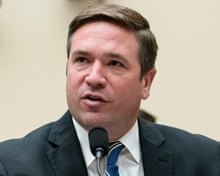
Supporters of the referendum had submitted hundreds of thousands of petition signatures in an effort to force a November election on whether to use a new US House map approved by the Republican-led state legislature. But the Republican secretary of state, Denny Hoskins, asserted on Tuesday that the petition was void because congressional redistricting plans cannot be subject to voter referendums.
The number of petition signatures submitted did not matter, Hoskins said, because “challenging a congressional map is unconstitutional under Missouri law”.
A group backing the referendum effort said it would contest Hoskins’ decision in court.
“Secretary of State Hoskins is making a last desperate attempt to silence the people’s voice in Missouri,” Richard von Glahn, executive director of People Not Politicians Missouri, said in a statement, while asserting there were more than enough signatures to qualify the referendum for the ballot.
Missouri was the second Republican-led state, after Texas, to respond to Trump’s call last year to redraw congressional districts to the GOP’s advantage in hopes of holding on to the party’s slim House majority in the midterm elections.
The new map, which is being used in Tuesday’s primaries, dramatically reshapes the Kansas City-based fifth congressional district, held by longtime Democratic representative Emanuel Cleaver, by stretching it into rural central Missouri to give it a Republican tilt. Republicans already hold six of Missouri’s eight congressional seats and hope to gain another under the new map.
Hoskins shoots down amendment on citizen initiatives
Hoskins also rejected a potential November ballot measure seeking to fortify the initiative process.
The proposed amendment would bar the legislature from making it harder to qualify citizen initiatives for the ballot or approve them at an election. It also would make it harder for the legislature to reverse or amend voter-approved initiatives by requiring an 80% vote in both the house and senate, instead of the current simple majority.
Although supporters had submitted thousands of signatures, Hoskins asserted that the petition violated a constitutional prohibition against rolling multiple subjects and sections of the constitution into a single amendment.
The Respect Missouri Voters coalition said it would take legal action to try to get its amendment on the ballot.
“This brazen disregard for the will of the people is exactly why the people of Missouri came together to gather signatures ... because we are sick of these games in Jefferson City,” said Bob Johnson, a coalition member and former Republican state senator.
For both the redistricting referendum and the citizen initiative measure, Hoskins released opinions from the Republican attorney general, Catherine Hanaway, laying out the rationale for his decisions.
People Not Politicians, the group sponsoring the referendum drive, submitted more than 300,000 signatures to the secretary of state’s office in December. Local election officials reviewed the signatures’ validity over the ensuing months and approved significantly more than the roughly 111,000 needed to qualify for the ballot.
But Hoskins waited until the last day allowed under state law to announce his decision about the referendum – a move that let the new districts be used in the meantime.
Hoskins had long signaled that he was likely to reject the referendum. He asked a federal court last fall to block the referendum petition from being submitted, arguing that congressional redistricting is not subject to a referendum under the US and Missouri constitutions. A judge dismissed the lawsuit as premature, noting in a December ruling that Hoskins had the authority to reject the petition himself if he thought it was unconstitutional.
When Missouri candidates began filing for office in February, Hoskins said they were doing so under the new districts and told the Associated Press that “the referendum process was never meant to be used for redistricting”.
If Hoskins is wrong, and a court orders him to place the redistricting referendum on the ballot, it’s unclear what that means for the 2026 elections. Would candidates who win Tuesday’s primaries be allowed to continue running under the new districts in November while voters simultaneously decide whether those districts can be used in future elections? Would candidates run in different districts for the general election than were used in the primaries? Or would courts order a do-over for the congressional primaries using the state’s prior congressional districts?
Missouri’s mid-decade redistricting effort already has been among the most litigated nationally, triggering about a dozen lawsuits over the past year.
Legislative voting districts typically are redrawn at the start of each decade, immediately after a census. But Trump’s call for Republicans to redraw districts to their advantage led to an unusual outbreak of mid-decade mapmaking. The redistricting effort gained additional steam when the US supreme court struck down a majority Black congressional district in Louisiana in late April, prompting Republicans in several southern states to also redraw districts that had large minority populations.
All told, Republicans think they could win as many as 16 additional seats from new House maps enacted in eight states – Texas, Missouri, North Carolina, Ohio, Florida, Tennessee, Louisiana and Alabama. Democrats, whose counterattack faced several setbacks, think they could win up to six additional seats from new districts in California and Utah.
Voters ultimately will determine whether the new districts perform as intended. Even with redistricting, Republicans are facing headwinds. The president’s party historically has lost congressional seats in the midterms, and Trump’s poor approval ratings could provide an extra hurdle for Republican candidates.
Nearly 145 million people – about two of every five US residents – live in states with new congressional districts for this election. Additional states are considering redistricting before the 2028 elections. Maryland lawmakers voted on Tuesday to place an amendment on November’s ballot that could pave the way for mid-decade redistricting.
At this dangerous time
We hope you appreciated this article. Before you close this tab, we want to ask if you could support the Guardian at this dangerous time for journalism in the US. For the next several days only, we are offering 50% off our most impactful monthly support option.
According to a leading global watchdog, American democracy is now more imperiled than at any point since the 1960s, marked by a precipitous decline in press freedom – driven by mounting pressure from the Trump administration in the form of threats, criminal investigations, politicized regulation, frivolous lawsuits and, for public media, catastrophic funding cuts.
Meanwhile, organizations that are supposed to be independent like the FBI and the FCC, our radio and television regulator, have also been targeting press freedom under Trump-aligned leadership, with the FBI raiding a reporter’s home and the FCC threatening ABC’s TV licenses after Jimmy Kimmel made a joke about Melania Trump.
The response from some ultra-wealthy and corporate media owners, keen to appease the president, has been chilling: CBS News has been taken over by a Trump ally; CNN may be taken over by the same billionaire; Jeff Bezos has continued to impose cuts and editorial interventions at the Washington Post; and multiple outlets have settled multimillion-dollar lawsuits from the administration to protect their business interests.
Democracy is best served by a robust, thriving free press. But when that freedom is under attack, it falls to a determined few news organizations to ensure the full truth still reaches the public. Owned neither by a billionaire nor a corporation, the Guardian remains dedicated to covering this administration with uncompromising moral and factual clarity – and to keeping trustworthy journalism paywall-free for the world.
Despite the risks of maintaining our fierce independence, what sustains us – and fills us with deep gratitude – is the unwavering support we’ve seen from readers. It is no exaggeration to say that we are here because of you: a majority of our funding comes directly from people like you responding to messages like this. Your support not only powers our work, but more importantly, it safeguards the financial independence that underpins our editorial freedom and courage.
We know our requests for support are not as welcome as our reporting, but without them, it’s simple: our reporting wouldn’t exist. Of course, we understand that some readers are not in a position to support us, and if that is you, we value your readership no less.
But if you are able, please support us today. All gifts are gratefully received, but for the next several days only, we are offering a 50% discount for six months off our most impactful monthly support option. (Among the great benefits you get in return: you’ll see far fewer annoying fundraising messages like this.) It takes just 37 seconds to set up. Thank you for considering.