This article originally appeared on PolitiFact.
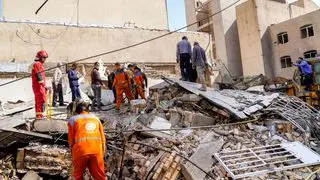
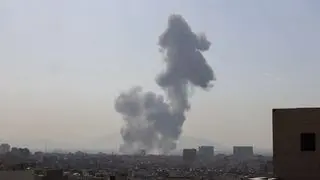
The United States and Israel bombed Iran Feb. 28, with President
Donald Trump accusing Iran of building nuclear weapons that threaten
U.S. allies and could "soon" reach the U.S.
WATCH: War with Iran | PBS News Special Report
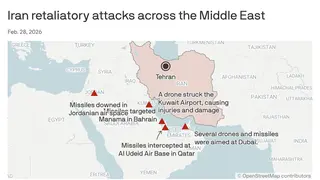
Iran retaliated by attacking Israel and Middle Eastern countries that host U.S. military bases.
Trump's eight-minute video shared
on Truth Social ended with a warning of the potential danger for U.S.
military members and an appeal to Iranians to overthrow their
authoritarian government.
Trump said the U.S. sought to make a deal with Iran after bombing three of its nuclear sites in June 2025, but Iran "rejected every opportunity to renounce their nuclear ambitions, and we can't take it anymore."
"Instead, they attempted to rebuild their nuclear program and to
continue developing long range missiles that can now threaten our very
good friends and allies in Europe, our troops stationed overseas and
could soon reach the American homeland," Trump said.
READ MORE: UN chief condemns U.S.-Israeli attacks on Iran during emergency Security Council meeting
Trump's statement is contradicted by a 2025 federal government
assessment that said Iran is years away from the ability to produce
long-range missiles; nuclear policy experts also cast doubt on the idea.
After Trump used similar language in his State of the Union address days earlier, Secretary of State Marco Rubio told reporters he wouldn't speculate how far away Iran is from having missiles that could reach the U.S.
"You've seen them increasing the range of the missiles they have now,
and clearly they are headed in the pathway to one day being able to
develop weapons that could reach the continental U.S," Rubio said.
Trump did not seek congressional approval for the military action. He
also acted unilaterally when launching June 2025 strikes on Iranian
nuclear facilities and for the January ouster of Venezuela's leader
Nicholas Maduro. Democrats and a handful of Republicans in the House and Senate are pushing to consider war powers resolutions addressing Iran next week.
A federal agency said missiles that could reach the U.S. are years away
The Defense Intelligence Agency released a missile threat assessment in May 2025 that said Iran could develop a long-range missile by 2035 if it chooses to pursue it.
"The U.S. intelligence community has been making a similar assessment
(that Iran might have an (intercontinental ballistic missile) in a
decade) since the mid-1990s," Daryl Kimball, executive director of the
Arms Control Association, told PolitiFact.
The White House did not immediately reply to PolitiFact's request for
comment about Trump's statement that Iran could "soon" have missiles
capable of reaching the U.S.
Richard Nephew, who worked for the U.S. government on Iranian issues
during the Biden administration, said Iran already has missiles that can
reach parts of eastern Europe.
Intercontinental ballistic missiles "are harder for Iran to achieve
now and I have no reason to doubt DIA's assessment," Nephew said. "Iran
does have the ability to hit Europe and is working towards capabilities
that could target the United States, but that those capabilities are
still many years away."
These timelines don't account for the possibility of other countries
helping Iran develop or obtain this technology, said Michael Singh,
managing director of the Washington Institute for Near East Policy.
Singh worked in the U.S. government, including the White House, from
2005 to 2008.
Russia, China and North Korea, some of Iran's closest allies, have intercontinental ballistic missiles.
Such a missile must be launched into space and survive re-entry into Earth's atmosphere. Iran has a nascent space program and recently collaborated with Russia on space launches.
Building a functional intercontinental ballistic missile capable of
striking the US would require overcoming substantial technical hurdles,
such as producing a nuclear warhead and successfully miniaturizing it,
Eliana Johns, a Federation of American Scientists senior research
associate, said.
Iran seems focused on short- and medium-range missiles, with a top
range of 2,000 kilometers, said Gary Samore, a Brandeis University
professor who worked on nonproliferation of weapons of mass destruction
in the Obama and Clinton administrations.,
The distance from Tehran to Washington, D.C., is about 10,000 kilometers.
In assessing Trump's justification for Iranian strikes, The New York Times cited
three unnamed American officials with access to intelligence about
Iran's missile programs who said Trump exaggerated the immediacy of the
threat to the U.S. Other outlets including CNN and Reuters had similar reporting.
Trump's assessment about 'obliterated' facilities is exaggerated
As he announced the Feb. 28 operation, Trump repeated his assessment
that the U.S. military "obliterated" Iran's nuclear facilities at
Fordow, Natanz and Isfahan.
His language contradicts a November 2025 White House document that said the strikes "significantly degraded Iran's nuclear program."
Top Trump administration officials were talking up Iran's capabilities in the leadup to the strikes. Trump envoy Steve Witkoff said Feb. 21 on Fox News Iran is "probably a week away from having industrial grade bomb making material."
When PolitiFact reviewed Witkoff's
comments with nuclear policy experts, they expressed skepticism about
the extent of the program's destruction, its supply of uranium and
Iran's desire to pursue enrichment.
The International Atomic Energy Agency, which tracks Iran's nuclear
program, has been unable to access the sites the U.S. bombed. In 2018, Trump withdrew from the Iran nuclear deal, which
had allowed monitoring of the country's nuclear program. This means
experts lack confirmed, independent information about the status of
Iran's efforts.
Chief correspondent Louis Jacobson contributed to this article.