Monday, March 2, 2026

Trump’s Lawsuit Against the IRS Is Even More Outrageous Than It Seems


 https://newrepublic.com/article/205998/trump-lawsuit-irs-more-outrageous

KLEPTOCRACY

Trump’s Lawsuit Against the IRS Is Even More Outrageous Than It Seems

You don’t know the half of it.
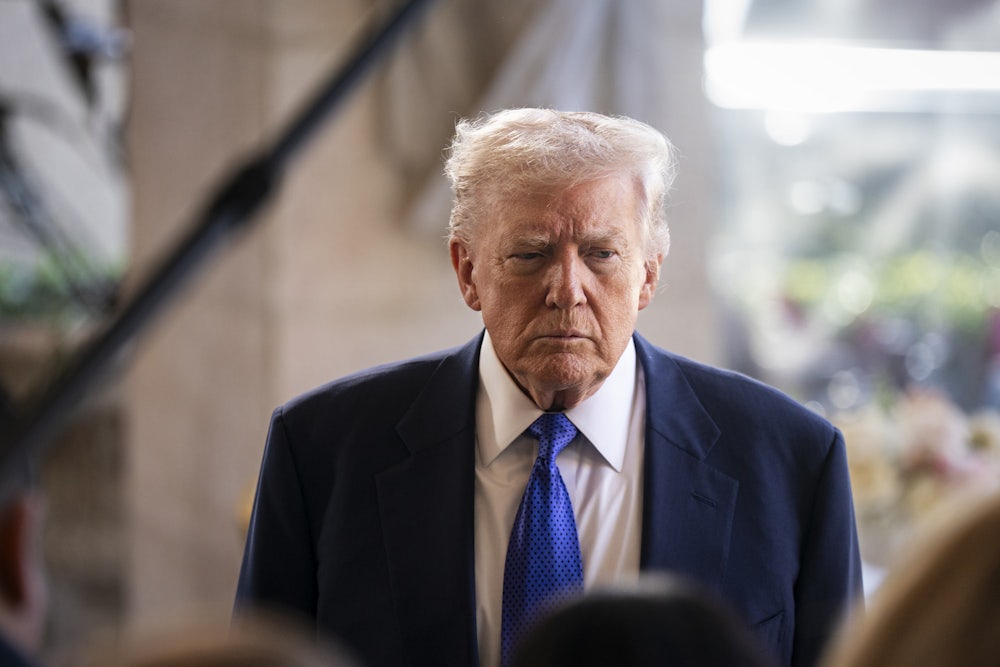
Donald Trump speaks to reporters and members of the media at Mar-a-Lago.
Al Drago/Getty Images

Last week Donald Trump filed suit against the IRS, demanding $10 billion in compensation for the unauthorized disclosure of his taxes in September 2020. 

Oftentimes a news story will seem outrageous at first glance but, on closer inspection, will become less outrageous, or perhaps not outrageous at all. On such occasions, it’s the duty of a sober journal of opinion like The New Republic to set the record straight. 

This is not one such occasion. 

Rather, this is a story that, the more you dig into the details, the more outrageous it becomes. News coverage has actually failed to capture fully how very stupid this lawsuit is. I have now reviewed the relevant documents and can attest that, even for Trump, this lawsuit is an outlier. It’s batshit crazy.

And now, I’ll be happy to take your questions.

Has a president of the United States ever before sued the executive branch over which he presides?

He has not.

Wait, didn’t Trump previously sue the Justice Department over the FBI’s Russiagate investigation and its Mar-a-Lago search for documents that he refused to turn over to the National Archives?

Trump wasn’t a sitting president then, and that wasn’t a lawsuit but rather two administrative claims filed with the Justice Department. An administrative claim bypasses the courts to seek settlement under threat of filing a lawsuit. The Russiagate claim was filed in 2023, and the Mar-a-Lago claim was filed in 2024. You can read a copy of the latter here.

The administrative claims were unresolved after Trump began his second term, and as recently as October The New York Times reported that they remained so and that Trump was demanding the Justice Department pay him $230 million. In one respect, the administrative claims are even more kleptocratic than the IRS lawsuit: The decision about whether to settle, and for how much, resides entirely with Trump’s own Justice Department.

“It looks bad,” Trump admitted in October. “I’m suing [sic] myself, right? So I don’t know. But that was a lawsuit [sic] that was very strong, very powerful.” It’s possible that Trump is suing the IRS for $10 billion to make his demand for a $230 million settlement seem reasonable.

OK, so Trump just became the first sitting president to sue the executive branch. But he’s suing over something that happened not recently, but years ago. Who was president when Trump’s taxes were disclosed?

Donald J. Trump! Trump’s taxes were downloaded and then made public during Trump’s first term. This is a president not only suing his own executive branch, but suing it over something that happened while he was running it

Do we know who stole the tax records?

Yes. It was an enterprising IRS contract employee named Charles “Chaz” Littlejohn (whose surname, yes, is also how the Merry Men addressed Robin Hood’s second-in-command). Littlejohn downloaded Trump’s tax information in October 2018 and gave it to The New York Times in May 2019. The Times then used the material in a September 27, 2020, story headlined “Long-Concealed Records Show Trump’s Chronic Losses and Years of Tax Avoidance.”  

Littlejohn also downloaded tax filings by thousands of rich people and gave those to ProPublica, which, starting in June 2021 (after Trump was president), published a series of stories documenting how the ultrarich avoid paying taxes.

Where is Littlejohn today?

Between now and 2029, you’ll find him at the Federal Correctional Institution in Marion, Illinois. Although Littlejohn’s removal of the tax filings went undetected for three years, after the Times piece was published the IRS tracked Littlejohn down and prosecuted him for unauthorized disclosure of tax information. Littlejohn entered a guilty plea and is now serving a five-year sentence.

Is five years a lot?

Sure is. Federal sentencing guidelines recommend 10 months, and if the judge had followed these, Littlejohn would have gotten out last March. But the prosecution asked for five years to make an example of Littlejohn, and the judge (a Biden appointee, incidentally) assented.

Do people who cheat on their taxes get five years?

Not even close. More than a third who are prosecuted get no prison time at all, and among those who do, the average sentence is 16 months. Of course, every case is different. But in May 2024, Reuven Avi-Yonah of Tax Notes reviewed recent cases of massive tax fraud and couldn’t find anybody sent up the river even for three years. In effect, the federal judiciary would rather you commit tax fraud than that you make public the tax returns of the only president since Richard Nixon who refused to do so.

Trump’s lawsuit says it’s the IRS’s fault that Littlejohn downloaded his files. How did Littlejohn do it?

He explained all in a video deposition taken in March 2024. This was in a lawsuit that the hedge fund billionaire Ken Griffin brought against the IRS because he was mad that details of his tax returns turned up in ProPublica. Although the IRS’s internal computer safeguards prevented anyone from downloading tax files to Dropbox or other large-file storage sites (something that was well known inside the agency), Littlejohn discovered that the safeguards didn’t prevent him from downloading these to a private web page set up for that purpose. Then he transferred the tax files to a flash drive.

OK, Trump was president when Littlejohn downloaded his taxes and gave them to The New York Times. Still, how was Trump supposed to know there were vulnerabilities in the IRS’s internal computers?

Because while he was president, the IRS inspector general told him so. In support of its argument that the IRS is culpable, the Trump complaint says:

“Every year from 2010 through 2020, the Treasury Inspector General for Tax Administration (“TIGTA”) has warned the IRS about security deficiencies related to the protection of taxpayers’ confidential tax return information.” “Many of these deficiencies went uncorrected and … allowed Littlejohn to misappropriate the information, upload it to a private website, and then disclose it[.]”

But for four of those years Trump was president. If the IRS was negligent in not responding sufficiently to these inspector general warnings, then Trump’s White House was negligent too. As Harry Truman said, the buck stops here. And for crying out loud, these reports were available not just to the Oval Office but to the general public.

It’s weird that Trump’s lawyers think mentioning the IRS inspector reports helps Trump’s case when so clearly it does the opposite. Probably this language is included because Griffin’s lawsuit included near-identical language. The Trump lawyer who cribbed this language doesn’t seem to have considered that Trump’s relationship to the IRS is markedly different from Griffin’s.

So Griffin’s lawsuit was the dry run for Trump’s. What happened?

The case was more or less thrown out of court. Griffin filed his lawsuit in 2022 and reached a puny settlement with the IRS in 2024. In the settlement, Griffin received no money; the IRS apologized. It was a complete waste of Griffin’s time and lawyer’s fees. 

I can’t resist voicing my disappointment that the IRS apology didn’t say the following: “We are sorry there was an unauthorized disclosure that showed Ken Griffin paid a scandalously low average effective income tax rate of 29.2 percent when Griffin was the fourth-highest paid human in the United States.” The apology just said the IRS “failed to prevent Mr. Littlejohn’s criminal conduct,” that it was working hard to prevent such disclosures in the future, et cetera.

In his lawsuit, Griffin demanded $1,000 for every unauthorized disclosure of his tax returns, including subsequent disclosures. Trump’s demand for $10 billion follows the same formula, which according to Trump’s complaint works out to $10 billion. But again: Griffin didn’t get a dime. You’d think that would discourage Trump. Maybe nobody told him. (Trump deals harshly with subordinates who deliver bad news.)

Why did Griffin settle? 

Because the judge tossed out Griffin’s claim that the IRS violated the 1974 Privacy Act, on the grounds that Griffin (net worth: $51 billion) couldn’t show he suffered pecuniary harm. Trump’s lawsuit similarly claims that the IRS violated the Privacy Act. But since the Times published his tax data, Trump’s net worth has more than tripled to $6.5 billion. That should make it very difficult for Trump to show pecuniary harm. 

Griffin also faced steep obstacles demonstrating, as Trump’s lawsuit also seeks to, that Littlejohn was a joint employee of his contracting firm, Booz Allen, and of the IRS.

“Joint employee.” That terminology sounds familiar. Don’t Republicans typically move heaven and earth to prevent contract employees from being assigned legal status as joint employees, in order to shield big corporations that routinely contract out work, especially low-paid work?

Bingo. Trump’s expansive definition of joint employment in his IRS lawsuit flatly contradicts his own administration’s policy, which is to narrow that definition to maximally benefit big business. In this, as in so many other instances, Trump is a total hypocrite.

During his first administration, Trump’s Labor Department issued a regulation dramatically limiting the circumstances under which the law would consider a contract employee to be jointly employed by the company (again, typically a large corporation) that hired out the work. Doing so effectively gave big corporations carte blanche to outsource labor violations to smaller and less visible firms. It also freed those big corporations from having to provide legally required benefits like Social Security, Medicare, and unemployment insurance. The human cost of this practice is documented extensively in David Weil’s 2014 book, The Fissured Workplace.

The Biden administration reversed Trump’s rule, but the Trump administration is expected to reverse Biden’s reversal, restoring a narrow definition of joint employment. 

 If Trump actually pried $10 billion from the IRS, would it be the biggest civil judgment in history?

Just about

The very biggest was the $206 billion tobacco company settlement in 1998. But the plaintiff in that case was not one person but forty state governments.

The second biggest judgment was in a lawsuit against a 13-year-old boy who sexually assaulted and then set fire to an 8-year-old boy, who years later died from related causes. In 2011, the jury gave the child’s estate $150 billion, but of course the perpetrator didn’t have and would never have the money to pay even a fraction of that. The case was brought mainly to pressure prosecutors in Montgomery County, Texas, to bring murder charges against the 13-year-old, who was now an adult. The prosecutors did so, and in 2015 the killer was convicted of murder.

Trump’s $10 billion, if he got it, would be the third-biggest civil judgment in U.S. history. It would be the the biggest civil judgment ever awarded to a plaintiff in a case where the defendant didn’t kill at least one person.

What’s the IRS’s overall budget?

The Trump administration has requested $15 billion to fund the IRS this fiscal year. So yes, Trump wants to help himself to two-thirds of the IRS’s annual budget.

So, wow, the whole thing is pretty nuts, huh.

You can say that again.


Lutnick and Epstein were in business together, Epstein files show

 https://www.cbsnews.com/news/howard-lutnick-jeffrey-epstein-in-business-together/


Watch CBS News

Exclusive
Politics

Lutnick and Epstein were in business together, Epstein files show

U.S. Commerce Secretary Howard Lutnick has said he had "limited interactions" with Jeffrey Epstein, but documents show they were in business together as recently as 2014.

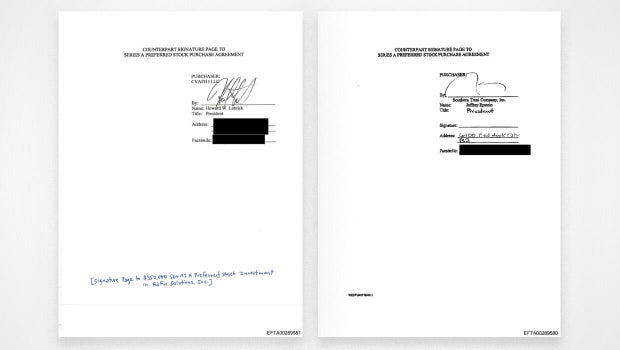
Lutnick and Epstein each signed on behalf of limited liability companies that agreed on Dec. 28, 2012, to acquire stakes in a now-shuttered advertising technology company called Adfin, documents released among the so-called Epstein files show. 

Epstein and Lutnick's signatures appear on neighboring pages in the contract, with Epstein signing for his Southern Trust Company, Inc. and Lutnick for a limited liability company called CVAFH I. The documents list nine shareholders in total. 

Howard Lutnick and Jeffrey Epstein's signatures on business documents
Signatures of Howard Lutnick and Jeffrey Epstein appear on pages in a 2012 contract for Adfin. Released by Department of Justice

Lutnick, the former chairman of the financial services firm Cantor Fitzgerald who at one point lived next door to Epstein, told the New York Post in October that he and his wife Allison had cut ties with Epstein in 2005, deciding after taking a tour of Epstein's New York townhouse, "I will never be in the room with that disgusting person ever again."

However, it appears Epstein and Lutnick continued to maintain contact and emails show they arranged calls and planned to have drinks in 2011. 

The following year, the couple and their four children planned a visit to Epstein's island, Little St. James, emails show. Lutnick was invited for lunch on Dec. 24, 2012, and later, Epstein's assistant wrote on behalf of Epstein, "it was nice seeing you."

Their Adfin deal was signed four days later. 

A source close to Lutnick told CBS News "Cantor [Fitzgerald] was a small minority investor in Adfin. At the time of doing the deal, as a minority investor, Mr. Lutnick would not have any knowledge of who the other investors were."  

Eleven days after that, on Jan. 8, 2013, Epstein had his assistant forward Lutnick a document related to casino legislation in the U.S. Virgin Islands, where Epstein had his island and a variety of business dealings. A spokesperson for Lutnick says he ignored the document sent to him. 

A spokesperson for the Commerce Department said, "This is nothing more than a failing attempt by the legacy media to distract from the administration's accomplishments including securing trillions of dollars in investment, delivering historic trade deals and fighting for the American worker." 

"Secretary Lutnick had limited interactions with Mr. Epstein in the presence of his wife and has never been accused of wrongdoing," the spokesperson said.

Correspondence relating to Adfin continued until at least 2014 when one of the shareholders, David Mitchell, wrote to Epstein regarding additional fundraising involving Cantor Ventures, a venture capital subsidiary of Cantor Fitzgerald. Lutnick had been president and CEO of Cantor since 1991 and was elevated to chairman in 1996. 

Also in 1996, Epstein sold a property located at 11 East 71st St. in New York to an entity called Comet Trust, which two years later sold the property to Lutnick. It became his primary residence, next door to Epstein's New York City mansion.

By the time Epstein and Lutnick agreed to buy stakes in Adfin, it had been more than four years since Epstein agreed to enter a guilty plea to Florida state charges of procuring a child for prostitution and soliciting a prostitute. The case brought forth allegations of far broader sex trafficking and victimization of girls, but it wasn't until 2019 that Epstein was charged with federal felonies including trafficking. He died in jail in the weeks after his arrest.

In the wake of the release of the Epstein files, Lutnick has been one of a broad international network of powerful Epstein associates who distanced themselves from the financier, only to be asked now to clarify relationships with him that appear to be closer or lengthier than they previously acknowledged. 

Epstein appears to have been aware of the public relations challenge he posed to people close to him. Emails show in 2017 he agreed to donate $50,000 to a dinner in honor of Lutnick

"hope pr is ok," Epstein wrote to billionaire hedge fund manager John Paulson, an organizer of the dinner. Epstein declined to take a table awarded to donors of that level, writing that Lutnick could fill the seats. 

Their relationship continued into the next year, 2018, when Lutnick emailed Epstein apparently complaining about an expansion plan for their neighboring Frick Collection art museum.

Lutnick warned Epstein that the renovation might "block your sunlight and views."

"You should put in a letter. I'm sending a lawyer. Don't ignore this," Lutnick wrote to Epstein. 

Alarm bells sound over Trump’s ‘take over the voting’ call

 https://www.theguardian.com/us-news/2026/feb/07/trump-interference-voting-midterms

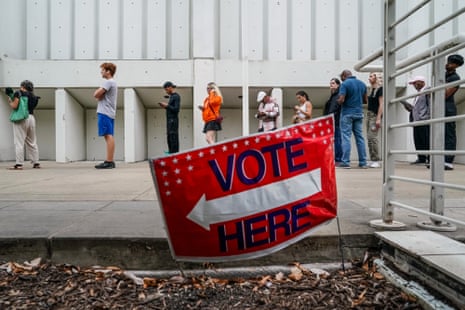
people by a sign

Alarm bells sound over Trump’s ‘take over the voting’ call

Democracy experts say there is little doubt about president’s desire to interfere in elections this November

Donald Trump set off alarm bells earlier this week with comments that his administration should “take over the voting” in some states in the run-up to the 2026 midterms, which followed an unprecedented FBI raid on an election office in Georgia. Although election experts say it’s clear the president doesn’t have authority over elections, they warn the president’s corrosive rhetoric leaves little doubt about his intent.

For months, the Trump administration has stoked doubts about the integrity of American elections largely through lawsuits designed to create the impression states aren’t doing enough to keep ineligible voters off the rolls. That effort escalated significantly last week when the FBI raided the election office in Fulton county, Georgia and seized ballots, along with other materials, related to the 2020 election. Shortly after the raid, Trump escalated his attack even further, saying the federal government should take over elections.

“The Republicans should say, ‘We want to take over,’” he said during a recent interview with Dan Bongino, the former deputy FBI director who has returned to hosting a podcast. “We should take over the voting, the voting in at least many – 15 places. The Republicans ought to nationalize the voting.”

Democracy experts believe there is no longer any doubt about Trump’s desire to interfere with this fall’s elections.

“We should not be waiting for the next shoe to drop,” said Wendy Weiser, vice-president for democracy at the Brennan Center for Justice. “There is a full-blown effort to seize control of some of the mechanisms of our elections and to lay the foundation for interfering in upcoming elections.”

The president has no power over federal elections, and the US constitution is not ambiguous on the matter. Article I, section 4 of the document gives states the power to run elections. Congress, the constitution says, can pass nationwide rules for federal elections.

Nonetheless, Trump and his allies have suggested the president may still be able to wield some kind of emergency power to take control of the electoral process.

“The president’s authority is limited in his role with regard to elections except where there is a threat to the national sovereignty of the United States – as I think that we can establish with the porous system that we have,” Cleta Mitchell, a conservative lawyer and Trump ally said on a podcast interview last year. “Then, I think maybe the president is thinking he will exercise some emergency powers to protect the federal elections going forward.”

Declaring a national emergency unlocks about 150 statutory powers for the president, including things like shutting down radio stations, suspending certain military regulations, and to sanction foreign countries.

But none of those powers “even come close to giving the president any authority over elections”, Weiser said. “The president has zero emergency powers over elections.”

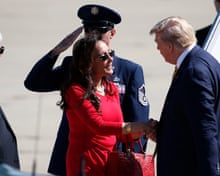
The concern about the president using emergency powers has only been amplified by the presence of Tulsi Gabbard, the director of national intelligence, at the Fulton county raid. Gabbard, whose presence as an intelligence official on a domestic matter has caused widespread outrage, is said to be investigating voting equipment and foreign interference.

Among others, Gabbard is briefing Mitchell and Kurt Olsen, another lawyer who was involved in Trump’s effort to overturn the election, on her investigation, the Wall Street Journal reported.

Mitchell declined to comment on those briefings, but said she understood Trump’s comments to be more about the need to change federal voting laws.

“All of the election statutes need significant revision, updating, and reform. And many of us are working on that,” Mitchell said in an email. “Clearly there are far too many election officials nationwide who treat the law as optional suggestions. And have instituted procedures that are contrary to law. That happened in spades in 2020 and is all too common every election. Sloppy, poor administration and intentional disregard of basic statutory requirements. We see it everywhere.”

There is no evidence of widespread fraud in 2020 or in any other election.

The White House press secretary, Karoline Leavitt, has framed Trump’s comments similarly. Trump subsequently undercut those efforts to downplay his comments, criticizing Democratic cities such as Philadelphia, Detroit and Atlanta, saying: “If they can’t count the votes legally and honestly, then somebody else should take over.”

Beyond unspecified actions to take control of state election processes, there are other pathways for Trump to try to interfere in the election process.

Steve Bannon, the influential conservative personality and former Trump strategist, has called for Trump to deploy ICE agents at the polls. Such an effort would violate a federal law that prohibits federal troops from being at the polls “unless such force be necessary to repel armed enemies of the United States”.

“We’re going to have ICE surround the polls come November. We’re not going to sit here and allow you to steal the country again,” Bannon said on his podcast on Tuesday. “And you can whine and cry and throw your toys out of the pram all you want, but we will never again allow an election to be stolen.”

The Trump administration has already shown its willingness to use emergency powers to try to expand the president’s authority. Last spring, the Trump administration invoked the Alien Enemies Act, an 18th-century law that allows the government to deport immigrants without full due process. The United States, the government argued, was subject to an invasion by the Venezuelan gang Tren de Aragua. Federal judges have since blocked that order and expressed skepticism it is a legitimate invasion. Trump has also claimed he has emergency powers to impose tariffs, though the supreme court appears poised to reject that argument.

Part of the reason Trump is talking about nationalizing elections now may be to try to get the public to accept an idea that is obviously illegal.

“He is trying to socialize an idea that has nothing to do with what our actual system is and that is actually against the law, to change public expectations about what’s actually valid and allowed,” she said. “That’s why the public needs to know about this. Because they need to know in advance that if that happens, that’s a trick, that’s a plot, that’s actually deception to get you to accept the unacceptable.”

You've read 47 articles in the last year
Article count

We know. You’ve seen these notes to support us – 47 times so far this year – but you haven’t responded. It’s a little awkward for both of us. But wait:

In our experience, it’s not a lack of enthusiasm that stops frequent Guardian readers like you from supporting our journalism – it’s how long you imagine it’s going to take.

So we timed it, and on average it takes just 37 seconds. (Yes, you need your credit card, but it’s over there in your wallet – or you might already have the details saved on this device?)

But did you also know that, as a thank you for your support, you get access to exclusive extras (including seeing far fewer fundraising messages like this one)?

If you can, please support us on a monthly basis. It takes less than a minute to set up, and you can rest assured that you’re making a big impact every single month in support of fearless, independent journalism. Thank you.

Related stories

  • Trump suggests Republicans should ‘take over’ elections to protect the party

  • Trump’s assault on voting intensifies as midterms loom: ‘A wholesale attack on free and fair elections’

  • Democrats sound alarm over Trump’s reported $1bn plan to retrofit gifted Qatari jet

  • A risky bet? Texas Republicans poised to redraw congressional map on Trump’s orders

  • Trump’s justice department appointees remove leadership of voting unit

  • Fears grow for voting rights as Trump plots to reshape US justice department

  • Alarm after lawyer who aided Trump’s 2020 election lie attacks campus voting

  • Draft Trump order told defense chief to seize swing-state voting machines

More from News

  • Analysis
    The Epstein files reveal that a vast global conspiracy actually exists – sort of

  • Arizona
    Blood droplets, a white van, a ransom note: where is Savannah Guthrie’s mother?

  • ‘A harmful barrier’
    New Florida law mandates all driving tests to be offered in English only

  • JD Vance
    NBC appears to cut crowd’s booing of JD Vance from Winter Olympics broadcast

  • Live
    Winter Olympics 2026: first gold to Swiss, GB await helmets verdict, slopestyle and more – live

  • Russia-Ukraine war
    Zelenskyy says US has set June deadline for Ukraine-Russia peace deal

  • Iran
    BBC Persian journalists say Iran monitoring them and targeting their families

  • Drinking water
    Outrage after US Congress votes to slash $125m in funding to replace toxic lead pipes


Musk calls for Trump's impeachment

Musk calls for Trump's impeachment

 https://www.axios.com/2025/06/05/musk-trump-impeachment


Musk calls for Trump's impeachment

Zachary Basu

Trump and Musk

Photo: Anna Moneymaker/Getty Images

Elon Musk unleashed a fresh round of tweets late Thursday afternoon, calling for President Trump to be impeached and declaring that SpaceX would begin decommissioning a spacecraft essential to NASA's operation — though he later backtracked on this threat.

Why it matters: Trump's threat to cancel billions of dollars of government contracts with Musk's companies has ignited a new round of escalation in the explosive civil war between the two former allies.

Driving the news: "In light of the President's statement about cancellation of my government contracts, SpaceX will begin decommissioning its Dragon spacecraft immediately," Musk wrote on X.

  • The U.S. has relied on the Dragon spacecraft, both crewed and cargo versions, for years to keep the International Space Station supplied and operating. Shutting them down would leave the ISS reliant on Russia.

The intrigue: Ian Miles Cheong, a prominent Musk supporter and right-wing activist on X, tweeted: "President vs Elon. Who wins? My money's on Elon. Trump should be impeached and JD Vance should replace him."

  • Musk responded to Cheong: "Yes."
  • When another follower suggested they could finally be honest about the stupidity of Trump's tariffs, Musk posted: "The Trump tariffs will cause a recession in the second half of this year."
  • When another X user on Thursday night called the back and forth between Musk and Trump "a shame" and suggested they cool off and "take a step back for a couple days," Musk responded: "Good advice. Ok, we won't decommission Dragon."

Musk, the world's richest man, also spent much of the afternoon tweeting about Trump's alleged ties to notorious sex offender and financier Jeffrey Epstein.

  • "Time to drop the really big bomb: Trump is in the Epstein files. That is the real reason they have not been made public. Have a nice day, DJT!" Musk posted.

The big picture: The stunning collapse of the relationship was ostensibly triggered by Musk's scathing criticism of Trump's signature bill, which is projected to add trillions to the national debt.

  • Trump suggested that the Tesla CEO was upset about the rollback of electric vehicle credits, and that he — like other disgruntled former officials — was suffering from "Trump Derangement Syndrome."
  • That's when Musk set the feud on fire — unleashing dozens of tweets highlighting the GOP's hypocrisy on deficits, claiming Trump would have lost in 2024 without him, and floating a new political party.

What to watch: The MAGA coalition is now under massive pressure to pick sides, splintering after six months of a mostly harmonious relationship between the president and the world's richest man.

  • Steve Bannon, a prominent MAGA voice who has long despised Musk, called for the South African-born billionaire to be deported in an interview with the New York Times.

More from Axios:

Editor's note: This article has been updated Elon Musk's Thursday night X post saying that he won't decommission Dragon.