A
Flightradar24 map shows civilian aircraft avoiding Iranian and Iraqi
airspace on March 1, after regional governments closed their skies amid
escalating U.S.-Israel strikes on Iran. Photo: Anna Kurth/AFP via Getty
Images
Four U.S. service members have been killed in action following the massive U.S.-Israel military operation launched in Iran Saturday that sparked swift retaliation.
State of play:
U.S. Central Command confirmed that as of Monday morning the death toll
had climbed to four after a service member seriously wounded during
Iran's strikes succumbed to their injuries.
Zoom out: Three U.S. fighter jets supporting Operation Epic Fury
were also mistakenly shot down by Kuwaiti air defenses Sunday night,
U.S. Central Command said in a Monday statement. All six aircrew ejected
safely and are in stable condition.
The incident shows how chaotic the air war with Iran has become as allies defend against Iranian attacks while American jets fly through the same airspace.
Context:
Kuwait, which has acknowledged the incident, is one of several Gulf
states that have come under Iranian retaliation since the U.S.–Israel
strikes began Saturday, with missiles and drones hitting near Kuwait's international airport and U.S. facilities.
Trump’s Lawsuit Against the IRS Is Even More Outrageous Than It Seems
You don’t know the half of it.
Al Drago/Getty Images
Last week Donald Trump filed suitagainst the IRS, demanding $10 billion in compensation for the unauthorized disclosure of his taxes in September 2020.
Oftentimes
a news story will seem outrageous at first glance but, on closer
inspection, will become less outrageous, or perhaps not outrageous at
all. On such occasions, it’s the duty of a sober journal of opinion
like The New Republic to set the record straight.
This is not one such occasion.
Rather,
this is a story that, the more you dig into the details, the more
outrageous it becomes. News coverage has actually failed to capture
fully how very stupid this lawsuit is. I have now reviewed the relevant
documents and can attest that, even for Trump, this lawsuit is an
outlier. It’s batshit crazy.
And now, I’ll be happy to take your questions.
Has a president of the United States ever before sued the executive branch over which he presides?
Wait,
didn’t Trump previously sue the Justice Department over the FBI’s
Russiagate investigation and its Mar-a-Lago search for documents that he
refused to turn over to the National Archives?
Trump
wasn’t a sitting president then, and that wasn’t a lawsuit but rather
two administrative claims filed with the Justice Department. An
administrative claim bypasses the courts to seek settlement under threat
of filing a lawsuit. The Russiagate claim was filed in 2023, and the
Mar-a-Lago claim was filed in 2024. You can read a copy of the latter here.
The administrative claims were unresolved after Trump began his second term, and as recently as October The New York Times reported that they remained so and that Trump was demanding the Justice Department pay him $230 million. In
one respect, the administrative claims are even more kleptocratic than
the IRS lawsuit: The decision about whether to settle, and for how much,
resides entirely with Trump’s own Justice Department.
“It looks bad,” Trump admitted in October. “I’m suing [sic] myself, right? So I don’t know. But that was a lawsuit [sic]
that was very strong, very powerful.” It’s possible that Trump is suing
the IRS for $10 billion to make his demand for a $230 million
settlement seem reasonable.
OK,
so Trump just became the first sitting president to sue the executive
branch. But he’s suing over something that happened not recently, but
years ago. Who was president when Trump’s taxes were disclosed?
Donald
J. Trump! Trump’s taxes were downloaded and then made public during
Trump’s first term. This is a president not only suing his own executive
branch, but suing it over something that happened while he was running it.
Do we know who stole the tax records?
Yes.
It was an enterprising IRS contract employee named Charles “Chaz”
Littlejohn (whose surname, yes, is also how the Merry Men addressed
Robin Hood’s second-in-command). Littlejohn downloaded Trump’s tax information in October 2018 and gave it to The New York Times in May 2019. The Times then used the material in a September 27, 2020, story headlined “Long-Concealed Records Show Trump’s Chronic Losses and Years of Tax Avoidance.”
Littlejohn also downloaded tax filings by thousands of rich people and gave those to ProPublica, which, starting in June 2021 (after Trump was president), published a series of stories documenting how the ultrarich avoid paying taxes.
Sure is. Federal sentencing guidelines recommend 10 months, and if the judge had followed these, Littlejohn would have gotten out last March. But the prosecution asked for five years to make an example of Littlejohn, and the judge (a Biden appointee, incidentally) assented.
Do people who cheat on their taxes get five years?
Not even close. More than a third who
are prosecuted get no prison time at all, and among those who do, the
average sentence is 16 months. Of course, every case is different. But
in May 2024, Reuven Avi-Yonah of Tax Notesreviewed recent cases of massive tax
fraud and couldn’t find anybody sent up the river even for three years.
In effect, the federal judiciary would rather you commit tax fraud than
that you make public the tax returns of the only president since
Richard Nixon who refused to do so.
Trump’s lawsuit says it’s the IRS’s fault that Littlejohn downloaded his files. How did Littlejohn do it?
He explained all in a video deposition taken
in March 2024. This was in a lawsuit that the hedge fund billionaire
Ken Griffin brought against the IRS because he was mad that details of
his tax returns turned up in ProPublica. Although the IRS’s internal
computer safeguards prevented anyone from downloading tax files to
Dropbox or other large-file storage sites (something that was well known
inside the agency), Littlejohn discovered that the safeguards didn’t
prevent him from downloading these to a private web page set up for that
purpose. Then he transferred the tax files to a flash drive.
OK, Trump was president when Littlejohn downloaded his taxes and gave them to The New York Times. Still, how was Trump supposed to know there were vulnerabilities in the IRS’s internal computers?
Because while he was president, the IRS inspector general told him so. In support of its argument that the IRS is culpable, the Trump complaint says:
“Every
year from 2010 through 2020, the Treasury Inspector General for Tax
Administration (“TIGTA”) has warned the IRS about security deficiencies
related to the protection of taxpayers’ confidential tax return
information.” “Many of these deficiencies went uncorrected and … allowed Littlejohn to misappropriate the information, upload it to a private website, and then disclose it[.]”
But for four of those years Trump was president.
If the IRS was negligent in not responding sufficiently to these
inspector general warnings, then Trump’s White House was negligent too.
As Harry Truman said, the buck stops here. And for crying out loud,
these reports were available not just to the Oval Office but to the general public.
It’s
weird that Trump’s lawyers think mentioning the IRS inspector reports
helps Trump’s case when so clearly it does the opposite. Probably this
language is included because Griffin’s lawsuit included near-identical
language. The Trump lawyer who cribbed this language doesn’t seem to
have considered that Trump’s relationship to the IRS is markedly
different from Griffin’s.
So Griffin’s lawsuit was the dry run for Trump’s. What happened?
The case was more or less thrown out of court. Griffin filed his lawsuit in 2022 and reached a puny settlement with the IRS in 2024. In the settlement, Griffin received no money; the IRS apologized. It was a complete waste of Griffin’s time and lawyer’s fees.
I
can’t resist voicing my disappointment that the IRS apology didn’t say
the following: “We are sorry there was an unauthorized disclosure that
showed Ken Griffin paid a scandalously low average effective income tax
rate of 29.2 percent when Griffin was the fourth-highest paid human in
the United States.” The apology just said the IRS “failed to prevent Mr.
Littlejohn’s criminal conduct,” that it was working hard to prevent such disclosures in the future, et cetera.
In
his lawsuit, Griffin demanded $1,000 for every unauthorized disclosure
of his tax returns, including subsequent disclosures. Trump’s demand for
$10 billion follows the same formula, which according to Trump’s
complaint works out to $10 billion. But again: Griffin didn’t get a dime. You’d think that would discourage Trump. Maybe nobody told him. (Trump deals harshly with subordinates who deliver bad news.)
Why did Griffin settle?
Because
the judge tossed out Griffin’s claim that the IRS violated the 1974
Privacy Act, on the grounds that Griffin (net worth: $51 billion)
couldn’t show he suffered pecuniary harm. Trump’s lawsuit similarly
claims that the IRS violated the Privacy Act. But since the Times published his tax data, Trump’s net worth has more than tripled to $6.5 billion. That should make it very difficult for Trump to show pecuniary harm.
Griffin
also faced steep obstacles demonstrating, as Trump’s lawsuit also seeks
to, that Littlejohn was a joint employee of his contracting firm, Booz
Allen, and of the IRS.
“Joint employee.” That terminology sounds familiar. Don’t Republicans typically move heaven and earth to prevent contract
employees from being assigned legal status as joint employees, in order
to shield big corporations that routinely contract out work, especially
low-paid work?
Bingo. Trump’s expansive definition of
joint employment in his IRS lawsuit flatly contradicts his own
administration’s policy, which is to narrow that definition to maximally
benefit big business. In this, as in so many other instances, Trump is a
total hypocrite.
During his first administration, Trump’s Labor Department issued a regulation dramatically
limiting the circumstances under which the law would consider a
contract employee to be jointly employed by the company (again,
typically a large corporation) that hired out the work. Doing so
effectively gave big corporations carte blanche to outsource labor
violations to smaller and less visible firms. It also freed those big
corporations from having to provide legally required benefits like
Social Security, Medicare, and unemployment insurance. The human cost of
this practice is documented extensively in David Weil’s 2014 book, The Fissured Workplace.
The Biden administration reversed Trump’s rule, but the Trump administration is expected to reverse Biden’s reversal, restoring a narrow definition of joint employment.
If Trump actually pried $10 billion from the IRS, would it be the biggest civil judgment in history?
The very biggest was the $206 billion tobacco company settlement in 1998. But the plaintiff in that case was not one person but forty state governments.
The
second biggest judgment was in a lawsuit against a 13-year-old boy who
sexually assaulted and then set fire to an 8-year-old boy, who years
later died from related causes. In 2011, the jury gave the child’s
estate $150 billion,
but of course the perpetrator didn’t have and would never have the
money to pay even a fraction of that. The case was brought mainly to
pressure prosecutors in Montgomery County, Texas, to bring murder
charges against the 13-year-old, who was now an adult. The prosecutors
did so, and in 2015 the killer was convicted of murder.
Trump’s
$10 billion, if he got it, would be the third-biggest civil judgment in
U.S. history. It would be the the biggest civil judgment ever awarded
to a plaintiff in a case where the defendant didn’t kill at least one
person.
What’s the IRS’s overall budget?
The Trump administration has requested $15 billion to fund the IRS this fiscal year. So yes, Trump wants to help himself to two-thirds of the IRS’s annual budget.
Lutnick and Epstein were in business together, Epstein files show
By
/ CBS News
U.S. Commerce Secretary Howard Lutnick has said he had "limited
interactions" with Jeffrey Epstein, but documents show they were in
business together as recently as 2014.
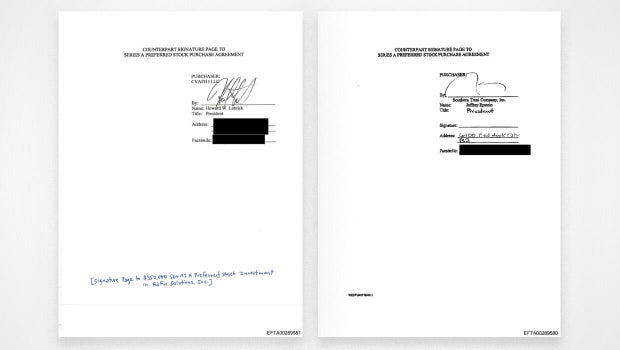
Epstein
and Lutnick's signatures appear on neighboring pages in the contract,
with Epstein signing for his Southern Trust Company, Inc. and Lutnick
for a limited liability company called CVAFH I. The documents list nine
shareholders in total.
Signatures of Howard Lutnick and Jeffrey Epstein appear on pages in a 2012 contract for Adfin.
Released by Department of Justice
Lutnick, the former chairman of the financial services firm Cantor Fitzgerald who at one point lived next door to Epstein, told the New York Post
in October that he and his wife Allison had cut ties with Epstein in
2005, deciding after taking a tour of Epstein's New York townhouse, "I
will never be in the room with that disgusting person ever again."
However, it appears Epstein and Lutnick continued to maintain contact and emails show they arranged calls and planned to have drinks in 2011.
The
following year, the couple and their four children planned a visit to
Epstein's island, Little St. James, emails show. Lutnick was invited for
lunch on Dec. 24, 2012, and later, Epstein's assistant wrote on behalf of Epstein, "it was nice seeing you."
Their Adfin deal was signed four days later.
A source close to Lutnick told CBS News "Cantor [Fitzgerald] was a
small minority investor in Adfin. At the time of doing the deal, as a
minority investor, Mr. Lutnick would not have any knowledge of who the
other investors were."
Eleven days after that, on Jan. 8, 2013,
Epstein had his assistant forward Lutnick a document related to casino
legislation in the U.S. Virgin Islands, where Epstein had his island and a variety of business dealings. A spokesperson for Lutnick says he ignored the document sent to him.
A
spokesperson for the Commerce Department said, "This is nothing more
than a failing attempt by the legacy media to distract from the
administration's accomplishments including securing trillions of dollars
in investment, delivering historic trade deals and fighting for the
American worker."
"Secretary Lutnick had limited interactions
with Mr. Epstein in the presence of his wife and has never been accused
of wrongdoing," the spokesperson said.
Correspondence relating to Adfin continued until at least 2014 when
one of the shareholders, David Mitchell, wrote to Epstein regarding
additional fundraising involving Cantor Ventures, a venture capital
subsidiary of Cantor Fitzgerald. Lutnick had been president and CEO of
Cantor since 1991 and was elevated to chairman in 1996.
Also in
1996, Epstein sold a property located at 11 East 71st St. in New York to
an entity called Comet Trust, which two years later sold the property
to Lutnick. It became his primary residence, next door to Epstein's New
York City mansion.
By the time Epstein and Lutnick agreed to buy
stakes in Adfin, it had been more than four years since Epstein agreed
to enter a guilty plea to Florida state charges of procuring a child for
prostitution and soliciting a prostitute. The case brought forth
allegations of far broader sex trafficking and victimization of girls,
but it wasn't until 2019 that Epstein was charged with federal felonies
including trafficking. He died in jail in the weeks after his arrest.
In
the wake of the release of the Epstein files, Lutnick has been one of a
broad international network of powerful Epstein associates who
distanced themselves from the financier, only to be asked now to clarify
relationships with him that appear to be closer or lengthier than they
previously acknowledged.
Epstein appears to have been aware of
the public relations challenge he posed to people close to him. Emails
show in 2017 he agreed to donate $50,000 to a dinner in honor of Lutnick.
"hope pr is ok," Epstein wrote
to billionaire hedge fund manager John Paulson, an organizer of the
dinner. Epstein declined to take a table awarded to donors of that
level, writing that Lutnick could fill the seats.
Their relationship continued into the next year, 2018, when Lutnick emailed Epstein apparently complaining about an expansion plan for their neighboring Frick Collection art museum.
Lutnick warned Epstein that the renovation might "block your sunlight and views."
"You should put in a letter. I'm sending a lawyer. Don't ignore this," Lutnick wrote to Epstein.