The Supreme Court Lands Its Fatal Blow on the Voting Rights Act
https://newrepublic.com/article/209677/supreme-court-voting-rights-act
The Supreme Court Lands Its Fatal Blow on the Voting Rights Act
The conservative bloc has dismantled the law that ensures that Black Americans can fully participate in American electoral politics.
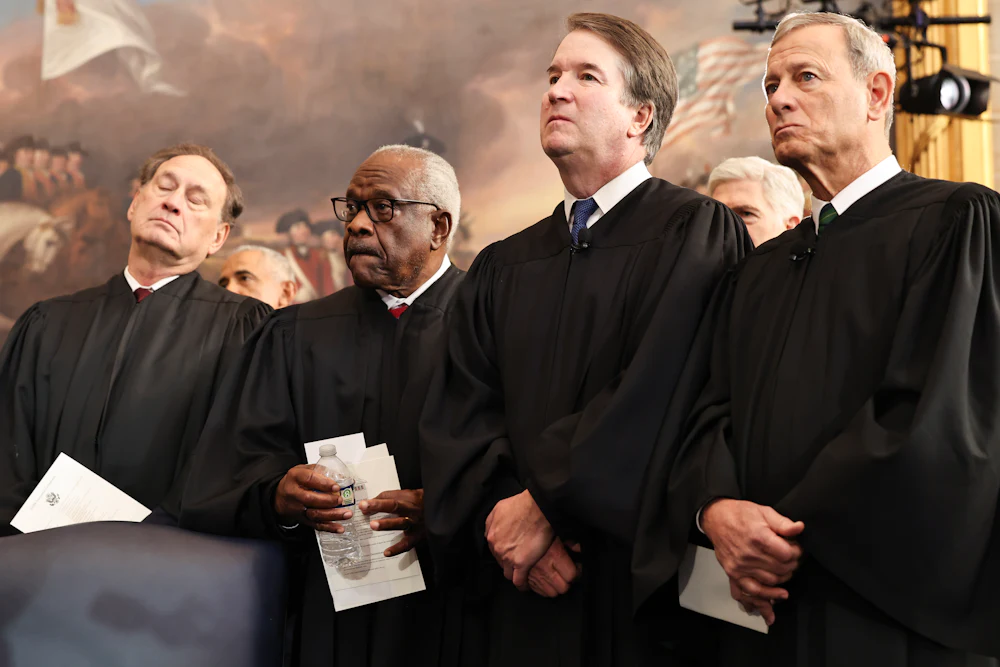
“Section 2 of the Voting Rights Act of 1965 was designed to enforce the Constitution—not collide with it,” Justice Samuel Alito wrote for the court. “Unfortunately, lower courts have sometimes applied this Court’s Section 2 precedents in a way that forces states to engage in the very race-based discrimination that the Constitution forbids.”
Alito’s majority opinion fundamentally rewrote the court’s Section 2 precedents and the law itself to achieve the conservative bloc’s goals. It raised numerous new hurdles to racial gerrymandering claims, including some that will likely be insurmountable. It even blessed the use of partisan gerrymandering as an explicit legal defense by states against racial gerrymandering.
The effects for American democracy will be corrosive. Southern Republicans will now likely set out to wipe out as many majority-minority congressional districts in the South, some of which were created by past VRA lawsuits, as they feasibly can without diluting other solidly Republican districts. Black representation in Congress will likely plummet, further tilting the House map in favor of the GOP.
Something noble and dignified has also been lost. The Voting Rights Act “was born of the literal blood of Union soldiers and civil rights marchers,” Justice Elena Kagan wrote in her dissent. “It ushered in awe-inspiring change, bringing this Nation closer to fulfilling the ideals of democracy and racial equality. And it has been repeatedly, and overwhelmingly, reauthorized by the people’s representatives in Congress. Only they have the right to say it is no longer needed—not the members of this Court.”
After the 2020 census, every state redrew its congressional map to account for population changes over the previous 10 years. Louisiana’s map was an obvious gerrymander that locked in Republican control of five districts. The sixth one, centered in and around New Orleans, packed most of Louisiana’s Black residents into an ultra-Democratic district.
A coalition of Black voters and voting rights groups filed a Section 2 challenge to the new map, arguing that Louisiana lawmakers had diluted their electoral power by packing them into a single district. A federal district court agreed and ordered the state to draw a second majority-minority district. The Fifth Circuit Court of Appeals, which is generally considered to be the country’s most conservative court, upheld that ruling.
Normally, that would be the end of that matter. After Louisiana adopted a revised map to comply with the court order in 2023, however, a separate group of plaintiffs who described themselves as “non–African American voters” filed a separate lawsuit to challenge the new map’s constitutionality. They argued that state lawmakers had impermissibly used race as a factor when drawing the new districts, even though the new map was drawn to remedy racial gerrymandering in the first instance.
This upside-down approach already had supporters at the Supreme Court. That same year, the high court upheld a court order for Alabama to draw a second majority-minority district, with the court’s liberals joined by Chief Justice John Roberts and Justice Brett Kavanaugh. In a concurring opinion, however, Kavanaugh suggested that he would be open to considering in a future case whether such remedies were themselves a form of racial gerrymandering.
Wednesday’s result was hardly a surprise. The high court originally heard Callais during its last term to decide a much narrower question, only to schedule it for reargument this term to allow for a much broader challenge to Section 2 of the Voting Rights Act. Lest there be any doubt about the conservatives’ goals, Justice Clarence Thomas wrote an unusual side opinion where he complained about the court’s delay.
That frustration only made sense, as I noted at the time, if Thomas knew that there was already at least a five-justice majority for attacking Section 2 and they could simply do it now. But some of the justices apparently wanted to do things by the book, leading to the yearlong delay and to Wednesday’s decision. Indeed, Alito wrote on Wednesday that the court had delayed the case to avoid upending elections.
I am journalistically obligated to note that conservatives’ attack did not fully succeed. Thomas wanted the court to hold that Section 2 does not apply to redistricting at all, which would leave voters with no mechanism whatsoever to challenge racially gerrymandered maps in court. Alito instead left Section 2 nominally intact and framed Callais as a mere tune-up to the court’s preexisting framework for weighing racial gerrymandering claims.
“We need only update the framework so it aligns with the statutory text and reflects important developments since we decided Gingles 40 years ago,” Alito wrote, referring to Gingles v. Thornburg, the 1986 case where the court first interpreted a strengthened version of Section 2 passed in the 1980s.
The reality is that, thanks to the court’s butchery, it will be nearly impossible for any future racial gerrymandering claim to succeed. Thomas’s concurring opinion, joined by Justice Neil Gorsuch, lamented that his approach was not followed but celebrated that his preferred outcome was attained. “Today’s decision should largely put an end to this disastrous misadventure in voting-rights jurisprudence,” he crowed.
Kagan found this explanation unpersuasive. “Let’s first drop the majority’s misleading label,” she wrote in her dissent. “What the majority gives us today is not an ‘updated Gingles framework.’ It is its own thing, deserving of its own name. Maybe the Callais contrivance? Or if that seems too immediately pejorative, just say that what the majority does today is to impose the Callais requirements.”
At the core of the new Callais requirements is backbreaking deference to partisan gerrymandering, the sordid practice where state lawmakers draw maps to dilute a party’s electoral power as much as possible. In the 2019 case Rucho v. Common Cause, the Supreme Court’s conservative majority held that federal courts could not hear partisan-gerrymandering claims, finding no justiciable standards for them under the Fourteenth Amendment. The justices have traditionally described the practice in negative terms, with Alito noting on Wednesday that “disapproval” of it “dates back to the founding.”
Now Rucho has swallowed the court’s racial gerrymandering cases whole. Alito warned that litigants could try to circumvent Rucho by using racial gerrymandering claims to break extreme partisan gerrymanders. “In a state where both parties have substantial support and where race is often correlated with party preference,” he claimed, “a litigant can easily exploit Section 2 for partisan purposes by repackaging a partisan-gerrymandering claim as a racial-gerrymandering claim.”
This is wretched reasoning, driven by a clear desire to avoid handing victories to certain plaintiffs instead of a faithful adherence to law and precedent. The obvious outcome is that states can now, with the court’s blessing, invoke partisan gerrymandering as a legitimate rationale to foil racial gerrymandering claims, especially in states where race and partisanship are closely correlated. “Assuming the State has left behind no smoking-gun evidence of a race-based motive (an almost fanciful prospect), Section 2 will play no role,” Kagan warned in her dissent.
Gingles’s first precondition, for example, was that a “community of minority voters” is “sufficiently numerous and compact to constitute a majority in a reasonably configured district.” Section 2 plaintiffs typically accomplished this by drawing an “illustrative map” to show, as Alito put it, “their desired number of majority-minority districts.”
Alito revised this prong to require Section 2 plaintiffs to also meet “all of the state’s legitimate districting objectives, including traditional districting criteria and the state’s specified political goals.” The first part basically repeats the existing Gingles precondition: Districts must generally be contiguous and compact. But the second part requires plaintiffs to draw maps that comply with a state’s partisan-gerrymandering aims.
“If the State’s aims in drawing a map include a target partisan distribution of voters, a specific margin of victory for certain incumbents, or any other goal not prohibited by the Constitution, the plaintiffs’ illustrative maps must achieve these goals just as well,” he wrote. “If not, the plaintiffs would fail to demonstrate that the State’s chosen map was driven by racial considerations rather than permissible aims.”
That also sounds suspiciously like a requirement that Section 2 plaintiffs must prove discriminatory intent by lawmakers. The Supreme Court has been down that road before: In the 1980 case Mobile v. Borden, the justices read an intent requirement into Section 2, only to be overridden by Congress when it passed an updated version of the VRA to explicitly nullify that ruling. Gingles and its preconditions emerged from the aftermath where the court—until now, at least—accepted Congress’s discriminatory-effects test.
“The problem, as even the majority recognizes, was ‘that a focus on discriminatory intent, rather than discriminatory effects, would defeat worthy claims because of the difficulty of proving intentional discrimination,’” Kagan wrote, quoting from precedent. “It is the rare legislature, as the history of voting discrimination shows, that cannot camouflage racial targeting with race-neutral justifications.”
Alito claimed that he wasn’t simply reintroducing a discriminatory-intent test in his opinion, but it was not convincing. “The dissent states over and over again that our decision requires a Section 2 plaintiff to prove discriminatory intent,” he wrote, referring to Kagan’s dissent. When a discriminatory effect is shown, he continued, plaintiffs must then show that “the circumstances must give rise to a strong inference of racial discrimination.”
Kagan, in a footnote, sounded almost surprised to read this portion of Alito’s opinion, “which, if true, would be welcome news. And welcomer still if lower courts took those last words seriously and allowed Section 2 claims to succeed even absent proof of race-based purpose. But I suspect they will not. Because they, like I, will have read the many pages leading up to the majority’s coda.”
It was “something of a mystery,” Kagan wrote, to try to figure out what Alito meant to do by disclaiming an intent test. “To try to disguise what it is really doing?” she asked, rhetorically. “To somehow absolve itself of responsibility? Or could it just be that, in responding to this dissent, the majority can do nothing but agree?”
Few conservative justices have been honest enough to describe what they have been doing to the VRA. The plot against the VRA was best articulated 13 years ago by Justice Antonin Scalia, one of the principal co-conspirators. He delivered a lengthy monologue on why the Supreme Court had to act, during oral arguments in Shelby County v. Holder, the 2013 case where the justices considered the constitutionality of the VRA’s preclearance mechanism.
“This Court doesn’t like to get involved in racial questions such as this one,” Scalia claimed. “It’s something that can be left to Congress. The problem here, however, is suggested by the comment I made earlier, that the initial enactment of this legislation in a time when the need for it was so much more abundantly clear was—in the Senate, there—it was double-digits against it. And that was only a 5-year term.”
The justice was describing the law’s original passage and the stiff resistance of Southern senators to it. “Then, it is reenacted 5 years later, again for a 5-year term,” Scalia continued. “Double-digits against it in the Senate. Then it was reenacted for 7 years. Single digits against it. Then enacted for 25 years, 8 Senate votes against it. And this last enactment, not a single vote in the Senate against it. And the House is pretty much the same.”
What Scalia is describing is factually true. The Voting Rights Act became much more popular over time, and was eventually seen as a celebrated milestone of the nation’s progress in dismantling racial segregation and creating a more equal country. “Today, we renew a bill that helped bring a community on the margins into the life of American democracy,” President George W. Bush told an audience on the White House lawn when signing the 2006 reauthorization.
But not everybody was so celebratory. “Now, I don’t think that’s attributable to the fact that it is so much clearer now that we need this,” Scalia continued. “I think it is attributable, very likely attributable, to a phenomenon that is called perpetuation of racial entitlement. It’s been written about. Whenever a society adopts racial entitlements, it is very difficult to get out of them through the normal political processes.”
Describing the VRA as a “racial entitlement” for ensuring that Black people in the South can fully participate in American political life needs no further comment. But his ultimate point was that since the Republican Party could not openly oppose the Voting Rights Act without immense political backlash, it must fall to the conservative legal movement and the Roberts court to demolish it.
“I don’t think there is anything to be gained by any Senator to vote against continuation of this act,” Scalia explained. “And I am fairly confident it will be reenacted in perpetuity unless a court can say it does not comport with the Constitution. You have to show, when you are treating different States differently, that there’s a good reason for it.”
To that end, the court’s conservative majority held in Shelby County that the VRA’s preclearance formula was no longer valid because Congress had not taken changing circumstances into account. “Nearly 50 years later, things have changed dramatically,” Roberts wrote for the court, in what now sounds less like a celebration of America’s progress toward racial equality and more like a lament—or a threat to reverse it.
Then, in the 2021 case Brnovich v. Democratic National Committee, the Supreme Court struck again, this time by throwing new encumbrances on plaintiffs who wish to invoke Section 2 to challenge election laws with racially discriminatory effects. Alito, writing for the court that time, even managed to invoke concerns about voter fraud—a phantasmal specter in American elections—to hamstring the VRA’s ability to protect Black and Hispanic voters.
In her Callais dissent, Kagan noted that Alito’s work in 2021 was so thorough that since Brnovich was handed down, “not a single Section 2 suit has successfully challenged such a restriction on voting, however discriminatory in operation.” The same fate will now likely befall racial gerrymandering claims under Section 2, as well. Thanks to Callais, the Voting Rights Act is dead.
So, what is to be done? First, if they are ever able to retake Congress again, Democrats must now abolish single-member districts and adopt proportional representation instead. (I have written about this at some length before.) Only then will the American electorate be free from the antidemocratic poison of gerrymandering—of any kind, in all places, at all times, and for any reason.
Second, and perhaps more importantly, there must be consequences for the Supreme Court for its war on the Reconstruction amendments and on multiracial democracy. Twenty years ago, President George W. Bush signed the VRA’s reauthorization into law with civil rights leaders around him, only for two of his Supreme Court appointees to destroy the law and its protections. No civil rights advance, no voting rights protection, no democratic recourse can survive a conservative Supreme Court majority that is determined to stop it.
Since the Supreme Court as currently constructed cannot be trusted to protect the egalitarian republic that, as Kagan noted, Union soldiers and civil rights activists fought and died to build, sufficient justices must be appointed to it to remedy the problem. Fortunately, since the conservative justices lacked the courage of their convictions to strike down the VRA altogether, all the liberal justices must do is wipe away the false shackles that bind it: Shelby County, Rucho, Brnovich, and now Callais. The Voting Rights Act may be dead today, but through court reform, it can one day be given new life again.


No comments:
Post a Comment