The Communist Conspiracy Theory Consuming the Right
https://nymag.com/intelligencer/article/the-communist-conspiracy-theory-consuming-the-right.html
The Communist Conspiracy Theory Consuming the Right

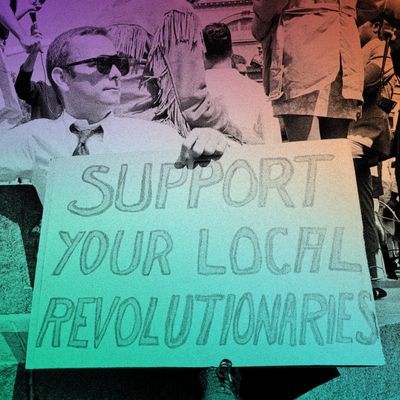
In 2003, the Southern Poverty Law Center warned of a “bizarre” label gaining popularity with the right. “Cultural Marxism” was everywhere, according to believers. Pat Buchanan thought it was so powerful that it could “de-Christianize” America, and William S. Lind, the former director of the Free Congress Foundation, said it was turning colleges into “ivy-covered North Koreas.” The SPLC warned that cultural Marxism, as a narrative, promoted antisemitic falsehoods about a cabal composed of Jewish intellectuals — “nefarious, communistic destroyers” of the American way of life.
Years later, cultural Marxism is still in the news. Jordan Peterson has repeatedly blamed cultural Marxists for corrupting western universities. In 2022, the Heritage Foundation published a report warning that cultural Marxists could soon enslave “the United States to a totalitarian, soul-destroying ideology.” Mike Gonzalez, a Heritage senior fellow, and Katharine Gorka, the foundation’s former director for civil society and the American dialogue, identified cultural Marxism in everything from the rise of the new left in the 1960s to more recent grievances, like “gender ideology,” ESG (or environmental, social, and corporate governance), and the woke-ification of Star Wars and Star Trek. A similar concept shows up in the work of Christopher Rufo, who once linked a supposed “ideological shift” at the New York Times to the political theories of Herbert Marcuse.
But what is cultural Marxism, and why is it such an influential idea? As typically defined by the right, it’s a convoluted and somewhat esoteric conspiracy. Proponents believe a group of left-wing academics devised “a fresh strategy of communist subversion” as early as the 1930s, writes the British historian A.J.A. Woods in their new book, The Cultural Marxism Conspiracy: Why the Right Blames the Frankfurt School for the Decline of the West. In this view, Woods explains, scholars associated with the Frankfurt School infested “the cultural apparatus” of western society in order to elevate “the petulant demands of various minority groups,” including feminists and Black civil-rights activists, and build “a Marxist egalitarian utopia” on “the ruins” of Western capitalism and culture. The ideology of cultural Marxism is alien to the West, an infiltration helped along by “political correctness” or more recently, “wokeness,” Woods concludes.
Although the Frankfurt School was real, cultural Marxism is more of a changeling. It is not “a generic conspiracy theory,” Woods argues, but “an ever-changing combination” of narratives with shifting purpose and meaning. In general, it’s a convenient way for conservatives to discredit their critics — especially on campus. Rufo has helped purge the public New College of Florida of ideologically troublesome faculty and staff. The Department of Education is investigating Smith College for admitting trans women while slow-walking the settlement of racial- and sexual-harassment cases. The result may be as transformative as anything the right has pinned on cultural Marxism.
I spoke to Woods about their new book, the past and future of cultural Marxism, and the difficulty of fact-checking a conspiratorial idea.
Why do you say that cultural Marxism isn’t a conspiracy theory?
I tend to approach intellectual history from a Marxist perspective. When I’m talking about conspiracy, and when I’m talking about cultural Marxism as a shifting bundle of narrative elements, I’m pointing out that cultural Marxism hasn’t been the same thing throughout its history. When we use the label “cultural Marxism conspiracy theory,” we tend to treat it as something singular, something that’s passed from person to person like a baton. Instead I want to shift the focus onto the people who are actually coming up with the ideas because they are part of larger political projects to further particular interests and certain goals. I want to show that there are varying levels of intellectual work taking place when people are talking about cultural Marxism, whether they are producing magazine articles within a political cult, or doing work for right-wing think tanks.
You write pretty early in the book that if we conflate cultural Marxism with other conspiratorial tropes, like Judeo-Bolshevism, we imply “that all right-wing politics are fundamentally the same. The right is the right is the right.” With that in mind, can you explain what makes cultural Marxism so distinctive?
Judeo-Bolshevism was a narrative that the Russian Revolution had been engineered by Jewish people to destroy Christendom, and that had originated as part of The Protocols of the Elders of Zion. The other trope is cultural Bolshevism, which was largely promulgated by the Nazi intellectual Alfred Rosenberg and Adolf Hitler, who suggested that Jewish people were genetically predisposed to produce degenerate art that would demoralize the Aryan race. What you needed to do was replace it with classical European art to boost the spirit of the people.
Cultural Marxism is a post-1960s narrative. The student movement, as a generation, was brainwashed or inspired by the Frankfurt School to pursue the causes of Black liberation, women’s liberation, and gay liberation. The exploitation that the new left was fighting against, from the war in Vietnam to civil rights, were all fictionalized. They had been tricked by the Frankfurt School into thinking that these oppressions actually existed to try and further a more nefarious plan. So you do need to distinguish cultural Marxism from those earlier tropes, partially because of the historical context, but also because it’s much more attached to the shift from industrial to postindustrial society, and it’s more of a reaction to specific forms of organizing for liberation.
What can we glean, if anything, about the recent trajectory of the right from the trajectory of cultural Marxism as a concept?
The theme of betrayal is very strong. You see that throughout the histories of cultural Marxism. In the earliest uses of this anti–Frankfurt School narrative with the LaRouchites, a group that initially formed on the left in the 1960s, you see they have a sense that other groups within the student movement had betrayed the true aims and aspirations of the American left, that they had been compromised, brainwashed by a secret fascist conspiracy that was lurking behind the liberal establishment at the time. In the ‘90s, William S. Lind and Paul Weyrich actually felt that American conservatism, particularly the neocons, had betrayed them on the terrain culture, so the culture war had been lost and western civilization was crumbling precisely because the American right had conceded ground to cultural Marxists to the left.
Narratives like cultural Marxism are all about someone working behind your back to undermine you, or the people of a nation. And I think that position has become much more prominent in right-wing discourse and policy over the past few years.
It has been very strange to read the work of someone like Christopher Rufo, and other conservative writers, who often cite left-wing intellectuals while misinterpreting their work. What is it about this particular group of academics and ideas that agitates certain factions on the right?
I often wonder why the Frankfurt School has been such a persistent villain in the imagination of the American right, because the reason that people like Adorno and Herbert Marcuse, two Frankfurt School thinkers, are cast as the central antagonists of the cultural Marxism narrative is somewhat historically contingent. The LaRouchites didn’t get on with Marcuse’s stepsons at Columbia, for example, and developed a whole narrative about why they represented the wrong kind of student politics and the wrong kind of left-wing politics. Over the decades, that developed into a much more substantial vision of how the Frankfurt School was destroying American and western culture.
For them, one of the benefits of the Frankfurt School surnames is that they sound decidedly foreign, not particularly Anglo-Saxon figures, on an intuitive level. It’s also quite easy to caricature or distort their work to make it seem much more simplistically threatening than it really is. You can present them as challenging traditional moral norms. And I think that there is something compelling to conservative audiences about a right-wing activist who sneaks into left-wing circles and comes back with stolen knowledge.
You’ve mentioned the LaRouchites. Who exactly was Lyndon LaRouche, and how does he factor into this history of cultural Marxism?
Lyndon LaRouche came up with a strategy for building a socialist revolution in the United States. He argued that it was imperative for socialist groups to recruit a revolutionary intelligentsia. So as a guy in his 40s, he started teaching at a school in New York that was frequented by student activists, who were involved in a number of radical groups at the time. He was a very charismatic figure. His lectures would often go on for hours. And he cultivated a group of devotees, which formed the basis of an organization called the National Caucus of Labor Committees.
So the LaRouchites saw themselves as the true revolutionary left. They had very severe disagreements with people who were activists and saw other forms of left activism as possibly serving the interests of the elite. And as a number of antagonisms grew between them and other left-wing groups, the narrative about the role of the Frankfurt School became much stronger, and the LaRouche movement shifted from the left to the right over the course of the 1970s. As they were kicked out of left groups, they started to cultivate more links with the Republican Party and even further right-wing organizations, like Liberty Lobby.
When you get to the 1970s and 1980s, you see the LaRouche movement turn into a political cult thinking of itself as an intellectual elite, fighting a secret counter elite including the Frankfurt School. The Frankfurt School were seen as the orchestrators of counterculture, whether that was folk and rock music or soap operas. So they were seen as almost like a laboratory, used by a grand conspiracy to produce popular culture that would demoralize the masses. LaRouche had this idea that the way to rescue capitalism from all of its different crises was to intensely reindustrialize. Any argument there which said we should support pro-environmental ideas or we should support women’s reproductive choices were seen as anti-growth policies, or a way to control the population and prevent LaRouche’s policies of restoring prosperity to the world and leading the world to a new golden age. When we get to the 1990s, we see LaRouchites argue that the Frankfurt School produced political correctness to control the American population and make them more pliable for elite initiatives.
You’ve said that cultural Marxism is distinct from other tropes on the right, but it does seem that depending on who’s using it and how they’re using it, racism and antisemitism are still very much part of what’s going on. Can you go into that a bit more, and explain how that illuminates the purpose cultural Marxism serves for the right?
I use the phrase “cultural Marxisms,” plural, to point out the variability of narratives around the Frankfurt School as a destroyer of western civilization. And this is to focus on the fact that it changes up, depending on who is using it and what political projects they are part of. It varies a lot, right? And throughout its history, racism and antisemitism have been quite present in the way it’s used. One of the reasons the Frankfurt School is an appealing target for some parts of the far right is precisely because you can sort of say that these scholars are Jewish, and their influence is proof of a larger Jewish plot. And you can do that in much more subtle ways if you’re only just talking about the Frankfurt School.
Cultural Marxism is a way of introducing a subtextual racism or antisemitism. And sometimes it’s not even subtextual. It is so compatible with racist and antisemitic ways of thinking, not only because of explicit statements, but also in the assumptions of how it works, or the assumptions that central to the narrative itself, like the way it delegitimizes the struggle in the 1960s for civil rights and the continuing struggle against racial inequality today. It says Black people actually belong in a social position that is inferior to white people, and that it is an act of social engineering to aspire towards racial equality, because Black people are naturally inferior and would only get this idea about their innate dignity if they’ve been misled by someone else. Presumably someone or some people that did not belong. For generations, those figures have been scapegoated as Jewish. Cultural Marxism is not just a narrative that’s appealing to forthright racists or antisemites, but has a way of justifying conservative notions about hierarchy and freedom.
In your view, what has to happen, structurally, for people to become receptive to an esoteric concept like cultural Marxism?
I
owe a lot to the work of Stuart Hall, a British Jamaican cultural
theorist. He was very interested in figuring out the cultural and social
impulses and aspirations that motivated people to support Thatcherism
in the 1970s and 1980s. What kind of experiences did Thatcherism latch
onto and convert into political support? I think we see with the far
right today an adoption of liberal ideals for illiberal ends. Take, for
example, the anti-critical-race-theory scare, right? It worked because
it told white parents their children were learning in school that they
were evil, an oppressor, that they were bad in some way. And that was
all overexaggerated, but the emotional core was that children were being
harmed, and also, here is this thing that undermines the principle of
equality, which we should all believe in.
It was also telling that
the anti-CRT scare tried to target Black parents by saying this theory
frames your child as the oppressed, a victim who will never achieve
anything. As if by teaching about racial equality, we were forcing
people to be unequal. You can see that again with attacks on trans
people, or attacks on pro-Palestinian solidarity. They say they believe
in equality for women, or they believe that racism and antisemitism are
wrong, if it helps them suppress dissent. They speak in an indirect way
to people’s alienation from the democratic process itself. It’s a sense
that someone has taken control away from the people, and the people need
to take it back.


