Trump Keeps Promising His War With Iran Is Almost Over. It’s More Likely to Get Way Worse.
https://slate.com/news-and-politics/2026/08/trump-iran-war-peace-oman.html
Trump Keeps Promising His War With Iran Is Almost Over. It’s More Likely to Get Way Worse.
Thanks, Donald
This story is adapted from the Slatest newsletter. You can sign up here to get it in your inbox every day.
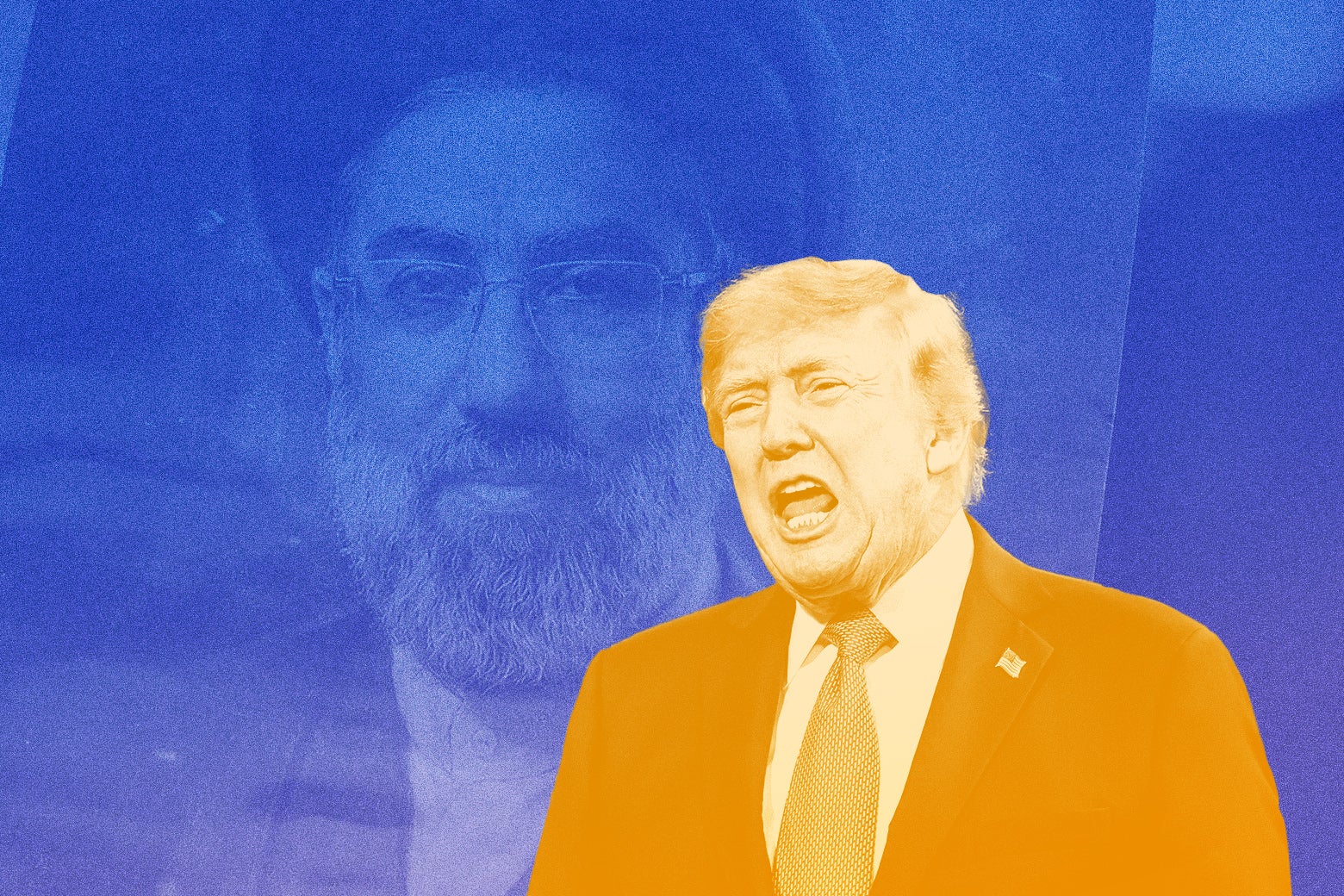
On paper, Donald Trump’s war in Iran seems like it could be close to over. The U.S. has paused its attacks and Iranian strikes on commercial ships have gotten more infrequent. But less fighting doesn’t necessarily mean we’re getting closer to peace. Beneath the surface, the conditions are brewing for a prolonged conflict—and possibly an even more intense one.
Wait, back up: Why did the fighting taper off?
Good question. Last month, after Trump’s fragile ceasefire collapsed, the U.S. launched 13 straight days of missile strikes and bombing runs against Iran. Iran, in turn, used missiles and drones to attack U.S. military bases around the region. But in August, the guns have largely gone silent. Trump abruptly called off more strikes a couple of weeks ago, citing progress in peace talks. The real reason for the pause may be that the U.S. is reportedly running dangerously low on the interceptors it uses to shoot down Iranian missiles and drones, interceptors it also needs elsewhere (including to help Ukraine against Russia). Either way, Iranian attacks—which the country’s officials have characterized as “retaliatory operations”—have mostly abated since Trump hit pause, leaving the war in a state of limbo.
But the war isn’t over, right? So if not with drones and missiles, how are the two sides fighting?
At least for now, a hot war has morphed into an economic and political war of attrition. Having failed to beat Iran into submission with bombs, Trump is banking on economic pressure to bring it to heel. The U.S. has yanked away the waivers it gave Iran to sell oil during the ceasefire, reimposed its naval blockade on Iranian ports, and reportedly plans to slap on another round of economic sanctions this week. Throttling Iran’s economy to force its leaders to make a better deal appears so key to Trump’s strategy that today he threatened to “bomb the shit out of” Oman, a U.S. ally that’s been mediating talks, if it “gets in the way” of a peace deal. Iran’s leaders, meanwhile, can read polls—and the calendar. They think a prolonged, unpopular war will keep gas prices high, perhaps costing Trump and his party control of Congress in the November midterms. That might be enough to deter future U.S. attacks.
Who has the advantage?
Iran’s economic pain is real. Inflation is high, poverty is rising, there are shortages of medicine and other goods, and the fighting has damaged businesses. But Iranians have long lived under the yoke of U.S. sanctions, and the country’s new supreme leader—who inherited the job after U.S. and Israeli strikes killed his father early in the war—seems prepared to quash dissent. He recently appointed a hard-liner to run the Basij, a domestic paramilitary group that helps the regime disrupt protests and carry out mass arrests. Iran’s president is popularly elected. But he ultimately answers to the country’s autocratic supreme leader, who can afford to brush off at least some amount of public unhappiness. That looks like a recipe for nobody to give in anytime soon.
It sounds like neither the U.S. nor Iran has enough of a military, economic, or diplomatic edge to decisively win—but neither is willing to back down either.
Well put. But Trump’s position may be deteriorating as his allies in the region get increasingly nervous about what a prolonged war could mean for them. Israel has urged on the fighting, but others appear to be getting squirrely. As the Wall Street Journal reported last night in an article headlined “Iran’s Secret Plan to Escalate the War,” Iran could try to sabotage internet cables in the Persian Gulf, fuel domestic unrest inside Kuwait and Bahrain, and maybe even attack Kuwait with ground forces. Iran has also urged the militant groups it supports in Yemen and Iraq to target Saudi Arabia, a key U.S. ally whose oil exports Iran wants to disrupt. The Houthis, a Yemeni militia, reportedly attacked Saudi ships in the Red Sea on Monday. And despite the overall lull in the fighting, Iran fired drones at oil tankers from the United Arab Emirates, another U.S. ally, as they transited the Strait of Hormuz this month.
OK, but you mentioned that we might be in for even more intense fighting. Why would a conflict that’s cooled off suddenly turn hot again?
Right now, diplomacy doesn’t seem to be working. Today brought a punctuation mark of sorts: the end of the 60-day negotiating period in which Trump’s team was supposed to hammer out an agreement over the future of Iran’s nuclear program. Instead, those talks never really got off the ground after the ceasefire collapsed, and Iran instead seems to be preparing for an escalation. Per the Journal, the hard-liners who occupy the country’s key military posts have focused on rebuilding their missile and drone arsenal. So even if one side or the other does claim that diplomatic progress is being made, it could just be a smoke screen before the fighting starts again.

Time to focus less on the vagaries of geopolitics and more on how you can have a great rest of your night. My colleagues suggest:
An old-school habit that could change your relationships: Party Like It’s 1996, Slate’s six-week time-travel challenge to rediscover the lost art of hanging out, is back with its second installment today. This one is focused on how lonely many of us are despite being constantly connected with everyone in our lives through our phones, and proposes a way to change it. (If you missed the start of this series, you can sign up and start getting it in your inbox from the beginning!)
A subversive, funny new show: HBO’s new Sunday night series Lanterns is the spiritual successor to Watchmen: a superhero show for people who don’t think they like superhero shows. Sam Adams explains why it’s worth the watch.
A candid conversation with a man who loves to lead people on: As part of Pillow Talk, an interview series that deciphers our mixed signals about sex, Slate’s Isabelle Kohn spoke to a 38-year-old who’s often accused of being a fuckboy about why he acts the way he does. If you enjoy puzzling over the mysteries of the human psyche (or rubbernecking over other people’s messy love lives), this one is a juicy read.
A chance to flex your big vocabulary: Do you know which activity a pugilist engages in? Do you pride yourself on the depth and breadth of your command of the English language? Today’s bite-size trivia quiz might be worth a try!
Thanks, as always, for reading the Slatest, and see you tomorrow!


No comments:
Post a Comment