The
president called his old golfing buddy to boast about his war effort,
which has already killed dozens of people, including three American
soldiers.
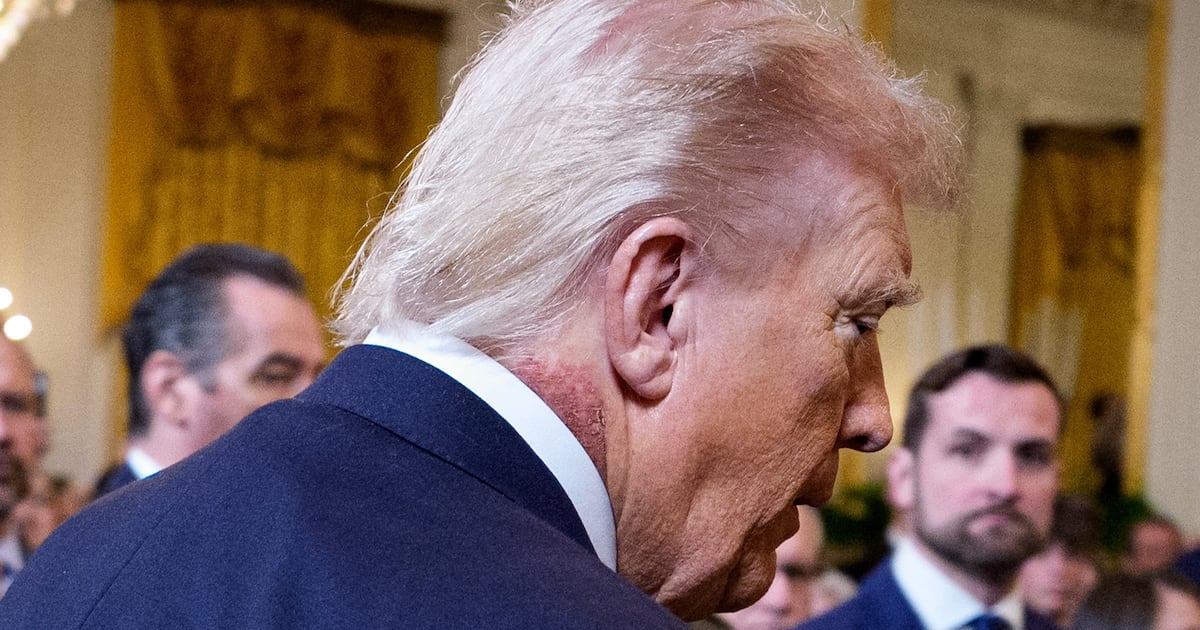
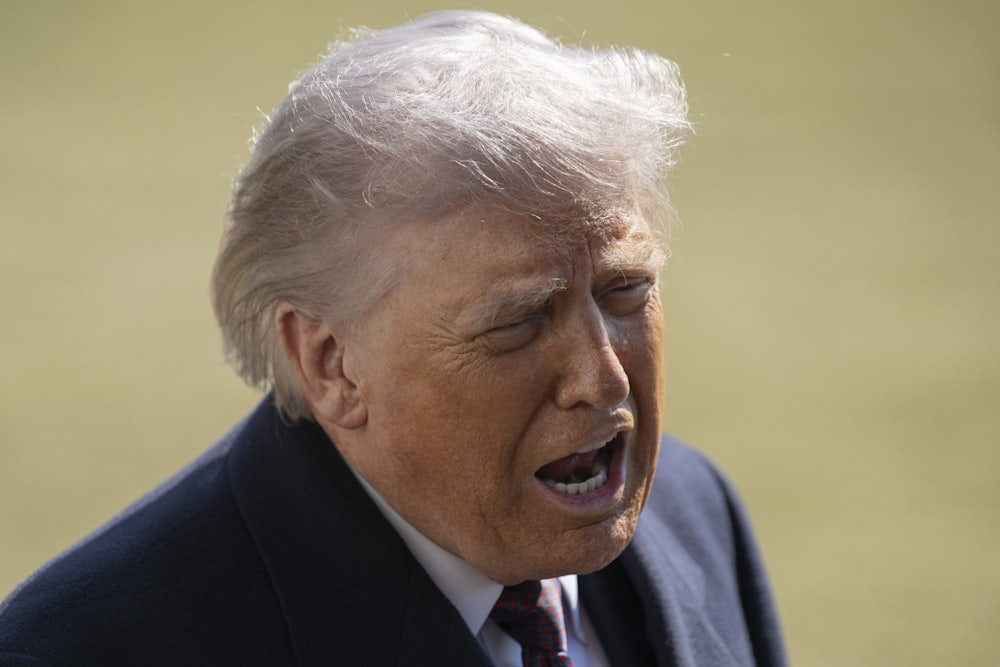
Following the U.S. and Israeli attacks on Iran on Saturday, President Donald Trump called Squawk Box
host Joe Kernen to share an update on the so-called Operation Epic
Fury. Trump told the CNBC anchor in a phone interview on Sunday that the
military operation in Iran is “moving along very well, very well —
ahead of schedule.”
The president did
not provide an exact timeline for ending the conflict, but he insisted
that the developments were good. “Things are evolving in a very positive
way right now, a very positive way,” he told Kernen.
Trump's
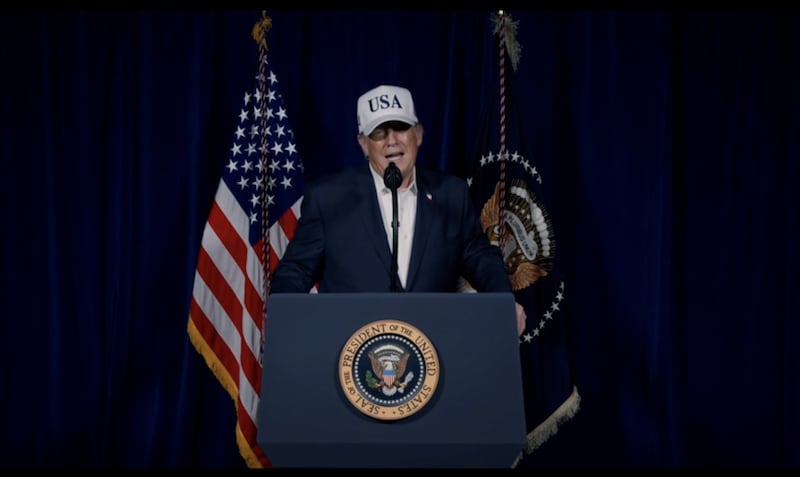
only on-camera address to the American public so far was delivered in
the early hours of Saturday morning. The president appeared sans tie and
in a trucker hat for the historic remarks. US President Trump Via Truth Social/Anadolu via Getty Images
While the president’s assault on Iran, which was done without congressional approval,
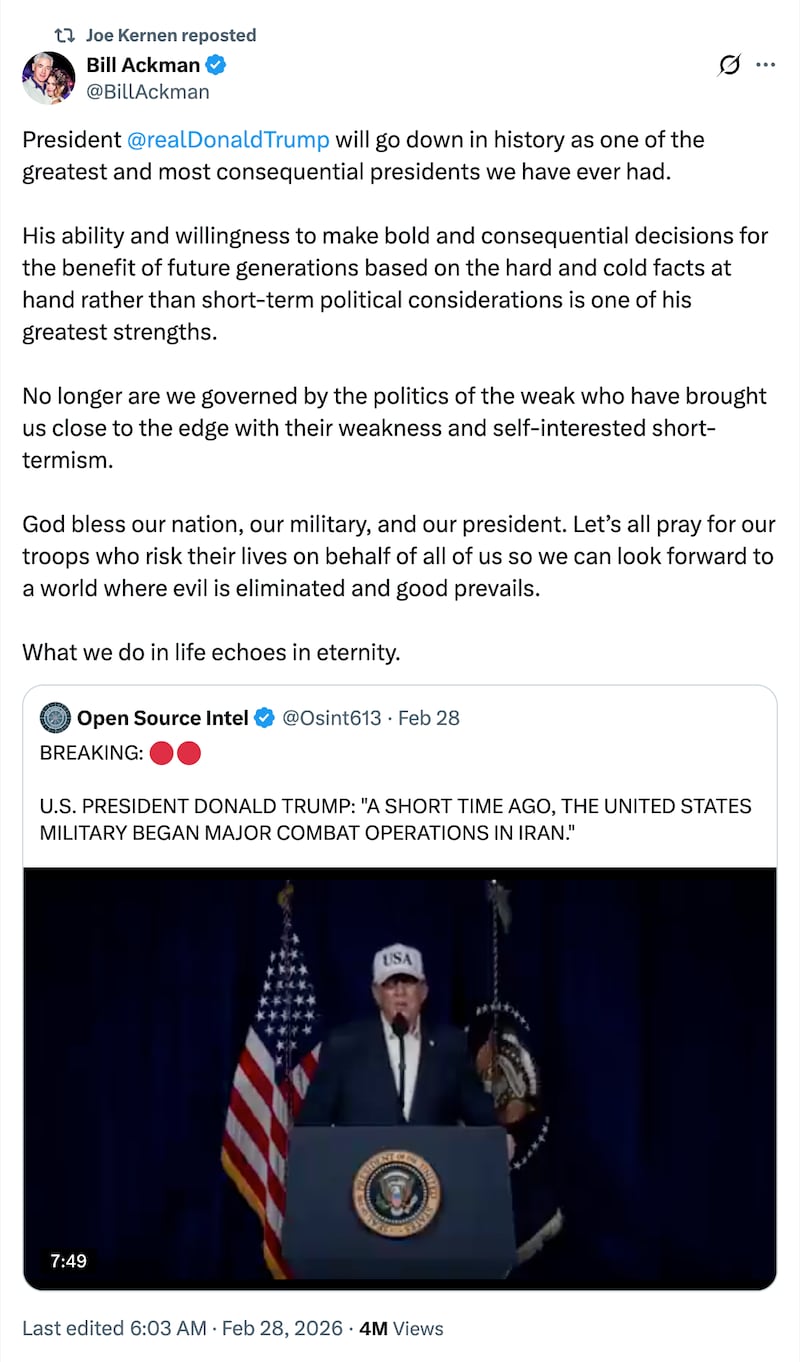
was divisive, Kernen reshared Trump ally and billionaire hedge fund
manager Bill Ackman’s endorsement of the military offensive. Ackman had
praised Trump for “his ability and willingness to make bold and
consequential decisions” for America’s future.
“No
longer are we governed by the politics of the weak who have brought us
close to the edge with their weakness and self-interested
short-termism,” Ackman wrote Saturday. “God bless our nation, our
military, and our president. Let’s all pray for our troops who risk
their lives on behalf of all of us so we can look forward to a world
where evil is eliminated and good prevails.”
Kernen has a long, documented relationship with Trump. In addition to sharing numerous X posts taking jabs at Democrats, Kernen uploaded an old photo
of himself golfing with Trump in honor of the president’s birthday last
year. The photo is signed by Trump, and bears the words “Joe — We are
getting older!"
Kernen has worked for CNBC since 1991, and was a recurring guest on Trump’s TV show, The Apprentice in the early 2000s.
The Daily Beast reached out to CNBC and the White House for comment.
Operation
Epic Fury, the U.S. name for the joint operation with Israel against
Iran, has provoked outrage among Americans and people across the world.
While many celebrated the killing of Supreme Leader Ayatollah Ali Khamenei,
others were concerned about the consequences of the U.S. and Israel’s
attacks, including a rising death toll and the potential for an extended
conflict.
Anti-Iranian
regime protesters burn an image of Ayatollah Ali Khamenei in January.
Deadly protests erupted in the country against his regime. HENRY NICHOLLS/AFP via Getty Images
Trump casually suggested that Americans on Saturday would die as a result of military action in Iran, which even drew backlash from allies.
“The
lives of courageous American heroes may be lost, and we may have
casualties, that often happens in war,” he said in the early morning
video posted to announce the attacks.
People
cross a street as smoke rises from the site of a reported Iranian
strike in Dubai on March 1. Iranian officials promised retaliation for
the death of their Supreme Leader. FADEL SENNA/AFP via Getty Images
On Sunday, Pope Leo XIV shared a message of peace to X, condemning the attack on Iran and urging the end of military intervention.
“I
make a heartfelt appeal to all the parties involved to assume the moral
responsibility of halting the spiral of violence before it becomes an
unbridgeable chasm,” Pope Leo said.
“May diplomacy regain its proper role, and may the well-being of
peoples, who yearn for peaceful existence founded on justice, be upheld.
And let us continue to pray for peace.”
Transcript: As Trump Goes Off Rails on Economy, Fox Bursts His Bubble
Even
Fox News is now admitting hard truths about the state of Trump’s
economy. We talked to a chronicler of right-wing media who explains how
all this is straining his propaganda apparatus to the breaking point.
Celal Gunes/Anadolu/Getty Images
The following is a lightly edited transcript of the March 2 episode of the Daily Blast podcast. Listen to it here.
Greg Sargent: This is The Daily Blast from The New Republic, produced and presented by the DSR Network. I’m your host, Greg Sargent.
Donald Trump’s State of the Union speech told a story about his economic successes that is pure fiction
from top to bottom. But for Trump to tell this story all the way
through Election Day this fall, he’s going to rely heavily on the MAGA
and right-wing propaganda apparatus to do it for him. But here’s the
thing: Sometimes the news is so bad that even Trump’s media allies can’t keep a lid on it. Trump was just hit with some very tough inflation numbers that showed up in a damning way on Fox. The network has also been surprisingly blunt about other recent bad economic news as well. And all this comes as a new poll
shows enormous majorities rejecting the story Trump told in his speech.
So can Trump’s propaganda network hold together his fictional story or
not? We’re parsing through this with the excellent Matthew Gertz, a
senior fellow at Media Matters. Matt, good to have you back on, man.
Matthew Gertz: Always good to be here.
Sargent:
So we just learned that inflation was worse than expected for
producers, which is a sign that more inflation might be coming. Listen
to the news as it was described by Stuart Varney on Fox Business. The first voice is his, the second one is his guest, David Bahnsen.
StuartVarney (voiceover):Let’s
begin with the latest read on inflation. This is important and it’s
probably moving markets. It’s the producer price report. It came in
hotter than expected—prices up 2.9 percent over the last 12 months. Now
look at the core number. This pulls out the volatile prices for food and
energy. Prices up a whopping 3.6 percent in the last 12 months. That is
the highest reading since March of 2025.
David Bahnsen (voiceover):This PPI number was not good.
Varney (voiceover): No, it’s not. It’s not encouraging at all, is it? The Fed’s going to be looking at that for sure.
Bahnsen (voiceover): They are. And so are the people that are making capital investments that are seeing higher prices.
Sargent: This story generated a lot of bad
headlines for Trump. USA Today said, “Price bump may signal inflation is
on the rise.” Matt, this seems like bad timing for Trump after the
State of the Union speech, which claimed this massive historic
turnaround. What did you think of that?
Gertz: Yeah, that’s
really the issue. You have a situation where Donald Trump wants to talk
about his golden age of America. He wants to talk about all the great
jobs that he’s creating, how he’s got inflation squashed, how everything
is going great. But the numbers that come out about this economy are
not as rosy as he would like it to be.
And
in some cases we see Fox just rolling with his BS and parroting it as
propaganda. But every now and again, especially on Fox Business, you see
them coming to grips with reality—that the economy is sputtering, that
everything is not as great as he would have it be. And when that
happens, it creates some dissonance for the viewers.
Sargent:
I want to get into that dissonance at some length later. We like
dissonance on here, especially with right-wing media. Can you, for now,
though, map out for us the way right-wing media treats this stuff in a
broader sense? The tariffs are deeply unpopular and have had all sorts
of negative effects. Yet meanwhile, Trump is spinning a fictional story
on the economy that numbers keep debunking. How does right-wing media,
as a general matter, deal with all this?
Gertz: In general
you see them falling back on two narratives. Whenever there’s a good
piece of news, it’s a sign that Trump’s economy is booming. Whenever
there’s a bad piece of news, a bad number that comes out, it is evidence
that Joe Biden is still waging war on the American business community
in some way.
This
has worked well enough to get them through the day over the last year,
but eventually you have to think that is going to run out. Not yet,
obviously—you still see JD Vance out on the stump saying this is all Joe
Biden’s fault. But Election Day is coming, and two years in, blaming
your predecessor for the economy is just not going to sell to people.
Sargent:
We just learned that economic growth was far lower for the fourth
quarter of 2025 than we thought—1.4 percent. Here’s Fox Business
reporter Lauren Simonetti describing that.
LaurenSimonetti (voiceover):OK,
it was a bad miss. The economy grew at an annualized rate of just 1.4
percent at the end of last year, down sharply from the 4.4 percent
growth in the prior quarter. What happened? The government shut down.
Sargent: And here’s former torture memo author John Yoo discussing those numbers right after the Supreme Court struck down Trump’s tariffs.
JohnYoo (voiceover):This
might be a blessing in disguise, because we just had GDP report numbers
from last year that showed the economy significantly slowed.
Sargent: So Matt, here again, you see Fox
Business and Fox News letting some bad news slip through. How often does
that happen on those two channels?
Gertz:
It’s pretty rare. I don’t want to exaggerate this too much. In general,
Fox News is a propaganda apparatus for Donald Trump, and they make
really little bones about it, particularly compared to the first
term—they have stapled themselves to him. But at the same time, during
the daytime news hours and over on Fox Business, the audience is a
little bit different than it is in primetime on Fox News.
And
because of that, I think you see the bad news slipping out a little bit
more often, especially on Fox Business, which, as the name might
suggest, has more of an audience of people interested in business news.
They can’t entirely wave away the actual numbers that are coming out,
because the audiences are people who are interested in business, who
know some things about business, and are more likely to be the kind of
old-school conservative business types than the new-school MAGA types on
issues like tariffs.
Sargent: Yeah, they’re a little less
tethered to Trump and MAGA in a sense. Let’s listen to a couple more
examples from Fox News. Here’s Fox’s Brian Kilmeade on the tariffs.
BrianKilmeade (voiceover):If
you go blow up a fantastic deal with the EU by putting 10 percent on,
they go and answer with more. And a lot of the goods that we get will
affect what we are paying in the stores. If you affect what we’re paying
at the stores, Republicans have almost no chance of holding the House
and Senate. And might even lose the Senate.
ShannonBream (voiceover):We
all know members that we’ve talked to on the GOP side of the aisle who
are silently, quietly breathing a sigh of relief. There have been
Republicans on Capitol Hill who have voted against some of the
president’s tariffs. They think it’s actually hurt the economy and hurts
their ability to go out and make the argument that this president is
working to make things more affordable.
Sargent: So Matt, what’s striking to me about
this really is that here you see a bit of a divergence in interests
between Fox News on one side and Trump and MAGA on the other. Fox News
is heavily tethered to the business community in many ways, and the
tariffs in particular are something that the business community really
hates. So ... in addition to the audiences being a little different,
their masters are a little different here, aren’t they? Can you talk
about that split?
Gertz: I think that’s right. To some
extent you have a traditional business community that is wary of
tariffs, and you have a MAGA audience that has bought into them to a
greater degree. Notice, though, that no one is saying this was a bad
idea for Trump to do this in the first place.
Instead it’s always
hedged as: Trump would be in a better spot if he were to get rid of
these tariffs, it would be in the interests of the Republican Party
candidates if there weren’t all of these tariffs. It’s always framed in a
way where they’re trying to help Trump help himself.
They’re
part of the same team, all pulling for the same goals, rather than
trying to actually criticize the president for his policy decisions.
Sargent: They’re not allowed to really say anything like, boy, Trump really screwed this one up pretty badly, didn’t he?
Gertz:
No, that would be a bridge way too far. That’s the sort of thing that
causes Trump to get angry and lash out at the network, which is
something that we have seen him do over the years when he thought
particular hosts got out of line.
That’s
happened less frequently, though, certainly in the second term than the
first term. I think that’s largely a function of the fact that a lot of
the old standbys in the Fox straight-news branch who might, from time
to time, tell the truth—people like Shep Smith or Chris Wallace—aren’t
around anymore. A lot of them were either forced out or left
voluntarily. But it is much more of a new-school MAGA brand at Fox News
now. The fact that we’re talking about Brian Kilmeade as the voice of
reason is really a sign of how far things have gone.
Brian Kilmeade is not ... a
liberal by any stretch of the imagination. He is a hardcore
conservative who supported Trump down the line. But nonetheless, someone
whose familiarity with politics predates Donald Trump, and thus has
some values from before the MAGA takeover of the party.
Sargent: Let’s talk about the heavy lift that Trump’s propaganda apparatus has here, because it’s really heavy. Reuters had this new poll. It looked at some of the claims Trump made in his speech. So for instance, Trump essentially said, The economy is booming, we’re booming. And Reuters found that 68 percent of Americans say no, the economy’s not booming. Then Trump also essentially said, We’ve defeated inflation, which Biden saddled us with.
Reuters found that 82 percent of Americans disagree with the statement
that there’s hardly any inflation in the U.S. So that’s a heavy lift for
the propaganda apparatus, isn’t it?
Gertz:
It’s definitely a heavy lift, which isn’t to say that there aren’t
people at Fox willing to try to do the work. Sean Hannity, for instance,
after the State of the Union on Tuesday night, went on Fox for a
special edition of his show and he started by saying, “Moments ago,
President Trump wrapped up yet another iconic, uplifting, patriotic
State of the Union.”
He said that Trump had championed our
country and the achievements of “you, the American people.” And he said
that Trump delivered a glowing speech that highlighted the triumphs, the
struggles, the bravery of so many American people. “Under President
Trump’s leadership, America’s full potential is unlocked and the state
of our union, thankfully, is strong.” And that was just the monologue. Then
he hosted a bunch of different Republican leaders, all of whom agreed
that this was the greatest State of the Union they had ever heard.
It’s
interesting—I noticed the next morning that the Wall Street Journal,
which is corporate cousin to Fox News, put out a report from their Korea
bureau chief highlighting how North Korean state media had provided
“unbridled flattery that underscores the dictator’s need to establish a
cult of personality supremacy as a smokescreen for his nation’s
woes”—basically praising Kim for nonsensical, meaningless
accomplishments, saying that he was the greatest person in the world
with unimaginable accomplishments and that their “future is infinitely
bright and promising.” There’s basically no daylight between how North
Korean state media talks about that country’s dictator and how Sean
Hannity talks about Donald Trump.
Sargent:
Donald Trump actually exploded on Truth Social over the Supreme Court
decision on tariffs, and he did something odd, which is suggest that
it’s time for the court to rehear it, which I’m not sure is a thing or
not.
I’m going to read from the [post] that Donald Trump sent:
“The recent decision of the United States Supreme Court concerning
tariffs could allow for hundreds of billions of dollars to be returned
to countries and companies that have been ‘ripping off’ the United
States of America for many years, and now, according to this
decision, could actually continue to do so at an even increased level.
I’m sure that the Supreme Court did not have this in mind!”
Trump
then goes on and says: “Lots and lots of countries are taking advantage
of us, have been taking advantage of us for decades.” They’ll now be
entitled to an “undeserved windfall” from the United States. And then he
concludes with this: “Is a rehearing or re-adjudication of this case
possible???”
Matt,
I don’t know what to make of that. I don’t think the Supreme Court is
going to rehear or re-adjudicate the case. And I also think the Supreme
Court did have this in mind. What do you think of this?
Gertz:
The Justice Department, as this case was going through the courts,
repeatedly said that it was not an emergency that had to be sped up in
the process specifically because any funds that were tariffed could be
returned by the federal government. That has been baked into their legal
arguments over and over again this entire time. So the idea that we
have just discovered that oh my God, the money that has been illegally taxed has to be returned is utter nonsense.
It’s
also interesting how he describes this as allowing the money to be
returned to countries that have been ripping off the United States. One
of his repeated lies throughout the entire debate about tariffs has been
over who pays tariffs. He claims—and has claimed and told his
supporters for years—that tariffs just get paid by foreign countries,
and therefore now that the money has to be returned, it would
theoretically go to foreign countries. In reality, we pay the tariffs.
The cost is paid by the importer and gets passed on to the consumer.
These are all taxes on us. We, for some reason, have huge tariffs on
literally everything we buy now, and we are the ones who ultimately pay
for them.
On
Fox, that has often not broken through to viewers, in part because
people are so eager to support the president. So earlier this week there
was a segment on Fox—Virginia Governor Abigail Spanberger gave the
rebuttal to the State of the Union on Tuesday night and she described
the tariffs as a massive tax hike on you and your family. And after
that, Fox & Friends co-host Lawrence Jones said that was 100
percent false—that there’s been zero inflation based on the tariffs,
that you cannot say that it caused inflation on the American people—that
it is lies that Trump’s trade policies forced American families to pay
more than $1,700 each in tariff costs.
But, in fact, that is the
case! Fox doesn’t want its viewers to know that their prices are going
up because of what Donald Trump has done. He doesn’t want them to know
that either. But that is the state of affairs.
Sargent:
I think this is a good place to conclude. So basically Fox News mostly
deceives people about tariffs. But as we went over earlier, it’s also an
area where Fox News sometimes tells the truth because Fox News and Fox
Business feel somewhat beholden to the business community as well. And
yet here you’ve got Donald Trump signaling with this kind of rage rant
that he simply will never, ever, ever give up on the tariffs.
He’s
going to keep running at it, he’s going to keep trying to inflict them
on everybody, and he’s probably going to succeed in inflicting some
tariffs on the American people for the rest of this year, potentially
through the election.
So where does that leave right-wing media?
Where does that leave Fox News going forward? How are they going to try
to contain this disaster so it doesn’t just murder Republicans in the
midterms?
Gertz: It leaves them in a very chaotic
situation. I would say if there’s a guiding line, it’s that if
Democrats are criticizing tariffs, the Democrats are wrong, but Donald
Trump might want to back off the tariffs to help Republicans—because
Democrats will attack them on tariffs.
There’s a total
incoherence, a mishmash of different talking points, all of which lead
up to the idea that Donald Trump must be supported at all costs. And I
don’t think there’s a way out of that trap for Fox News, Fox Business,
for any of them. They have made their bed with Donald Trump, Donald
Trump really loves tariffs, and so they’re all stuck with each other.
Sargent:
I will say that dissonance is going to get really shrill and difficult
for them going forward, right through Election Day. Matt Gertz, thanks
for coming on with us, man. Always super illuminating.
CHARLOTTE, N.C. (AP) —
Americans are losing a vast array of people and programs dedicated to
keeping them healthy. Gone are specialists who were confronting a measles outbreak
in Ohio, workers who drove a van to schools in North Carolina to offer
vaccinations and a program that provided free tests to sick people in
Tennessee.
State and local health departments responsible for
invisible but critical work such as inspecting restaurants, monitoring
wastewater for new and harmful germs, responding to outbreaks before
they get too big — and a host of other tasks to protect both individuals
and communities — are being hollowed out.
“Nobody wants to go
swim in a community pool and come out of it with a rash or a disease
from it. Nobody wants to walk out their door and take a fresh breath of
air and start wheezing,” said Lori Tremmel Freeman, executive director
of the National Association of County and City Health Officials.
But local health officials say they now have no choice but to do a
lot less of it. The Trump administration is cutting health spending on
an unprecedented scale, experts say, including pulling $11 billion of direct federal support because the pandemic is over and eliminating 20,000 jobs at national health agencies that in part assist and support local public health work. It’s proposing billions more be slashed.
Children walk
through a sports field in Independence Park under the skyline of
Charlotte, N.C., on March 20, 2025. (AP Photo/Mary Conlon)
Together, public health leaders said, the cuts are
reducing the entire system to a shadow of what it once was, threatening
to undermine even routine work at a time when the nation faces the deadliest measles outbreak since at least the 1990s, rising whooping cough cases and the risk that bird flu could spread widely among people.
The moves reflect a shift that Americans may not fully realize, away
from the very idea of public health: doing the work that no individual
can do alone to safeguard the population as a whole. That’s one of the
most critical responsibilities of government, notes James Williams,
county executive in Santa Clara County, California. And it goes beyond
having police and fire departments.
“It means not having babies suffering from diseases that you
vanquished. It means making sure that people have access to the most
accurate and up-to-date information and decisions that help their
longevity,” Williams said. “It means having a society and communities
able to actually prosper, with people living healthy and full lives.”
Keeping communities healthy saves lives — and money
Just
outside a Charlotte, North Carolina, high school in March, nurse Kim
Cristino set out five vaccines as a 17-year-old girl in ripped jeans
stepped onto a health department van. The patient barely flinched as
Cristino gave her three shots in one arm and two in the other to prevent
diseases including measles, diphtheria and polio.
Like many other teens that morning, the girl was getting some shots
years later than recommended. The clinic’s appearance at Independence
High School gave her a convenient way to get up to date.
A student
receives a vaccination inside a mobile health unit visiting Independence
High School in Charlotte, N.C., on Wednesday, March 19, 2025. (AP
Photo/Matt Kelley)
“It lessens the barriers for parents who would have to
be taking off from work and trying to get their kids to a provider,”
Cristino said.
The vaccinations also help the community around
her. The teen won’t come down with a life-threatening disease and the
whole community is protected from outbreaks — if enough people are
vaccinated.
The Mecklenburg County department, with “Protecting
and Promoting the Public’s Health” emblazoned on its van, is similar to
other U.S. health departments. They run programs to reduce suicides and
drug overdoses, improve prenatal health and help people stop smoking.
They educate people about health and test for and treat diseases such as
HIV and tuberculosis. Some, including Mecklenburg, operate medical and
dental clinics too.
“You come to work every day and think: What’s
going to be my challenge today? Sometimes it’s a new disease,” said
Raynard Washington, Mecklenburg’s director. “That’s why having a
backbone infrastructure is so important.”
Mecklenburg
County Health Department Director Raynard Washington speaks during an
interview in Charlotte, N.C., on March 18, 2025. (AP Photo/Mary Conlon)
Disease prevention is unseen — and ignored
Critical
care can be glamorous — surgeons, cardiologists and cancer doctors can
pull off breathtaking medical feats to save lives at the last possible
moment. Prevention work is low key. It’s impossible to identify who was
saved because, if it goes well, the person never knows when they’ve
fended off a mortal threat with the invisible shield of public health.
“People
don’t appreciate it,” said Dr. Umair Shah, former health director for
Washington state. “Therefore, they don’t invest in it.”
State
health departments are funded by a varying mix of federal and state tax
money. Some states deliver services in a centralized way while others
provide resources to local departments, which generally also get money
from counties, cities or towns. Some large cities get direct federal
funding for their health departments.
Mecklenburg — a large department with around 1,000 workers serving
1.2 million people — has an annual budget of around $135 million, while
some metro hospitals have operating expenses in the billions. About 70%
of the department’s budget comes from local funds, which helps fill gaps
in state and federal money. But Mecklenburg is still strapped for cash
and resources.
At times, employees work 12- to 14-hour days,
especially during outbreaks. Nurse Carmel Jenkins recalled responding to
mpox exposures at a day care center — arriving before 5:30 a.m. to
alert the children’s parents and working late into the evening.
“Even
though there may be limited resources, we still have a service to
provide,” said Jenkins, a director of clinical services for the
department. “We don’t mind going above and beyond to be able to do
that.”
Chaos in Washington puts ‘lives at risk’
In March,
the Trump administration pulled $11 billion from state and local health
departments without warning under the leadership of Health Secretary
Robert F. Kennedy Jr., a longtime anti-vaccine activist and public
health critic. The cuts abruptly ended COVID-era grants, which had also
been approved for non-COVID work including vaccination and disease
detection, tracking and testing.
A week later, thousands of people
were laid off at the Centers for Disease Control and Prevention. Many
had worked closely with state and local health departments to provide
information, grants and other support.
The sudden, one-two punch
delivered a serious blow to the system, public health leaders said in
interviews, court filings and public testimony.
A Kennedy
spokesman said in an email that America remains unhealthy compared with
other developed nations and HHS is reorganizing what he said were
“broken systems” and reprioritizing resources to “centralize programs
and functions that will improve our service to the American people.”
“These
cuts are not about abandoning public health — they’re about reforming
it,” spokesman Andrew Nixon said, adding: “We reject the implication
that HHS has turned its back on urgent health threats.”
HHS
justified the grant cancellations by saying the money was for COVID and
the pandemic is over. But most of the cuts were in areas that are
especially important given today’s health threats. The biggest chunk,
more than $8.9 billion, involved epidemiology and laboratory capacity
related to infectious diseases, while another $2 billion was related to
immunizations. In some places, the cuts are on hold due to a federal
judge’s order in a lawsuit by states. But elsewhere, cuts are
continuing.
In Mecklenburg, for example, 11 community health
workers lost their jobs, meaning less outreach to groups like the
Hispanic community. All eight employees dedicated to the mobile vaccine
program were laid off.
A mobile
health unit is parked outside of Independence High School in Charlotte,
N.C., on Wednesday, March 19, 2025. (AP Photo/Matt Kelley)
In Columbus, Ohio — one of several communities in
Republican-led states suing over the cuts — the health department had to
lay off nine disease intervention specialists. This left it operating
at 25% capacity in its disease tracing and investigation work just as it
prepared to address a measles outbreak.
Kansas City, Missouri,
will not be able to do its own testing for infectious diseases because
the cut came just as the city was about to buy $500,000 worth of
equipment. And Nashville had to end a program offering free flu and
COVID tests and cancel plans to buy a van to deliver vaccinations.
The
cities complained the cuts had created “severe budget uncertainty” and
forced them to redirect their limited resources “to respond to the
resulting chaos.”
CDC staff cuts are also having a ripple effect
on state and local departments. Children who are deaf or hard of hearing
will no longer benefit from an early intervention program run by states
after everyone who worked on the program at CDC was laid off. The team
in the Office on Smoking and Health, which funds state tobacco hotlines
that help people quit, was let go.
So was the CDC team that worked
to reduce drownings, partly through funding low-cost swimming lessons
in local communities. Drownings kill 4,000 people a year in the U.S.
“The
experts who know the things that can be done to help prevent the No. 1
cause of death from children ages 1 to 4 have been eliminated,”
Connecticut state health commissioner Dr. Manisha Juthani told a
Democratic congressional hearing in April, referring to drownings.
She
said the abrupt and disorganized nature of the cuts leaves her
department scrambling as officials try to understand what is being cut
and to close important programs on the federal government’s impractical
timelines.
“The current uncertainty puts lives at risk,” she said.
Public health funding is going bust — and about to get worse
The
new cuts are especially damaging because health departments are funded
differently than other government agencies meant to protect the public:
Funding pours in during emergencies and slows to a relative trickle when
they subside. Mecklenburg’s Washington notes the contrast with fire
departments, which are kept ready at all times, not scrambling to find
firefighters and fire trucks when houses are already burning.
With
health departments, “there’s a long-established pattern of
boom-and-bust funding,” said Dr. Steven Stack, Kentucky’s public health
commissioner and past president of the Association of State and
Territorial Health Officials.
A temporary surge of money during
the pandemic allowed some health departments to expand and strengthen
programs. In Alabama, the influx of COVID money allowed the state to
reopen a health department in largely rural Coosa County that closed a
decade ago due to a lack of money. In California’s Santa Clara County, a
COVID-era lab grant paved the way for a new science branch with nearly
50 positions.
“We’re
facing funding cliff after funding cliff after funding cliff,” said Dr.
Sara Cody, Santa Clara County’s health director. “What really worries
me is I felt that we had finally built the infrastructure in the public
health department. ... We were still pretty trim, but we weren’t just,
like, bones.”
In Chicago, one-time COVID grants made up 51% of the
health department budget, and their ending will push staff numbers
below the pre-pandemic level of 588 — slowing responses to outbreaks and
forcing officials to scale back food safety, violence prevention and
other programs.
In Mecklenburg, the department lost 180 employees
as COVID funds dried up. It also lost a wastewater monitoring
partnership with the University of North Carolina at Charlotte that
helped the county react quickly to changing COVID variants and could
have also been used to detect new threats like bird flu.
The cuts are not over.
The
Trump administration has proposed cutting billions more from CDC’s
budget, enough to cut the agency’s spending in half. CDC sends about 80
percent of its budget to states and local communities.
Michael
Eby, director of clinical services in Mecklenburg, said the relentless
cuts to the system leave departments unable to respond to new pandemics
and old diseases returning across the United States.
“Without the
appropriate funding, we can’t properly address these threats,” he said.
“We’re at risk of them getting out of control and really causing a lot
of damage and death to individuals that we could have saved, that we
could have protected.”
___
Ungar reported from Charlotte and
Louisville, Kentucky, and Smith reported from Providence, Rhode Island.
Associated Press reporters Mary Conlon in Washington and Kenya Hunter
in Atlanta contributed to this report.
———
The
Associated Press Health and Science Department receives support from
the Howard Hughes Medical Institute’s Science and Educational Media
Group and the Robert Wood Johnson Foundation. The AP is solely
responsible for all content.