Midwest and South see steepest fuel cost increases
Analysts predict further price rises due to market conditions
MARIETTA/NEW YORK, March 6 (Reuters) - U.S. retail gasoline and diesel prices are soaring as the U.S.-Israel war with Iran constrains oil and fuel exports, which could be a political test for President Donald Trump's Republican Party ahead of midterm elections in November.
Fuel
prices jumped more than 10% this week as oil rose above $90 a barrel,
its highest in years, adding pain at the pump for consumers already
strained by inflation. Trump on Thursday shrugged off higher gasoline
prices in an interview with Reuters, opens new tab, saying "if they rise, they rise."
The
president had vowed to lower energy prices and unleash U.S. oil and gas
drilling during his second term, but much of his tenure has been marked
by volatility and uncertainty amid shifts in policies like tariffs and
geopolitical turmoil. The U.S.
is the world's largest oil producer. It is a major exporter but also
imports millions of barrels a day since it is the world's largest oil
consumer.
As
of Friday, the national average prices for regular gasoline stood at
$3.32 a gallon, up 11% from a week ago and the highest since September
2024, according to data from the motorists association AAA. Diesel was
at $4.33, up 15% from a week ago, surging to the highest since November
2023.
MIDWEST, SOUTH FEEL THE PINCH
U.S.
motorists in parts of the Midwest and the South, including states that
supported Trump, have seen some of the steepest increases in fuel costs
since the conflict in Iran started.
In
Georgia, a swing state, average retail gasoline prices rose 40.1 cents a
gallon over the past week, according to fuel tracking site GasBuddy.
Andrenna
McDaniel, a healthcare insurance worker in South Fulton, Georgia, said
she was surprised to see prices skyrocket overnight.
"They jumped up so quickly," she said on Friday, adding that she does not agree with the war at all.
McDaniel,
a Democrat, said that for now she is only driving for the most
important things, and feels lucky that she works from home so she does
not have to drive as much as other people do.
Georgia voted for Donald Trump in the 2024 election.
Trump
voter Richard Soule, 69, a U.S. Air Force veteran and a retired
firefighter, said a little pain at the pump is worth Trump's efforts to
protect America.
Gasoline
prices are displayed at a gas station price display, in Carlsbad,
California, U.S., March 3, 2026. REUTERS/Mike Blake/File Photo Purchase Licensing Rights, opens new tab
"When
President Trump went in there and bombed out their nuclear, and they
just thumbed their nose at it, I believe he did the right thing at the
right time," Soule said on Friday as he filled up his Ford F-150 truck
in Marietta, Georgia.
Other states, including Indiana and West Virginia have seen prices rise by 44.3 cents and 43.9 cents, respectively.
US retail fuel prices have surged sharply
PRICES MAY RISE FURTHER
More
pain may be on the way, analysts said, as oil prices continue to trend
upward. On Friday, U.S. oil futures settled at $90.90 a barrel, up
nearly $10 and the biggest single-day rise since April 2020.
"Given
current market conditions, the national average price of gasoline could
climb toward $3.50 to $3.70 per gallon in the coming days if oil
continues rising and supply disruptions persist," GasBuddy analyst
Patrick De Haan said.
The
disruptions in the Middle East and the Strait of Hormuz, a key trade
conduit, have boosted demand for U.S. oil abroad, which in turn has
driven up prices for domestic refiners too.
"The
U.S. has weaned itself off of its dependence on Middle Eastern crude,
but obviously Asian refineries, and to a lesser extent, European
refineries have not," Denton Cinquegrana, chief oil analyst with OPIS.
"That's what you're seeing happen in the spot market, because the demand
for U.S. exports rise, and so the price rise."
Seasonal
factors could add further pressure. Gasoline prices typically go up
in the spring and peak in the summer due to higher gasoline demand and
production of summer-blend gasoline, which is more costly to produce.
Diesel fuel saw an even more aggressive jump since Iran began retaliating against U.S. and Israeli strikes, significantly disrupting shipping in the Strait of Hormuz.
Global
diesel inventories have remained in tight supply due to heavy demand
for heating and power generation during a prolonged winter in the U.S.
and other parts of the world and a structural tightness of refining
capacity.
Sticker
prices of everything from food to furniture go up when the cost of
diesel goes up, as the fuel is mainly used in freight transportation,
manufacturing, agriculture, and global shipping, analysts said.
"In a world where buzzword seems to be 'affordability', that is certainly not going to help," Cinquegrana said.
Reporting by Nicole Jao, Jayla Whitfield-Anderson and Rich McKay; Editing by Liz Hampton and David Gregorio
Rich
McKay has been a reporter for more than 30 years, spanning beats from
crime and courts to local government and general assignment desks. McKay
previously worked at the Winston-Salem Journal and Greensboro News
& Record in North Carolina and then the Orlando Sentinel in Florida.
He now reports for Reuters' National Affairs desk covering news across
the United States from Atlanta, Georgia. He reports on disasters such as
mass shootings, hurricanes, and wild fires, along with news features
out of Georgia. Noteworthy stories include one about Minneapolis
children showing courage at a church shooting and a news feature on how
Atlanta was taking so much water from the Chattahoochee River it was
wiping out the oyster beds hundreds of miles away in Apalachicola,
Florida.
https://www.reuters.com/world/us/minneapolis-children-revealed-courage-absorbed-fear-during-church-shooting-2025-08-28/
https://www.reuters.com/article/legal/as-florida-georgia-battle-over-water-panhandle-oystermen-struggle-to-survive-idUSKBN20F1LK/
He earned a bachelor of arts degree from the University of Massachusetts
and a master's degree in journalism from the University of Michigan.
When he's not working, you can find him puttering in his vegetable
garden or reading from his comic book collection. He can be reached at
470-249-6238 or rich.mckay@thomsonreuters.com.
Trump
administration officials on Sunday defended a decision to temporarily
lift some sanctions on Russian oil and predicted that a sharp increase
in gasoline prices resulting from the Iran war would last only weeks.
The United States-Israeli war on Iran could leave consumers and businesses worldwide facing weeks or months of higher fuel prices even if the conflict,
which is now in its eighth day, ends quickly, as suppliers grapple with
damaged facilities, disrupted logistics, and elevated risks to
shipping.
The outlook poses a global economic threat
and a political vulnerability for US President Donald Trump leading
into the midterm elections, with voters sensitive to energy bills and
unfavourable to foreign entanglements.
Global
oil prices have surged by more than 25 percent since the start of the
war, driving up fuel prices for consumers worldwide.
The national
average petrol price reached $3.41 per gallon ($0.9 a litre) on
Saturday, according to the American Automobile Association (AAA), rising
by $0.43 over the past week. Goldman Sachs warned oil prices could
climb above $100 per barrel if shipping disruptions continue.
US
crude oil settled at just below $91 per barrel on Friday – its largest
weekly gain on record in data dating back to 1983, indicating prices
could continue to rise.
“The market is shifting from pricing pure
geopolitical risk to grappling with tangible operational disruption, as
refinery shutdowns and export constraints begin to impair crude
processing and regional supply flows,” JP Morgan analysts said earlier
this week, according to the Reuters news agency.
28:15
Now Playing
28:15
How will the Middle East conflict affect global energy prices?
Next
05:02
Trump threatens to expand attacks in Iran, claims Tehran's military capability 'wiped out'
01:58
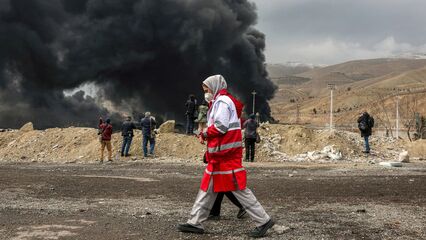
Plumes of smoke rise over Tehran after Israeli air strikes hit Iran’s oil facilities
00:41
Protesters in Seoul rally for Palestinian and Iranian women on Women’s Day
01:25
‘Gulf countries may question US capability to protect them’
The conflict has already led to the suspension of
about a fifth of global crude and natural gas supply, as Tehran targets
ships in the vital Strait of Hormuz between its shores and Oman, and attacks energy infrastructure across the region.
A
nearly complete shutdown of the strait means the region’s top oil
producers – Saudi Arabia, the United Arab Emirates, Iraq and Kuwait –
have had to suspend shipments of as much as 140 million barrels of oil –
equal to about 1.4 days of global demand – to global refiners.
More
than 80 percent of global trade moves by sea, according to the World
Bank, meaning disruptions in the waterway could increase freight costs
and delay deliveries of goods.
Djibouti’s finance minister, Ilyas
M. Dawaleh, warned on Saturday that the fighting would “bring severe
economic consequences for developing countries”. Small states which
depend on maritime trade “risk being pulled into deeper economic
uncertainty as external shocks ripple across the region and #Africa”, he
wrote on X.
Egypt’s President Abdel Fattah el-Sisi said last week
that his country’s economy was in a “state of near-emergency”, warning
of growing inflation.
Storages in the Gulf filling
As
a result of these developments, oil and gas storage at facilities in
the Gulf is rapidly filling, forcing oilfields in Iraq and Kuwait to cut
oil production, with the UAE likely to cut next, analysts, traders and
sources told Reuters.
“At some point soon, everyone will also shut
in if vessels do not come,” a source with a state oil company in the
region, who asked not to be named, told Reuters.
Oilfields
forced to shut in across the Middle East as a result of the shipping
disruptions could take a while to return to normal, said Amir Zaman,
head of the Americas commercial team at Rystad Energy.
“The
conflict could be ended, but it could take days or weeks or months,
depending on the types of fields, age of the field, the type of shut-in
that they’ve had to do before you can get production back up to what it
once was,” he said.
Iranian forces, meanwhile, are targeting regional energy
infrastructure, including refineries and terminals, forcing them to
shut down, too, with some of those operations badly damaged by attacks
and in need of repairs.
Qatar declared force majeure on its huge
volumes of gas exports on Wednesday after Iranian drone attacks, and it
may take at least a month to return to normal production levels,
sources told Reuters. Qatar supplies 20 percent of global liquefied
natural gas (LNG).
Saudi Aramco’s mammoth Ras Tanura refinery and
crude export terminal, meanwhile, has also closed due to attacks, with
no details on damage.
Economists warn that the situation could create a combination of higher prices and slower growth.
[Verse 1] I'm a sleepy time baby A sleepy time boy Work only maybe Life is a joy
[Chorus] We'll have a sleepy time, time We'll have a sleepy time, time We'll have a sleepy time, time We'll have a sleepy time, time Sleepy time, time Sleepy time, time, all the time
[Verse 2] Asleep in the daytime Asleep at night Life is all playtime Working ain't right
[Chorus] We'll have a sleepy time, time We'll have a sleepy time, time We'll have a sleepy time, time We'll have a sleepy time, time Sleepy time, time Sleepy time all the time
[Instrumental Break 2:10 – 3:08] [Guitar Solo]
[Verse 3] I have my Sunday That ain't no lie But on Monday morning Came my favourite cry
[Chorus] We'll have a sleepy time, time We'll have a sleepy time, time We'll have a sleepy time, time We'll have a sleepy time, time Sleepy time, time Sleepy time all the time
About
This song bio is unreviewed
Song Bio
This songs timestamp is 4:20, and is most likely an obvious reference to a certain green substance people can use to get sleepy.
Q&A
Find answers to frequently asked questions about the song and explore its deeper meaning