Sign up for the Slatest to get the most insightful analysis, criticism, and advice out there, delivered to your inbox daily.
When
the Qualified Data Center Task Force for Prince George’s County,
Maryland, held its fourth public meeting on a rainy morning last
September, dozens of people gathered for the occasion and lined up
around the block—an uncommon audience size for this
government-sanctioned group. “I’d decided to host a rally prior to it,
and so many people turned out,” Taylor Frazier McCollum, who
lives in the town of Landover, told me. She’d been looking for some
space, any space, to register her community’s concerns around a data
center campus that had been proposed for their small, majority-Black
town, in a plan that encompassed five buildings, 87 acres, 820 megawatts
of power—and, bafflingly, little public awareness effort.
The
task force meeting—featuring local elected officials, union leaders,
tech-company representatives, business advocacy orgs, and a few
activists—seemed like a place where residents could raise objections.
But the task force had arranged the meeting in a manner where public
comment was restricted to Post-it notes, on which attendees could only
pen their thoughts and stick them up on whiteboards. “What we didn’t
realize was that the public can watch, but there’s no talking allowed,”
Michael Lavina, a protest organizer and volunteer with the local chapter
of the Party for Socialism and Liberation, told me. “Some of those
people told me, ‘I live across the street from this Landover site, and I
had no idea they were building this data center there.’ ”
But
what the attendees couldn’t say out loud was at least conveyed by their
massive presence: They would not let a data center go up without their
input. Just after that mobilization, Prince George’s County Executive
Aisha Braveboy halted the Landover groundbreaking and imposed a
temporary pause on all new hyperscale data center permits in the area
(referring specifically to computing facilities that require large
amounts of land for establishment, water for cooling, and power for
operation). Last month, following months of feedback and organizing
actions by McCollum, Lavina, and the broader Prince George’s community,
the County Council extended that permit pause for two years. That such an initiative got consistent governmental support in the second-largest county in Maryland, an already data center–dense state that was vying for even more tech infrastructure
barely a year ago, is a remarkable tell as to how the A.I. tides are
shifting. That it got passed in the same week that saw New York’s
governor sign the country’s first-ever statewide data center
moratorium—and saw capital cities like Lansing, Michigan, and Jackson,
Mississippi, approve their own pauses—likewise demonstrates how
widespread this popular opposition really is.
In
many ways, it feels like an inflection point in which more community
leaders and elected officials are listening to their concerned
constituents and hitting the pause button
on development for now. But an even bigger fight is at hand: whether
these halts on buildouts will eventually lead to permanent bans, or
whether elected officials are just kicking the clankers down the road.
The saga of Prince George’s County will be a telling preview of that
next battlefront.
It
was hard enough even getting to this point. The Landover data center
site was proposed by Lerner Enterprises, a D.C.-based real estate firm
that’s operated by the family that owns the Washington Nationals and has
rights to that fallow lot. After failing to persuade the FBI to site its new headquarters
on that land back in 2023, the company decided to capitalize on the
A.I. data center rush, announcing the following year that it would transform the demolished mall into an artificial intelligence “tech park.”
The Landover plan earned the quick approval of the PGC Planning
Department, which cited the region’s desperate need for tax revenue.
Construction was scheduled for January 2026.
One
problem was that the location is not exactly remote; the torn-down mall
once served families who live in an apartment complex right next door,
with a school, a hospital, and a childcare center nearby. Another was
that few in Landover seemed to even know about the development plan, much less have the chance to weigh in on it.
McCollum
had only heard about the tech park from a neighbor in February 2025—and
immediately grew concerned, having already seen reports about big data centers’ impacts in residential Georgia, from water use to noise pollution. “I saw a video showing how noise and light pollution was affecting the people daily, and how they couldn’t sleep,” she said.
Inspired
to dig up more details around the Lerner Enterprises project, McCollum
found out that the firm could evade substantive public feedback, thanks
to a law the PGC Council passed in 2021 designating data centers as an
appropriate land use under existing zoning regulations. In a
pre-ChatGPT, post-pandemic moment when PGC was looking at ways to revive economic growth without raising taxes,
data centers seemed a reasonable bet: They were already a feature of
the country landscape, had not yet garnered political controversy, and
were not yet at consistent hyperscale size. The council thus gave the
county’s Planning Department broader discretion over the approval of
data center proposals so as to “fast-track” their construction.
“We
worked with various agencies on incentivizing these centers in the
county because we realized they were such an economic driver, and there
were a lot of financial benefits” like tax revenue and local employment
opportunities, James Hunt, acting deputy director of the PGC Planning
Department, told me. “We reached out to Loudoun County in Virginia,
whose budget was in the red before they started welcoming more data
centers. Now they’re operating in the black.” (Loudoun recently began considering a pause on data center expansion, thanks to constant complaints from residents now disgruntled with the constant noise.)
As
for the Landover proposal, Hunt insists that “we did give public
notice, and the only speakers who weighed in on the project were from
the town of Glenarden. It was after approval that more of the public seemed to get wind.”
That
recognition came about thanks in significant part to McCollum’s
efforts. Throughout 2025, she contacted her council reps, started a Change.org petition, and posted Facebook videos
about the campus, warning that sizable data centers in other states had
led to environmental pollution, costlier utility bills, and lower
property values. This put her on the radar of the local Party for
Socialism and Liberation chapter, which asked if it could include her in
an Instagram reel
about the Landover project. “They had a much bigger following, so I
knew it would help get more signatures,” McCollum said. “But when we
posted it that September, it just went viral. People posted it on
TikTok. We ended up getting over 20,000 signatures.” McCollum thus
became the face of the burgeoning data center backlash in Landover.
At first, this motley crew
of activists took care to insist they were not against data centers
writ large. “Data centers, while necessary in a digital age, are
industrial facilities that demand substantial electrical power and
cooling resources,” McCollum wrote in her petition. “It’s imperative
that the community has a voice in such significant changes.” Likewise,
Michael Lavina, who’s also a Hyattsville-based software engineer, told
me he’s “not anti-tech.”
“I
build A.I. applications, I like Netflix, and I think networks of data
centers have value,” he said. To Lavina, however, hyperscale campuses
like the Landover park are not comparable to a standard Maryland data
center that may consume a few dozen megawatts of power at most.
“We’re talking about two different pieces of technology,” he added.
“I’ve heard officials say, ‘We had data centers before,’ And I’m like,
‘Landover would be bigger than any of the others.’ ”
The
skepticism also extended beyond data centers, factoring in previous
economic development promises that never quite lived up. “People
approached us to say, ‘They promised the same with the MGM Casino,
that it would get built here and solve all our problems with revenue.
All I see is traffic, roads are still unbuilt, and I’m still having an
affordability crisis,’ ” Lavina said.
These
messages seemed to get through to the PGC government. After McCollum’s
video gained widespread attention, Braveboy issued a six-month pause on
data center permits by executive order, calling the government’s 2021 decision to fast-track data center approval “a huge mistake,”
because “residents have a stake in where these data centers are
located.” She still praised computing facilities themselves as a “really
good economic tool” and noted that the Qualified Data Center Task Force
was working to outline recommendations on how PGC should approach
hyperscale centers going forward.
“The
council wanted to get more insight and information on data centers,
because they were being told by constituents about their impacts to
water quality, noise, air, other pollutants,” said Hunt, explaining how
the task force came to be. The group also included members like County
Council member Wala Blegay, who was elected after the 2021 fast-track
legislation passed and had joined other newer, younger local lawmakers
in largely voting against incentives for Big Business. “We have a lot of
development throughout this county. Frankly, not every development in
this county is quality,” she told Maryland Matters early in her tenure.
When it came to hyperscale data centers, Blegay likewise emphasized the need for countywide standards instead of deciding key matters, such as clean vs. dirty energy sources, on a project-by-project basis.
Such
a sympathetic ear on the task force allowed for activists to push for
an extra meeting in October; McCollum made sure to spread the word and
ensure an even bigger community turnout. Yet again, they found their
voices stymied, their input limited to Post-it notes. (Hunt explained
that the task force made a decision not to change the usual format of
their meetings.) “We were able to get almost 500 people to that meeting,
and they still would not let us say anything. One person decided to
start demanding that we speak, banging on the tables, and the rest of
the room erupted in the same chant,” McCollum said. “That finally gave
some of us the opportunity to address the crowd.” It also gave them a spotlight on local news.
“I
think the community outpouring really got officials to change their
mind because they have not seen something of this magnitude done in
Prince George’s County,” said McCollum. “At least in my lifetime, I
haven’t seen so many people organize for one effort.” Government
representatives finally appeared to understand the depth of opposition.
Council member Jolene Ivey, who’d originally favored the fast-track
legislation, came out against the Landover proposal and told the
Maryland Daily Record that she supported “strict guidelines” on data center approvals. The task force released a final report.
Such
turnabouts among pro–data center politicians aren’t limited to PGC. In
Michigan, where Gov. Gretchen Whitmer controversially appeared
for a data center groundbreaking alongside OpenAI CEO Sam Altman,
outright data center opponents have won Democratic primaries; for her
part, Whitmer has come to demand
concessions from data center builders, including commitments to
covering energy costs and employing people within the Mitten. In
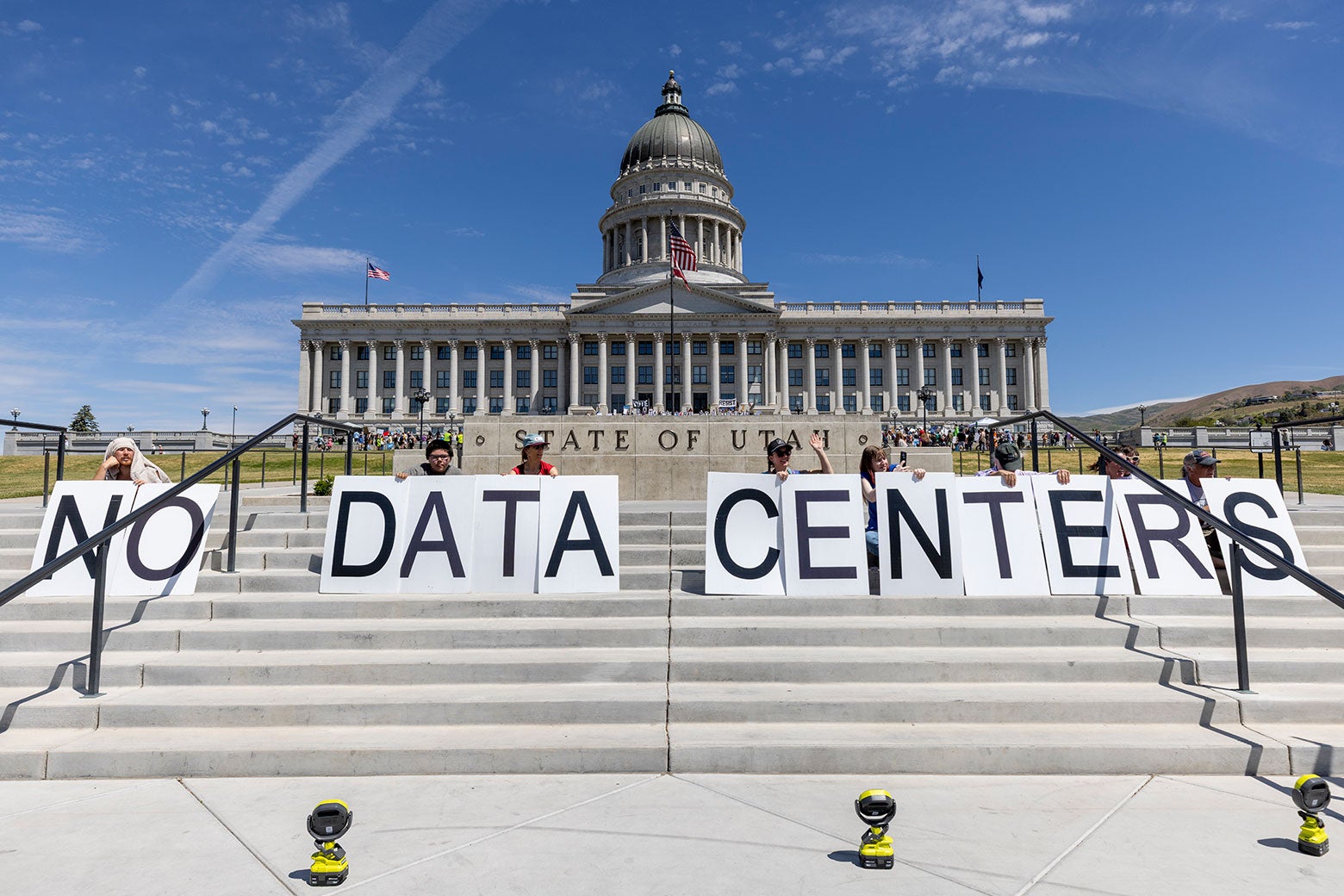
deep-red Utah, state Senate President Stuart Adams was ousted from his
longtime district by a GOP primary challenger who’d opposed a Kevin O’Leary–sponsored A.I. campus that Adams helped initially approve. (His belated requests
for O’Leary to reduce the planned acreage taken up by the data center
clearly weren’t enough, and came much too late.) Texas Gov. Greg Abbott,
who’s running for a fourth term, had boasted last year about planning more Google data centers than any other state; this week, he sent a letter to his electricity regulators instructing them to pause approvals on new centers until they can complete a thorough energy audit.
Other
A.I.-boosting politicians have begun adapting their messages to the
times—albeit with some caveats. New York Gov. Kathy Hochul, a
techno-optimistic moderate Democrat, passed an executive order pausing
hyperscale permits for a year after the Legislature sent an
anti-data-center bill to her desk. While Hochul’s action has been
celebrated, it’s not lost on anyone that she sidestepped a bill with
more aggressive data center constraints,
including renewable energy sourcing requirements, from New York
lawmakers. State Sen. Liz Kruger, a co-sponsor of that measure, wrote to
me that it “has clearer and stronger requirements to protect
ratepayers, water resources, clean air, the climate, and grid
reliability, as well as community input” than the executive order. She
still referred to the governor’s action as a “good first step.”
Meanwhile,
activists like McCollum have expanded their focus to opposing all
hyperscale data centers, taking Lavina’s perspective that bigger
facilities are not worth the potential economic payoff. But as the PGC
moratorium bill neared a council vote, these activists were soon facing
opposition from locals like Ursula Franklin, former program manager for
the Pride Center of Maryland, who’d show up to county meetings and
anti–data center rallies with countering messages of their own. “They’re
everywhere in the U.S. and other countries, and we have to know
technology is going to move forward,” Franklin told a local ABC7 station. “Why not bring something to the county that can be long-lasting?” Franklin added that she wasn’t against a moratorium, but very much wanted to ensure it was temporary, not permanent.
That
clash of both public and governmental priorities meant that the final
two-year moratorium came with some inconvenient carveouts. “There’s a
clause that if the county passes a reform bill that has some
regulation on data centers, then this ban is lifted,” Lavina explained.
That may already be on the way, via a newly introduced council amendment
that would allow bigger data centers to be sited in rural and agricultural areas instead of residential corners—a move the organizers oppose.
Plus,
Lavina and McCollum and the community members they organized don’t just
want hyperscale centers out of all PGC land; they also want the
Landover proposal to be killed for good. “The county executive order
that paused the Landover park expires on Sept. 30, and if it’s not
renewed, Lerner can go ahead and build because they got the permits
before this moratorium was passed,” said Lavina. In other words, the
mall site that launched the entire movement could see the tech park go
ahead if the county executive fails to follow her own rhetoric, even if
the two-year moratorium otherwise lasts.
The
Prince George’s County moratorium is thus a testament to how community
resistance can hold elected officials to account—but also a note of
caution. It’s one thing to impose a pause for a period of time. It’s
another to actually make use of that time and figure out where to go
next. So far, only one American city—Monterey Park, California—has passed a permanent
data center ban of the kind McCollum would prefer; it’s unlikely that
too many other municipalities, which generally need to maintain balanced
budgets, will go so far. New moratoriums rarely tend to address extant
data center projects, as seen in Landover’s case, and are even fuzzier
when it comes to future policy. If data centers will continue to be
permitted down the line, how big can they be, where will they get built,
what sorts of tax and revenue and community benefits will be arranged,
where will the power come from, and who will be on the hook for that
cost? And what happens if a developer comes in and starts a project
anyway, only to ultimately back out? For now, politicians
of all ideological stripes in just about every state—Wisconsin, Oregon,
Florida—are seeing favorability boosts from rhetorical data center
opposition. But the details will be all the more important, as activists
may not be pacified by temporary measures. It’s so meaningful to them
that many are risking arrest.
In
McCollum’s case, she’s now taking this fight to a higher authority that
could stop all of this once and for all, if it wants to: the Maryland Legislature.
“The next step is to take this momentum and work toward a statewide
ban,” she said. “I want people to know that data centers aren’t just
going to come to their backyard.”