Provided to YouTube by Universal Music Group
Hum Allah Hum Allah Hum Allah · Pharoah Sanders
Jewels Of Thought
℗ 1969 UMG Recordings, Inc.
Released on: 1998-01-01
Producer: Ed Michel
Tenor Saxophone, Associated Performer, Composer Lyricist: Pharoah Sanders
Vocals, Associated Performer, Composer Lyricist: Leon Thomas
Associated Performer: Lonnie Liston Smith
Associated Performer, Upright Bass: Cecil McBee
Associated Performer, Drums: Idris Muhammad
Drums, Associated Performer: Roy Haynes
Auto-generated by YouTube.
A verifiable public record of U.S. immigration
enforcement, built by all of us and open to everyone - incidents,
agents, deaths, vehicles, and facilities, documented with sources.
A verifiable public record of U.S. immigration
enforcement, built by all of us and open to everyone - incidents,
agents, deaths, vehicles, and facilities, documented with sources.
Swipe
documented incidents and unidentified agents that still need footage or
an ID, and drop an anonymous tip. Anonymous, reviewed before anything
appears, installs to your phone.
The ICE List Wiki is a public, verifiable record of immigration enforcement activity in the United States.
It documents incidents, agencies, individuals, facilities, vehicles, and legal authorities involved in enforcement operations.
Entries are structured, sourced, and timestamped to support verification, cross-referencing, and long-term analysis.
The wiki is intended for use by journalists, researchers, advocates, and the general public.
Project status: This wiki is
in active development. Structure, navigation, and data standards are
being finalised. Older pages may be reformatted as standards are applied
consistently.
Johan Sebastián Durán Guerrero, a 26-year-old man originally from
Colombia, was shot and killed on the morning of 13 July 2026 during a
U.S. Immigration and Customs Enforcement (ICE) operation in Biddeford, Maine.
Senator Angus King said Guerrero was not the operation's target; his
wife and young daughter were at the scene, and the agents wore no body
cameras. It is at least the 11th fatal shooting involving ICE or Border
Patrol agents this administration; the FBI is expected to investigate.
Most wanted
Most Wanted - unidentified agents
Federal agents recorded using force against the public who remain unidentified. Recognize someone? Submit a tip on their entry - your identity is not recorded.
No one in immigration court has the right to a public defender.
Detained adults and children often face deportation alone. The Florence
Project provides representation, Know Your Rights education, and family
support at no cost.
A community-curated library of films, documentaries, music and books
about immigration, detention and the fight for immigrant justice - kept
separate from the documented record.
The ICE List Wiki is designed for public use.
Journalists, researchers, and advocacy groups use the data to track
enforcement patterns, identify repeat agencies or jurisdictions, and
contextualise individual incidents.
Pages may be cited with attribution.
Coverage
ICE List in the media
The ICE List has been reported on and analysed by independent news
organisations, and indexed by academic and civic-tech projects. Read
some of that coverage here.
The .onion link requires Tor Browser. For maximum anonymity, use Tor and avoid submitting from a work device or network.
Verification and sourcing
Each page includes a verification status indicating whether claims
are supported by public records, media, video evidence, or other
documentation.
Unverified information is clearly labelled and is not presented as
established fact.
Pages may be updated as additional sources become available.
Navigate
Quick links
How to report an incident
Step-by-step instructions for submitting an incident with enough detail to verify and map it.
Deportation agents
Overview of ICE ERO officers, how we document them, and how to read agent pages.
By state
State directory
Browse state-specific portals documenting facilities, incidents, agents, and 287(g) agreements.
Submissions should be factual, specific, and supported by evidence where possible.
Speculation, harassment, or unverifiable claims are not published.
Contributors are encouraged to prioritise accuracy over speed.
The United States and Iran have exchanged new demands
during negotiations for the reopening of the Strait of Hormuz, raising
new doubts about prospects for a wider deal to end their five-month war.
While
the US has said it is involved directly in the talks, Iran has said it
is talking directly only with Oman, with which it proposes sharing
future management of the critical waterway, through which one-fifth of
the world’s oil and liquefied natural gas supplies were shipped before
the US-Israel war on Iran began at the end of February.
On
Monday, US President Donald Trump said he would demand compensation
from Iran for deaths and injuries linked to conflicts and attacks over
several decades after Iran last week issued new demands
for reparations for the war and said it would not reopen the strait
until Washington meets its political and economic conditions.
Experts
said broader peace negotiations between the two countries are unlikely
to restart until the issue of the Strait of Hormuz is resolved.
“The
two sides are further apart,” Al Jazeera’s Tohid Asadi reported from
Tehran. “They are getting more and more distant when it comes to the
possibility of any diplomatic settlement.”
The latest developments
threaten to further complicate the talks between Tehran and Oman on
future management of the strait despite both Iran and the US previously
indicating they want an agreement to end the fighting.
Here is what we know:
What has Trump said about ‘compensation’?
Trump said Iran should pay compensation for people killed or seriously wounded through Iranian actions.
“We’re
going to ask for money for the damage they’ve done over a 50-year
period,” Trump told reporters at the White House. “So if there’s damages
to be paid, I think Iran should pay those damages.”
Then in a
post on his Truth Social platform, the US leader said Iran should
compensate families of the 17 US sailors killed in an October 2000
attack in Yemen on the naval vessel USS Cole, which was blamed on
al-Qaeda not Iran.
Want to come back to this article? Save it for later.
He also demanded compensation for the families of Iranian protesters killed during antigovernment unrest in January.
“Also,
with respect to the Iran negotiations, Iran should be responsible for
the damages and death caused to the people of Lebanon, Syria, Yemen, and
Gaza!” Trump wrote.
Trump’s demands came after Iran said the US
should compensate Tehran for damage caused by US and Israeli attacks
during this year’s war.
The escalatory rhetoric from the US
president appeared to conflict with comments made by his vice president,
JD Vance, who on Saturday said he was confident about reaching a deal
with Iran and the agreement would be good for the American public.
Vance
also said Iran had told the US that it has “no plans” to impose tolls
on the Strait of Hormuz – one of the points of friction between the two
sides.
However, oil prices jumped more than 5 percent on Monday
after Trump’s new demands while prices rose again on Tuesday as hopes
for a deal faded.
1:47
Now Playing
01:47
Trump sends conflicting signals on Iran strategy
Next
27:25
How significant are recent gains by Sudan's army? | Inside Story
What are Iran’s new demands?
Iran
says reopening Hormuz, which it essentially closed to shipping shortly
after the start of the war, depends on Washington taking several steps,
including agreeing to a set of new demands.
Six new conditions announced by Iran’s Supreme National Security Council on Saturday were:
An end to US threats and insults against Iran
A permanent end to attacks against Iran and its allies in Lebanon, Palestine, Yemen and Iraq
The lifting of the US naval blockade on Iranian ports and the withdrawal of US naval and air forces from around Iran
Compensation for damage from what it called two “imposed wars”,
referring to the war begun on February 28 and the 12-day war with Israel
in June 2025, which the US also joined
The lifting of sanctions
The unconditional release of frozen Iranian assets
At the same time, Tehran said negotiations with Oman over a new
shipping arrangement in the Strait of Hormuz, in which they are to
define new shipping lanes, have made progress and are in their
“final stages”, according to Foreign Minister Abbas Araghchi.
On
Sunday, Araghchi reiterated the Iranian position that there are no
direct talks with the US, but messages are understood to be being
exchanged through intermediaries.
What does this mean for peace talks?
US-Iran
negotiating positions over the Strait of Hormuz appear to be hardening,
raising doubts over the prospects for a diplomatic breakthrough for a
broader peace deal, according to analyst Negar Mortazavi. Experts said
it is unlikely that talks for this larger agreement could restart until
the issue of the Strait of Hormuz and how it will be managed is settled.
“Both
sides appear to be putting forward maximalist demands ahead of serious
negotiations,” Mortazavi, senior fellow at the Centre for International
Policy, told Al Jazeera.
Mortazavi said the latest US stance is especially sensitive.
“Trump’s
new demands are particularly problematic because they introduce issues
that go beyond ending the current conflict. If compensation over
protests and other past events becomes a genuine US condition for an
agreement, rather than simply a negotiating position, it could make a
deal extremely difficult for Tehran to accept,” she added.
In
turn, Tehran, she said, is also seeking significant guarantees, not only
for an end to the fighting but also “assurances that the conflict will
not simply restart later, as well as economic relief after the war”.
Tehran
has previously indicated that it has lost trust in US negotiators
because the US has commenced attacks three times on Iran while previous
talks had been going on.
According to Tehran-based political analyst Hossein Royvaran, how the Strait of Hormuz standoff ends will come down to which party has the greatest endurance.
“This equation now exists: closure vs blockade. But the question is, who cries out first?” he told Al Jazeera.
“Right
now, America is suffering: in petrol prices, in inflation, in the
rising cost of living at home. There is deep discontent inside America
over this war and its consequences for society there,” Royvaran told Al
Jazeera.
“The same is true in Iran, though in Iran there are
justifications society finds acceptable: that this war was imposed on
Iran and Iran had no choice but to defend itself.”
26:56
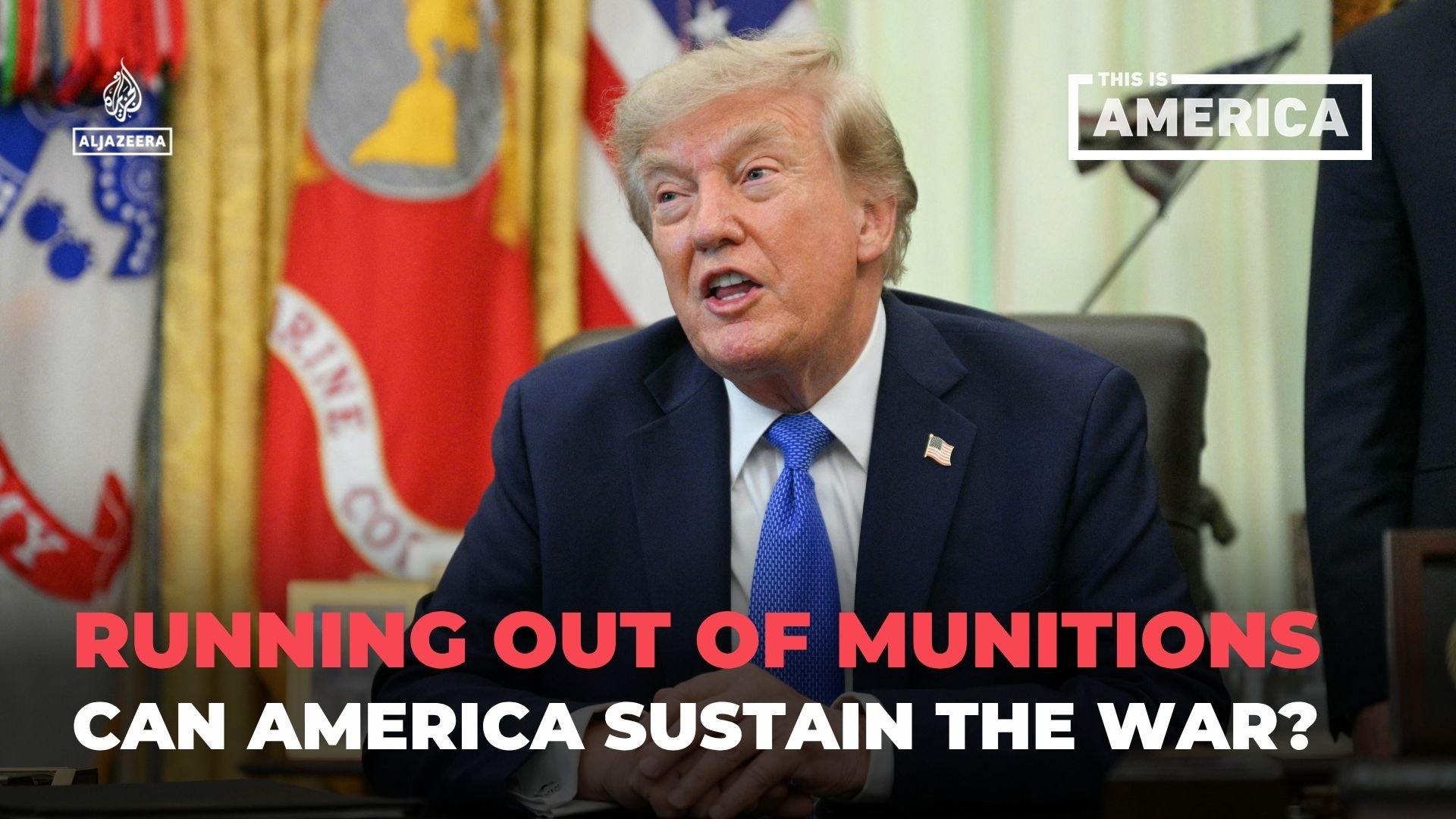
What does a depleting munitions supply mean for the Iran war? | This Is America