Bill Clinton’s Party Needs a ‘Different Kind of Democrat’ Again
https://nymag.com/intelligencer/article/bill-clinton-different-kind-democrat-again.html
Bill Clinton’s Party Needs a ‘Different Kind of Democrat’ Again

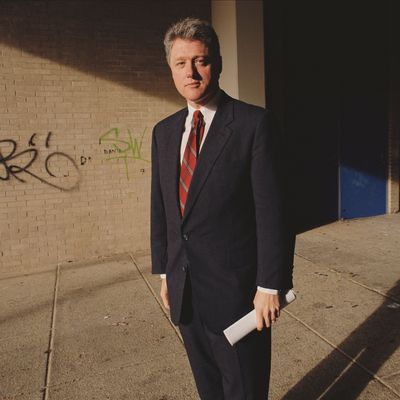
The 42nd president of the United States just turned 80 this past week, and you have to be pretty long in the tooth yourself to remember how very young Bill Clinton seemed when he first ran for the White House in 1992. He was objectively pretty young, actually; 46 when he took his first oath of office, he was the third-youngest president in U.S. history. But beyond the biological facts, his campaign relentlessly promoted the idea of party and national reform and renovation, a theme of youthful vigor reinforced by Clinton’s very unconventional choice of 44-year-old Al Gore as his running mate against 68-year-old George H.W. Bush. One campaign poster at the time showed Clinton and Gore together over the caption “Young Guys. Great Hair.” (This was before Gore began losing his hair and Clinton’s turned prematurely grey).
Nowadays, many progressives dyspeptically remember Clinton’s “New Democrat” brand and following as mere packaging for pro-corporate neoliberal policies that betrayed the party’s traditional working-class and minority constituencies. But it very much did address the psychological needs of a tired and demoralized Democratic Party that had lost three straight presidential elections by large margins and was slipping rapidly in Congress and in state governments, especially in the South and Midwest. Clinton’s pledge that he was a “different kind of Democrat” was what many swing and base voters wanted to hear. It also helped head off what might have been an existential threat from Ross Perot’s third-party bid (as Perot himself acknowledged in temporarily abandoning his candidacy, saying, “The Democratic Party has revitalized itself. They’ve done a brilliant job, in my opinion, in coming back”).
Indeed, it was reasonably clear that the midterm calamity Democrats experienced in 1994 was less about anything Clinton had done in his brief period in office than about the demise of the old Democratic coalition he was seeking to replace. Any doubts about that subsided with his big 1996 reelection win and the shocking gains Democrats made in the 1998 midterms (the first midterms since 1934 when the party controlling the White House gained seats). As Clinton left office, Democrats appeared to have once again achieved parity with Republicans, going on to win the popular vote in four of the next five presidential elections and controlling Congress about half of the time.
But by then Clinton’s promise of renewal was already beginning to wear off. That was partly because of his adulterous behavior and the mendacity he displayed in his reckless affair with a White House intern (which Al Gore spent much of his 2000 campaign trying to distance himself from). But it was also partly because his policy agenda had unleashed market tempests that would soon lead (with much help from George W. Bush’s Republicans) to a devastating recession that wrecked the manufacturing industries that had employed working-class Americans since the New Deal.
Still, Barack Obama borrowed a lot from Clinton’s policy agenda and political messaging, enhanced by his own political genius and “all things new” persona, in his 2008 presidential campaign, which lifted Democrats to their strongest position since the 1960s. That, too, didn’t last, and Obama’s election gave way to the turbulent period that eventually produced President Donald Trump with Clinton’s own wife presiding over a divided party’s fateful defeat. The 42nd president was increasingly a figure from a rapidly retreating political past, and yet as late as 2016, he was the politician Democrats most wanted to hear from at their national conventions, a warrior-chieftain uniquely able to combine policy chops, humor, and partisan fisticuffs to rally the troops even as others led them into battle.
Then, all of a sudden, the Big Dog lost his bite. Democrats notably moved toward progressive-populist themes as Trump dragged the GOP into the fever swamps, all but generally accepting the old progressive complaint that Clinton (and even Obama) had pursued corporate and donor interests at the expense of working people struggling under conservative rule. The overdue Me Too movement eradicated any lingering tolerance for Clinton’s sexual misconduct and unsavory associations with predators like Jeffrey Epstein. By the time Democrats held their 2020 convention, the New York Times noted, Bill Clinton had become “an afterthought:”
This is the first Democratic convention since the 1980s where Mr. Clinton is little more than a bystander. Other than legacy-burnishing, there is almost nothing explicitly at stake for him politically. He is not running for president, thinking of running for president or promoting a spouse or protégé running for president.
Mr. Clinton’s blink-and-you’ll-miss-him moment before a party that once revered him was testimony to how his influence has faded, a reflection of time and age, to be sure — he turns 74 on Wednesday — but also of the baggage he carries with the re-examination of allegations of sexual assault and harassment over his years in public life in the wake of the #MeToo movement.
After a brief flurry of activity in 2024, Bill Clinton and his nearly presidential wife are both far from the center of power in the Democratic Party, anachronisms from a bygone and somewhat embarrassing era. And now the once-youthful avatar of Democratic renewal is joining Trump and Joe Biden in the octogenarian club.
But here’s the thing: Even if Democrats don’t want or need to hear from Bill Clinton, they are in something of the same psychological fix they were in when he announced his candidacy in 1991, offering something new:
The country is headed in the wrong direction fast, slipping behind, losing our way … and all we have out of Washington is status quo paralysis. No vision, no action. Just neglect, selfishness, and division …
Make no mistake — this election is about change: in our party, in our national leadership, and in our country.
And we’re not going to get positive change just by Bush-bashing. We have to do a better job of the old-fashioned work of confronting the real problems of real people and pointing the way to a better future …
This must be a campaign of ideas, not slogans. We don’t need another President who doesn’t know what he wants to do for America. I’m going to tell you in plain language what I intend to do as President. How we can meet the challenges we face — that’s the test for all the Democratic candidates in this campaign. Americans know what we’re against. Let’s show them what we’re for.
In 2028, 36 years after Clinton uttered those lines, Democrats again need to display a willingness to do something other than link arms to protect their programs and policies from The Bad Man, something other than restore the status quo ante while singing “Happy Days Are Here Again.” Even if the Democratic renovation project of the future winds up repudiating every single policy legacy the 42nd president left behind, it needs to emulate his commitment to change, risk, and intellectual enterprise. Quite probably, Bill Clinton has no personal place at all in this endeavor, but he should be remembered for shaking things up, as they ought to be shaken up right now. A “different kind of Democrat” is what this struggling party needs.
More on Politics
- Who Is Natalie Harp? Trump’s Most Ardent Aide, Explained
- Despite Primary Whiffs, Poll Haters Are Still Wrong
- Supreme Court Gives Trump Temporary Pass for His Ballroom

No comments:
Post a Comment