US supreme court rules Trump can proceed with crackdown on mail-in voting
https://www.theguardian.com/us-news/2026/aug/24/supreme-court-trump-mail-in-voting
US supreme court rules Trump can proceed with crackdown on mail-in voting
Justices’ ruling comes after lower courts had blocked president’s election order ahead of November midterms
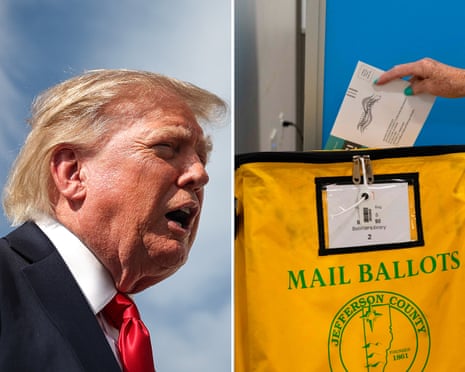
The US supreme court sided with Donald Trump on Monday in his effort to crack down on mail-in voting, though it remains unclear if his administration can take action ahead of the midterm elections in November.
Justices on the court voted 6-3 along ideological lines to lift an injunction from June that a judge in Massachusetts placed on an executive order issued by the president. But a second injunction remains in place and the ruling leaves room for legal challenges.
“The Court’s disposition of this application does not mean that any measure taken by the Government to implement the Order will necessarily be lawful,” the majority wrote in an unsigned order. “On that score, time will tell.”
The three liberal justices dissented. In a blistering dissent, Justice Ketanji Brown Jackson wrote that the decision “needlessly injects chaos and uncertainty into the upcoming midterm elections”.
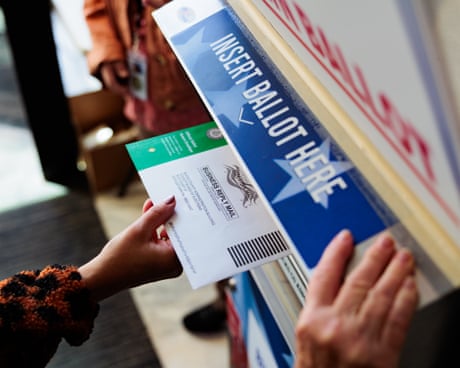
Trump has repeatedly likened voting by mail to cheating, despite his own use of it and overwhelming evidence that the system is secure.
In March he ordered the government to create a “state citizenship list” of eligible voters, requiring that mail-in ballots only be delivered to people on that list. He also directed the justice department to prioritise investigations and prosecutions of state and local election officials who issue ballots to people deemed ineligible to vote in federal elections.
Democratic officials in 23 states and the District of Columbia sued over Trump’s March order, saying the US constitution gives states and Congress the authority to set election rules, not the president. They argued that imposing sweeping changes so close to the election risked disenfranchising voters and disrupting preparations already under way.
A judge in Massachusetts, Indira Talwani, sided with the plaintiff states – nearly half the country – and ruled that Trump lacked authority to dictate how states administer federal elections. She also questioned whether federal agencies could compile accurate citizenship lists.
An appeals court upheld her decision. Talwani later issued a second injunction with nationwide effect.
The justice department had argued that the states’ lawsuit was premature because the administration had not yet taken concrete actions that harmed them and they therefore lacked legal standing to sue. The administration said the Massachusetts injunction prevented it from finalising and implementing policies intended to promote “election integrity” before November.
Republican-led states backed the administration before the supreme court, arguing that states would have an opportunity to provide input on the final lists of eligible voters.
The supreme court’s conservative majority has now lifted the first injunction, allowing the administration to move forward while litigation continues.
Hakeem
Jeffries, the Democratic minority leader in the House of
Representatives, said: “The sycophantic Supreme Court majority’s
decision in the vote-by-mail case is sowing chaos in service to Donald
Trump’s effort to undermine our free and fair elections. The
Trump-aligned justices on the supreme court did not and cannot give the
President the power to decide how states run elections or who gets to
vote by mail.”
Jeffries added: “The legal fight against Donald Trump’s unlawful
executive order is not over, the order does not override the
Constitution and the power to regulate elections remains with states and
the Congress.”
Letitia James, New York’s attorney general, called the court’s decision a “painful setback” but said her office was exploring all legal options. “It won’t be the final word,” she said.
Gavin Newsom, California’s governor, said his state is also planning a legal challenge.
after newsletter promotion
“The Supreme Court just let the Trump administration move ahead (for now) with its plan to disenfranchise voters across the country,” Newsom said in a statement. “California will be suing AGAIN to block these Orwellian rules from being implemented.”
Voting right activists condemned the ruling. Derrick Johnson, the president of the NAACP, said: “Let this ruling be a reminder that democracy is never, ever, guaranteed. We have to fight for it, we have to fight to keep it, and we have to protect the rights we do have within it.
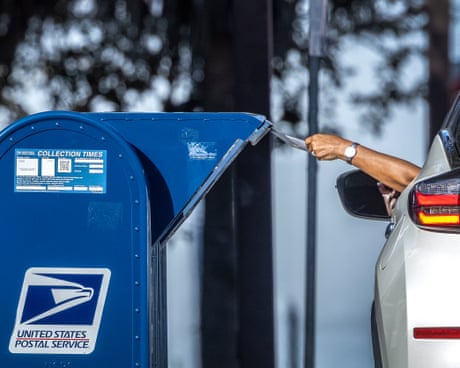
“Those in power know full well that they are unpopular and will lose in a free and fair election, and so they are trying to do everything they possibly can to make it difficult for you to vote. Trump’s order has nothing to do with election integrity. It has everything to do with maintaining power at all costs.”
The wrangling over how US voters can cast their ballots comes less than 100 days until November’s midterm elections, which will decide the balance of power in the US Senate and House of Representatives.
Democratic voters are deemed more likely to cast their ballots by mail than Republicans: about one in four registered Democrats did so in 2024, according to the States United Democracy Center, alongside one in five registered Republicans.
About 30% of all ballots were cast by mail in the 2024 presidential election, according to federal data. A 2025 Brookings Institution study found roughly four cases of fraud for every 10m mail ballots cast.
Trump’s executive order forms part of a wider effort to reshape the electoral system. He has repeatedly made false claims of widespread fraud in American elections, including his defeat by Joe Biden in 2020, and has pressed the Republican-controlled Congress to pass the Save America Act, a contentious package of voting restrictions.
Consider us impressed
Nice: you just finished reading article
the past year. It seems you really value our work. We really value you too.We couldn’t help but notice though that while you’re a loyal Guardian reader, you’re not a recent supporter. (As you likely know, we are reader-funded. No billionaires behind the scenes here!) With dedicated people like you who haven’t contributed yet or recently, we often find one of two things are going on.
First: perhaps you simply don’t have anything to spare right now. If that's the case, we want you to know: we value your readership as much as those who can contribute, and please keep reading, as much as you like, forever. One of the wonderful values shared by Guardian readers around the globe is a desire to ease the burden for others. So ignore these appeals: our community of supporters has your back.
But if you can afford to spare something, here’s what we also know: most likely you’ve thought about giving, but for whatever perfectly human reason, you haven’t got round to it yet. So perhaps today is the day? We know – you’ve finished reading what you came to read, and you have other things to get on with. But we promise it’s quick, and even more: we promise it matters.
We survive entirely because people like you decide to respond to messages like this.
While all support is gratefully received, and even $5 helps, please consider a monthly contribution: it takes less than a minute to set up, and it’s the best way to make the biggest impact – helping sustain our fearless, independent journalism for the long haul. We’re not going anywhere; we hope you’ll stick with us too. Thank you for helping protect the non-billionaire-owned press.














No comments:
Post a Comment