Trump’s Iran Blunders Suddenly Look Darker After Damning New Leaks Hit
As
brutal revelations emerge about Trump’s handling of the war, a foreign
policy expert explains why he won’t be able to extricate us from this
debacle anytime soon—and provides a roadmap to what’s next.
Roberto Schmidt/Getty Images
For Donald Trump, the news is getting worse on his war against Iran.The New York Timesreports that the Trump team badly miscalculated Iran’s response to the American invasion, leading to a developing energy fiasco. The Times also reports that some officials are pessimistic about the lack of any real strategy to end the war, adding this: “They
have been careful not to express that directly to the president, who
has repeatedly declared that the military operation is a complete
success.” Their fear of telling Trump the truth about our fix is highly
unnerving. We’re also learning
that the United States was likely responsible for bombing the Iranian
elementary school. We talked to Columbia political scientist Elizabeth
Saunders, author of a new piece on this whole mess.
We discuss Iran’s closing of the Strait of Hormuz, why Trump can’t
easily end the war even if he wants to, what it means that officials are
leaking dismay about the war’s direction, and what likely lies ahead.
Listen to this episode here. A transcript is here.
13 Year Old Jane Doe 4 and the Missing Donald Trump Files
How
FBI 302s, a Hilton Head real estate scheme, and 37 missing DOJ pages
connect Jeffrey Epstein and Donald Trump to a teenager's abuse in the
early 1980s — and what the documents prove
Cliff’s Note: Ellie
Leonard is a contributing editor at Blue Amp Media, and what she does —
reading every released document, finding the details no one else finds,
and reporting only what she can prove — is exactly the kind of work we
built BAM to support. This piece is free to read. If you want more of
it, a paid subscription to Blue Amp Media is how we make sure she can
keep going. Subscribe below, or just read on.
by Ellie Leonard, BAM Contributing Editor
Trigger warning: this article contains limited descriptions of abuse
When
the DOJ handed us three of four missing 302s—code for “FBI
interviews”—from a young teen out of the Southeast, it didn’t really
feel like a lot to go on. We knew they’d been hidden for a reason. After
all, this was the second major case implicating Donald Trump and
Jeffrey Epstein together for sexual abuse of a child. But we didn’t have
much to work with, and what we did have all occurred in the early
1980s, pre-internet, and with a number of details that felt out of place
for who we’d come to know as the early 2000s middle-aged millionaire
sex predator.
But even with very little information, the FBI had
taken “Jane Doe 4” seriously, interviewing her at least four times. It
was only recently that NPR reporters discovered the missing 53 pages of
Doe’s 302s, leading to an uproar, and eventually the DOJ handing us 16
more pages, the remaining 37 still nowhere to be found. But not only did
the FBI take this woman seriously, but she was now represented by Lisa
Bloom, daughter of Gloria Allred, and lawyer for one of the most
significant cases in this entire investigation: Katie Johnson.
So
with my laptop in hand, some late nights, and a whole lot of coffee, I
dug in. I wanted to see if this case was provable, disprovable, or
simply a question mark swallowed up by time.
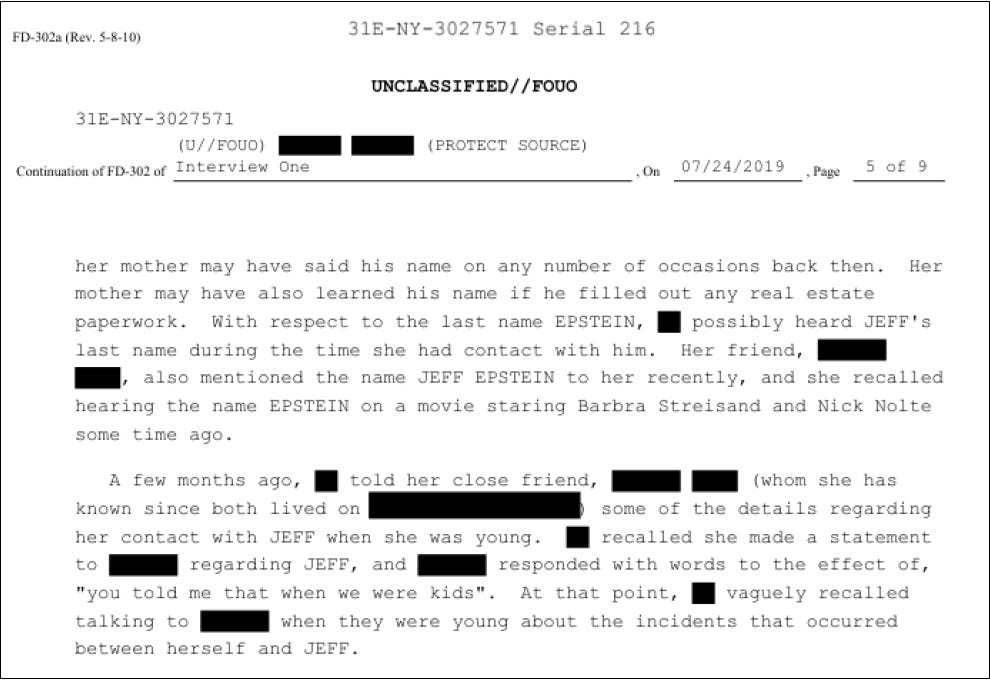
FBI Interview 1 - July 24, 2019
To
summarize, Jane Doe 4 arrived at an unknown island in 1981, where her
mother was hired as a broker for a real estate firm managing vacation
homes in the Sea Pines Plantation. This clarified that we were talking
about Hilton Head Island, South Carolina. At 13, the girl attended
school with her siblings, and was encouraged by her mother to make
babysitting fliers to hand out to visitors and long-term renters for a
little extra cash. She did, and quickly got her first call, a man she
remembered only as “Jeff.” When she arrived, there were no children, and
“Jeff” offered her alcohol, marijuana, and cocaine. After that, things
got hazy, but she knew he sexually abused her, and could only think how
pleased her friends would be that she’d found someone to give them
drugs.
Hilton Head High School’s yearbook, 1985
This
continued over the course of two or three years, and often included
other men, old and overweight, wealthy, and often physically abusive.
The only one she ever named was “Jim Atkins,” but often shut down the
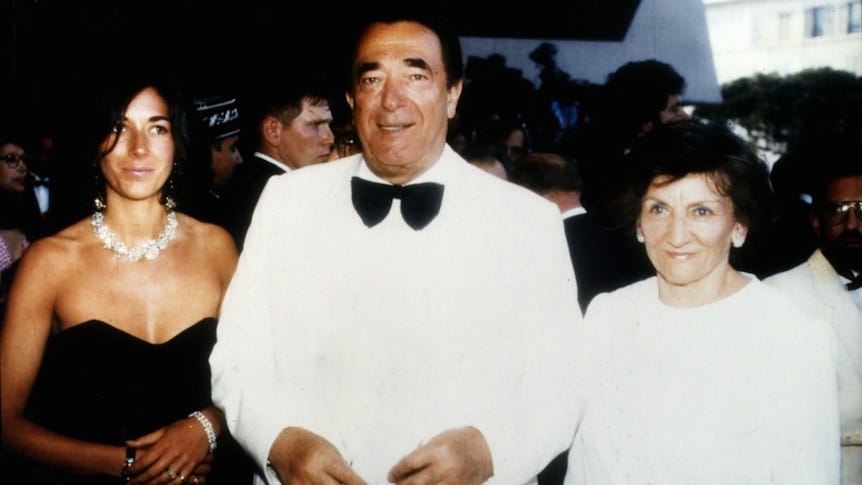
interviews, too upset to say any more. Epstein had a woman with him at
times, though not likely a partner in the traditional sense. She “wasn’t
black or Caucasian,” Doe remembered, but came off as very “cold.”
Ghislaine Maxwell in the 1980s
At
some point, Doe found pictures of herself in one of “Jeff’s” drawers,
Polaroids that he’d taken on a tripod when the young girl was naked. It
was this moment that set off a chain of events, leading to her mother’s
criminal conviction on the island. But we’ll come back to that.
I
started piecing apart this investigation with tiny details, unique but
simple things Doe included in her statements that might otherwise appear
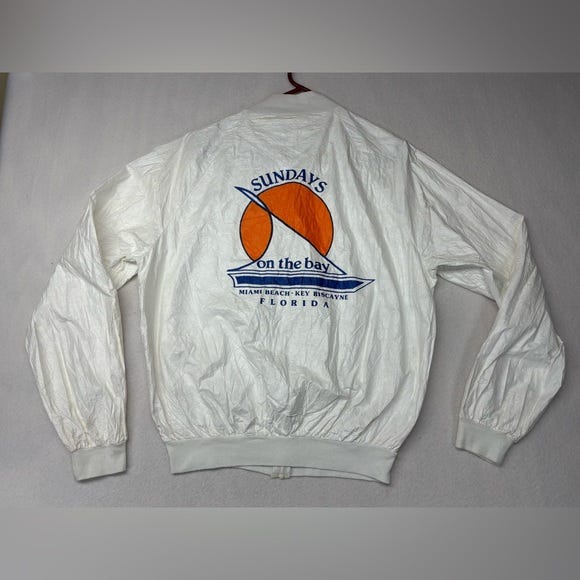
like they don’t matter. She mentioned a crinkly “cardboard shirt” he
made her wear during one of their “between 6 and 20” interactions. She
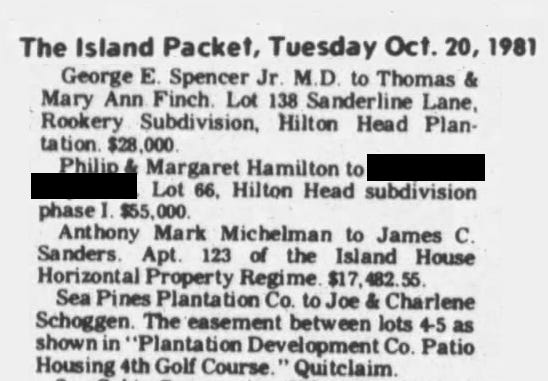
said her mother had a house somewhere nearby, one she’d bought for
$55,000 in 1981. One of the abusive men had stomped her toe. She’d gone
to a Rick James concert in Savannah and bumped into “Jeff,” who offered
to drive her home, but dropped her off miles away. When the police
picked her up, they’d fed her fried chicken. She couldn’t remember if he
was called “Jeff Epstein” or not, but remembered he looked like Lurch
from the Addams Family, very long in the face. And when he got angry, he
lisped and she could see he had a snaggle tooth in the back of his
mouth.
Doe’s
mother passed away a long time ago, and she never told anyone else
except a close friend what had happened to her when she was 13, maybe 14
years old, and in the years after. And when Jeffrey Epstein was
arrested in July, 2019, her friend gave her a call, reminding Doe what
she’d said all those years ago. At some point she agreed to come
forward, but she still wouldn’t mention anything about Donald Trump. And
when the only picture she had to show agents the man named “Jeff”
included Trump, she requested that the agents crop the President out.
But
the friend remembered what Doe said, that at some point “Jeff” had
taken her to New York, into office buildings, big homes, and she was
chided and abused by Donald Trump. He made fun of her for being a
tomboy, just as Epstein had made fun of her overly large breasts, making
the girl extremely self-conscious. And without going into detail, Doe’s
experience with Donald Trump deeply reflected the same experience had
by Katie Johnson, that not only included sexual abuse but physical as
well.
And now we had a case that was, again, seemingly credible
according to FBI records, and also credible enough to be represented by a
major law firm representing other Epstein and Trump survivors.
So
I started at the very beginning. They’d moved to the island in 1981,
when her mother purchased a house for $55,000. I didn’t have her
mother’s name, so I’d have to go in another direction before I could dig
for a deed.
According
to Doe, her mother had been charged with embezzling money. She was very
up front about both her and her mother’s criminal histories, issues
with sobriety, and frequent moves, marriages, and divorces. Doe wanted
to be credible, but knew a woman in her position would have to fight. So
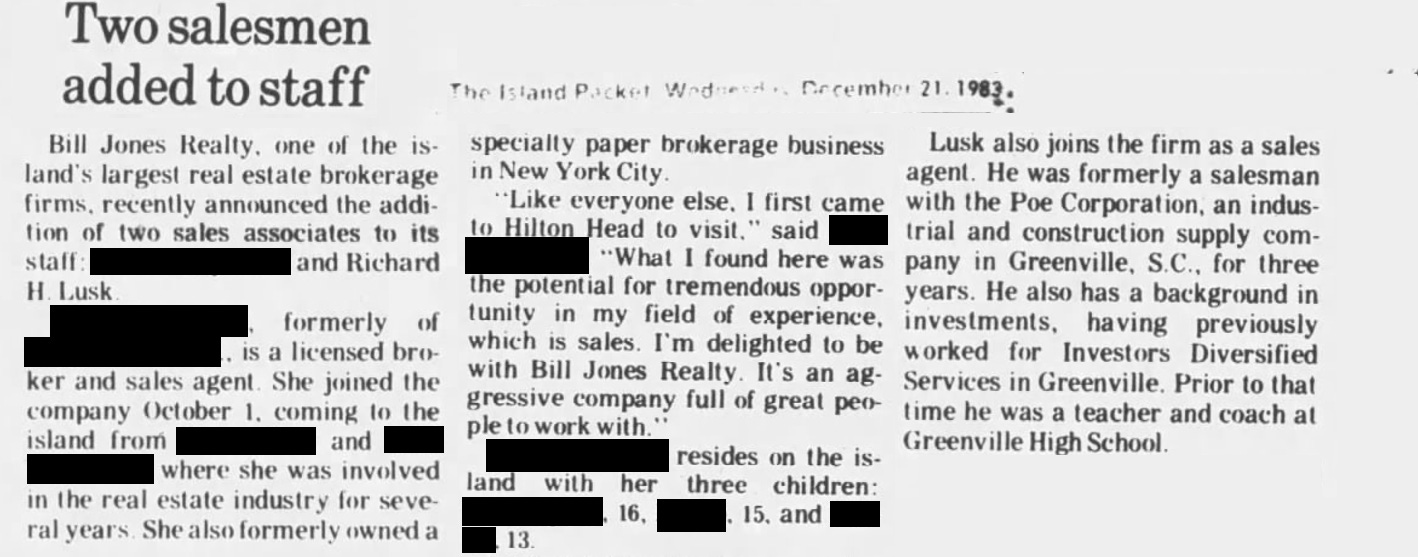
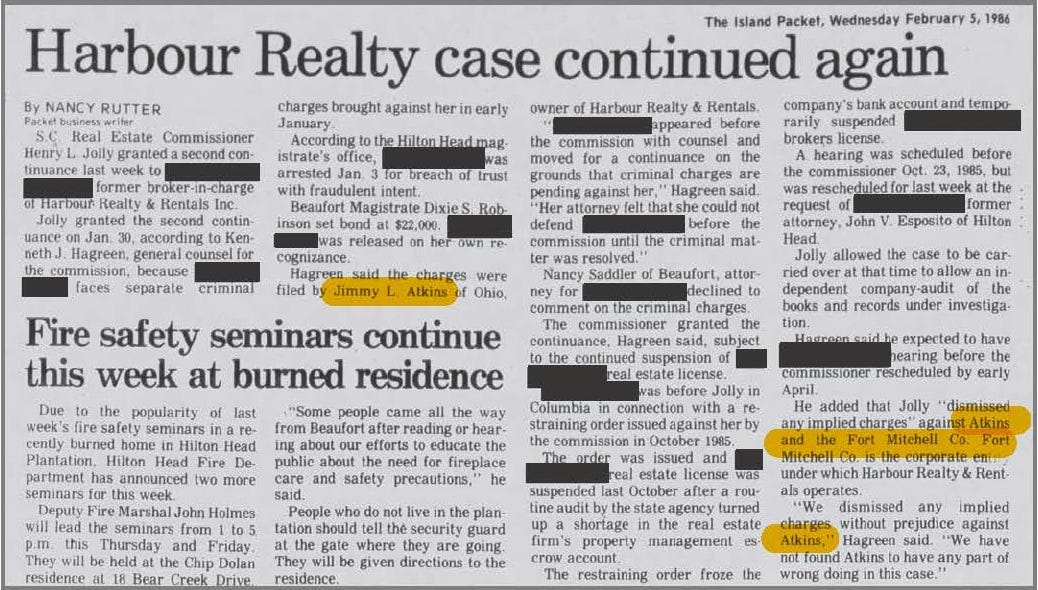
I looked for the case, using archived copies of the Island Packet
Newspaper, and I found it. Her mother had embezzled $22,000. But
according to Doe it wasn’t a simple case of stealing. She’d eventually
told her mother about the abuse and the pictures in “Jeff’s” drawer. And
Doe’s mother tried to get everything back, anything she could do to
protect her daughter, stealing money to give to the young, wealthy New
Yorker who vacationed on the island.
This takes us back to Jim Atkins.
Jim
Atkins, as described in Doe’s interviews, was Jeff’s wealthy friend
from Ohio. He was the “money guy” or something involved in education,
maybe a dean, someone on the board, but connected with a “for-profit”
college out of Cincinnati. I dug for schools, bypassing the major
universities and checking every board of regents, board of trustees,
administrations, faculty, donors, you name it. And then we found
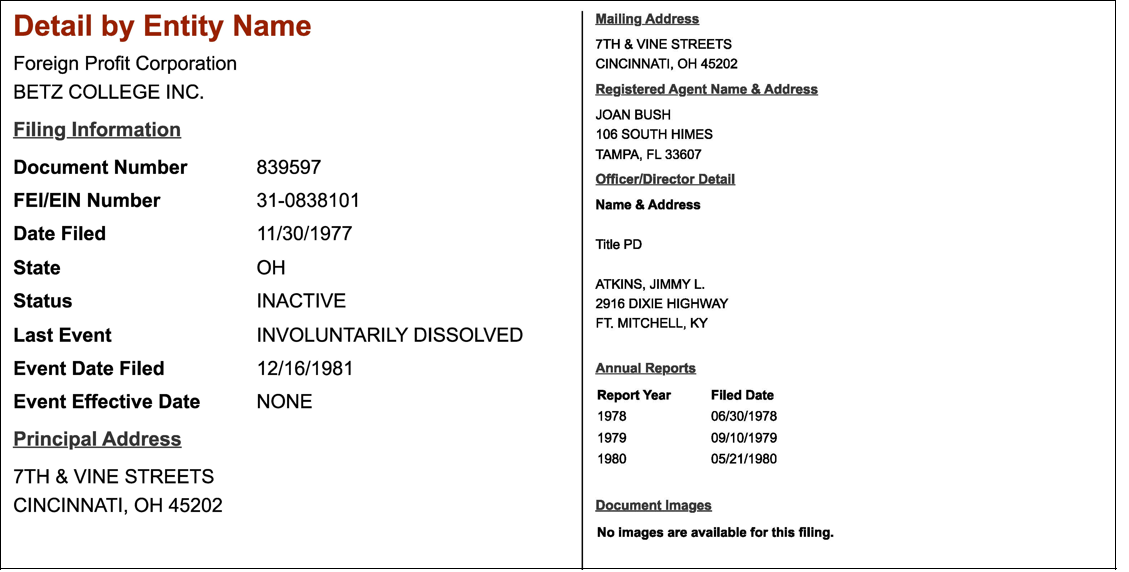
him—yes, we; it’s a team effort—Jimmy L. Atkins of Fort Mitchell,
Kentucky. He was director of the now defunct Betz College Inc. and Betz
Business School. He also owned Harbour Homes Realty, which managed most
of Sea Pines Plantation, and was Doe’s mother’s boss. They’d also dated,
she claimed, likely an affair hidden from his wife back in Ohio.
I
found the school records, the ownership records, and the records of
Doe’s mother’s embezzlement case. And something definitely felt off, as
indicated by her lawyer in the newspaper.
“[I am]
dismayed by the fact that the commission has acted in such an arbitrary
and capricious manner by revoking [REDACTED]’s license, without any
opportunity for her to be heard relative to the accusations. It
certainly appears to me that the actions of the commission, at least at
this point in time, are premature and grossly violate the basic
rudiments of due process.” - Jane Doe’s mother’s attorney
In
short, Jimmy Atkins had bypassed all due process when it came to a full
audit and chance for Doe’s mother to state her case, pulling the plug
on everything immediately. This resulted in Doe’s mother losing her job,
and having to pay Atkins back $150/month, equivalent to $448 by today’s
rates. She couldn’t afford it, and when threatened with jailtime, her
daughter went to Atkins to beg for leniency. He told her he hoped they’d
“end up in the gutter”—the man who sexually and physically abused Doe.
Eventually,
Doe and her mother and siblings all moved away from Hilton Head, her
mother remarried, and ended up on the West Coast. Their marriages were
what you might expect, following trauma and a criminal history that
would never disappear.
At
some point Doe met up with a man, maybe a roommate, maybe just a
friend, and smelled cologne on him that repulsed her, triggering a
memory that caused her to panic. Years later, the pair remembered the
day and the cologne, “Grey Flannel,” that the man had worn. History
shows us that Grey Flannel peaked in popularity sometime in the 1980s,
leading one to believe she would have smelled it during a moment of
trauma around the same time.
And that “cardboard shirt,” a weird,
crinkly material called “Tyvek” that was quite popular in the ‘80s, and
might have been worn with penny loafers, which Doe said “Jeff” wore, and
would trade out often for a newer, shinier pair.
She
remembered shelves filled with books, and classical music, but also
Neil Diamond. We know now that Epstein always kept massive bookshelves, a
busy reader in order to keep up his façade of knowledge in every
subject, but also was an accomplished classical pianist. And Neil
Diamond? His name shows up the files, innocently enough, but Epstein
seemed to care about his music.
But what about the drugs? What
about the gin and tonic she said he occasionally drank? That didn’t seem
like Epstein. Or at least not the Epstein we know in 2000, 2004, 2010,
2019. But this might have been Jeff Epstein, the young financier, the
rich-but-not-so-rich guy getting his feet wet in things like overseas
intelligence and billionaire tax management. He was still sociopathic
and a sexual deviant, but he might’ve been a little less careful—maybe
not the teetotaler we knew him to be in later years. She never said he
took drugs, only handed them out as a kind of payment, something he
replaced later with real cash. And if you look at the history of the
Southeast, just as Doe said, drugs like LSD and cocaine spiked just
after the early 1980s. It made her suspicious, but she didn’t push.
Then there was that Rick James concert, the one in Savannah when she was 15. Trickier to pin down, if I’m honest. Rick James did
play quite a bit in Georgia and the Southeast, but not necessarily the
exact dates Doe said. He was in Savannah in 1982, when she was 12, in
Atlanta in 1983, and then took a break until 1985, when the tour started
back up along the East Coast. It’s not a huge discrepancy, considering
she’s trying to remember one night 40 years ago (could you give details
about that Green Day concert in the ‘90s?), but she wasn’t far off.
Maybe there are more details in the other 37 pages we still don’t have.
But
there was one other thing that stood out to me, and I will include a
trigger warning here just for clarification. Doe mentioned that one way
Epstein abused her was by tugging at her nipples, something described in
multiple other survivors’ interviews. A small detail, though just as
damaging, but curious to hear the same form of abuse across the gamut of
women’s stories.
FBI Interview 2 - August 7, 2019
When
Doe finally talked about Donald Trump, a couple interviews in and
encouraged by the FBI, she mentioned unique and interesting details
outside of the actual abuse. She knew he had illegal building permits.
And she’d heard him talking about “washing money” through his casinos.
His favorite number was six. What did it mean? She didn’t know.
Jane
Doe did her best to run from Hilton Head and the abuse that she endured
there. But like most kids who never resolve their trauma, she struggled
with relationships and crime. In 2023 she was arrested for taking money
from a dying man saving for his funeral. She admitted it, talked to the
agents up front, and the story is pretty devasting. Doe’s picture shows
the years, the trauma, the substance abuse, and the damage a man like
“Jeff” inflicted on all those little girls. But it was also another
detail Doe provided that linked to real information that I could track
down.
Obviously
we’re not at the end of this story, not even close. I’ve reached out to
the brokers and agents who worked with Doe’s mother, trying to find any
kind of a record that showed Jeffrey Epstein rented a vacation home or
homes on Hilton Head Island in the 1980s. There are flight logs from
several years later that showed he traveled to the island quite a bit, a
hotspot for wealthy investors and yachting types. But nothing was
digitized, and I’m sure no one thought anything of destroying a box of
rental records that was four decades old.
But maybe not. Maybe
there’s something still there that they could find, like a little girl’s
babysitting flier, or a man giving piano lessons, or a wealthy young
New Yorker with a long face, a snaggle tooth, and a lisp that showed up
when he got upset.
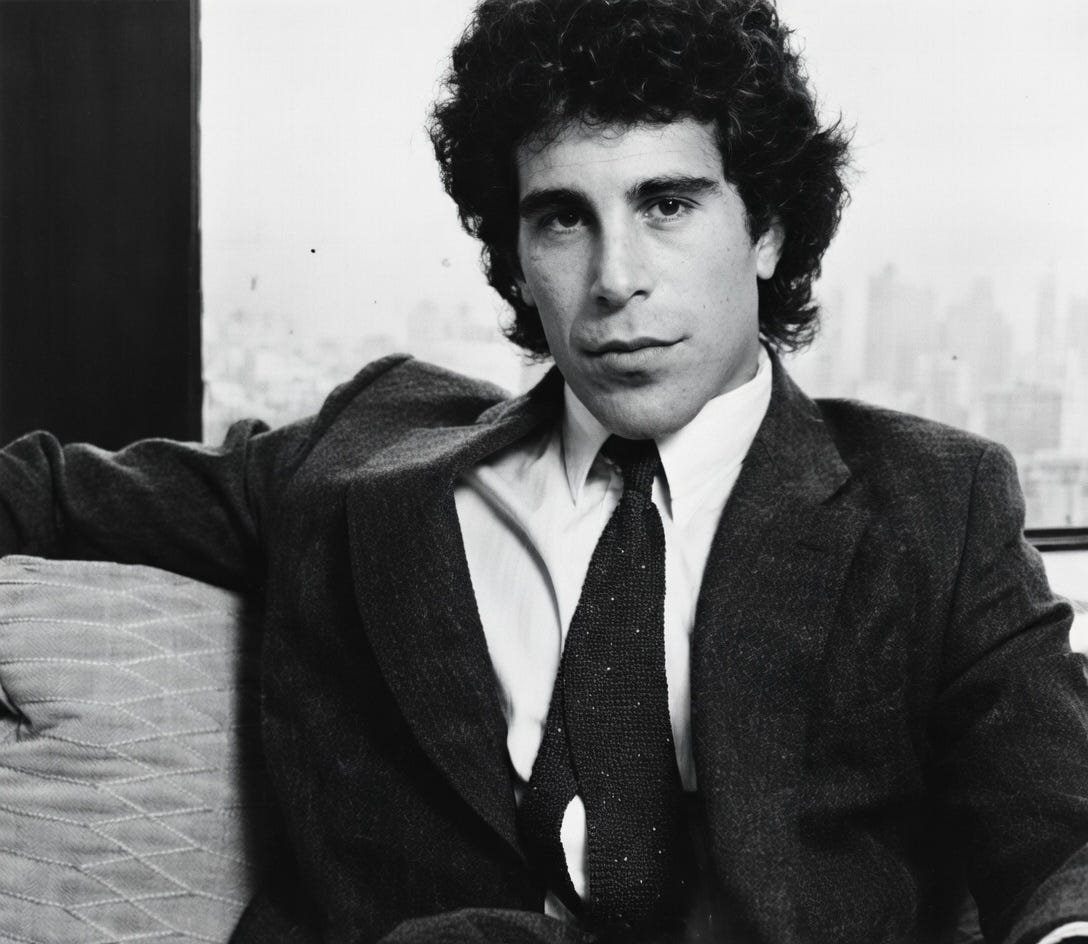
Cosmopolitan Magazine’s “Bachelor of the Month” - July, 1980
For
now, we know who Jane’s mother is, and when she passed, and the name of
her nursing home. We know Jane and her siblings, when she was born,
where, who she married, her criminal history, and the fact that she
desperately wants to remain anonymous, which I will respect. But the
FBI believed her enough to call her back three more times. The Bloom
Firm believed her enough to represent her case.
And the DOJ believed her enough to hide 37 pages, detailing her abuse at the hands of the President of the United States.
Jane Doe 4 sued the Epstein Estate in 2019, and later received a settlement.
This is an ongoing story...
This is why Blue Amp Media exists.
Ellie
spent weeks on this. Late nights, archived newspapers, property
records, court filings, FBI interview transcripts — cross-referencing
details that a 13-year-old girl remembered 40 years ago against
documents that the DOJ tried to keep hidden. And she found things.
Verifiable, documented things. That is not nothing. That is exactly what
independent journalism is supposed to do, and almost never does
anymore.
There are still 37 pages missing. This story is not over. And Ellie is not stopping.
A
paid subscription to Blue Amp Media directly supports this work — and
everything else we do to hold power accountable, keep the midterms
alive, and make sure the people who need to answer for what they’ve done
don’t get to just walk away. If that matters to you, we’d be glad to
have you with us.
Subscribe below. And thank you for reading Ellie’s work. She’s the real deal.
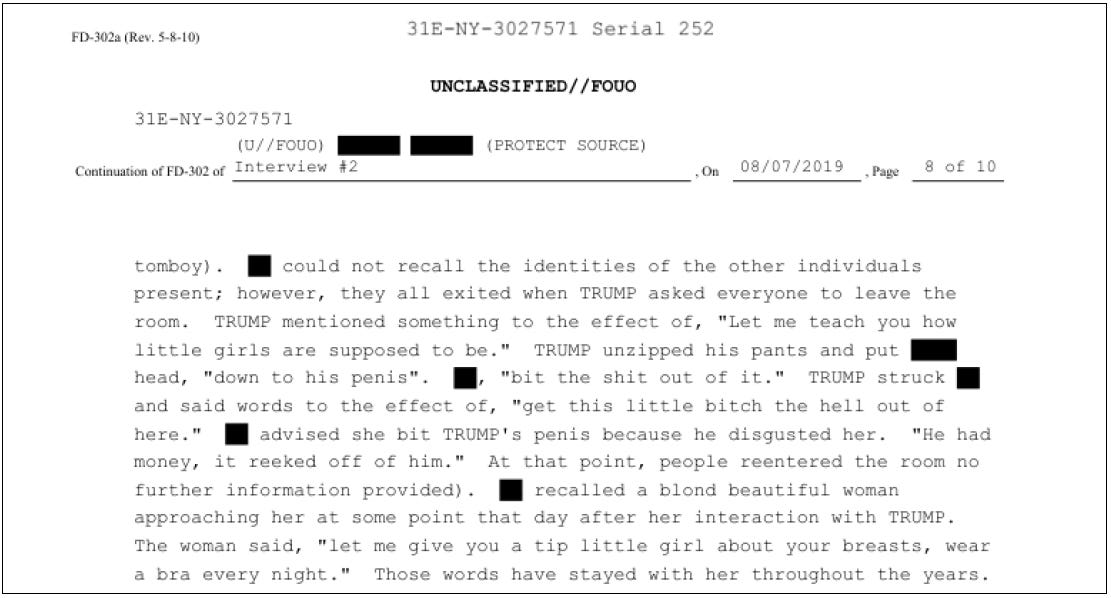
The Justice Department posted a trio of FBI interviews
with a woman who alleged President Donald Trump sexually assaulted her
when she was a young teenager after she was introduced to him by Jeffrey
Epstein.
The
woman’s central allegation, according to FBI summaries of her
interviews with investigators, known as FBI 302s, is that Trump hit her
after she bit his penis when he attempted to force her to perform oral
sex.
The three files come as Democrats are investigating whether the department purposefully withheld materials that included sexual assault allegations against Trump.
Trump
has denied wrongdoing in relation to the Epstein allegations and he
hasn’t been charged with a crime in connection with them. There’s no
evidence to suggest Trump took part in Epstein’s sex trafficking
operation. Many of the materials released by the Justice Department lack
substantiation or context.
White
House press secretary Karoline Leavitt called the allegations
“completely baseless accusations, backed by zero credible evidence, from
a sadly disturbed woman who has an extensive criminal history.”
“The
total baselessness of these accusations is also supported by the
obvious fact that Joe Biden’s department of justice knew about them for
four years and did nothing with them — because they knew President Trump
did absolutely nothing wrong. As we have said countless times,
President Trump has been totally exonerated by the release of the
Epstein Files.”
In
the files, dated between August and October 2019, the woman, whose name
is redacted, alleges that when she was between 13 and 15 years old,
Epstein took her to either New York or New Jersey, where, “in a very
tall building with huge rooms,” he introduced her to Trump. Trump, she
said, “didn’t like that I was a boy-girl,” which the interview notes
interpreted to mean tomboy.
The
woman said other people were present, but she couldn’t recall who.
Trump asked them to leave the room, then said “something to the effect
of, ‘Let me teach you how little girls are supposed to be,’” according
to the interview notes. Trump then unzipped his pants and put her head
“down to his penis,” she recalled in the interview. She said she “bit
the shit out of it.” In response, she said he pulled her hair and
punched her on the side of her head.
“Get
this little bitch the hell out of here,” the woman recalled him saying.
At that point, she said, people reentered the room. The FBI interviews
don’t contain information about how the incident ended or how the woman
exited the encounter.
In
one of the interviews, the woman disclosed that she had begun working
with attorneys and “wanted to be upfront” about “her pending civil case
in the event the agents determined a conflict of interest could occur.”
The
woman said she or people close to her received a series of threatening
phone calls, one of which included a message left on the phone of a
co-worker but intended for her. She told the FBI she believed the calls
were related to Epstein, and “stated under her breath that if it was not
Epstein, maybe it was the ‘other one.’” When agents pressed her on who
she meant, she said Trump, according to the interview notes.
In
the final interview, agents asked her again about her allegations
concerning Trump, noting in the document he was the “current U.S.
president.” The woman, according to the interview summary, asked “what
the point would be of providing the information at this point in her
life when there was a strong possibility nothing could be done about
it.”
Trump
has faced allegations of sexual assault and sexual misconduct before,
including accusations from multiple women who came forward during the
2016 presidential campaign.
In
2023, he was found liable by a federal jury for having sexually abused
and defamed the writer E. Jean Carroll after Carroll claimed Trump raped
her in a Manhattan department store in the 1990s and then denied her
account of rape, calling her a liar. Trump has asked the Supreme Court to overturn the $5 million judgment the jury awarded Carroll.
Carroll
also won a $83.3 million judgment in 2024 after a separate jury found
Trump defamed her with an additional set of remarks about the same
claims.
The
House Oversight and Government Reform Committee has been investigating
whether the Epstein-related documents were improperly withheld from
public view.
“For
the last few weeks, Oversight Democrats have been investigating the
FBI’s handling of allegations from 2019 of sexual assault on a minor
made against President Donald Trump by a survivor,” Rep. Robert Garcia
(D-Calif.), the ranking member of the committee, said in a statement last week.
“Oversight
Democrats can confirm that the DOJ appears to have illegally withheld
FBI interviews with this survivor who accused President Trump of heinous
crimes,” he added.
In a post on social media
in response to the statement, the Justice Department said Oversight
Democrats “should stop misleading the public while manufacturing outrage
from their radical anti-Trump base,” adding that “NOTHING has been
deleted.”
“If
files are temporarily pulled for victim redactions or to redact
Personally Identifiable Information, then those documents are promptly
restored online and are publicly available,” the post continued. “ALL
responsive documents have been produced unless a document falls within
one of the following categories: duplicates, privileged, or part of an
ongoing federal investigation.”
The
documents come as the Trump administration continues to battle
criticism over its handling of the files, about 3.5 million of which it
published in late January.
In
addition to accusations over withholding certain records, the
department has also come under fire from lawmakers for improperly
disclosing identifying information of victims and for redacting the
names of some men.
On Wednesday, a House committee voted to subpoena Attorney General Pam Bondi to testify about her handling of the Epstein files.
Jeffrey Epstein’s personal accountant sat before the House Oversight
Committee for seven hours yesterday, and by the end of it, the levy had
broken.
Richard Kahn — the man who managed every dollar Epstein moved for
over a decade, who was named in Epstein’s will two days before his
mysterious death, and who appears more than 50,000 times in the DOJ’s
Epstein files — confirmed under congressional questioning that a woman
who accused Donald Trump of sexual abuse received a settlement payment
from Epstein’s estate.
Epstein’s estate.
Trump’s accuser.
A cheque that matches up perfectly with the infamous 53 missing pages
and hundreds of thousands of redactions referencing Donald J Trump in
abuse accounts so sick, I had a hard time detailing them here:
But wait — there’s more:
Kahn didn’t stop there. He confirmed the names of five “rich and powerful” parties who bankrolled Epstein’s operation:
Les Wexner. Glenn Dubin. Steven Sinofsky. The Rothschilds. Leon Black.
These are the people who transferred significant sums of money to
Jeffrey Epstein — a convicted sex trafficker and predator of underage
girls. Kahn’s explanation? He thought Epstein was a tax advisor and
financial planner. He thought the money was consulting fees.
Nobody believes that. Not one person on that committee. Not one person reading this.
Blundell goes on to describe each of the five and their history with
Epstein. It is not hard to look at the information and suspect there’s
multiple reasons the Trump regime is fighting so hard to keep the
Epstein files under wraps and control what gets released.
And then there’s this:
Kahn wasn’t just Epstein’s number cruncher. He ran Epstein’s
financial infrastructure through his company, HBRK Associates Inc. He
coordinated wire transfers. He signed cheques. He managed what the DOJ
files describe as medical reimbursements for “the girls.” He vouched for
Epstein when banks flagged tuition payments to young women. He
impersonated Epstein in communications with banks, which he admitted to
Congress yesterday. He helped facilitate a fake marriage between two
women connected to Epstein, which he also admitted yesterday.
And then he showed up to Congress and said he had no idea anything was wrong.
What’s also interesting is how the testimony by Kahn is being
headlined in regular media outlets. What’s the important thing that
should lead off the reporting? Here’s a sampling:
I’d be inclined to believe Trump decided to attack Iran as a
distraction from the Epstein files, but at this point I wonder if he
really needed to? There should have already been sufficient evidence to
have brought Trump down by now. Certainly any Democratic president would
already have been driven from office with accusations like the ones
that have already surfaced.


![Rick James / Kool & The Gang / Maze / War / Atlantic Starr / One Way on Jul 3, 1982 [649-large]](https://substackcdn.com/image/fetch/$s_!uTcP!,f_auto,q_auto:good,fl_progressive:steep/https%3A%2F%2Fsubstack-post-media.s3.amazonaws.com%2Fpublic%2Fimages%2F659eadda-c30c-4b64-a44f-d4cda2f32254_836x1200.jpeg "Rick James / Kool & The Gang / Maze / War / Atlantic Starr / One Way on Jul 3, 1982 [649-large]")