Sunday, July 5, 2026

Severe weather disrupts US’s 250th celebrations


Severe weather disrupts US’s 250th celebrations

 https://www.aljazeera.com/news/2026/7/5/severe-weather-disrupts-uss-250th-celebrations

Severe weather disrupts US’s 250th celebrations

President Trump describes milestone as ‘one of the most joyous and glorious’ in US’s history in campaign style speech.

President Donald Trump and first lady Melania Trump attend "Salute to America 250" Fourth of July celebrations on the National Mall in Washington, DC, on July 4, 2026, as the US marks its 250th anniversary amid an extreme heatwave [Andrew Harnik/Getty Images via AFP]
US President Donald Trump and first lady Melania Trump attend a Fourth of July rally on the National Mall in Washington, DC [Andrew Harnik/Getty Images via AFP]

Severe weather has disrupted celebrations of the United States’ 250th anniversary of independence, including in Washington, DC, where a thunderstorm delayed a speech from President Donald Trump by almost two hours.

Trump, addressing a crowd of thousands after Saturday’s delay, described the milestone as “one of the most joyous and glorious” in the nation’s history.

Recommended Stories

list of 4 itemsend of list

He paid tribute to veterans, including several who served in the second world war, and celebrated US military prowess, claiming that the US had “wiped out” Iran’s military.

The president used the occasion to press his case for the SAVE America Act, which would require ID and proof of citizenship to vote, and renewed his attacks on the progressive wing of the Democratic Party, which he has repeatedly described as “communist” and compared to a cancer.

“It’s like a cancer – you’ve got to cut it out”, he said.

In New York City, authorities put on a large fireworks display to mark July 4th celebrations, bringing the 30-minute show forward because of the threat of storms.

The rain and lightning stayed away, allowing thousands of people to enjoy the spectacle.

Macy's Fourth of July fireworks explode as the United States celebrates its 250th anniversary on Independence Day in New York City, U.S., July 4, 2026.
Macy’s Fourth of July fireworks explode as the US celebrates its 250th anniversary on Independence Day, in New York City, US, July 4, 2026 [Carlos Barria/Reuters]

Elsewhere, severe weather prompted the cancellation of celebrations in Hartford in the state of Connecticut, along with Harrisburg and Wilkes-Barre in the state of Pennsylvania. Spectators in the city of Boston, who had gathered to watch fireworks, were told to briefly seek shelter before events later resumed. The city of Pittsburgh also moved forward with fireworks but shifted the time to accommodate the shifting weather.

Earlier in Washington, DC, authorities ordered a weather-related evacuation, with spectators sheltering in nearby museums and government buildings for a few hours. But the crowd later retuned to an open field near the Washington Monument several hours later.

Visitors had waited hours to get into the event, contending with stepped-up security and temperatures that reached 102 degrees Fahrenheit (39 degrees Celsius). The record-breaking heat wave forced the cancellation of several parades and other events in the area.

“It’s just part of the deal I signed up for,” said Glen Solander, 60, ‌a software engineer visiting from Sioux Falls, South Dakota, as he waited at a security checkpoint on Saturday afternoon.

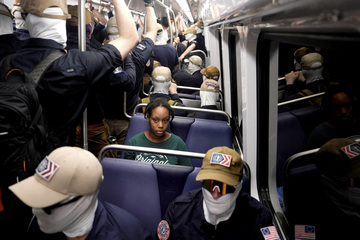
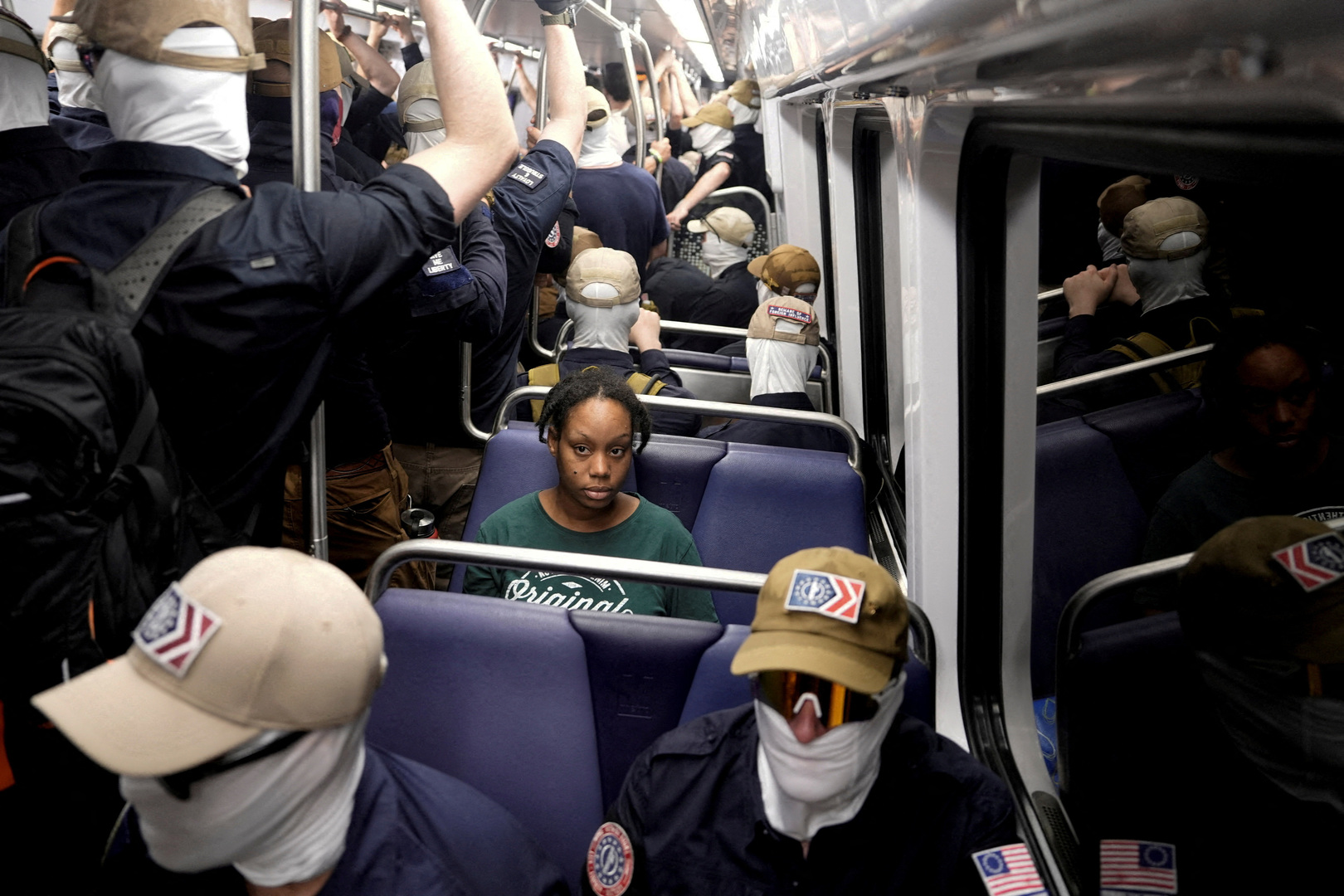
Other visitors included the white nationalist organisation Patriot Front.

The group posted on social media that it had arrived in the capital, and hundreds of people wearing the group’s outfits travelled to the city on Metro trains serving the District of Columbia region.

Local police said they had not received any reports of violence.
0:28
  • Now Playing
    00:28
    White nationalists march on Washington DC ahead of Freedom 250 celebrations

    White nationalists march on Washington DC ahead of Freedom 250 celebrations

  • Next
    00:32
    Cape Verde celebrates team’s return after historic World Cup

    Cape Verde celebrates team’s return after historic World Cup


Past presidents have generally avoided in-person appearances at July 4 celebrations, but Trump has blurred the line between official commemoration and campaign-style politics.

The Trump administration’s Freedom 250 group has largely sidelined a nonpartisan body set up in 2016 to handle the 250th anniversary ⁠and has fenced off much of the 2.4-kilometre (1.5-mile) National Mall for a “Great American State Fair” featuring attractions such ⁠as a Ferris wheel alongside displays by conservative groups and defence contractors.

Freedom 250 says the fair aims to showcase the people and innovations that make the US “the greatest nation on Earth”.

Several Democratic-led states declined to send delegations, and many performers scheduled to appear dropped out, citing concerns about partisanship.

Trump opened the event with a rally on June 24.

Other activities with Freedom 250 branding include a ⁠faith rally featuring mostly conservative Christian speakers, and multiple sports events, including a card of mixed martial arts bouts on the White House grounds for Trump’s 80th birthday on June 14.

An IndyCar race in Washington is scheduled for August.

The Freedom 250 organisation also sponsored “Freedom Trucks” that critics say paint an overly religious version of American history and gloss over issues such ‌as slavery and racial injustice.

Trump has sought to remake wide swaths of the capital city ahead of the 250th celebration, with mixed ‌results. ‌Many fountains and statues have been renovated, but problems have beset a much-touted $15m renovation of the Lincoln Memorial’s Reflecting Pool.

Security cameras and soldiers now stand watch over its peeling paint and algae-fouled waters.


This Data Center Is Everything That Everyone Hates About AI

This Data Center Is Everything That Everyone Hates About AI 

https://newrepublic.com/article/212169/stratos-data-center-utah-investors 

Stratos Fear

This Data Center Is Everything That Everyone Hates About AI

Utah’s Stratos Project is showing how everyone loses in the unregulated rush to build these Big Tech behemoths—even investors.

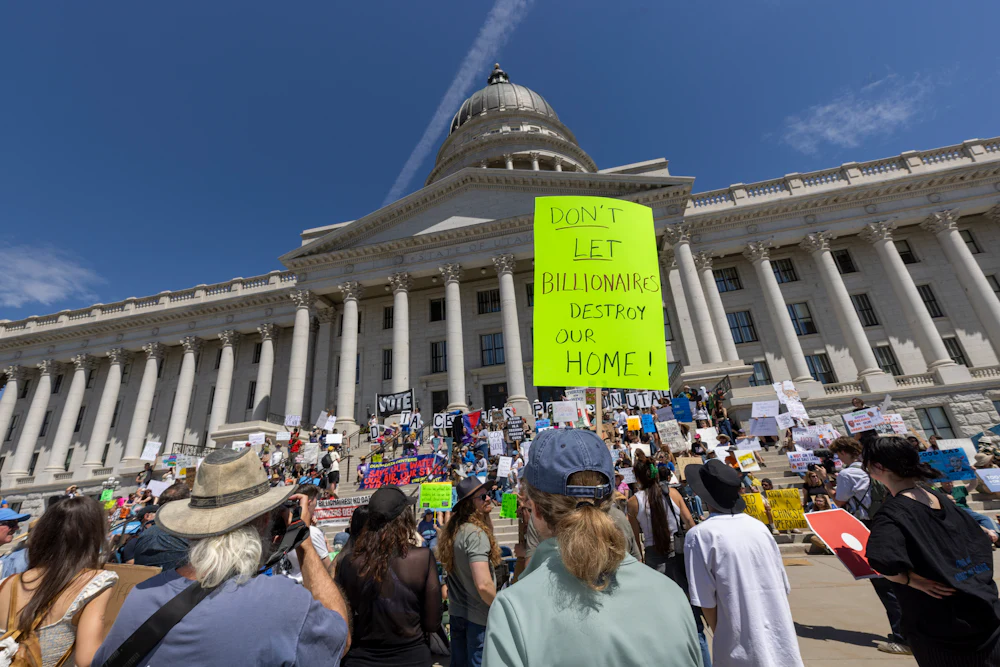
Protesters hold signs in front the of the Utah State Capitol building to oppose the construction of the Stratos data center in Box Elder County, Utah.
Natalie Behring/Getty Images
A protest at the Utah state Capitol building to oppose the construction of the Stratos data center in Box Elder County, Utah 
 
The Stratos Project was supposed to be an industrial marvel for the AI age. The proposal—a massive hyperscale data center in Box Elder County, Utah—was initially slated to be more than 2.5 times the size of the island of Manhattan. Once completed, it would use more than double the state’s average electricity demand and draw power from a dedicated natural gas supply. These immense figures would allow Stratos to train cutting-edge AI models, assist in advanced manufacturing, and even help with defense-related computing.

This, at least, was the idea when the project was officially announced in March 2026. Since then, however, the project has become an encapsulation of Americans’ distrust of the AI industry at large and the structural risk that unregulated data center development creates for investors across the board.

In Utah, opposition to the Stratos Project was driven in part by predictions that it would have severe adverse effects on the environment. Utah State University professor Robert Davies calculated that the heat from the completed Stratos center would raise local daytime temperatures by five degrees Fahrenheit and a staggering 28 degrees at night, a thermal load equivalent to “23 atom bombs” worth of energy. Ben Abbott, an ecology professor at Brigham Young University, warned that these temperature spikes would transform the local environment from semiarid into something more closely resembling the Sahara Desert. There were also additional concerns that the center would be a massive water draw in a region already prone to drought and facing increasing water shortages.

Despite this, and the complaints of thousands of residents, the project was approved by the Box Elder County Commission in May 2026—barely two months after it had been announced. The relative alacrity of their decision-making was partially enabled by the fact that Stratos utilized Utah’s Military Installation Development Authority, a state entity whose involvement let it bypass ordinary county zoning and the public review such projects normally require (since the project could theoretically help improve military AI adoption and cybersecurity).

Stratos’s chief backer is Kevin O’Leary, a celebrity billionaire investor better known for his role on the TV show Shark Tank than as an AI infrastructure guru. He has claimed that Stratos would create 2,000 permanent jobs (despite the fact that Stratos is yet to have a tenant, and that data centers have historically created far fewer jobs than advocates claim).

But O’Leary’s promises have done nothing to dampen local opposition to Stratos. In fact, opposition intensified throughout the month of May until Utah Governor Spencer Cox—who had initially backed the project when O’Leary met with him in January 2026—signed an executive order on May 29 to ensure that the state properly evaluates data center proposals. While the Stratos Project was not specifically mentioned in the order, the timing of the announcement, coupled with the significant statewide pushback to the project, showed it was clearly an inflection point. Less than a week later, O’Leary agreed to significantly scale back the proposed data center from 40,000 acres to just over 20,000.

“People are concerned about data centers,” Cox said in a press conference, “they’re concerned about the lake, they’re concerned about resources, and they should be concerned.”

So, six months after the supposed “industrial marvel” of the Stratos Project was introduced, the results have been an angry local community, an embarrassed investor, and a local state government belatedly searching for a sensible framework with which to govern data center growth. The backlash has not stopped yet, either. On June 23, Utah state Senate President J. Stuart Adams, who was also the chairman of the Utah agency that initially approved Stratos, lost his Senate seat to a rival who explicitly criticized his support of O’Leary’s project.

But data center investors face a more significant problem than public embarrassment—they risk losing money. In Utah, there are now two separate lawsuits underway against O’Leary’s project, each likely to further slow the already scaled-back data center. The problem isn’t confined to the Stratos Project, either. According to a recent analysis by JPMorgan, more than 60 percent of data center capacity planned for 2027 isn’t yet under construction. The research firm Data Center Watch has claimed that in the first quarter of 2026, over $130 billion worth of data center projects were either delayed or canceled.

Together, this suggests that regulatory and community friction is already taking a significant toll on investors’ bottom lines, alerting them to the dangers of rushing headlong into new proposals. A May 2026 note from the law firm Ropes & Grey warned as much, noting that “permitting challenges and local [community] resistance are emerging as serious obstacles” and that “standstills are a real risk absent industry engagement or federal preemption.”

States have caught on to this problem. Beyond Spencer Cox’s executive order, which directs Utah agencies to protect the environment while promoting economic growth, Maine passed a bipartisan data center moratorium act in April. Initially vetoed by outgoing Governor Janet Mills, the act could come back into consideration after the November 2026 midterms. Ohio and California, meanwhile, have both passed legislation, with Ohio requiring data center operators to cover their own grid costs, and California mandating that they disclose their electricity consumption.

Big Tech firms are now keenly aware of the need for their data centers to have at least some environmental protections and community considerations built into development plans. Microsoft, for instance, announced its “Community-First” AI infrastructure plan in January 2026, shortly after it was forced to cancel a proposed data center in rural Wisconsin. The plan calls for covering the grid and electricity costs its data centers create, minimizing and replenishing local water use, and paying its full share of local property taxes rather than seeking the tax breaks data centers typically negotiate. OpenAI has called for significant investment in renewables to help modernize the U.S. electrical grid and make data center build-out more sustainable, while Anthropic has pledged to cover the grid infrastructure improvements and electricity cost increases that are generated from the data centers it uses.

These actions from both big business at one end and state actors at the other are a recognition of the problem. But they are the inverse of the kind of investment that the Stratos Project represents: rushed ad hoc investment on one side of the coin, and reactive ad hoc regulation on the flip side.

What’s more, both actors have fundamental limitations. Data centers are a footloose industry, meaning if one state is deemed to be overregulating, investors can easily shop for a friendlier jurisdiction. And while Big Tech firms might talk a good game, they are also subject to severe market pressures that could make them put their plans for equitable, environmentally friendly data centers on the back burner.

What’s needed is a concrete set of enforceable federal standards that can slow down the ad hoc gold rush in favor of equitable (and ultimately faster) long-term build-out. But here, the Trump administration is doing the exact opposite. In its July 2025 executive order, the White House moved to ease regulatory burdens on data centers costing at least $500 million, while compressing review windows and streamlining environmental evaluations meant to identify those burdens, and saying nothing about the water consumption or community frustration driving the backlash.

It’s a counterproductive way to win the AI race. On one hand, the Trump administration (as well as backers like O’Leary) insist that data centers are a strategic imperative for the United States. But the administration is blocking the one thing—a clear set of rules—that would allow for data center construction without risking a backlash in every county they touch.

The alternative is another dozen Stratoses, each one announced in the dark and built in haste, before an angry public demands concessions. That option leaves everyone on the losing end—including, it turns out, investors.


A Troubling Milestone: Most Supreme Court Rulings Are Secretive Votes With Little Justification


A Troubling Milestone: Most Supreme Court Rulings Are Secretive Votes With Little Justification

https://www.propublica.org/article/supreme-court-shadow-docket-rulings-milestone 

A dark shadow falls across the Supreme Court building.
The Supreme Court is deciding more consequential rulings than ever before in secret, issued in unsigned orders with little to no justification. Bryan Dozier/NurPhoto via AP

A Troubling Milestone: Most Supreme Court Rulings Are Secretive Votes With Little Justification

ProPublica conducted a new analysis that shows the court is deciding more consequential rulings than ever before in largely unsigned orders with little to no explanation.

In its term that ended last October, the Supreme Court passed an important milestone that went unnoticed: For the first time, it decided more cases by secret ballot, and with few signed opinions, than it did for cases argued in open court.

These decisions, which make up the court’s “shadow docket,” are a fast-track way to get a decision from the top court. They rarely include arguments, have limited briefings and have expedited timetables, and justices infrequently provide explanation of how they voted or to cite legal precedent. 

The Supreme Court’s increased willingness to bypass its regular process has empowered President Donald Trump at the same time as the administration has increased use of executive authority. The court has repeatedly green-lit policies of his that lower courts have blocked — and has done so with little to no explanation. 

These emergency decisions have thrown lower courts’ processes into turmoil and have sometimes directly contradicted longstanding legal precedent. The outcomes have been consequential: The high court has used the process to limit federal courts from issuing nationwide injunctions and diminished Congress’ authority over federal agencies, and it has allowed for the detention of American citizens by immigration agents

ProPublica analyzed over two decades of Supreme Court rulings, which cover all of the years under Chief Justice John Roberts and go as far back as the online archives allow. We found that when the last court term ended, justices had issued 63 orders on the shadow docket, as opposed to 56 orders on the more traditional merits docket — where the court hears oral arguments scheduled months in advance and the justices issue signed opinions.

Legal scholars and court watchers were shocked by our finding. They told ProPublica it’s likely the first time in modern history that so many consequential decisions were made in secret by its nine members.

“The patterns show a court going out of its way to enable Trump,” said Stephen Vladeck, a law professor at Georgetown University and a Supreme Court analyst. He said that our findings reinforce the appearance that the justices are voting on their political preferences. 

“That’s the real blow to the court’s credibility,” he said.

Representatives from the Supreme Court did not respond to a detailed list of questions. 

In a statement, a spokesperson for the White House wrote, “President Trump has faced a historically unprecedented number of injunctions by liberal lower court judges, the same judges who would rather push their own policy schemes and undermine the Administration’s lawful agenda. President Trump will not stop implementing the America First initiatives on which he was elected.”

For the First Time in Two Decades, Decisions on the Supreme Court’s Shadow Docket Outnumber the Merits Docket

Note: Supreme Court terms run from October to October. Ken Morales/ProPublica

There are two ways to get a decision from the Supreme Court. One is to exhaust your appeals to lower courts and ask to argue your case in front of the high court. The justices determine whether to take the case on, and if they do, lawyers argue their case in front of them. The other is to petition the justices directly via the emergency docket — to freeze a lower court ruling or government policy while the case goes through appeal.

The appeals to the emergency docket have long outnumbered those to the merits docket, but most are procedural requests or requests to stay execution for capital offenses. When those are removed, what’s left is known as the shadow docket — cases that seek to skip the usual order of things and ask for a quick ruling from the court’s justices.

The modern shadow docket was born in 2016 when the Supreme Court issued an emergency stay against President Barack Obama’s Clean Power Plan, experts say. Papers obtained by The New York Times show that liberal justices at the time urged Roberts not to decide the case on an emergency basis because it broke with longtime precedent. The conservative justices, meanwhile, forcefully argued that the president’s plan would eventually be overturned by the court anyway and that it would put too much of a burden on the energy industry.

Driven by its numerous losses in lower courts, the current Trump administration appeals to the emergency docket significantly more often than previous administrations, and the court has increasingly agreed to take quick action on its appeals.

The Obama and George W. Bush administrations together filed just eight petitions in 16 years. The Trump administration filed 32 in 2025 alone, an analysis by the Brennan Center for Justice found.

The increased willingness of the Roberts court to intervene on Trump’s behalf — as well as in other issues that favor conservatives and Trump allies — has upended American life, said Donald Ayer, a former deputy solicitor general and deputy attorney general who served under the Reagan and George H.W. Bush administrations.

“On many subjects of real importance to our future, they’ve demolished what used to be the law,” he said.


Public scrutiny of the shadow docket ramped up in September 2021 after the Supreme Court used it to issue a one-paragraph, unsigned opinion that further rolled back abortion rights established in the 1973 Roe v. Wade ruling. In the order, the court refused to block Texas’ Senate Bill 8, the “Heartbeat Act,” which banned abortion after an embryo’s cardiac activity is detectable, typically at six weeks of pregnancy and before many people know they are pregnant. Protests erupted nationwide, and the Senate held a hearing on the shadow docket.

In an unusual public acknowledgement, Justice Elena Kagan referenced the shadow docket by name in her scathing dissent, accusing the majority of green-lighting a “patently unconstitutional law” with only a cursory review in less than 72 hours.

“In all these ways, the majority’s decision is emblematic of too much of this Court’s shadow docket decisionmaking — which every day becomes more unreasoned, inconsistent, and impossible to defend,” Kagan wrote.

That an opinion was even issued and that four of the justices signed their names to it was uncommon. On the shadow docket, justices do not have to make their votes known. In rare cases, their votes are revealed in terse indications that they grant or deny the application, or even more rarely, as an opinion. We found that just 17% of votes cast had any sort of public record of a vote or opinion.

Responding to public criticism, Justice Samuel Alito contended that the court isn’t to blame for the rise in shadow docket cases. “We do not file these emergency applications,” he said. “Parties file them.”

The debate has continued. “We cannot expect the public to have faith in our judicial system if, without clear explanation, we consistently green-light harmful acts that do real damage,” Justice Ketanji Brown Jackson said during an April speech on the shadow docket at Yale Law School.

Until this past Supreme Court term, emergency applications fluctuated year to year but showed no clear upward trend. The applications are given first to a single justice, who decides if a case is worth referring to the full court. In recent years, justices have referred more of such appeals for a review and vote by the full court.

Last term, when there were both more cases and more referrals to the full court, the appeals to the shadow docket finally overtook those to the merits docket.

Emergency Applications Referred for a Full Court Vote Have Risen Sharply

Total applications have varied over the last two decades, with a surge last term under President Donald Trump. 

Ken Morales/ProPublica

The cases were consequential. On June 23, 2025, after a lower court had ruled that eight men being deported to South Sudan should have due process, the Supreme Court intervened after a request from the administration to stop that order. The men were deported. The majority didn’t issue an opinion justifying its ruling.

Three months later, the Supreme Court voted to allow immigration agents to stop people based on racial or ethnic characteristics while still-ongoing litigation against it proceeded. To justify the decision, Justice Brett Kavanaugh wrote a rare shadow docket opinion that people who were in the country legally would be “free to go after the brief encounter.” These became known as “Kavanaugh stops.” Last year, ProPublica found more than 170 citizens who had been stopped and detained by ICE agents. The more than 50 Americans held even after agents learned of their citizenship were almost all Latino.

And in May, while an election in Louisiana was already underway, the justices allowed the state to immediately redraw its electoral map, removing one of the two majority-Black voting districts. Louisiana can now use that map for the 2026 midterms as part of a nationwide redistricting battle for control of the House of Representatives — an effort touched off by Trump’s call for Republican-led states to create more safe seats for themselves.

Roberts once signed on to a Kagan dissent that assailed the shadow docket. But our analysis found that he has referred more substantive cases for a vote by the full court than any other justice, going from just one in the 2005 term when he joined the court to nearly half of all referrals in the last term.

There is an additional difference between the shadow docket and the merits docket. After the court holds public argument, the justices’ ultimate merits decisions are closely watched and extensively covered by the press. The summer’s “decision season,” when the final and most significant rulings come down, has a predictable cadence that ends when the justices go on summer recess. Not so with the shadow docket. Increasingly, the justices are making big decisions after they’ve issued their final merits docket decision, when public attention has waned.

A group of Democrats led by Rep. Jamie Raskin, D-Md., have sponsored legislation to make the shadow docket more transparent.

Raskin told ProPublica that the court’s legitimacy has fallen with every significant decision made without “real opinions or analysis.”

“Lower federal courts have been deciding against the Trump administration in an overwhelming majority of cases with weighty and well-reasoned opinions,” Raskin said in a written statement. “Yet when things get to the twilight zone of the shadow docket, the Supreme Court is overturning 100-page opinions with a flippant sentence or two.” He added, “The result is a body that looks less like a Supreme Court and more like a Royal Court rubber stamping the madness and folly of the Trump Administration.”

“The jurisprudence of the Roberts Court today is as murky as the green algae water in the Reflecting Pool.”


How We Reported This Story

To compare the number of cases on the Supreme Court’s shadow docket to the traditional merits docket, we compared emergency applications listed on the court’s online docket search with counts of decisions compiled in Penn State’s Supreme Court Database (Version 2025 Release 01). For the merits docket, we counted only signed decisions in argued cases, the typical format for those rulings.

The court’s online docket goes back to the year 2000, but our analysis looks at Supreme Court terms from October 2003 to October 2025, where emergency applications are easily identified by the letter “A” in their docket number.

We identified more than 27,000 emergency applications during that period, including thousands of requests that are not commonly understood to be a part of the shadow docket. Most appeals to the emergency docket are the type of requests that were traditionally handled there: procedural requests, such as extending the time to file, and requests to stay execution for capital offenses. The remainder are the focus of our reporting.

Substantive Shadow Docket Cases Are a Small Fraction of All Emergency Applications

Note: The COVID-19 lockdown impacted applications for filing relief in the 2020-21 term. Ken Morales/ProPublica

We defined a substantive application on the shadow docket as any filing where the full court was asked to intervene in the traditional appeals process, such as staying a lower court’s order. 

Most of the cases we excluded are decided by just one justice, each of whom oversees one or more federal circuits and has the power to refer filings to the wider court. When the cases are referred to the full court, they are the subject of a vote by the justices. We ran our approach by multiple experts, all of whom found it sound.

A filer can appeal to another justice if their application is denied. The next justice to receive the application always refers it to the full court. We did not include these renewed applications because our analysis found the court has never granted one.

The court has labeled capital punishment cases only since the October 2017 term. To identify them prior to that, we flagged applications for stays of execution. We then manually reviewed every case referred to the full court. For applications decided by a single justice, we used an AI model to flag potential capital cases by examining the parties on the application and the relief requested. The model flagged over 60 possible capital cases, and those were manually reviewed. Despite our effort, it is possible some capital cases may still be included in our final tallies before the 2017 term.

Although rulings on the shadow docket are typically unsigned and do not include vote breakdowns, we were able to identify how a justice voted in some cases. The analysis is based on either the opinions issued by the justices, most of which are dissenting opinions, or if the justice indicated they would have granted or denied. In some decisions, the justices issued a statement not attached to either a grant or denial. We did not record these as votes.