Trump’s Dim-Witted Tirade Accidentally Reveals Iran Deal’s a Sham
https://newrepublic.com/article/211903/trump-dimwitted-tirade-iran-deal-accidentally-reveals-it-sham
Trump’s Dim-Witted Tirade Accidentally Reveals Iran Deal’s a Sham
As Trump’s agreement with Iran starts looking even worse under scrutiny, Tom Nichols of The Atlantic explains how this whole fiasco has left the U.S. in a weaker position than before.
Greg Sargent: This is The Daily Blast from The New Republic, produced and presented by the DSR Network. I’m your host, Greg Sargent.
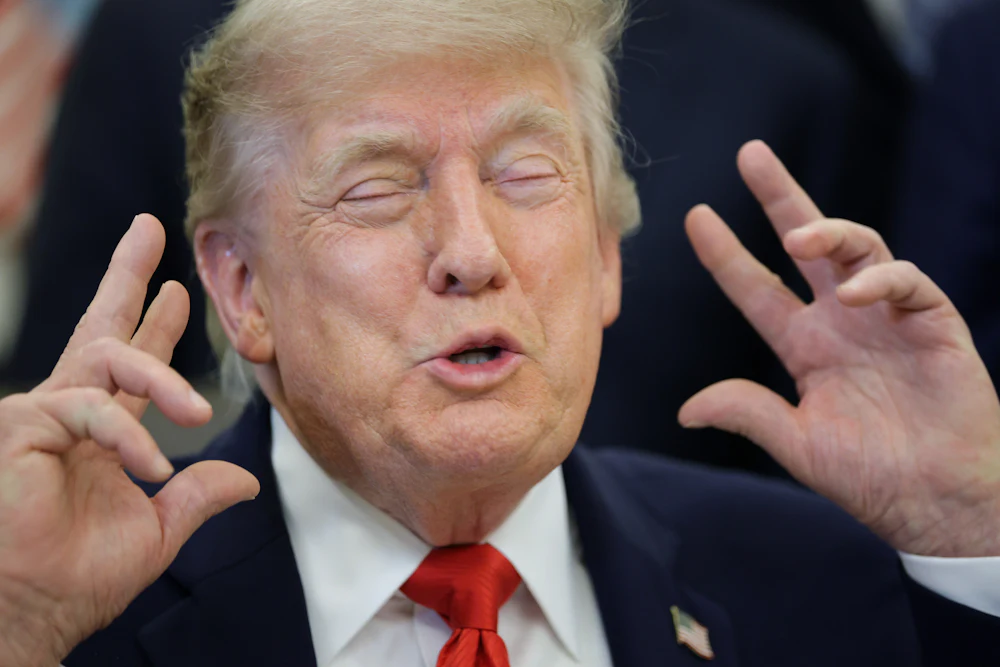
Donald Trump has signed a deal with Iran to cease hostilities and reopen the Strait of Hormuz. We still haven’t seen the document, but all of the reporting suggests a very simple story: Trump lost. He got nothing of any significance. Trump himself plainly has no idea what happened, as he revealed in a strange ramble to reporters. But JD Vance does know what happened, even though he’s trying very hard to sugarcoat it in a pretty revealing way.
We’re really lucky to be talking about all of this with Tom Nichols, a staff writer for The Atlantic, who has a good piece arguing that Trump capitulated to Iran. Tom, great to have you on, man.
Tom Nichols: Good to see you, Greg.
Sargent: So let’s just sum up where we are. We haven’t seen the document, but all the reporting suggests that while the Strait of Hormuz will reopen, all that does is return us to where we were before Trump’s war.
Meanwhile, they’ve punted the discussion over Iran’s nuclear program until later. And the Iranian regime has survived. So basically, Trump’s tens of billions of dollars in bombing didn’t compel Iran to do what he said he’d make them do. Tom, is that basically the size of things?
Nichols: I think it’s worse than that. The bigger problem is that he counted on regime change. This was what the war was really about. So when that wasn’t going to happen, when it became clear a week or so in that this regime wasn’t going to collapse, this outcome, I think, was more or less inevitable.
And I think the people that are now waiting and saying, well, we need to see the details of this MOU—that’s fine. But even without knowing the details of the MOU, the Americans have been defeated here. And that pains me to say as an American. Because the regime is still intact, their nuclear material is still in their country. They’re actually politically more powerful now that they’ve flexed muscle and done some serious harm to the other Gulf states as a warning not to cooperate with the United States. There’s going to be some money going back into Iran, whether it comes through third parties or not.
I think if you had said any of this to Donald Trump on the first night of the war, he would have said, that’s impossible, we’re going to get unconditional surrender. Well, we didn’t. And all of these things are going to happen. Even without knowing what’s in the MOU, you can know at least this much.
Sargent: Right. Trump absolutely did expect unconditional surrender, even though he was told by lots and lots of different people within his administration, including the chairman of the Joint Chiefs, that that wouldn’t happen. He was told that the strait would be closed by Iran and that that would exercise leverage over the global economy and over us.
Trump couldn’t fathom that possibility because he’s strong. It’s just that simple, right? He’s strong, he wins, he’s a winner, he’s strong, so there’s no way that things won’t go exactly the way he says they will.
Nichols: Yeah, this is—it’s bitten him before and caused him problems before—but there’s this kind of weird quirk in Trump’s personality where he really believes that saying things makes them real. That, like a child, he can sort of wish-cast things into existence.
And you can play that game with domestic politics and tariffs and taxes and do some fancy dancing around where the money is in terms of things like revenue. You can bully other Republicans to agree with you. What you can’t do is do that with a war where the enemy gets a vote.
Every day that Trump said they’re eager to make a deal, there’s going to be a deal, a deal is imminent—the Iranians are not Republican House members. They are a foreign country and an enemy of the United States. And there’s nothing to stop them from saying no, there is no deal. And now that we have one, it’s not great. It’s basically an acknowledgment that the United States failed to gain any of its strategic objectives.
Sargent: That seems beyond clear. So Trump talked to the media about his deal today. He blasted Obama’s 2015 nuclear deal, which unfroze tens of billions of dollars that Iran could then access in foreign accounts. Listen to Trump.
Donald Trump (voiceover): It was a horrible deal for the United States. It was a deal where billions of dollars was given to Iran. It was a deal where $1.7 billion in cash was put on a Boeing 757—well, not a 757, I guess, right? But on a big, beautiful Boeing 757. They needed a Boeing 747, to be honest with you, because it was a lot of cash. $1.7 billion was taken out of the banks and given to Iran. And on top of that, tens of billions of dollars was spent. So they tried to bribe them to make a deal and that didn’t work. It never works.
Tom, as far as we know now, Iran will also be able to access a huge tranche of funds under Trump’s deal too, right? Can you explain that? How do you respond to what Trump said there?
Nichols: Well, I was a critic of the JCPOA because I didn’t like how much of it was front-loaded. But I also have to be honest and say that in the years that followed, the deal seemed more or less to work.
Now Trump has kind of wandered into a crappier version of the JCPOA, starting all over again, with the argument that they’ll get access to this money if they clear certain gates and engage in certain things. And the Iranians are just better at this than he is. And I think that money is going to start coming to them again through third parties.
And I think that’s why you keep hearing Trump and Vance both being careful to say, well, we’re not just going to give them cash. No, you’re going to open up the ability to have cash get to them with your OK. And I suspect that once people are tired of this whole process, which will be very soon, and once Trump is no longer paying any attention to it, the Iranians are going to get what they want. How soon, how much—that’s just a matter of working out the details.
Remember, in the end, this was supposed to be giving the Iranian government back to its people, who would then dismantle the nuclear program, end support for terrorism, restrain their proxies, blah, blah, blah, blah, blah. None of that’s going to happen. They’re going to get the money one way or another.
Sargent: What’s the basic difference between what Obama did with the money and what Trump is doing with the money? Do we know?
Nichols: Well, without seeing the MOU, hard to say. But I would say that Obama did it without completely disrupting the international economy, blowing billions of dollars’ worth of expensive American weapons, getting some Americans killed, getting many hundreds more wounded, and then weakening the United States by forcing us to basically admit that, yes, the Iranians own the Strait of Hormuz.
Sargent: Right. The bottom line here is that Trump is in some sense using the mechanism Obama used, which is a financial incentive to get Iran to cooperate with oversight of its nuclear program. Obama did this through negotiation.
Trump did it through spending tens of billions of dollars committing massive war crimes, bombing an Iranian school filled with children, et cetera, et cetera, to practically melting down the global economy. That’s the difference, right? They’re using more or less the same mechanism.
Nichols: Trump blew up a lot of things, expended a lot of weapons, messed up the global economy, and now is doing it exactly the way Obama did it. And we’ll probably not get as good a deal, because now the Iranians have made sure to do things like booby-trap the uranium. Even if international inspectors get in there—and whatever Pete Hegseth says, you’re not going to have Marines in there digging this stuff out—getting inspectors in there is going to be a lot trickier than it was 10 years ago. It was just stupid and pointless.
Sargent: I think there’s actually another reason for that that I want to get to in a second. But first, let’s listen to JD Vance for a second. There’s a bit of confusion about how Iran will get access to this money. It’s being described as $300 billion. JD Vance was asked about this. Listen to this.
Reporter (voiceover): The Iranians are saying that they’re going to have access to a $300 billion reconstruction fund. True or false?
JD Vance (voiceover): Well, that’s the sort of thing they could have access to, funded by the Gulf Coast coalition, so long as they honor their end of the obligation. I think that one of the things you’re going to see, Ed, and people have to be skeptical of this, is that the hardliners in the Iranian system will overemphasize the benefits that Iran gets while underemphasizing all the things that they have to concede and all the things they have to provide in order to get these benefits. So we absolutely are open to the Gulf Coast countries investing in the reconstruction of Iran, but only if Iran ends their nuclear program, ends their enriched stockpile of material, and is really open to an inspections and enforcement regime that gives the American people confidence they’re never going to have a nuclear weapon.
Sargent: So if I understand this correctly, the U.S. will allow Iran to get access to this money if and only if Iran agrees to some kind of binding long-term constraint on its nuclear program. What you’re saying is that once the nuts and bolts really hit, when they really start to talk about this, probably Iran will be able to get access to that money fairly quickly, or at least before any final commitment is made.
And when JD Vance says this money will come from other Gulf Coast countries investing, what’s he referring to there? And what’s your overall reaction to what you heard from JD?
Nichols: Well, I don’t know how quickly they’ll get it. And this is where I will be cautious and say that until we see this MOU—which for some reason the administration really doesn’t want to release to the public, which should tell you something right there—I don’t know how quickly it’ll get here. But basically, we’re committing to supporting the reconstruction of the country we just blew to smithereens after getting nothing.
This notion—it really is staggering to have the administration claiming, well, we finally got a commitment not to build nuclear weapons. Look, I considered myself—I was never in favor of attacking Iran, but I was a real hawk on the issue of, if they ever get close to a nuclear weapon, that could actually be the trigger for war. But there was no evidence of this, and there’s been no evidence of it for 10 years, since the JCPOA.
So again, we’re back to this problem that they’re going to get a lot of money, they’re going to get reconstruction support from the Gulf states that they have pounded and inflicted punishment on for cooperating with us. How does this not leave Iran, even though Iran is temporarily militarily weakened, how does this not leave Iran in a strategically more powerful stance?
And I think that’s why, when you listen to that part we just listened to, Greg—where you ask JD Vance these questions and he kind of does the Jackie Gleason thing, where he’s trying to explain his way out of it—the reality is Trump wants out. And he’s willing to buy his way out if he couldn’t bomb his way out.
Sargent: Right. Obama actually ended up getting more because he had an actual deal that laid out what oversight of the Iranian nuclear program would look like. Trump doesn’t have that. He’s just now doing what Obama did, which is using money to try to get it, right?
Nichols: And doing it without the support of the international community.
Sargent: And after spending tens and tens of billions of dollars committing war crimes, destroying the global economy—
Nichols: I’m not there yet on war crimes. I think that waits for an investigation. But he started a preventive war. He started a war of choice, which itself is horrific because there was no—this didn’t even have the rationale of the Iraq War behind it. I said at the beginning of this, the Iraq War looks like it was competently lawyered up compared to this.
I mean, Bush went to the United Nations, he had allies on board with at least some of it. He made a case, he put a clock on it about the inspectors. This was Trump just getting up one morning and saying, you know what, it’s time to take out Iran.
Which itself is a problem when you’re talking about war crimes and crimes against humanity. But in the end, I will also say that had he toppled this regime, Greg, I would have been one of the people shrugging and saying, well, you have to congratulate him if he managed to get rid of one of the worst, most dangerous regimes on this planet. I may not have liked the way he went into it, but I would have had to certainly congratulate him on coming out of it.
Now he’s gotten the worst of all worlds. He’s taken America on a discretionary war, didn’t get what he wants. He’s going to have to pay off the bad guys so that he can get out of this. And basically he’s going to paper over his own mistake here with dollars. That’s what he’s going to do.
Sargent: Right. I think that’s basically the size of it. I just want to say one more thing about JD Vance’s strange ramble there. He’s basically admitting that Trump is using the same mechanism that Obama used—a financial incentive to get Iran to cooperate with oversight of its nuclear program. Doesn’t JD just end up making Trump look like a complete moron, given that it comes right after Trump compared his deal favorably to Obama’s unfreezing of funds to Iran?
Nichols: Yeah, no part of this administration communicates within itself. And I think what we’re seeing here—given the concerns about Trump’s health, his state of mind—JD Vance’s answer was sort of stumbling and bumbling, but within the normal range of political dissembling, if that makes any sense.
Trump, I think, just doesn’t have any idea what’s going on. That’s the bigger worry—that Rubio and Witkoff and Kushner are saying, OK, we’ve got it, but I don’t get the sense that Trump himself really understands anything that’s going on here. So the idea that Trump and Vance aren’t on the same page isn’t surprising at all. I really wonder how much Trump understands any of this at this point.
Sargent: So Tom, I just want to close on a point you make in your piece, which is really interesting. Trump is threatening to restart hostilities against Iran if it doesn’t agree to surrender its nuclear program. And you point out that Iran just won’t believe that, because Trump has shown that he wanted an exit from all this. I want to add to your point and get you to talk about this. As we get closer to the midterms, it becomes next to impossible for Trump to restart military action of any kind, let alone using any kind of ground invasion. Republicans will just not allow that to happen because it’ll utterly crush them in the midterms.
So I think, Tom, what Trump has really done here is lock in a time frame that actually weakens his leverage over Iran over time. It weakens his leverage over Iran’s nuclear program over time. And Iran knows that. Am I right?
Nichols: I think so. And he’s also alluded to using a nuclear weapon at one point. He said, we still have the ultimate, you know— But I just find it hard to believe, although with this administration and this president you never know, that right after Labor Day, as everybody’s going into the midterms and he’s still trying to wait for good news on the economy, because remember what he really cares about is international markets. He’s going to say, OK, we’re starting up the war again. On what pretext? And also by that time, then he really will have to go to Congress or do something.
I mean, he surprised the country and the American people and the world by doing this when he did it. I don’t think you can go to that well twice. And I just don’t—I could be wrong—I just don’t believe him when he says, well, if this doesn’t work out and they don’t behave, I’ll just start up the war again.
That means he’s willing to tie down huge numbers of U.S. forces halfway around the world on a maybe while negotiators negotiate. At some point, ships have to come home. Soldiers and sailors need to be cycled through so they can do the things they need to do. They can’t just sit on ships for three or four months. I just don’t buy it.
Sargent: So just to boil this down, we’re now entering the really hard part, which is the part where we negotiate over the future of the Iranian nuclear program and the nuts and bolts of that have to be worked out. And Trump has weakened his leverage going into that. And Trump has also strengthened Iranian leverage because Iran knows it can hold the global economy hostage now. Is that the size of it?
Nichols: Right. And the Iranians get to appear like the aggrieved party now, that they’re the ones that have lost thousands of people and been attacked. And also, even with a competent team that understood the issues and knows what it’s doing, trying to negotiate a nuclear program after you’ve bombed it and put it under a lot of rubble, it takes a long time. It’s going to take even longer here.
So the idea that somehow in 60 days, sometime again around Labor Day or something, Trump’s going to say, that’s it, everything’s fixed, we’ve got it—none of that’s going to happen. This is going to be a kind of long cold war with the Iranians, just like the one we’ve been in with them for 45 years, 47 years. And Trump made it worse. So I don’t see any way out of this in a way that I think enhances American security anytime soon.
Sargent: Utter catastrophe all around. Tom Nichols, awesome to talk to you. Thanks so much for coming on.
Nichols: Thanks for having me, Greg.






We want to know what you think, but keep it respectful. Read our commenting guidelines
here.