Vultures Circle Trump’s $2.3Bn Do-Over of Deportation Disaster
EXCLUSIVE:
The list of organizations circling a recompete of the Trump
administration’s scandal-ridden Project Homecoming deal reads like a
who’s who of the immigration enforcement industry.
The
grim line-up of controversial companies jostling for a shot at a $2.3
billion contract to run the Trump administration’s scandal-hit
deportation scheme can be revealed by PunchUp.
Ten organizations dialed into a 45-minute virtual briefing
on the upcoming Project Homecoming contract hosted by the Department of
Homeland Security on Aug. 12. It marks the second installment of an
earlier, $915 million deal to run the scheme that went to Salus
Worldwide Solutions. That company has faced a barrage of corruption
allegations over how the award process ran last year. Sources have told
us that, as a result, it’s “unlikely” to win the recompete.
Draft
terms for the new contract, which we revealed earlier this week, show
the department wants bidders to pay unaccompanied migrant children if
they “choose” to leave the country. Its menu of stipends includes the
$2,500 on offer to minors since last October, with the money routed to a
“Government-designated adult.” DHS will also pay the winning company to
advertise the program through “trusted local networks,” hunt down
eligible participants using commercial data in a practice known as
skip-tracing, and set up “rover” teams that surge across the country to
sign up people already in detention.
PunchUp
is a reader-supported publication. To receive new posts and support my
work, consider becoming a free or paid subscriber.
In her decade of experience working with
unaccompanied migrant children in Texas, attorney Alexa Sendukas has
represented over a hundred children and youth. For years, Sendukas’s
work at the Galveston-Houston Immigrant Representation Project (GHIRP)
had been supported by federal funding meant to ensure that children do
not go defenseless in immigration court. But on July 31, the contract
governing that work expired.
GHIRP, which currently represents around 500 young clients, is now
staring down a situation Sendukas could never have previously imagined:
the possibility of withdrawing from hundreds of cases.
The long-standing contract had funded a network of nearly 100
organizations and hundreds of attorneys providing legal aid to more than
20,000 unaccompanied migrant children across the country. In its place,
the Trump administration has struck a $20 million agreement with the
nonprofit US Committee for Refugees and Immigrants and a $158 million
contract with Our Rescue,
an organization founded by an ex-ICE agent accused of sexual
exploitation and sex trafficking. On its website, Our Rescue touts its
collaboration with law enforcement—but the organization does not appear
to have experience providing immigrant legal services.
Reader-Funded since 1865
This article has been made free to read. Keeping it that way isn't.
In the past weeks, some organizations have shut down
their legal aid programs for unaccompanied children entirely. Others
are preparing to lay off staff and are making difficult decisions about
which young clients they can continue representing and which cases they
will have to discontinue. Meanwhile, in Central America, one major
nonprofit providing social services to returning migrant children told
me they are bracing themselves for an influx of deported children they
may not have capacity to serve.
This gutting of expert legal assistance for migrant children comes as
immigration enforcement increasingly targets children and families, and
the federal government fast-tracks court hearings for children across
the country.
“It’s very clear that this is a comprehensive targeting of children to accelerate their deportation,” Sendukas said.
The result is a deluge of legal proceedings for migrant children with
fewer lawyers than ever to represent them. GHIRP has some 70 asylum
interviews scheduled for the next six weeks; last Monday, Sendukas was
scheduled for five simultaneous interviews. Some young clients have been
working with Sendukas for years. GHIRP’s youngest client is 4 years
old.
Texas is a national epicenter for immigration enforcement, and in Houston, local law enforcement
collaborates extensively with ICE. Nearly every day, new children
continue to arrive to shelters for unaccompanied children within the
state, Sendukas says.
Sendukas’s work representing these young people is no longer funded,
but if she doesn’t show up for her clients, she asks, who will?
The administration has been trying to make it harder for unaccompanied migrant children to access legal representation since February of last year,
when it issued and then quickly rescinded a stop work order for legal
services funded through the unaccompanied children contract. The Trump
administration’s attempt to prematurely terminate the contract a month
later was blocked in federal court.
Yet, while the contract had continued until July 31, the Trump
administration stopped paying around December 2025, putting
organizations like GHIRP under financial pressure. Earlier this month, a
federal court ordered Trump to release those unpaid funds—an amount advocates say totaled $65 million.
Acacia Center for Justice, the prime contract holder on the original agreement that funded organizations like GHIRP, has said
that negotiations over a new contract failed because the Trump
administration demanded that it share confidential client information
that could be used to accelerate deportations.
In a statement to The Nation, the press secretary for the
Department of Health and Human Services wrote that the Office of Refugee
Resettlement (ORR), the agency responsible for unaccompanied children,
“remains fully compliant with its legal and regulatory obligations.”
The US’s celebrated right to counsel does not exist in immigration court. According to the Vera Institute of Justice,
of the more than 630,000 people ordered removed in immigration courts
over the past year, more than two-thirds had no lawyer representing
them.
However, a 2008 federal anti-trafficking law requires the federal
government to provide legal counsel to unaccompanied migrant children
“to the greatest extent practicable.”
The Trump administration is now dismantling a network of expert legal
organizations across the country, built up over the past two decades,
that provides know-your-rights presentations to unaccompanied children
in government custody, helps children file asylum claims, and represents
young clients in immigration court.
In a Thursday
court filing, a group of non-profits funded under the previous
contract, including GHIRP, called for an evidentiary hearing to examine
the Department of Health and Human Services’s failure to provide legal
services. The filing detailed examples of children–including a
seven-year-old in Los Angeles, a child in Texas, and a one-year-old baby
in Arizona–who appeared in court without an attorney, and in some cases
waived their rights to seek relief from removal.
In the days after the contract expired, Ana Devereaux, a staff
attorney at the Michigan Immigrant Rights Center, sorted through the
organization’s 950 ongoing cases to determine which unaccompanied
children they could continue to represent. MIRC is currently expecting
to withdraw from 520 of those cases.
Without federal funding, MIRC is planning to lay off the entire
70-person team working on unaccompanied children’s cases by October.
MIRC is in a better financial situation than many peer legal providers
across the country: It has managed to source funding from the state of
Michigan, private foundations, and individual donors to keep
representing children in as many cases as possible. But this
supplementary funding won’t be nearly enough to cover the full range of
services previously funded by the federal government.
Alexandra Manrique Alfonso, the director of the Children’s Legal
Program at the Miami-based legal nonprofit Americans for Immigrant
Justice (AI Justice), said the organization was similarly evaluating its
300-some cases to determine whom they could continue to represent.
Attorneys may look at a child’s age, the status of their case, and their
risk of removal when making these evaluations—but such decisions are
very difficult, Manrique Alfonso said.
“Every minor deserves representation,” Manrique Alfonso said. “We are
trying to see who is the most vulnerable out of the most vulnerable
set.”
GHIRP, MIRC, and AI Justice have also been facing a slew of asylum
hearings, suddenly scheduled just as the organizations are attempting to
downsize operations. MIRC has received around 21 asylum interview
notices in the last four weeks—more than they had received in the entire
previous year. This uptick in caseload aligns with Trump’s attempts to
accelerate the deportation process. For instance, in late July, the
administration instituted a new that allows asylum officers to determine
an applicant’s asylum eligibility without interviewing them.
The term “unaccompanied alien children” has
traditionally referred to children who cross the US-Mexico border alone.
But over the past year, new arrivals in ORR custody are increasingly
children and teens living in the US who are apprehended by internal
immigration enforcement, advocates say. Such children may not really be
“unaccompanied” at all. A child or teen who is living with their family
in the US may be stopped by immigration enforcement while alone and thus
processed as unaccompanied.
According to Devereaux, immigration enforcement in Michigan has
appeared to target parents who come forward to reunite with children in
ORR-run shelters. In one case Devereaux described, a father was detained
during a fingerprint appointment to be reunited with his teenage son.
The father was deported, and his son is now in long-term foster care.
Similar tactics have been reported in Texas, where attorneys say children are being used as “bait” to arrest and detain family members. In July, Reuters
reported that over 12,000 people had been arrested by immigration
enforcement using leads that ORR had shared with ICE about unaccompanied
children and sponsors.
Such stories reveal how unaccompanied children have become a central
target in the Trump administration’s mass deportation campaign.
Deportations of unaccompanied minors have tripled compared to Trump’s
first term, ProPublicahas reported.
“The mass deportation agenda is driving an unprecedented level of
family separation, and not just because parents are deported,” said
Becky Wolozin, a senior attorney at the National Center for Youth Law.
“Children are being taken into custody without their families; parents
and caregivers are threatened with deportation if they attempt to
reunite with their children.”
While such separation tactics are less visible than the infamous
family separation policy of Trump’s first term, they are “incredibly
harmful,” Wolozin said.
Over the past year, the number of days unaccompanied children spend
in ORR custody has skyrocketed (in July, the average stay in ORR custody
was 187 days).
Because the government has defunded attorneys who visit shelters for
legal rights presentations, children will lose key advocates who can
monitor the conditions in these shelters, which have sometimes been
sites of sexual harassment and abuse.
For the some 1,800 unaccompanied children currently in government
custody, suddenly losing a trusted attorney may be traumatic, advocates
warn. “Especially for kids in custody, they may trust their attorneys
more than any of the other adults in their life,” Devereaux said.
“Sometimes we have clients who are having mental health crises and the
first person they call is their attorney.”
Amy Schaltegger Escoto is the director of reintegration programs at
Kids in Need of Defense (KIND), which provides services to children
returning to Guatemala and Honduras. According to Schaltegger Escoto,
the number of children served by the program has doubled over the past
year, even as funding remains flat.
Children returning from the US can be traumatized by their journeys,
Schaltegger Escoto says. Restarting life in a new country—sometimes
after living all or most of their lives in the US—can be immensely
complex. In many cases, the children have lost some Spanish-speaking
ability; children may also feel shame, failure, and stigma after they
return to their country of origin.
In yet another move to lay the groundwork for possible mass
deportations, Trump administration is ramping up construction for
immigration facilities flagged specifically for unaccompanied children. A
request for proposal posted by the Department of Health and Human
Services in July invites contractors to bid on the construction of an “Emergency Intake Facility” to hold up to 3,000 unaccompanied children.
Advocates have raised alarm over this planned construction, pointing
out that shelters for unaccompanied children are currently at around
only 27 percent occupancy.
According to Sendukas, who has visited similar large-scale emergency
shelters to provide know-your-rights presentations, children in
emergency intake facilities often face poor conditions and inadequate
access to legal services.
In Alexandria, Louisiana, ICE plans to open a 528-bed facility for
families, unaccompanied children, and women, next to an airport that has
become the largest deportation hub in the nation. The facility will be
built on a defunct Air Force base that has been found to have some of
the highest levels of forever chemical contamination in the country.
ICE has described the facility as a 72-hour “staging area.” Yet investigations
into a similar short-term facility operating in the same town shows
that people are held well over the three-day limit, in unsafe
conditions. The LaSalle Family Foundation, the nonprofit arm of a
private prison corporation, is slated to run the new facility for family
and children. In the past year, two people have died at a LaSalle-run
ICE institution in a nearby town.
Tania Wolf, Southeast advocacy manager for the National Immigration
Project, rejects the idea that the Alexandria ICE facility could serve
as a humane and short-term holding spot for unaccompanied children. The
goal, Wolf says, is to expand detention and deportation.
“Once you build it, they will fill it,” Wolf said. “And they are moving at break-neck speeds to open up these facilities.”
Maggie Grether was a 2024 Puffin student writing fellow for The Nation. She served as the co–editor in chief of The New Journal at Yale University, where she also collaborates with the Investigative Reporting Lab at Yale.
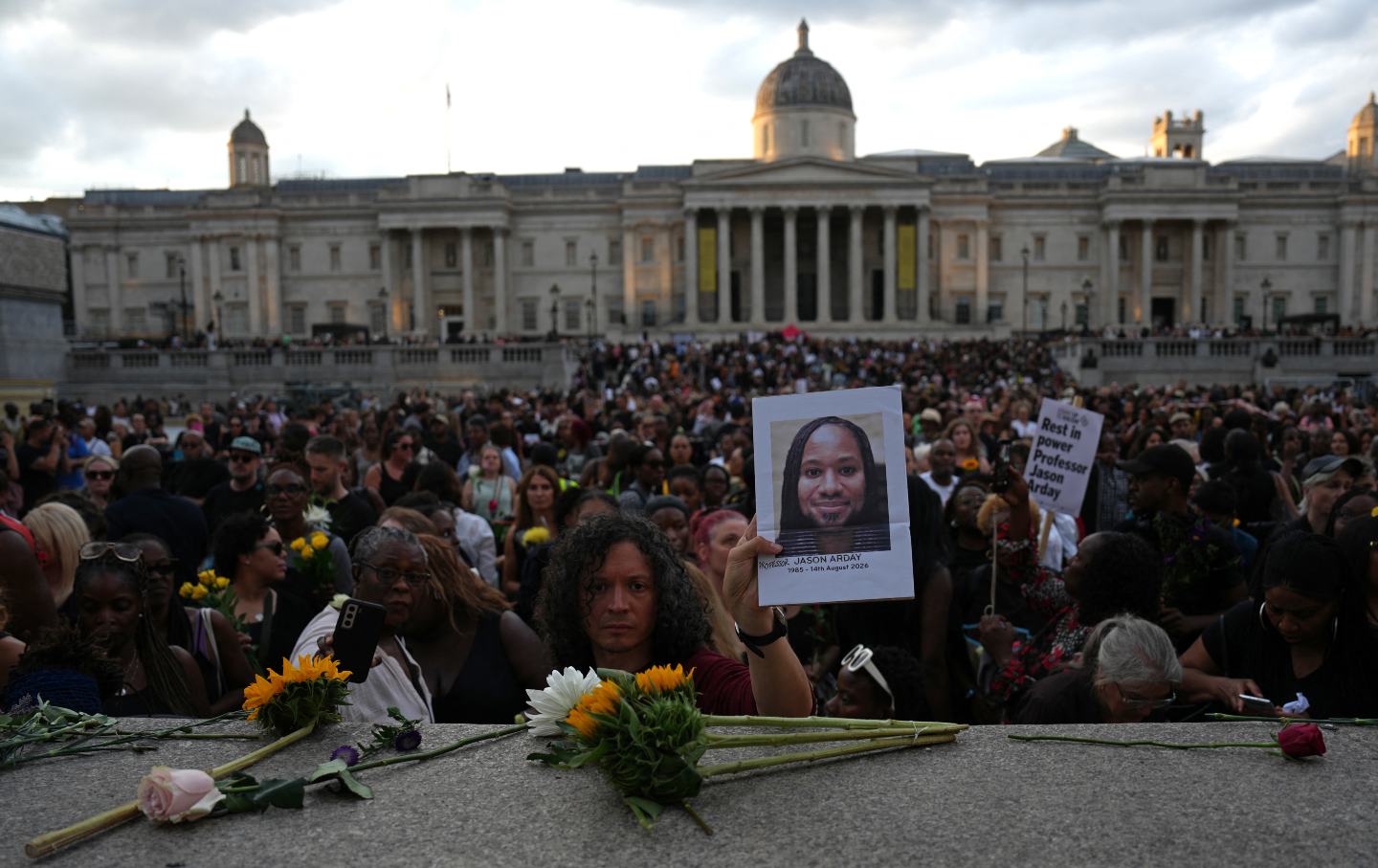
I was one
of the few Black scholars at both institutions. I understand—and
loathe—how their tendency to undermine the suffering of Black people led
to Jason Arday’s demise.
The
proposed Paramount/Warner Bros. merger does not just represent media
monopoly—it is another form of gerrymandering, of rigging the rules to
limit who has power.
Too
often, Democrats reinforce Republicans’ lie that the language of racial
justice is the problem—instead of the injustices the language is trying
to name.
Everyone from RFK Jr. to social media influencers are telling us that
the nutrient needs to be maximized in our diet as much as possible. But
is that actually good for our bodies?...
Construction of a White House ballroom continues on Aug. 18,
2026, three days before a court-ordered deadline to halt construction
unless Congress authorizes it.
Win McNamee/Getty Images
Is it illegal for the president to spend ‘patriotic’ donations on a White House ballroom or anything else?
The fate of President Donald Trump’s estimated US$400 million White House ballroom
may hinge on the little-known and somewhat surprising rules as to when
the federal government and its agencies can accept privately donated
funds.
As a scholar of nonprofit and tax-exempt law who has studied for
decades how the law governs deductible charitable contributions, including those to the government,
I find that this appeals court decision calls for an explanation of the
role that such private donations may play in any federal government
project or activity. An intricate statutory dance is required for
taxpayers to make donations to particular government agencies or for
particular government purposes.
Giving to the government
You may not realize that you can make potentially tax-deductible contributions to the federal government itself. An official website lists almost two dozen programs,
including the National Endowment for for the Humanities, the National
Arboretum and AmeriCorps, to which U.S. citizens can donate.
But such donations are allowed to government agencies only if
Congress has granted the agency statutory authority to receive those
funds.
In this context, according to the reasoning of the majority in the
appeals court case, that means spending donated funds to preserve the
East Wing would have been automatically allowed because it stood on a national park and the National Parks Service is an agency that individuals can donate to;
spending those funds to build something new to replace that structure
would not be allowed unless Congress had authorized the project.
What’s more, the Bureau of Fiscal Services – the central bank account and financial manager for the federal government – explains
that it “may accept gifts donated to the United States Government” and
that the account for such gifts, which dates back to 1843, was
established “to accept gifts, such as bequests, from individuals wishing
to express their patriotism to the United States.” Such gifts, however,
are subject to restrictions.
An excavator clears rubble after the East Wing of the White House was demolished on Oct. 23, 2025.Eric Lee/Getty Images
Statutory restrictions
Since 1982, a provision of the United States Code, the official
codification of all the nation’s general and permanent federal statutes,
has required that these “patriotic” donations be devoted exclusively to
reducing the national debt.
By law, federal agencies cannot augment congressional appropriations. The Miscellaneous Receipts Act
requires that “an official or agent of the Government receiving money
for the Government from any source shall deposit the money in the
Treasury as soon as practicable without deduction for any charge or
claim.”
Despite this seemingly absolute language, government agencies are
permitted to accept gifts of money or other property when – and to the
extent – they are given explicit statutory authority.
But any money must be spent only as Congress directed in establishing
the agency mission. The mission of the National Park Service is the
conservation and preservation of the land and structures under its
jurisdiction.
In contrast, the White House does not
have this authority. Its own website states that it “is unable to
accept cash, checks, bonds … or other monetary equivalents” as gifts
from private citizens.
The two judges in the majority concluded that neither the National Park Service, which is the steward for the national park
on which the White House stands, nor Trump himself had satisfied all
the statutory requirements needed to undertake building of the
above-ground ballroom. It did not block work on an underground military bunker the Trump administration began renovating after it demolished the East Wing in October 2025.
Crucial to this conclusion was a statute
declaring, “A building or structure shall not be erected on any
reservation, park, or public grounds of the Federal Government in the
District of Columbia without express authority of Congress.”
“We are aware of no instance in American history in which a President
unilaterally and using privately collected funds demolished substantial
portions of the White House that Congress authorized to be built and
American taxpayers paid
for,” the majority opinion says. “Until now.”
Satisfying 2 statutes
The Trump administration has pointed to two possible statutes it says provides the necessary authority to do that.
One involves the purposes for which the National Park Service can spend its funds, including privately donated funds. The other grants the president the ability to spend funds
for, among other items, “the care, maintenance, repair, alteration,
refurnishing, [and] improvement” of the executive residence at the White
House – funds that “are authorized to be appropriated each fiscal
year.”
The majority explained that authority for the president to construct
the ballroom requires satisfying both of those statutes; neither alone
suffices.
And it rejected the reliance on the National Park Service provision
alone. That statute limits use of the service’s funds, in the words of
the majority, to “the identified purposes of conservation and
preservation.”
In particular, the majority ruled, the provision does not authorize
the construction of a new building. Further, it held, the National Park
Service provision cannot authorize the president to lead the project;
only the provision related to the executive residence can do that.
As to the executive residence provision, the majority opinion
explains that it “does not expressly grant the President any independent
authority.”
Instead, the majority held, the president must rely on “an
accompanying appropriation.” The court found no such accompanying
appropriation.
This article was updated on Aug. 21, 2026, with news about the action taken by Chief Justice Roberts.
Deciding which causes to support can be overwhelming. Wouldn’t it be easier if you could get trusted information about philanthropy and nonprofits in one place?
That place is the “Giving Today” newsletter. As The Conversation’s Philanthropy + Nonprofits editor, I am fortunate to work with my counterparts at the Chronicle of Philanthropy and The Associated Press to produce this weekly email.
Every week, we team up to send a newsletter that brings together the best of our coverage on these important issues, plus useful articles from other news outlets.
In January 2012, Nina Keita
emailed Jeffrey Epstein to let him know she’d booked the ministerial
suite at the Hôtel Ivoire for his stay in Abidjan. As the name suggests,
the suite, with its panoramic views of the Ébrié Lagoon and its
tasteful African wood carvings, was intended for high-ranking government
visitors like Nelson Mandela, Hillary Clinton, and Keita’s uncle, the
president of Cote d’Ivoire. Epstein, apparently, was close enough.
He responded that he hoped “to seee [sic] very pretty girls there.” Keita confirmed, “You will!”
The two had likely met when Keita moved to New York seven years
earlier to work as a model. Epstein had invited her to visit his
Manhattan townhome and fly on his private jet, fostering a relationship
that would prove instrumental when he began traveling regularly to the
African continent: Senegal, Mali, and Gabon in 2011; Cote d’Ivoire in
2012; Morocco twice in 2015. Between 2000 and 2016, he made plans to
travel to Africa at least fifteen times. Even when he wasn’t there
physically, he kept his fingers on its pulse: Searching for “Africa” in
the Epstein files yields more than 5,600 results, including regional
financial bulletins from the World Bank, foreign policy updates from his
buddy the Norwegian diplomat Terje Rød-Larsen, and investment ideas for
the continent from Silicon Valley types.
What drew him there? During his 2012 visit to Abidjan, Keita and the
interior minister planned for him to join a “private night” at the
minister’s penthouse: “He knows what you like,” Keita wrote, four years
after Epstein was convicted of procuring a minor for prostitution. But
it wasn’t women alone that lured him to the continent. Keita also
arranged for Epstein to meet with her uncle, Cote d’Ivoire’s president,
at least twice, as well as the country’s minister of mines, petrol, and
energy. Later, she helped him broker a security agreement between Israel
and Cote d’Ivoire, after which the West African country acquired
Israeli-made surveillance technology. Returning the favors, Epstein
advised Keita on business ideas, introduced her to a Swiss bank advisor
to help realize her “goals,” and connected her with an American
philanthropic consultant to fund health and education programs in her
motherland.
This was how things worked in Epstein’s world, not just in Africa but
across the globe: Young women procured through the same networks in
which business deals were struck, lofty political connections
cultivated, and philanthropic projects funded. Yet there was something unique about his relations to and within Africa.
When I first searched the Epstein files for mentions of Africa, the
emails and texts I found churned with all the desire and revulsion a
European settler might have felt in traversing the “dark continent” a
century earlier. But by the time I reached the files’ end—if indeed one
can ever “finish” sifting through 3.5 million pages of documents,
180,000 images, and 2,000 videos—I suspected my initial conception of
Epstein was wrong, or at least incomplete. That his real position might
not be as obvious as “imperialist” or “conqueror” but something more
geopolitically specific: a role that required history to elucidate, and
that explained a man I thought the media had already covered in
excruciating, exhaustive detail in a new light.
Like the treaty-hunters and financiers of colonial and
post-independence Africa, Epstein fashioned himself as a modern-day
power broker. For more than fifteen years, he sought out local and
international elites who dreamed of exploiting Africa’s resources, away
from public oversight and apathetic to public benefit. There, under the
long shadow of colonial rule, Epstein cultivated clout the way he
preferred: through proximity rather than through holding office or
leading a C-suite; through personal relations rather than institutional
affiliation. In Africa, he wouldn’t get rich quick, but he would bring
together influential figures who might not have otherwise met, people
who might do him a favor in return—people who might, together, bend the
continent’s fate to their whims.
Perhaps in the beginning, Epstein dreamed of enriching himself
directly off Africa’s resources. He chased a crude oil venture with
Equatorial Guinea’s vice president, for instance, and tried to access
$80 billion in frozen Libyan assets after the 2011 uprising against
Gaddafi. Neither scheme worked out, so he returned to trading in his
most reliable investment: the introduction. To that end, Epstein wanted
to know: Did Rød-Larsen, the Norwegian diplomat, want to meet the prime
minister of Ivory Coast? Could Larry Summers, former U.S. treasury
secretary, make “some small time” to meet with Ivory Coast’s finance
minister? Did Ehud Barak, former prime minister of Israel, want to meet
the heads of state of Senegal, Ivory Coast, or various “Middle East
friends”? Did Tom Pritzker, head honcho at Hyatt, want to scout out
hotel opportunities at Dakar’s brand-new airport?
Across nationalities, generations, and political systems, what united these brokers was the impunity with which they operated.
Just as he opened doors in Africa when it suited him, he shut them
when it didn’t. In June 2011, he heard from Melanie Walker, whom he’d
approached twenty years earlier at a hotel lobby in New York because
he’d found her attractive. Now a deputy director at the Gates
Foundation, she pitched him a project to improve urban sanitation in
Dakar. His pals in the Senegalese government weren’t impressed. Her
plans reeked of “the colonial masters telling ys [sic] what we
need and not really listening,” he relayed. When Walker asked to meet
his contacts directly to discuss, Epstein shot her down. “No chance,” he
wrote.
In controlling entry to rarefied rooms, Epstein was occupying a role
older than some African nations. In the nineteenth century, “freelance”
brokers allowed European metropoles to acquire large swathes of the
continent without having to expend their own soldiers or money. Alfred
Beit, a German diamond buyer at the Kimberley fields from 1875 onward,
helped finance Cecil Rhodes’ chartered company that took what is now
Zimbabwe. The German explorer Carl Peters, whose own government refused
to back him, sailed for East Africa in 1884 anyway, returning with
treaties from chiefs of the interior. Presented with a fait accompli,
Bismarck chartered Peters’ private society and German East Africa
followed. The freelancer had birthed a colony.
African independence only solidified the broker’s role. More than
before, Washington, Paris, and Moscow needed access to the new leaders
of economies still built to ship raw commodities to Western ports. And
African rulers, their newfound power resting uneasily on administrative
systems turned skeletal by the sudden departure of colonial personnel,
were eager for allies with military, financial, and moral might.
Maurice Tempelsman, a Belgian-American diamond dealer, proposed in
the 1960s that Washington buy Congolese diamonds for its strategic
stockpile—with him acting as middleman, of course. He then spent three
decades encouraging Western backing of the autocratic Mobutu, who
returned the favor by granting Tempelsman the concession to a vast
copper and cobalt mine. In the 1970s and 1980s, Saudi businessman Adnan
Khashoggi converted the proceeds from his arms sales into an
infrastructure of hospitality: a 282-foot yacht, a DC-8 plane outfitted
with chamois and silk banquettes for entertaining, and beautiful women
hired to “liven up” business functions. He put these spaces and his name
behind Sudan’s “breadbasket” scheme, a Gulf-funded plan to turn the
country into a granary for the Arab world.
Across nationalities, generations, and political systems, what united
these brokers was the impunity with which they operated: none held
office, none answered to an electorate, and none could otherwise be held
accountable by the Africans whose very destinies they traded in.
Francophone West Africa birthed a class of brokers all its own. Dr.
Éric Tsimi, a scholar of Francophone African literature and culture at
Northwestern University, believes no other part of the continent remains
as tightly bound to its former colonizer. The CFA, which originally
stood for Colonies Françaises d’Afrique and still serves as the currency
of fourteen African nations, is pegged to the euro, facilitating trade
to the advantage of French companies. Since 1960, France has intervened
militarily in Africa at least fifty times, both through official
deployments and French mercenaries leading uprisings and coups with the
tacit approval of Paris. No wonder the region is still known as
“Françafrique.”
Even as Epstein publicly wooed some Africans, the continent repulsed him in private.
Within this tangled web, the “indigène évolué” emerges as a key
figure: literally translating to “evolved savage” in colonial-era French
(Tsimi prefers the translation of “elite magician”), the term referred
to an African who’d assimilated to European values through Western
education, language, and dress. The businessmen, diplomats, and military
officials occupying this role were not mere representatives of colonial
authority, extracting local resources and classified intelligence on
behalf of the metropole, but people holding great power and ambition
themselves. People like Keita. And people like Karim Wade, the son of
Senegal’s former president.
Known as Senegal’s “minister of earth and sky” for leading so many
governmental departments, Wade often played tour guide on Epstein’s
travels to West Africa. He arranged meetings between Epstein and the
heads of state of Mali, Gabon, and Senegal. On the road, the pair
debated Epstein buying a mansion in Morocco (“Do not forget in the house
the harem part,” Wade wrote. “Happy to manage it.”). They discussed
turning Senegal into a global banking center and nuclear power hub, and
offshore banking contacts for Wade. (Here again, Africa’s colonial
history created a dream playing field for brokers and creative money
managers: the under-regulated havens of modern offshore finance are
overwhelmingly current or former British territories—what historians
describe as a “second empire” whereby London continued capturing global
financial flows even after losing its colonies.)
In 2013, when Wade was charged by the Senegalese government with
siphoning roughly €178 million from state coffers to—you guessed
it—offshore bank accounts, Epstein spent at least $600,000 in legal and
lobbying fees fighting for his exoneration. In various messages, Epstein
called him “the most charismatic and rational of all the africans [sic]” and “a very good guy.” (The terms “good guy” and “great guy” appear in the files 788 times.)
In his efforts to free Wade, Epstein followed in a long line of
Western brokers protecting their most valuable assets in Africa. In
1888, agents of Cecil Rhodes obtained exclusive mining rights in the
dominion of Lobengula, king of the Ndebele in what is now Zimbabwe.
Because the grant was worth only as much as the territory that Lobengula
could be said to rule, Rhodes’s chartered company fought to convince
both the Portuguese—who claimed the same area by right of prior
presence—and London’s Colonial Office that Lobengula’s authority ran
across the Shona lands to the northeast. In 1960, when the mineral-rich
province of Katanga seceded from the newly independent Congo, the
Belgian mining conglomerate that owned its copper financed the breakaway
state and bankrolled a lobbyist in New York to support its president,
Moïse Tshombe, who stood accused of complicity in the murder of Congo’s
first prime minister.
Epstein was a single man, not a conglomerate, but he marshaled
similar resources, including money, lawyers, a lobbying firm, and
contacts at the European Court of Human Rights, where he floated filing a
suit challenging Wade’s conviction on the theory that Wade’s dual
French citizenship might open a European avenue. It’s almost certain he
didn’t view any of this as a favor but an investment: Without “indigènes
évolués” like Keita and Wade, Epstein had little hope of influencing
what unfolded in West Africa—in its earth, skies, or anywhere in
between.
Even as Epstein publicly wooed some Africans, the continent repulsed
him in private. While traveling in Senegal in 2011, a friend asked what
brought him there. “Would you believe great science,” he replied. A
rhetorical question with an obvious answer: no. He clarified his real
reasons: “primitive thinking , great petrie dishes oflife [sic]”
When the Hollywood publicist Peggy Siegal—one of the old-school
influencers who lubricated Epstein’s return to elite circles after his
first stint in jail—emailed him from East Africa in 2009 to say, “We are
going to photograph ourselves with the Masai in the mud hub and say we
crashed the winter White house and are posing with Obama’s relatives,”
Epstein replied, “You will be amazed by the aroma.”
He fixated on Africa’s “smells” the way nineteenth-century white
scientists obsessed over different races’ skull sizes. In a 2012
exchange with Corina Tarnita, a Harvard-educated evolutionary biologist
working in Kenya, Epstein said he’d always wanted to go to the country.
But “what about the smells?” he asked. “What smells?” Tarnita replied.
“Kenya” he answered.
The next year, he made plans to travel there. For even as he
denigrated Africa as a disgusting, desolate place, he couldn’t stay
away. “It’s not a paradox,” Tsimi told me in an interview. Africa “is
precisely the kind of terrain that racial hierarchy historically renders
exploitable.” Nor was Epstein an aberration in holding such seemingly
contradictory attitudes: Vincent Bolloré, the French billionaire whose
fortune was built largely in Africa, owns a news channel that regularly
faces sanctions and fines for inciting hatred and discrimination.
The frenzy of media attention devoted to Epstein and his misdeeds belies how his actions were, in many ways, unexceptional.
Desire and revulsion combined to create a good mercenary: Epstein
switched loyalties without hesitation, advising Africans and Westerners
alike on how to exploit the other. In a 2015 email with the subject line
“fertile land for exploration,” Epstein suggested to a former director
of the MIT Media Lab that they approach President Mugabe to create a new
Zimbabwean currency after the collapse of the local dollar, describing
the southern African country as another “great petri dish” for
experimentation. A few years later, he advised Nigerian-born investor
Jide Zeitlin on how to pressure the American government into giving him
control of mines under litigation in Congo.
How drastically did Epstein change the course of ordinary Africans’
lives? It’s a hard question to answer, in part because brokers exist to
preserve plausible deniability; the role had endured all these years to
obfuscate attribution. The archive shows Epstein opening and closing
doors. It does not establish to what extent he influenced Wade’s theft,
the 2014 Ivorian-Israeli defense agreement, or Dakar’s sanitation
failures.
Ultimately, the greatest harm that Epstein inflicted on Africa may be
in proving the old colonial tradition—of public questions settled in
private rooms—still worked. Opportunists paying attention will be
pleased: Apparently, outsiders can still divine the fates of the
continent, if only they know the right people.
The frenzy of media attention devoted to Epstein and his misdeeds
belies how his actions were, in many ways, unexceptional: from America
to Africa, sexual predation and opportunistic glad-handing are the axes
on which contemporary power turns. Even now, with Epstein gone, his
network in Africa remains alive and well. Keita is second-in-command at
Gestoci, the public company managing Côte d’Ivoire’s oil infrastructure.
She’s also married to the Minister of Employment and Social Protection,
elevating her to the highest ranks of the country’s elite. Wade was
released after three years in prison and immediately fled to Qatar, thus
avoiding paying a €150 million fine. Zeitlin, who resigned from his
role as a Fortune 500 CEO after being accused by a woman of posing as a
photographer to lure her into a relationship, now runs a private
investment company. On LinkedIn, he describes himself as a “globally
active business executive [with a] personal commitment to social justice
and educational access.”
As Western institutions retreat from the so-called “developing
world”—USAID dismantled, bilateral aid in tatters, foreign news bureaus
shuttered—the personal network economy that Epstein embodied represents
not only the past but also the future of Western engagement with these
countries. To decipher the inner and outer workings of Western
philanthropists, intellectuals, and billionaires—especially those
claiming to save humanity—following the money is no longer enough. We
need to trace the introductions, obligations, and relationships that
determine where the money moves and why.
Somewhere, an email is going out right now, vouching for a very good guy.