Photo illustration: Brendan Lynch/Axios. Photos: Anna Moneymaker and Win McNamee/Getty Images
When Secretary of State Marco Rubio abruptly announced plans Wednesday to cancel the visas
of all Chinese students in the U.S., the Trump administration was quick
to cast it as a way to root out spies from the communist nation.
But
behind the scenes, what really set off Rubio was the administration's
realization that China was withholding precious rare-earth minerals and
magnets as a tariff negotiating tool, sources tell Axios.
Why it matters:
The decision to target as many as 280,000 Chinese students — and throw
another complication into the ongoing trade talks with China — reflects
how crucial rare minerals are to the U.S. tech industry.
It also signaled how angry President Trump was after deciding China was operating in bad faith.
Zoom in: That's what inspired Trump's Truth Social post on Friday: "China, perhaps not surprisingly to some, HAS TOTALLY VIOLATED ITS AGREEMENT WITH US."
"So much for being Mr. NICE GUY!"
Zoom in: The
materials at issue are crucial for computing and telecom equipment,
F-35 fighter jets, drones, submarines and the Joint Direct Attack
Munition series of smart bombs.
The seven minerals include samarium, gadolinium, terbium, dysprosium, lutetium, scandium, and yttrium-related items.
Zoom out: Under President Xi Jinping's
"Made in China 2025" initiative launched a decade ago, China has come
to dominate the mining and processing of these minerals and other
precious materials, such as lithium used in batteries.
The
U.S. is the world's second-largest producer of rare-earth minerals but
is dwarfed by China, which controls about 70% of mining and roughly 90%
of the processing of such minerals globally, according to a Reuters report citing International Energy Agency estimates.
The big picture: Many
of China's ruling party elite, including Xi, have sent their children
to study in the United States. Targeting those students sends a message
to leaders of the Chinese Communist Party.
Rubio has long been a China hawk. As a senator in 2024, he issued a report, "The World China Made," that warned it could soon have "effective control over strategic supply chains" of the materials.
He also sounded an alarm about China spying through U.S. educational opportunities.
"If
you're a Chinese spy trying to get into America, you don't really have
to cross the border," he told Fox News' Maria Bartiromo in June 2024.
"You can just become a graduate student at one of our universities or
become a visa employee at one of our tech companies."
As secretary of state, Rubio has launched several initiatives to monitor and revoke the visas of foreign students.
What they're saying:
Education groups criticized Rubio's move. Asian Americans Advancing
Justice said that "national security should undeniably be a top priority
— but resorting to fearmongering, racial profiling, and xenophobia is
never the answer."
Trump's administration unapologetically sees Chinese students as leverage.
"This is about national security, trade, our economy," a senior administration official said. "Everything is a negotiation."
The timeline:
Trump launched his latest trade and tariff war on April 2, calling it
"Liberation Day. Two days later, China required that companies receive
export licenses for the seven minerals. The licenses restrict the flow
of the minerals out of the country.
On May 11, the U.S. and
China announced a preliminary trade deal. The two sides paused their
retaliatory tariffs. Treasury Secretary Scott Bessent and Trade
Representative Jamieson Greer negotiated for the U.S.
On
May 12, when asked by Fox News' Laura Ingraham whether rare-earth
export restrictions had been lifted, Greer said: "Yep. The Chinese have
agreed to remove those countermeasures."
But on May 20, CNN confirmed reporting from other publications that China wasn't "getting rid of its controls over rare earths," despite the trade truce.
The reports confirmed what administration officials had encountered in private talks with China: It was playing rare-earth hardball.
"China
cheats. It's what they do," Trump said, according to a White House
official briefed on the president's comments in a subsequent meeting
with his trade team.
"The president wasn't happy," the official said. "He was looking for ideas, and Rubio had this idea of Chinese students."
In
a statement to Axios, White House Press Secretary Karoline Leavitt said
Rubio "made this decision in the administration's ongoing effort to
protect our homeland from espionage and other hostile actions."
Just before 7 p.m. Wednesday,
Rubio announced on X that the "U.S. will begin revoking visas of
Chinese students, including those with connections to the Chinese
Communist Party or studying in critical fields."
About that
time, Commerce Secretary Howard Lutnick informed several U.S. companies
they needed to limit or stop exporting certain types of software,
semiconductor chemicals, machine tools, aviation equipment, butane and
ethane, according to Reuters.
On Thursday, Bessent acknowledged on Fox News that trade negotiations "are a bit stalled."
On Friday, Trump followed up with his statement blasting China.
Hours later Deputy White House Chief of Staff Stephen Miller was on CNN, linking Rubio's announcement to the China trade talks.
China's
industrial strategy, he said, "has been to use the student visa program
to conduct espionage on America's industrial trade secrets ... our
universities, our high-tech research and even our nation's most
sensitive and classified projects and programs."
The extra scrutiny of Chinese visas will protect "the security of America's own engineering, scientific and medical research."
CHARLOTTE, N.C. (AP) —
Americans are losing a vast array of people and programs dedicated to
keeping them healthy. Gone are specialists who were confronting a measles outbreak
in Ohio, workers who drove a van to schools in North Carolina to offer
vaccinations and a program that provided free tests to sick people in
Tennessee.
State and local health departments responsible for
invisible but critical work such as inspecting restaurants, monitoring
wastewater for new and harmful germs, responding to outbreaks before
they get too big — and a host of other tasks to protect both individuals
and communities — are being hollowed out.
“Nobody wants to go
swim in a community pool and come out of it with a rash or a disease
from it. Nobody wants to walk out their door and take a fresh breath of
air and start wheezing,” said Lori Tremmel Freeman, executive director
of the National Association of County and City Health Officials.
But local health officials say they now have no choice but to do a
lot less of it. The Trump administration is cutting health spending on
an unprecedented scale, experts say, including pulling $11 billion of direct federal support because the pandemic is over and eliminating 20,000 jobs at national health agencies that in part assist and support local public health work. It’s proposing billions more be slashed.
Children walk
through a sports field in Independence Park under the skyline of
Charlotte, N.C., on March 20, 2025. (AP Photo/Mary Conlon)
Together, public health leaders said, the cuts are
reducing the entire system to a shadow of what it once was, threatening
to undermine even routine work at a time when the nation faces the deadliest measles outbreak since at least the 1990s, rising whooping cough cases and the risk that bird flu could spread widely among people.
The moves reflect a shift that Americans may not fully realize, away
from the very idea of public health: doing the work that no individual
can do alone to safeguard the population as a whole. That’s one of the
most critical responsibilities of government, notes James Williams,
county executive in Santa Clara County, California. And it goes beyond
having police and fire departments.
“It means not having babies suffering from diseases that you
vanquished. It means making sure that people have access to the most
accurate and up-to-date information and decisions that help their
longevity,” Williams said. “It means having a society and communities
able to actually prosper, with people living healthy and full lives.”
Keeping communities healthy saves lives — and money
Just
outside a Charlotte, North Carolina, high school in March, nurse Kim
Cristino set out five vaccines as a 17-year-old girl in ripped jeans
stepped onto a health department van. The patient barely flinched as
Cristino gave her three shots in one arm and two in the other to prevent
diseases including measles, diphtheria and polio.
Like many other teens that morning, the girl was getting some shots
years later than recommended. The clinic’s appearance at Independence
High School gave her a convenient way to get up to date.
A student
receives a vaccination inside a mobile health unit visiting Independence
High School in Charlotte, N.C., on Wednesday, March 19, 2025. (AP
Photo/Matt Kelley)
“It lessens the barriers for parents who would have to
be taking off from work and trying to get their kids to a provider,”
Cristino said.
The vaccinations also help the community around
her. The teen won’t come down with a life-threatening disease and the
whole community is protected from outbreaks — if enough people are
vaccinated.
The Mecklenburg County department, with “Protecting
and Promoting the Public’s Health” emblazoned on its van, is similar to
other U.S. health departments. They run programs to reduce suicides and
drug overdoses, improve prenatal health and help people stop smoking.
They educate people about health and test for and treat diseases such as
HIV and tuberculosis. Some, including Mecklenburg, operate medical and
dental clinics too.
“You come to work every day and think: What’s
going to be my challenge today? Sometimes it’s a new disease,” said
Raynard Washington, Mecklenburg’s director. “That’s why having a
backbone infrastructure is so important.”
Mecklenburg
County Health Department Director Raynard Washington speaks during an
interview in Charlotte, N.C., on March 18, 2025. (AP Photo/Mary Conlon)
Disease prevention is unseen — and ignored
Critical
care can be glamorous — surgeons, cardiologists and cancer doctors can
pull off breathtaking medical feats to save lives at the last possible
moment. Prevention work is low key. It’s impossible to identify who was
saved because, if it goes well, the person never knows when they’ve
fended off a mortal threat with the invisible shield of public health.
“People
don’t appreciate it,” said Dr. Umair Shah, former health director for
Washington state. “Therefore, they don’t invest in it.”
State
health departments are funded by a varying mix of federal and state tax
money. Some states deliver services in a centralized way while others
provide resources to local departments, which generally also get money
from counties, cities or towns. Some large cities get direct federal
funding for their health departments.
Mecklenburg — a large department with around 1,000 workers serving
1.2 million people — has an annual budget of around $135 million, while
some metro hospitals have operating expenses in the billions. About 70%
of the department’s budget comes from local funds, which helps fill gaps
in state and federal money. But Mecklenburg is still strapped for cash
and resources.
At times, employees work 12- to 14-hour days,
especially during outbreaks. Nurse Carmel Jenkins recalled responding to
mpox exposures at a day care center — arriving before 5:30 a.m. to
alert the children’s parents and working late into the evening.
“Even
though there may be limited resources, we still have a service to
provide,” said Jenkins, a director of clinical services for the
department. “We don’t mind going above and beyond to be able to do
that.”
Chaos in Washington puts ‘lives at risk’
In March,
the Trump administration pulled $11 billion from state and local health
departments without warning under the leadership of Health Secretary
Robert F. Kennedy Jr., a longtime anti-vaccine activist and public
health critic. The cuts abruptly ended COVID-era grants, which had also
been approved for non-COVID work including vaccination and disease
detection, tracking and testing.
A week later, thousands of people
were laid off at the Centers for Disease Control and Prevention. Many
had worked closely with state and local health departments to provide
information, grants and other support.
The sudden, one-two punch
delivered a serious blow to the system, public health leaders said in
interviews, court filings and public testimony.
A Kennedy
spokesman said in an email that America remains unhealthy compared with
other developed nations and HHS is reorganizing what he said were
“broken systems” and reprioritizing resources to “centralize programs
and functions that will improve our service to the American people.”
“These
cuts are not about abandoning public health — they’re about reforming
it,” spokesman Andrew Nixon said, adding: “We reject the implication
that HHS has turned its back on urgent health threats.”
HHS
justified the grant cancellations by saying the money was for COVID and
the pandemic is over. But most of the cuts were in areas that are
especially important given today’s health threats. The biggest chunk,
more than $8.9 billion, involved epidemiology and laboratory capacity
related to infectious diseases, while another $2 billion was related to
immunizations. In some places, the cuts are on hold due to a federal
judge’s order in a lawsuit by states. But elsewhere, cuts are
continuing.
In Mecklenburg, for example, 11 community health
workers lost their jobs, meaning less outreach to groups like the
Hispanic community. All eight employees dedicated to the mobile vaccine
program were laid off.
A mobile
health unit is parked outside of Independence High School in Charlotte,
N.C., on Wednesday, March 19, 2025. (AP Photo/Matt Kelley)
In Columbus, Ohio — one of several communities in
Republican-led states suing over the cuts — the health department had to
lay off nine disease intervention specialists. This left it operating
at 25% capacity in its disease tracing and investigation work just as it
prepared to address a measles outbreak.
Kansas City, Missouri,
will not be able to do its own testing for infectious diseases because
the cut came just as the city was about to buy $500,000 worth of
equipment. And Nashville had to end a program offering free flu and
COVID tests and cancel plans to buy a van to deliver vaccinations.
The
cities complained the cuts had created “severe budget uncertainty” and
forced them to redirect their limited resources “to respond to the
resulting chaos.”
CDC staff cuts are also having a ripple effect
on state and local departments. Children who are deaf or hard of hearing
will no longer benefit from an early intervention program run by states
after everyone who worked on the program at CDC was laid off. The team
in the Office on Smoking and Health, which funds state tobacco hotlines
that help people quit, was let go.
So was the CDC team that worked
to reduce drownings, partly through funding low-cost swimming lessons
in local communities. Drownings kill 4,000 people a year in the U.S.
“The
experts who know the things that can be done to help prevent the No. 1
cause of death from children ages 1 to 4 have been eliminated,”
Connecticut state health commissioner Dr. Manisha Juthani told a
Democratic congressional hearing in April, referring to drownings.
She
said the abrupt and disorganized nature of the cuts leaves her
department scrambling as officials try to understand what is being cut
and to close important programs on the federal government’s impractical
timelines.
“The current uncertainty puts lives at risk,” she said.
Public health funding is going bust — and about to get worse
The
new cuts are especially damaging because health departments are funded
differently than other government agencies meant to protect the public:
Funding pours in during emergencies and slows to a relative trickle when
they subside. Mecklenburg’s Washington notes the contrast with fire
departments, which are kept ready at all times, not scrambling to find
firefighters and fire trucks when houses are already burning.
With
health departments, “there’s a long-established pattern of
boom-and-bust funding,” said Dr. Steven Stack, Kentucky’s public health
commissioner and past president of the Association of State and
Territorial Health Officials.
A temporary surge of money during
the pandemic allowed some health departments to expand and strengthen
programs. In Alabama, the influx of COVID money allowed the state to
reopen a health department in largely rural Coosa County that closed a
decade ago due to a lack of money. In California’s Santa Clara County, a
COVID-era lab grant paved the way for a new science branch with nearly
50 positions.
“We’re
facing funding cliff after funding cliff after funding cliff,” said Dr.
Sara Cody, Santa Clara County’s health director. “What really worries
me is I felt that we had finally built the infrastructure in the public
health department. ... We were still pretty trim, but we weren’t just,
like, bones.”
In Chicago, one-time COVID grants made up 51% of the
health department budget, and their ending will push staff numbers
below the pre-pandemic level of 588 — slowing responses to outbreaks and
forcing officials to scale back food safety, violence prevention and
other programs.
In Mecklenburg, the department lost 180 employees
as COVID funds dried up. It also lost a wastewater monitoring
partnership with the University of North Carolina at Charlotte that
helped the county react quickly to changing COVID variants and could
have also been used to detect new threats like bird flu.
The cuts are not over.
The
Trump administration has proposed cutting billions more from CDC’s
budget, enough to cut the agency’s spending in half. CDC sends about 80
percent of its budget to states and local communities.
Michael
Eby, director of clinical services in Mecklenburg, said the relentless
cuts to the system leave departments unable to respond to new pandemics
and old diseases returning across the United States.
“Without the
appropriate funding, we can’t properly address these threats,” he said.
“We’re at risk of them getting out of control and really causing a lot
of damage and death to individuals that we could have saved, that we
could have protected.”
___
Ungar reported from Charlotte and
Louisville, Kentucky, and Smith reported from Providence, Rhode Island.
Associated Press reporters Mary Conlon in Washington and Kenya Hunter
in Atlanta contributed to this report.
———
The
Associated Press Health and Science Department receives support from
the Howard Hughes Medical Institute’s Science and Educational Media
Group and the Robert Wood Johnson Foundation. The AP is solely
responsible for all content.
When
you’re alone it’s too easy to freeze. While keyboard warriors and
protest attenders are important — you’ll feel the greatest strength if
you gather with others semi regularly to plan together, share together,
and act together.
Create an affinity group
Potlucks
Weekly Study Groups
Care Calls
Join a local activist group!
Organize a “Minute of US”
#2.
Pressure a pillar of support to defect
Coups
only are successful when society bows to the orders of the autocrat.
These are “pillars of support” (military, media, corporations). Pick a
pillar you want to pressure and each day do at least one small thing to get them to defect.
Coup-supporting corporations
Elon Musk
Federal Workers
Undermine and Sabotage Trump’s Plans
Elected Officials
Courts
#3.
Devote yourself to a long-term project
All
of us cannot only be on defense. There are many productive projects you
might want to be part of that help address underlying problems of the
coup.
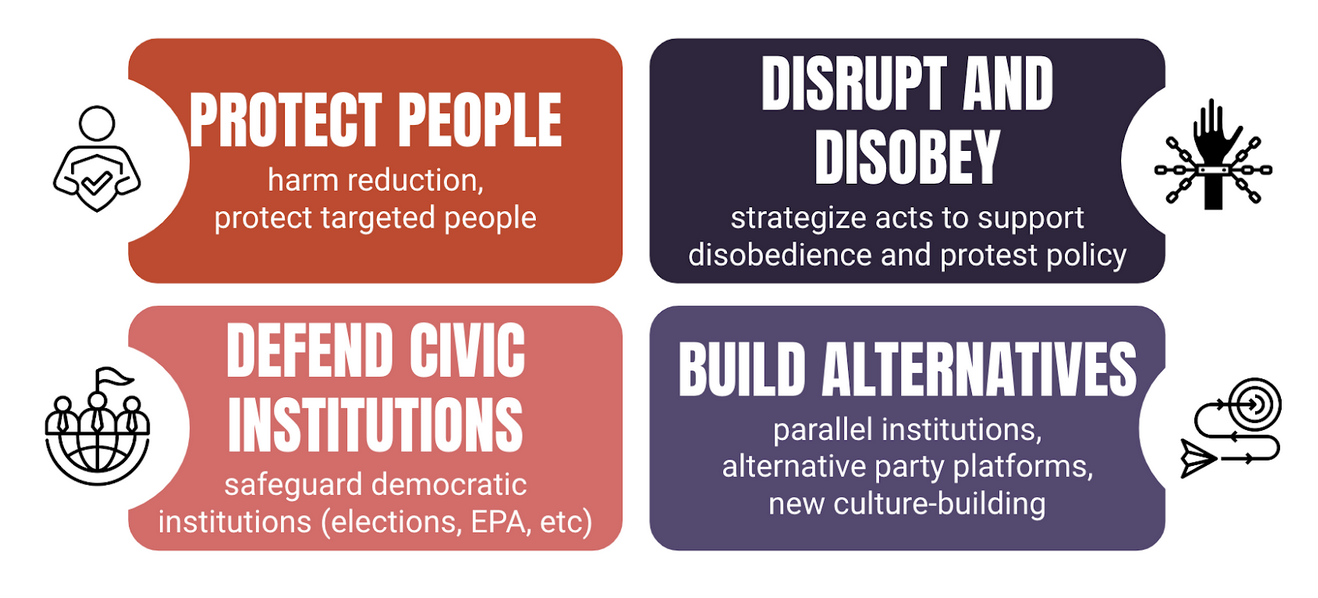
Protecting People. These are folks surviving and
protecting our own — especially those of us directly targeted, such as
trans people, folks in need of abortions, and immigrants.
Defending Civic Institutions. This group may or may
not be conscious that current institutions don’t serve us all, but they
are united in understanding that an autocrat wants them to crumble so
they can exert greater control over our lives.
Disrupting and Disobeying. This goes beyond
protesting for better policies and into the territory of people
intervening to stop bad policies or showing resistance.
Building Alternatives. We can’t just be stuck
reacting and stopping the bad. We have to have a vision. This is the
slow growth work of building alternative ways that are more democratic.
Pick a path and then find an action that fits your degree of
difficulty (we’ve categorized harder actions as those that require more
time, people skills, and often a small group to launch with).
Protecting People
Defending Civic Institutions
Disrupting and Disobeying
Building Alternatives
There is a lot of information here, so take a deep
breath. There is a Jewish teaching that says that you are not
responsible for completing the work, nor are you allowed to desist from
it. We will succeed because millions of people do a couple things well,
not because one person does a million things.
While we wish we were not compelled to travel down this path of
resistance. We are excited to realize the collective beauty we can and
will create together.
You got this.
Make
sure you are talking to people and doing something. The logic of “move
fast and break things,” like the logic of all coups, is to gain quick
dramatic successes that deter and demoralize and create the impression
of inevitability. Nothing is inevitable. Do not be alone and do not be
dismayed. Find someone who is doing something you admire and join them.
Timothy SnyderAuthor of On Tyranny
New
rule. Everything you want someone to be doing is your job. Start
talking to every Republican, independent, or disillusioned Democrat you
know and let them know they must fight back now.
Michelle RinguetteAmerican Federation of Teachers
There
is a very important distinction between what they’re trying to do and
what they’ll succeed in doing, between what they’ve launched a war
against and the outcome of that war.
Rebecca Solnit“Hope in the Dark”
Keep
calling. Do more if you can, but keep calling at the very least. You
already splintered some of their support away with…what, one week of
focused calling and demonstration woven together? Imagine what you can
do with two weeks of it, with a month, with months on end, imagine what
we could do if we were relentless.
Gabriel Valdez
Make
sure you are talking to people and doing something. The logic of “move
fast and break things,” like the logic of all coups, is to gain quick
dramatic successes that deter and demoralize and create the impression
of inevitability. Nothing is inevitable. Do not be alone and do not be
dismayed. Find someone who is doing something you admire and join them.
Timothy SnyderAuthor of On Tyranny
New
rule. Everything you want someone to be doing is your job. Start
talking to every Republican, independent, or disillusioned Democrat you
know and let them know they must fight back now.
Michelle RinguetteAmerican Federation of Teachers
There
is a very important distinction between what they’re trying to do and
what they’ll succeed in doing, between what they’ve launched a war
against and the outcome of that war.
Rebecca Solnit“Hope in the Dark”
Keep
calling. Do more if you can, but keep calling at the very least. You
already splintered some of their support away with…what, one week of
focused calling and demonstration woven together? Imagine what you can
do with two weeks of it, with a month, with months on end, imagine what
we could do if we were relentless.
Gabriel Valdez
Make
sure you are talking to people and doing something. The logic of “move
fast and break things,” like the logic of all coups, is to gain quick
dramatic successes that deter and demoralize and create the impression
of inevitability. Nothing is inevitable. Do not be alone and do not be
dismayed. Find someone who is doing something you admire and join them.