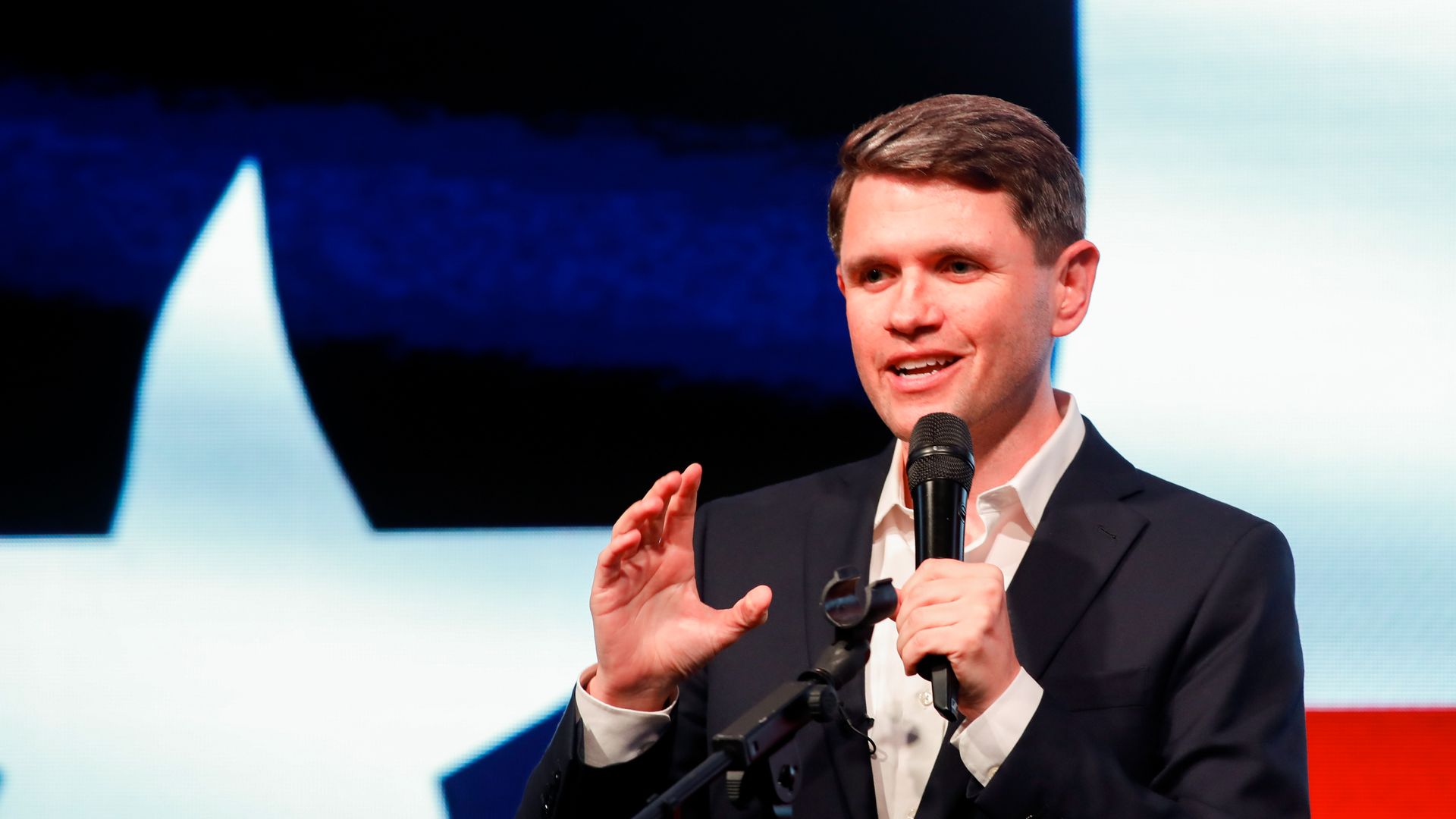
Democratic nominee James Talarico. Photo: F. Carter Smith/Bloomberg via Getty Images
The Texas Senate race has become a national laboratory for anti-"woke" politics, testing whether voters still recoil from the language of 2020 amid the economic pain of 2026.
Why it matters: Republicans came away from 2024 convinced they had won more than an election
— they had broken through on culture, turning Democrats' progressive
language and identity politics into symbols of elite detachment.
The
durability of that culture-war coup is now an open question, as the GOP
tries to redeploy the same playbook in a far more hostile midterm
environment.
Zoom in: Texas has produced a
Senate race in which both parties see the other nominee as the perfect
caricature of everything voters hate about the opposition.
For Republicans: Texas state Rep. James Talarico
offers the dream target — a young, viral progressive whose old comments
can be stripped of context and turned into a one-man museum of "woke"
Democratic excess.
Republicans have seized on Talarico's 2021 floor speech declaring that "God is nonbinary," along with past comments on racism, whiteness and trans children, to cast him as a radical disguised as a Texas preacher.
The
attacks already are veering into sexuality- and masculinity-coded
territory: Talarico's opponent, Texas Attorney General Ken Paxton, has mocked him as "Low-T," while White House adviser Stephen Miller falsely labeled him as Democrats' "first transgender Senate candidate."
Talarico has conceded
that he "missed the mark" on some "cringey comments," while insisting
his underlying principles — that "racism is immoral and wrong" and that
"trans people deserve dignity and equality" — flow from his Christian
faith.
For Democrats: Paxton is a scandal-scarred Trump ally whose legal and ethical baggage could turn even a red-state Senate race into a referendum on Republican corruption.
Paxton was impeached by the GOP-led Texas House in 2023 — then acquitted by the Texas Senate — over allegations that he abused his office to benefit a donor.
Talarico's
campaign wants to make Paxton the face of Republican impunity — arguing
that his scandals are not distractions from the race, but the clearest
evidence of what the GOP has become.
Between the lines: Republicans
believe Texas will prove the anti-"woke" playbook still works.
Democrats believe prices, Paxton and two years of Trump have changed the
terms of the fight.
An
influx of new residents — plus signs of buyer's remorse among Latinos
who backed Trump — has cracked open a once-unthinkable Democratic
scenario: Texas as the path to a Senate majority.
Flashback: The
Trump campaign's most memorable 2024 attack ad turned trans rights into
a broad indictment of Democratic priorities, ending with the now-famous
tagline: "Kamala is for they/them. President Trump is for you."
Testing by Harris' top super PAC found the ad
— which highlighted her 2019 support for taxpayer-funded
gender-transition surgeries for prisoners and detained immigrants —
moved viewers 2.7 points toward Trump.
The big picture: The
ad worked because it converted one obscure policy position into a
sweeping theory of Democratic "wokeness": a party fluent in elite
cultural language, but alien to voters' daily lives.
But it
didn't work in isolation: The Biden administration's handling of
inflation, immigration and affordability were already making Democrats
look out of touch before "they/them" gave the GOP the perfect slogan.
Today, those forces have flipped: Trump is now 52 points underwater on inflation, turning the economy from a tailwind into the central threat to his party's midterm survival.
The bottom line: Texas
will be the ultimate test of whether the GOP's anti-"woke" strategy can
survive the transition from insurgency to incumbency.
Israeli soldiers share rare accounts from Gaza, describing ongoing killings despite the ceasefire
The Israeli
combat soldier saw his teammates yelling in celebration, congratulating
one another. They had just struck a vehicle of Palestinians driving near
the Israeli-controlled part of the Gaza Strip, killing everyone inside.
The reservist said scenes like this had become common after a fragile
ceasefire took effect in October.
TEL AVIV, Israel (AP) — The
Israeli combat soldier saw his teammates yelling in celebration,
congratulating one another. They had just struck a vehicle of
Palestinians driving near the Israeli-controlled part of the Gaza Strip, killing everyone inside.
The reservist said scenes like this had become common after a fragile ceasefire took effect in October.
In the weeks he was stationed in Gaza, he said, he saw soldiers
relishing the chance to go after those who crossed — or came close to
crossing — the so-called yellow line that divides the strip into Israeli-controlled and Palestinian areas.
“It
was a jungle,” the soldier, in his 20s, told The Associated Press.
“After the ceasefire, the order was: If someone crosses the line, you
shoot them.”
Israeli
soldiers occupy a military position overlooking the so-called yellow
line in the central Gaza Strip, Tuesday, May 26, 2026. (AP Photo/Ariel
Schalit)
As diplomatic efforts to strengthen the deal have stalled,
three soldiers described to AP a sense of confusion in the embattled
territory, with a lack of clarity on rules of engagement around the
yellow line. Some commanders paid lip service to the agreement, the
soldiers said, while privately voicing desire for the war in Gaza to
continue. Sometimes, troops were too far away or acted too quickly to
recognize who they were shooting, one soldier said — a concern echoed in
comments from a whistleblower group of veterans.
The soldiers’ accounts are a rare glimpse into what’s happened in the
Israeli-controlled part of Gaza since the deal went into effect seven
months ago. The soldiers — reservists deployed throughout Gaza between
October and January who’ve since returned — spoke on condition of
anonymity because they feared being ostracized over their comments. They
said they were speaking out because they were angered and saddened by
what they saw.
AP has documented shootings
of Palestinian civilians, including children playing, close to the
yellow line. And the soldiers said it felt like the killings never
stopped amid the tenuous deal.
“To call it a ceasefire is a joke,” one soldier told AP.
Gaza’s yellow line has been ambiguous, and Israel has taken control of more land
When
the ceasefire went into effect, Israel withdrew troops to a buffer zone
demarcated by a yellow line, giving it control of just over half the
strip. Under the agreement, Israeli forces are meant to complete a
fuller withdrawal, though there’s no timeline for that. The U.S.-backed diplomat overseeing the truce says progress is deadlocked over the central sticking point of disarming Hamas, upon which all other issues — including Israeli withdrawals and reconstruction — hinge.
In
the meantime, Israel has expanded control over additional territory in
Gaza. Both sides have accused the other of violating the ceasefire.
The line’s exact location has been ambiguous and sometimes
invisible. In some places, it’s marked with yellow blocks and barrels;
in others, it at times hasn’t been indicated at all.
The
Israeli military invited AP this week to see a section of the yellow
line in central Gaza, near the Maghazi refugee camp. The line there was
visible, demarcated by a wide dirt path and small yellow markings. To
the east was a desolate stretch of open space leading to a heavily
fortified Israeli military post about 500 meters away.
An Israeli military commander said Hamas is active on the
other side of the line and frequently sends people — militants and
civilians — toward the line and even across it to test the army’s
readiness and responses.
“There is no reason for anyone to come near the line,” he
said, speaking on condition of anonymity under military rules. “There’s
nothing here.”
The army says the entire line, which stretches the length of Gaza, is now clearly marked.
Since the ceasefire went into effect, more than 900 people
have been killed in Gaza — dozens of those close to or over the yellow
line, according to Gaza’s Health Ministry. The ministry doesn’t say how
many are militants, but unarmed men and children have been among the
dead.
Israel’s military has said most of the people
killed crossing the line posed a threat to troops. But soldiers who
spoke to AP and Breaking the Silence — the whistleblower group that has
collected troops’ testimonies throughout the war — say that at times
soldiers were too far away, acting too quickly and under too much
pressure to tell.
Israel’s army told AP that the area adjacent to the yellow
line is a “sensitive operational environment” with signs saying
approaching is prohibited. It said the army doesn’t target civilians
solely for approaching the line and that its rules of engagement require
the use of warnings before using force. In situations involving an
immediate threat, forces are authorized to act, it said.
One soldier says troops must act fast, with information sometimes based on a hunch
It
was the combat soldier’s second tour in Gaza when the ceasefire began.
He said he was posted several hundred meters from the yellow line and
saw several people trying to cross it killed by soldiers.
An
Israeli soldier occupies a military position overlooking the so-called
yellow line in the central Gaza Strip, Tuesday, May 26, 2026. (AP
Photo/Ariel Schalit)
Soldiers shooting or ordering drone strikes
don’t always know who’s crossing the line, he said. Although soldiers
must provide coordinates and get approval from superiors before
striking, it’s hard to give exact information as people are moving, he
said. He described soldiers calling in coordinates based on a hunch or
the last place they saw someone.
Breaking the Silence says the general rules of engagement
are extremely permissive, especially for those crossing the line, with
orders in many areas being “shoot to kill.” Executive director Nadav
Weiman, a veteran who served in Gaza but not in this war, said distance
from the target and some trigger-happy soldiers can be problematic.
He
said orders and policies from the military’s high commanders “have
created a reality where countless civilians have and are being killed
for crossing invisible lines.”
In one account to Breaking
the Silence, in interview notes seen by AP, a soldier describes
instructions for troops about anyone crossing the yellow line:
“eliminate him no matter what.”
A soldier who was stationed in Gaza says human lives weren’t valued
Another
soldier stationed in Gaza for weeks after the ceasefire said the
message from commanders was to hold the line at all costs.
“There was a general feeling that human lives are not valuable,” he said.
When
it came to demarcating the yellow line, the soldier said his superiors
told him it was “too much work,” not their job and that Palestinians
should know where it was.
Being in Gaza took an emotional toll, he said.
Sometimes
snipers fired warning shots at people close to the line, he said, but
commanders told troops to do more to protect themselves. The soldier
understood that to mean firing more lethal shots.
He and
the other soldiers who spoke to AP said troops generally understood,
based on leaders and fellow soldiers’ actions, that Israel was in Gaza
for the long run, not an eventual withdrawal.
Israel’s strikes are ‘increasingly proactive,’ according to an internal report
An
internal report circulated among aid groups last month and seen by AP
said that across Gaza, Israel has become “increasingly proactive” with
its strikes.
Separate
data from the Armed Conflict Location and Event Data Project, a
U.S.-based nonprofit, said April was the deadliest month in Gaza this
year and that recorded deaths near the yellow line or of people who
crossed it increased by more than 25% from January to April, to 73 from
58.
A
yellow block stands demarcating the “Yellow Line,” which has separated
the Gaza Strip’s Israeli-held and Palestinian zones since the October
ceasefire, is visible in central Gaza Strip, Tuesday, May 26, 2026. (AP
Photo/Ariel Schalit)
This week, Israeli Prime Minister Benjamin
Netanyahu said Israel controls 60% of Gaza and the next step was to move
to 70% control.
The soldiers told AP that on the ground, the ceasefire is elusive.
“We need to stop using this term,” one said of the word, ceasefire. “It’s not serving people that want to stop the war.”
___
Josef Federman contributed reporting from the central Gaza Strip.
Mednick is an AP correspondent for Israel and the
Palestinian Territories. She focuses on conflict, humanitarian crises
and human rights abuses. Mednick formerly covered West & Central
Africa and South Sudan.
Support our work: https://democracynow.org/donate/sm-de...
The Justice Department has reportedly launched a criminal investigation into the writer E. Jean Carroll, who successfully sued Donald Trump twice, for sexual abuse and defamation. In 2019, Carroll published a memoir describing an encounter in the 1990s when she says Trump sexually assaulted her in a department store. When Trump denied the account, Carroll sued him and won $5 million in damages, with a unanimous New York jury finding Trump liable for sexual abuse and defamation. After Trump made disparaging remarks about Carroll, she sued him again and won a second defamation judgment for over $83 million. (She has yet to collect any money pending appeals by Trump.)
Democracy Now! is an independent global news hour that airs on over 1,500 TV and radio stations Monday through Friday. Watch our livestream at democracynow.org Mondays to Fridays 8-9 a.m. ET.
Subscribe to our Daily Email Digest: https://democracynow.org/subscribe
This is democracyow democracynow.org. I'm Amy Goodman with Nurmine Sher.
0:05
5 seconds
We
end today's show with the latest news that the Justice Department has
launched a criminal investigation into the writer Eugene Carol.
According to the New York
0:13
13 seconds
Times and CNN, the inquiries looking into whether Carol committed perjury in a 2022 deposition. That's despite a 2024
0:22
22 seconds
ruling by a federal appeals court panel that dismissed claims Eugene Carol committed perjury. In 2019, Carol
0:30
30 seconds
published
a memoir describing an encounter in the 1990s when she says Trump
sexually assaulted her in a department store dressing room. When
0:39
39 seconds
Trump
denied the account, Carol sued him and won $5 million in damages with a
unanimous New York jury finding Trump liable for sexual abuse and
defamation.
0:49
49 seconds
After Trump made disparaging remarks about Eugene Carol, she sued him again and won a second defamation judgment for
0:58
58 seconds
over $83 million. Federal courts have upheld both verdicts. Though on Wednesday, the US Supreme Court deferred
1:05
1 minute, 5 seconds
its decision on whether to hear President Trump's appeal of the $5 million civil verdict. It was the 12th
1:13
1 minute, 13 seconds
time the Supreme Court has deferred the appeal. We'll have more um right now with Deborah Turkheimr, professor of law
1:21
1 minute, 21 seconds
at Northwestern University and the author of Credible: Why We Doubt Accusers and Protect Abusers. Um,
1:30
1 minute, 30 seconds
Professor Turkheimer, if you can respond to this latest news that I think have rocked many in this country. President
1:40
1 minute, 40 seconds
Trump faces paying Eugene Carol close to $90 million
1:46
1 minute, 46 seconds
and
now his own Department of Justice is criminally investigating her. Can
you talk about the grounds and the history of this case?
1:57
1 minute, 57 seconds
Yes, I can do that. Thanks for having me. Uh, I I guess we need to go back to October 2022.
2:05
2 minutes, 5 seconds
During the discovery phase of Eugene Carol's lawsuit, she was deposed. And one of the questions that she was asked
2:14
2 minutes, 14 seconds
pertained to whether uh she was getting any outside funding for her legal fees.
2:22
2 minutes, 22 seconds
Uh, and she answered no. this Department of Justice investigation into perjury charges centers on that particular
2:31
2 minutes, 31 seconds
response. So, it's a it's a very small piece of this lawsuit. Donald Trump has tried over and over again to impugn
2:40
2 minutes, 40 seconds
Egene Carol's credibility around the sexual abuse allegations that has been unsuccessful over and over again. So
2:47
2 minutes, 47 seconds
this is about the question of whether she knew when she answered no to that question about outside legal funding
2:54
2 minutes, 54 seconds
that in fact billionaire Reed Hoffman had contributed some money to her uh to her case to her lawyers to to uh enable
3:03
3 minutes, 3 seconds
this to actually come forward because as we know it's very expensive to uh to sue civily and particularly to go up against
3:12
3 minutes, 12 seconds
someone with the resources of Donald Trump. So this perjury investigation centers on that deposition. It's unusual
3:20
3 minutes, 20 seconds
in so many ways. Amy, explain those ways.
3:24
3 minutes, 24 seconds
So there are some very technical uh let's say obstacles uh to uh to proving perjury in this case that I'm thinking
3:32
3 minutes, 32 seconds
about even at this very early stage of an investigation. So, you know, one point to make is that Egene Carol must
3:41
3 minutes, 41 seconds
have willfully or knowingly lied under oath in this deposition. If she simply made a mistake, if she wasn't aware of
3:49
3 minutes, 49 seconds
whatever funding arrangement was in place, that's not perjury. Uh, a second point is that the uh the statement must
3:57
3 minutes, 57 seconds
uh have some material bearing on the uh the likely outcome of the case here.
4:03
4 minutes, 3 seconds
When Eugene and Carol's allegations went to trial, ultimately the judge decided that none of this uh none of this should
4:12
4 minutes, 12 seconds
even come into evidence. It was too tangential uh to bear in any meaningful way on the case. So that materiality
4:20
4 minutes, 20 seconds
requirement is going to be tough. The venue is unusual here. Why Chicago, you might ask? Well, it it's unclear. Uh,
4:29
4 minutes, 29 seconds
apparently there may be some connection to one of Reed Hoffman's nonprofits, but but venue is ordinarily in the location
4:37
4 minutes, 37 seconds
where an offense occurred. There's no allegation that the funding of the uh legal fees was itself improper. So I
4:46
4 minutes, 46 seconds
find
that to be curious. And then the last point is probably the most
important which is there is a due process right uh not to be the victim
of
4:56
4 minutes, 56 seconds
any kind of selective or vindictive prosecution and it's very apparent on the face of this that the use of the
5:04
5 minutes, 4 seconds
justice department to go after Eugene Carol in this way is completely unprecedented. It is an obvious uh
5:14
5 minutes, 14 seconds
indication that Donald Trump continues to um go after Eene Carol in this
5:21
5 minutes, 21 seconds
vendetta and in this case he's using the taxpayer funded uh justice department to
5:29
5 minutes, 29 seconds
do that. These cases are brought in our name in the name of the people of the United States and it's it's frankly
5:37
5 minutes, 37 seconds
gling.
I mean, so what broader concerns arise uh from this uh Department of
Justice investigating someone who has successfully sued a sitting
president?
5:49
5 minutes, 49 seconds
Well, [snorts] there there is no precedent for anything like this. To to take uh one question and answer in a
5:56
5 minutes, 56 seconds
civil case um and to use that uh as the basis for this federal investigation, it
6:03
6 minutes, 3 seconds
raises questions about the allocation of resources. Why is this a federal case?
6:09
6 minutes, 9 seconds
Why is it in the interest of justice to go after Eugene Carol at this moment in time? And I think the inescapable
6:17
6 minutes, 17 seconds
conclusion is that the Justice Department is being used to pursue uh Donald Trump's continuing
6:23
6 minutes, 23 seconds
um revenge tour against Eugene Carol. I will also note that unlike cases against
6:31
6 minutes, 31 seconds
James Comey, Leticia James, Adam Schiff, Jerome Powell, Eugene Carol is and
6:38
6 minutes, 38 seconds
always has been a private citizen. And so there's something about this uh instance that I think may strike people
6:45
6 minutes, 45 seconds
as even more egregious than some examples in the past where selective or vindictive prosecution is is very much
6:52
6 minutes, 52 seconds
in the mix. This seems different. And I should say it's yet another example of the ways in which Donald Trump has tried
7:00
7 minutes
to silence Eugene Carol, has tried to deter her from coming forward, has tried to threaten her into keeping quiet. Even
7:08
7 minutes, 8 seconds
if this investigation goes nowhere, even if there are no successful perjury charges, as I suspect in the end there
7:15
7 minutes, 15 seconds
will
be no successful perjury charges, it's hugely daunting to know that you
are being investigated by the Justice Department. And it's very
interesting
7:24
7 minutes, 24 seconds
that he does this at the time of the theatrical release of the film about her called Ask Eene. And also that this came
7:33
7 minutes, 33 seconds
out after yesterday. If you can in this last 30 seconds explain what the Supreme Court did in Eugene's case.
7:43
7 minutes, 43 seconds
So,
the Supreme Court is continuing to sort of kick the can down the road
when it comes to deciding uh whether Donald Trump has has any reason not
to pay the
7:52
7 minutes, 52 seconds
judgment against him. It seems as if they may be waiting for his uh appeal to come up in the the second case. You
8:00
8 minutes
mentioned that there were two verdicts against him. Um one for around $5 million, one for around $83 million. And
8:07
8 minutes, 7 seconds
it
may be that they're sort of waiting to consolidate his arguments. Um we
we we won't know for a bit. Um but right now the Supreme Court is sort
of sitting on these cases.
8:17
8 minutes, 17 seconds
Thanks
for watching Democracy Now on YouTube. Subscribe to the channel and
turn on notifications to make sure you never miss a video. And for more
of our
8:26
8 minutes, 26 seconds
audience
supported journalism, go to democracynow.org or where you can download
our news app, sign up for our newsletter, subscribe to the daily







 255
255