Tuesday, July 7, 2026

Ships attacked in the Strait of Hormuz: What that means for ongoing talks


Ships attacked in the Strait of Hormuz: What that means for ongoing talks

https://www.aljazeera.com/news/2026/7/7/ships-attacked-in-the-strait-of-hormuz-what-that-means-for-ongoing-talks 

Ships attacked in the Strait of Hormuz: What that means for ongoing talks

While marine traffic in Hormuz has steadily risen, vague provisions on the strait remain contentious in peace talks.

boats anchored off Oman’s northern Musandam Peninsula near the Strait of Hormuz

A tanker caught fire off the coast of Oman on Monday night after being struck by an “unknown projectile” in the Strait of Hormuz, according to the United Kingdom Maritime Trade Operations (UKMTO).

Separately citing two unnamed US officials, news outlet Axios reported that Iran’s Islamic Revolutionary Guard Corps (IRGC) fired at least two missiles at commercial ships transiting through the strait on Monday night. The report added that two ships suffered significant damage but there were no casualties. It is unclear if one of the ships is the same one reported on by UKMTO.

The reports of attacks on shipping in the strait come as sensitive peace negotiations continue between the United States and Iran to bring a lasting end to their war, which began on February 28.

One of the key sticking points in the talks is the Strait of Hormuz, which Iran effectively closed to shipping after US-Israeli strikes began.

The attacks also come amid days of funeral processions for former Iranian Supreme Leader Ayatollah Ali Khamenei, who was killed in US-Israeli strikes on February 28, the first day of the war.

Here is a closer look at what has happened in the Strait of Hormuz, and whether this could threaten the peace process.

What has happened in the Strait of Hormuz?

The UKMTO reported early on Tuesday that a tanker had been struck by a “projectile” on its port side while moving southbound about 8 nautical miles (15km) off the coast of Limah in Oman, causing a fire.

Iranian television reported claims that the LNG tanker came under attack after ignoring warnings, but Tehran did not directly claim the assault. Neither the US Central Command (CENTCOM) nor the IRGC commented on the incident.

However, three unidentified sources told the Reuters news agency the ship was a Qatari tanker called Al Rekayyat, carrying liquefied natural gas (LNG), and that the crew were safe. The ship sent out distress signals when it was hit. However, it may be at risk of exploding due to a fire in its engine room, another source briefed on the incident told Reuters.

A second ship is believed to be a Saudi-flagged crude oil tanker which was also damaged in the Strait of Hormuz when the IRGC fired missiles, sources told Reuters.

Hossein Royvaran, a Tehran-based analyst, told Al Jazeera that the Qatari tanker might have been targeted because it strayed into an area where Iranian teams were performing mine-clearing operations.

“The area near Oman is likely full of mines,” said Royvaran.

“There is a possibility that these ships headed in directions where Iranian teams in that area are clearing mines, and the ships’ movement might have threatened those teams.”

In April, the IRGC released a map showing a safe route through the strait for shipping traffic it had approved. Although it has not confirmed the presence of mines in the strait, it noted that its approved route – which diverts ships much closer to its own coastline – would avoid any mines.

INTERACTIVE - Alternative route throughthe Strait of Hormuz - APRIL 14, 2026-1776162674

What is the current status of the strait?

Data tracking company Kpler said in an X post on Monday that traffic in the Strait of Hormuz over the weekend showed “resilience” with a total of 108 verified crossings.

There were 43 crossings on July 3, 34 on July 4 and 31 on July 5, it said.

Before the war, an estimated 120-140 vessels crossed through the strait each day, roughly half of them oil tankers moving approximately 20 million barrels per day. At the height of the US-Israel war on Iran, traffic through the waterway collapsed to as few as two tankers a day.

X trackers and content blocked

Your Firefox settings blocked this content from tracking you across sites or being used for ads.

Content from blocked embed
Hormuz weekend traffic shows resilience Between 3 and 5 July, the Strait of Hormuz traffic remained active, with total of 108 verified crossings recorded across a wide range of vessel and cargo types. Traffic was slightly weighted East to West and remained spread across… pic.twitter.com/9OIF3cm5GV — Kpler (@Kpler) July 6, 2026

The narrow waterway linking Gulf oil producers to the open ocean, through which 20 percent of the world’s oil and gas supplies were shipped before the war began, has become a focus of peace talks.

Since early March, Iran has restricted shipping through the strait, at times allowing passage by vessels from select countries only, which were required to negotiate transit with the IRGC, with some reportedly paying as much as $2m per ship at one point during the war. The US imposed its own corresponding naval blockade on Iranian ports, including those in the strait, in June.

Even after a preliminary US-Iran memorandum of understanding (MoU) was announced on June 14, only seven ships crossed the strait over the following four days, according to the shipping tracker MarineTraffic.

The MoU stipulated that the strait would be free to all shipping for at least 60 days. But uncertainty about its vague wording relating to the strait and other issues, such as Israel’s assault on Lebanon, plus the lack of clarity about mines in the channel, caused shipping operators to hesitate, analysts said.

What do the latest attacks on shipping mean for talks?

Experts say that while the agreement between the US and Iran has eased tensions between the two parties, the vague wording relating to provisions for the strait is contentious.

The war has been paused under the MoU signed last month, which provided 60 days for negotiations for a permanent deal. However, a round of indirect talks in Qatar concluded last week with no sign of headway towards a lasting peace.

One issue is whether Iran will charge fees to ships using the strait in the future, something the US strongly rejects.

“The idea to impose environmental or service fees, possibly with Oman, reflects Iran’s effort to convert its sovereignty over half of the strait into lasting influence,” Mohsen Milani, a professor of politics at the University of South Florida, told Al Jazeera.

Milani added that Iran is weaponising Hormuz geographically to bolster its bargaining power.

“Washington, by contrast, seeks to prevent any arrangement that expands Iranian control under the principle of freedom of navigation,” Milani, the author of Iran’s Rise and Rivalry with the US in the Middle East, said.

Trump has repeatedly threatened to resume bombing if Iran does not make a deal, most recently on Monday when he told reporters in the Oval Office: “We’re either going to make a deal or we’re going to finish the job. OK. And it won’t be tough to finish the job. I’d rather make a deal, because I don’t want to affect 91 million people.”

“We can knock down their bridges in one hour, we can knock out their energy supply.”

Iran’s Foreign Minister Abbas Araghchi said such threats violated the terms of the MoU.

He claimed the recent funeral processions for the late supreme leader have demonstrated Iranians’ unity.

“Millions of proud Iranians rallied in unity to honour Grand Ayatollah Khamenei and his legacy. Neither them nor our Brave Armed Forces are moved by any threats,” he wrote below a picture of a huge crowd of mourners.

“Negotiations on final Deal will not commence if threats continue,” he wrote. “Honor your signature.”

6:28
  • Now Playing
    06:28
    ‘Poison in the writing’ of US-Iran MoU haunts negotiators, analyst says

    ‘Poison in the writing’ of US-Iran MoU haunts negotiators, analyst says

  • Next
    01:07
    Nigel Farage resigns as MP, will run in UK by-election

    Nigel Farage resigns as MP, will run in UK by-election


Trump’s Vile New Birthright Stance Is So Toxic, Even Fox Admits It

Trump’s Vile New Birthright Stance Is So Toxic, Even Fox Admits It

https://newrepublic.com/article/212747/trump-birthright-citizenship-toxic-gop-fox-admits 

BRING IT ON

Trump’s Vile New Birthright Stance Is So Toxic, Even Fox Admits It

Mike Johnson is now floating a “legislative fix” to birthright citizenship. That’s an assault on the Constitution—and a vote that vulnerable Republicans will hate, if recent polling from Fox News is any indication.

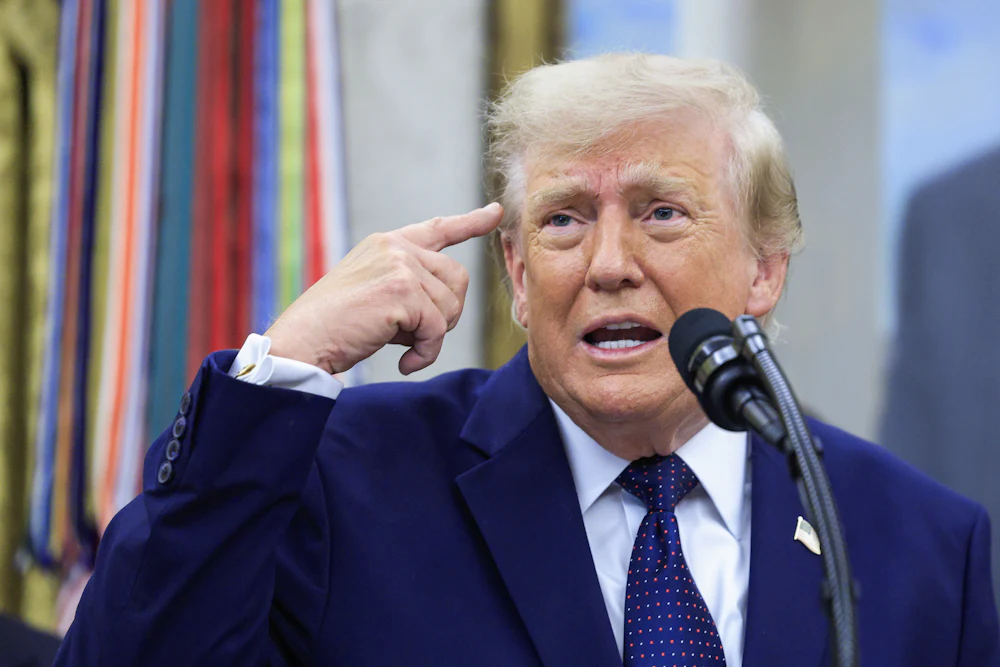
Donald Trump points his right finger at his head while grinning
Shawn Thew/EPA/Bloomberg/Getty Images

After the Supreme Court handed Donald Trump a major defeat by upholding birthright citizenship last month, an angry Trump took to Truth Social to urge Republican lawmakers to overturn it with legislation. “Congress should start TODAY,” Trump demanded, adding: “No long and unwieldy Constitutional Amendment is necessary!”

That’s nonsense—five justices affirmed that just about all children born on U.S. soil, including those with undocumented parents, are citizens under the Fourteenth Amendment. But House Speaker Mike Johnson knows he must appear prepared to obey Trump’s command, so on Fox News Sunday, he declared that House Republicans are examining ways to undo what the Constitution says.

“If there’s some legislative fix, we’ll advance that immediately,” Johnson insisted. Note the word “immediately,” which seems to mean “between now and Election Day.” Is this something vulnerable House Republicans will really want to vote on?

Doubtful. Indeed, look carefully and you’ll see the beginnings of a pattern: Republicans like Johnson—who know this would be extremely unpopular—are conjuring up a new tone and new language designed to recast it as a modest step, and not as the radical upheaval it would truly represent. Just watch Johnson’s full quote on this matter:

Birthright citizenship might require a mere “legislative fix,” Johnson says, because under it, citizenship has been “devalued” by “birth tourism.” That last phrase has long been a noxious rallying cry on the anti-immigrant right. But in Johnson’s hands, it’s meant to portray the birthright citizenship “problem” as no biggie, as a trivial matter that just needs a little patching up. And note the oh-so-casual tone he strikes throughout, as if he’s discussing an adjustment to marginal tax rates.

Or take Vice President JD Vance, who recently described ending birthright citizenship in similarly bland terms. “It’s fundamentally a loophole that exists in our immigration system that rewards illegal aliens,” Vance said on Fox News Sunday. “There are a number of things that we’re already looking at to close that loophole.”

Note Vance’s repetition of the word “loophole,” which seems suspiciously deliberate. Why, this would be a mere tweakakin to a new coat of paint on the garage door or oiling a squeaky hinge, you see.

Theoretically, Johnson and Republicans could write legislation that, say, prohibits the grant of citizenship to any babies born to one or two parents who entered illegally and/or were undocumented at the time of the birth. Right now, such a bill would presumably be upheld as constitutional by “only” four Supreme Court justices: Samuel Alito, Clarence Thomas, and Neil Gorsuch voted to overturn birthright citizenship on constitutional grounds, and Brett Kavanaugh sided with the majority but only on a statutory basis, not a constitutional one.

That’s alarming. It means only five justices now believe birthright citizenship is a “foundational guarantee,” explains Slate’s Mark Joseph Stern, so opponents need only to “nab one more vote” on the court to create a majority to uphold a congressional statute ending it. So Republicans might try to pass something that might be invalidated now but could test the court again—and lay the groundwork for more efforts later, similar to how Roe v. Wade foes chipped away at it for years before succeeding.

The irony to Johnson’s effort to make all this sound trivial is that the problem he identifies—people coming into our country solely to have a baby and scam the system into letting them stay—actually is very insignificant. A brief in the case by over 100 specialists in social science, demography, and other fields notes that the government’s own numbers put such births at far less than 1 percent of overall U.S. births. And even that low figure is almost certainly wrong: The real total, they detail, is far more “infinitesimal.”

But the change that Republicans are contemplating would be a moral, substantive, humanitarian, and constitutional earthquake. As Amanda Frost explains, ending birthright citizenship could lead to hundreds of thousands of newborn babies per year going forward remaining undocumented. That would mean they have less earning power as adults, harming the economy. Alternatively, if they are removed (or not born here at all), that means a future of national demographic decline.

Here it’s critical to stress that the overwhelming majority of those people would not be the children of “birth tourists.” They wouldn’t be the children of people who came here solely to have babies and are getting “rewarded” for this, as it doesn’t earn the parents legal status in any case. Instead, the parents constitute families already in the process of immigrating here for the same reasons immigrants long have done—to participate productively in our economy and communities and, ultimately, in our democracy.

So while Johnson and Vance are aiming their rhetoric at “birth tourists”—an easy-to-demonize grouptheir actual concern is with the much larger class of people who want to settle here for reasons that are recognizably American. That’s who they want to keep out.

Further underscoring the point, don’t overlook Johnson’s assertion that our citizenship is being “devalued” by birthright citizenship. Two of the justices—Thomas and Alito—used similar terms, insisting the children of undocumented immigrants “devalue” and “degrade” American citizenship more broadly. That’s extremely loaded language: As Adam Serwer notes, it echoes Civil War–era language about freedom for enslaved people “degrading” the white race, thus casting all those undocumented children as fundamentally “inferior” to other American-born children.

Which is ultimately why all this strikes so hard at our constitutional order. Ketanji Brown Jackson’s concurrence forcefully points out that birthright citizenship enshrines the promise of equality in part precisely by overturning “bloodline” as the “marker” of belonging. The key is that the child’s status should not be hereditary. Vance and Johnson want to undo that, reversing what Jackson calls the Fourteenth Amendment’s destruction of “racial caste.”

So let’s step back and really appreciate Johnson’s vile two-step. He claims in passing that birthright citizenship “devalues” American citizenship, casually endorsing a disgusting attack on the hallowed principle that a child’s status should depend on birthplace, not heritage or inheritance. Undoing this would be seismic, yet he frames it as a mere “fix” to “birth tourism,” making it sound benign to those who might not immediately appreciate the grand principles at stake here.

“The new quote-unquote ‘fixes’ try to shift the public’s focus to the legal status of the parents, away from the geographical birthplace of the child,” Anna O. Law, a historian of immigration law, tells me. “For people who don’t know the history of the Fourteenth Amendment, it might sound plausible. But it would blow a huge hole in the U.S. Constitution. It’s deeply cynical.”

It would also be deeply, deeply unpopular. A recent Fox News poll found that 69 percent of Americans think a kid born to an “illegal immigrant” (Fox’s language) should “automatically become a U.S. citizen.” That includes 65 percent of noncollege white voters, 61 percent of rural whites, and even 57 percent of white evangelicals. As Fox quietly reported in March (how often do you hear this finding on the network?), relative to previous years, support for it is up.

To be sure, now that Trump and MAGA have taken up this cause, it might shift some Republican voters their way. Focus-grouping by The Bulwark’s Sarah Longwell shows some Trump voters are now echoing his own language about it.

But still: It’s very, very doubtful that Johnson really wants vulnerable House Republicans to vote on such legislation before the midterms. Yet he’s now been pushed into the position of keeping expectations for a legislative “fix” alive with MAGA—all because he’s required to pretend Trump’s command for legislation is rooted in something real. And Vance will have to champion this when his presidential run starts next year, no matter how unpopular it remains. When he does, he’ll use euphemisms like “loophole” to mask how wildly radical and destructive it is. And it’ll be squarely on us to prevent him, at all costs, from getting away with it.


Amid Mounting War Casualties, Pete Hegseth “Defunded and Impeded” Efforts to Protect Civilians, Lawmakers Say


Amid Mounting War Casualties, Pete Hegseth “Defunded and Impeded” Efforts to Protect Civilians, Lawmakers Say

https://www.propublica.org/article/hegseth-trump-war-civilian-casualties-elizabeth-warren-pentagon 

A man in a suit and tie gestures with his hands while speaking in front of an American flag.
Defense Secretary Pete Hegseth gives a statement ahead of a NATO Defence Ministers meeting in Brussels in June. Omar Havana/Getty Images

Amid Mounting War Casualties, Pete Hegseth “Defunded and Impeded” Efforts to Protect Civilians, Lawmakers Say

Ten members of Congress have warned the secretary of defense that the Trump administration’s gutting of a program focused on shielding noncombatants puts service members in peril, erodes the military’s moral standing and may violate federal law.

ProPublica is a nonprofit newsroom that investigates abuses of power. Sign up to receive our biggest stories as soon as they’re published.

Ten Democratic lawmakers told Defense Secretary Pete Hegseth in a letter Sunday that his gutting of a program focused on protecting civilians is a leadership failure that imperils service members and erodes the military’s moral standing.

Led by Sen. Elizabeth Warren, D-Mass., the joint letter echoed concerns raised by a recent Defense Department inspector general report that described civilian protection efforts as largely “inactive.” Lawmakers also cited reporting by ProPublica and other news outlets in pushing to preserve the framework known as civilian harm mitigation and response, or CHMR.

“The Trump administration — potentially in violation of federal law — has defunded and impeded civilian protection efforts,” the lawmakers asserted.

A Pentagon spokesperson declined to answer questions from ProPublica, noting: “As with all congressional correspondence, the Department will respond directly to the authors.”

The retreat from civilian protection drew global attention in February when an apparent U.S. strike killed dozens of children and teachers at a school on the first day of the U.S.-Israeli war in Iran — an incident the Pentagon says is under investigation.

Beyond those deaths, conflict monitoring groups have recorded a surge in reports of civilian casualties, most notably in Somalia and Yemen, which have both seen a dramatic increase in U.S. strikes under the second Trump administration.

In March, ProPublica interviewed current and former national security officials across party lines who said the discarding of civilian protections is part of a broader remaking of the military around two key principles: more aggression, less accountability.

The harm mitigation leadership, housed in a specialized Civilian Protection Center of Excellence mandated by Congress in 2022, aimed to reduce the number of civilian casualties of U.S. military operations, a problem that has spanned administrations in the post-9/11 “forever wars.”

The idea was to embed prevention specialists within targeting teams and foster a culture that prioritizes civilian security in accordance with U.S. law and international rules of war. Senior military leaders have publicly supported the mission, expressing both a moral obligation to safeguard civilian life and a necessity to hit their intended targets.

The program was still being rolled out when momentum halted under Hegseth.

In the spring of 2025, as U.S. operations in Yemen reportedly killed dozens of civilians, the Defense Department was scrapping the CHMR mission as out of step with Hegseth’s “lethality” doctrine, according to current and former staffers. Hegseth repeatedly has expressed disdain for guardrails he describes as hindrances to combat forces.

By the time of the Iran school strike, current and former personnel told ProPublica, the protection mission had been slashed by about 90%, leaving just a handful of staffers to monitor civilian harm issues even as the Defense Department accelerated the strike tempo across swaths of Africa and the Middle East.

Militant groups exploit civilian casualties to gain recruits and support, a practice retired Gen. Stanley McChrystal, who commanded U.S. and NATO forces in Afghanistan, has called “insurgent math”: For every innocent killed, the theory goes, at least 10 new enemies are created.

“The Trump administration’s military adventurism overseas, combined with its obvious disregard for civilians, do not make the American people or our service members safer,” the 10 Democrats said in their letter to Hegseth.

Three signees are military veterans: Sen. Tammy Duckworth of Illinois, Sen. Mark Kelly of Arizona and Rep. Jason Crow of Colorado.

The letter ended with 20 questions the lawmakers want answered by July 9, including requests for the latest CHMR staffing and funding numbers, and an explanation for why the department wasn’t cooperative with the inspector general’s inquiry.

Current and former CHMR personnel said it’s impossible to know whether a more robust prevention team could’ve helped the military avoid civilian casualties in Yemen and Iran. But they said the program could have made a difference, providing transparency and immediate inquiries into civilian deaths.

Within days of the strike on the elementary school adjacent to an Iranian military compound in Minab, open-source investigative outlets surfaced video showing a U.S.-made Tomahawk missile likely was responsible. The Washington Post, citing officials familiar with the Minab inquiry, reported that the school was on a U.S. target list and “may have been mistaken for a military site.”

A partially destroyed building, with piles of rubble and school desks in front of it.
Over 150 students and staff members of the Shajareh Tayyebeh girls’ elementary school in Iran were killed in a missile strike. Stringer/Anadolu via Getty Images

Nearly five months later, the Trump administration has yet to explain what happened.

“The command investigation will take as long as necessary to address all the matters surrounding this incident,” Hegseth said in March.

Annie Shiel, U.S. director of the Center for Civilians in Conflict, which advocates for the protection of noncombatants in warfare, said congressional support is “critical” at a moment when the CHMR mission hangs in the balance.

“The department is violating U.S. laws and policies that have grown out of hard-learned lessons from past wars and garnered bipartisan support across multiple administrations,” Shiel said.

Plan Sprung From Civilian Deaths

Historically, the military’s prioritizing of civilian protection has followed a pattern, analysts say: A catastrophic incident kills civilians, the Pentagon pledges reviews and reforms, the issue recedes from view and oversight slips until the next disaster.

During the Biden administration’s chaotic withdrawal of U.S. forces from Afghanistan in August 2021, a missile strike in Kabul killed an aid worker and nine of his relatives, including seven children. Then-Defense Secretary Lloyd Austin apologized and said the department would “endeavor to learn from this horrible mistake.”

That incident, along with a New York Times investigation into deaths from U.S. airstrikes, spurred the adoption of the civilian harm mitigation and response action plan in 2022. Proponents didn’t view the plan as a cure-all but called it a step toward breaking the cycle of intermittent attention by making civilian protection a year-round mission.

Now that mission is in limbo, and, according to the May inspector general’s report, defense leadership “withheld access” to department tools that track the program’s implementation.

“You are in violation of the law right now on civilian harm,” Rep. Adam Smith, D-Wash., told Army Secretary Daniel Driscoll at a hearing in May. “I’d like to know either A. what the explanation is for why you think it’s OK for you to ignore the law that this Congress passes or B. what you’re planning to do to fix that problem.”

The new letter comes as critics, including some Republicans and veteran commanders, grow increasingly vocal about Hegseth’s attempts to overhaul the Department of Defense, which the Trump administration refers to as the Department of War.

The secretary’s sweeping terminations of high-ranking officers without public explanation has drawn bipartisan criticism and accusations that the moves are rooted in political vengeance, racism and bias against women. Hegseth has repeatedly condemned military officers for comments lauding diversity, saying in one speech, “We became ‘the woke department.’ … We’re done with that shit.”

Hegseth has said that out of respect for the officers he won’t speak about why they were fired. He said it was “very difficult to change the culture of a department that was destroyed by the wrong perspectives with the same officers that were there.”

Public rebukes followed Hegseth’s decision last month to effectively fire Gen. Chris Donahue, a respected four-star commander who came up the ranks through the special forces. In 2023, Donahue said that any concerns over wokeness were “BS,” adding: “We’re focused on people, war-fighting and making sure that we’re prepared for the next fight. There ain’t no ‘woke’ here.”

Contributors

Filed under — ,