The
proliferation of online betting markets like Polymarket and Kalshi has
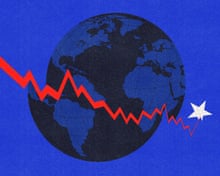
allowed bets on virtually any news event, including the Iran war. Illustration: Guardian Design / Getty Images
Traders placed over $1bn in perfectly timed bets on the Iran war. What is going on?
Suspicious wagers on the US-Israel war in Iran are creating huge windfalls and raising concerns among lawmakers
Sixteen
bets made $100,000 accurately predicting the timing of the US
airstrikes against Iran on 27 February. Later, a single user would make
over $550,000 after betting that Ayatollah Ali Khamenei would topple,
just moments before his assassination by Israeli forces. On 7 April,
right before Donald Trump announced a temporary ceasefire with Iran,
traders bet $950m that oil prices would come down. They did.
These
bets and other well-timed wagers accurately predicted the precise
timing of major developments in the US-Israel war with Iran, creating
huge windfalls and raising concerns among lawmakers and experts over
potential insider trading.
When
completed, the data center being built in Abilene, Texas, will be the
largest in the world. This site is part of Stargate, OpenAI and Oracle's
joint data center venture.Stephen Voss
Two years ago, we devoted an entire issue to the rise of the American oligarchy.
Since then, our oligarchic system has become more entrenched and
pervasive, revolving around a small crew of tech titans whose quest for
wealth and power—in all of its forms—is destabilizing our democracy and
reshaping our society. In the May + June 2026 issue, we investigate our
new AI overlords and the world they are striving to create, whether we
like it or not. Read the rest of the package here.
One of the largest data center
projects ever proposed covers a roughly 5.7-square-mile stretch of
farmland in the Louisiana Delta hamlet of Holly Ridge. When it is
finally completed at a cost of $27 billion—if it is finally completed—it
will house 11 buildings and hundreds of thousands of GPUs and produce
enough electricity to power New Orleans three times over. The project,
named Hyperion after a Titan from Greek mythology, will “unlock historic
innovation, and extend American technology leadership,” Meta’s Mark
Zuckerberg declared in a Facebook post after returning from President Donald Trump’s inauguration
in January 2025—which is another way of saying it may someday power
chatbots. The site, he boasted, “is so large it would cover a
significant part of Manhattan.” To underscore the point, Zuckerberg
helpfully attached an illustration: a jagged lavender rectangle,
stretching from the bottom of Harlem to the top of SoHo.
But the thing about building a data center this big is you cannot
simply build a data center—you must build a world to go with it. You
need three new power plants and transmission lines to connect them to
the grid. You need hundreds of millions of gallons of water and miles of
pipes. You must pave roads and build new ones, clear fields, and build
ponds. You need a port to bring in gravel and dirt from wherever you can
get it. You need stoplights and sheriff’s deputies and laundromats. You
need thousands of workers and places to house them—executive lodging,
cheap motels, and man camps with movie theaters and gyms. Pecan groves
will become RV lots; homes will become parking lots or a Dollar General
or food truck parks.
When I visited Holly Ridge last November, nearly a year after the
project was first announced, the surrounding parish was experiencing a
speculative frenzy. It felt like everything that had not already flipped
was on the market—and everyone who had not sold out or been priced out
was cashing in or thinking about it.
If the economic story of the last two decades was the consolidation of wealth and power in Silicon Valley,
the story of the last few years is what tech billionaires want to do
with it. Since the summer of 2024, America’s richest men have been on a
building spree with few precedents
in recent history. The scale of the investment, in the hopes of winning
the race to create artificial general intelligence (or AGI), is so vast
that proponents have turned to previous eras of reckless extraction and
technological advancement to describe it. Energy Secretary Chris Wright
called it “Manhattan Project 2.” It is one of the largest investments
of private capital since the transcontinental railroads. Expenditures
for AI data centers amounted to about a quarter of all GDP growth in the
first half of 2025, with the largest companies collectively spending
$400 billion on construction projects—many of which won’t be fully
operational for years.
Data centers have replaced megayachts
as the preferred theater of oligarchic status signaling. Instead of
submarines and retractable dance floors, these billionaires tout their
compute, their gigawatts, and their acreage. The largest of the new
facilities, the so-called “hyperscale” sites where AI models are to be
trained, come with names that reflect the pathologies of their founders.
Sam Altman’s Stargate in Abilene, Texas, will be “roughly the size of
New York’s Central Park,” according to Bloomberg—while OpenAI’s Project Jupiter site in New Mexico could be larger still. Amazon and Anthropic are developing Project Rainier on 1,200 acres outside South Bend, Indiana. Elon Musk trained his Mein Kampf–loving chatbot, Grok, at Memphis’ Colossus 1. Colossus 2 is on the other side of town. The names evoke both ancient and
contemporary mythology; in D.F. Jones’ science fiction trilogy,
Colossus is the rogue AI that enslaves mankind. (Grok, for its part,
has described itself as “MechaHitler.”) Both Zuckerberg and Jeff Bezos
have AI projects called Prometheus. There are at least five AI
companies named for Icarus.
A housing development near data centers in Sterling, Virginia.Stephen Voss
These futuristic fantasies are being planted on the ruins of the
past. OpenAI is sourcing data center parts from the Ohio plant where
union autoworkers once made Pontiac Firebirds. (Full disclosure: The
Center for Investigative Reporting is currently suing OpenAI and Microsoft for copyright infringement.) Meta is building another hyperscale campus in the master-planned community where Jeffrey Epstein once lived. A company called Patmos installed a data center in the building where the Kansas City Star was once printed. Microsoft is reopening Three Mile Island, and developers are renovating robber baron–era
steel mills for server farms. A mock-up of a rebuilt Gaza City pitched
to the Trump administration by a group of Israeli businessmen envisioned
an “Elon Musk Smart Manufacturing Zone”
next to a cluster of data centers, tailored to meet US AI
regulations—of which, I’m pleased to report, there are vanishingly few.
Then Jared Kushner unveiled a similar plan at Trump’s Board of Peace signing ceremony at Davos.
Across the country, third-party agents are stalking bean fields on
behalf of anonymous buyers, making big promises about tax revenue and
jobs in exchange for a still bigger quantity of water and power. Utilities are keeping coal plants online. The White House is slashing regulations on nuclear safety. Demand for gas turbines to power these facilities is so high that there is a backlog until 2030,
and people like Musk are importing power plants from overseas piece by
piece, like Italian relics in the Gilded Age. The gold rush is driving a
relentless demand for energy (which will nearly triple within the industry by 2030), real estate (nearly 2 billion square feet and counting), and investor cash ($1.6 trillion
by 2030). When did you suspect it was a bubble? Maybe it was when
former Energy Secretary Rick Perry became the face of a $15 billion
project in Amarillo named for Enrico Fermi. Maybe it was when Altman literally said it was.
The AI boom has ushered oligarchy onto a new plane by uniting the
monopolistic ambitions of the world’s richest men with the nationalist
ambitions of their political champions. In the process, it has sparked a reckoning,
in big towns and small and across the political spectrum, over the
demand for resources and tax dollars and over what kind of future we
might build—about who gets to decide to bet the house and whose chips
are simply fodder for the pot. The data centers have, in a sense,
transformed opaque structures of inequality and power into literal ones.
Oligarchy is now more than an idea; it is a place. Across the country,
the empire builders of AI have sold themselves as the gateway to the
future you’ve always dreamed of, and the solution to the problems they
helped bring about. I hit the road because I wanted to see what this
historic disruption was doing to the communities it was purporting to
level up. The only thing more disruptive than if the oligarchs are right
might be what happens if they’re wrong.
It is
no longer novel or even particularly accurate to note that the richest
Americans control a greater share of resources than they did during the
Gilded Age.
They are about three times wealthier.
That wealth is increasingly concentrated in a single industry, consumed by a singular purpose.
Land is cleared for the Stargate data center project in Abilene, Texas.Stephen Voss
When I rolled into Abilene one evening in August, a few weeks before the first machines powered on
at OpenAI and Oracle’s joint venture, the parking lot of the Super 8
motel outside of town was filled with trucks, splattered with red clay.
The woman at the front desk just laughed when I asked if they’d gotten
much business from the data center’s construction. A smoke detector was
going off next door and my room smelled like cigarettes; the nightly
rate had nearly doubled. Signs advertising short-term housing and RV
rentals lined the roads. On a Sunday afternoon, when the rest of the
city shut down, crew after crew, in black boots and blue jeans, emptied
out of pickups and four-wheelers to grab energy drinks and snacks at the
nearest gas station. It was 99 degrees.
The shock of what Trump calls “big, beautiful buildings” is not that
their footprint is so unlike anything you have ever seen—from the
outside, data centers resemble nothing more futuristic than souped-up
fulfillment centers or a series of airplane hangars—but that all these
plants are simply there, where nothing once was. “This is the
unicorn that comes, like, once in a billion years,” the then–city
manager explained when a plan to build data centers on the site first
came up for a vote in 2021. “I feel like it was an invasion,” a neighbor
told local officials a few years after that—as though a “monstrosity”
of “concrete palaces” had simply risen out of the plains.
Altman, who has a propensity for delivering grandiose statements
about his industry in the soft-spoken and reflective tone of a
philosophy student confessing to a murder, once told the New Yorker,
“If I weren’t in on this, I’d be, like, ‘Why do these fuckers get to
decide what happens to me?’” This is a pretty good description of what
it was like to attend a local planning meeting in America in 2025.
According to Data Center Watch,
a newsletter published by an industry intelligence firm, an estimated
$98 billion in projects were paused or canceled in the face of community
opposition in the second quarter of last year alone. Opponents have
blocked major deals in Tucson, Arizona; Indianapolis; New Brunswick, New
Jersey; and Prince William County, Virginia. In February, protesters
fed up with data centers filled the rotunda of the Minnesota State
Capitol.
Hyperscale projects have galvanized everyone from singer SZA
(“AI is killing and polluting black and brown cities. None of you care
cause your [sic] codependent on a machine. Have a great life”) to Dale
Earnhardt’s son Kerry, who helped defeat
a proposal to turn the Intimidator’s North Carolina land into a
technology park, and then-Rep. Marjorie Taylor Greene, who argued that
their spread would hasten the arrival of Skynet. Angry ratepayers helped power Democratic sweeps in Virginia and New Jersey last fall.
There is a whole lot of NIMBYism packed into these local fights,
often in the most literal kind of way. Arguments about traffic and the
character of the community are not unique to the AI boom. But I’ve
listened to hours and hours of community meetings, in towns across the
country, and you can hear in this opposition a reckoning with something
more profound, too. At a county commissioners meeting
in Indiana, an attorney for an anonymous developer promised that a $12
billion data center in the town of New Carlisle would be “laid out in a
way to be bucolic.” Speaker after speaker threw the word back in his
face. New Carlisle already had an $11 billion data center. They
knew what it looked like. What New Carlisle didn’t need, one Hoosier
told her county commissioners, was to give away its power and water for a
technology that would “radicalize our teenagers to be hateful and
dangerous or suicidal.” This is not the kind of person who can be swayed
by Altman’s promise of erotica on demand.
The facelessness of the buildings is a symbol for the coldness of the
corporations themselves. “Why should I trust this company that doesn’t
trust themselves enough to let me know who you are?” asked a woman at a meeting
in Menomonie, Wisconsin, where a $1.6 billion, 300-plus-acre data
center was proposed. Another speaker found it suspicious that the
anonymous buyer was headquartered in the “tax shelter” of Delaware.
When I asked Timothy Accola about the proposed project in his
Menomonie backyard, he quickly set me straight: “Front yard, really.”
Accola, a 38-year-old microbiologist with bushy sideburns like a Civil
War general, lives with a Great Dane named Hamlet on the edge of town.
He recently installed solar panels and tends a small orchard—peaches,
cherries, apples, plums. “I was planning,” he told me, “on staying there
the rest of my life.”
But in July, he got back from a work trip to find a letter in his
mailbox from the city, alerting him that his neighbors’ farm was poised
to become a data center. Accola’s opposition, he admits, carries a
strong whiff of self-interest. He dreads the light and noise from a
facility that must operate 24 hours a day and believes the proposal has
“ruined any sort of value that my property has on a domestic sale
market.” But his concerns went deeper.
At a community meeting later that summer, Accola told the city
council that he had been reading up about data centers on Reddit and
listening to a lot of Ed Zitron—the acerbic tech podcaster who has emerged as perhaps the foremost chronicler of the flimsy finances and false promises of the AI bubble.
“This thing is going to pop. Is it going to pop before or after they
finish building this place? Anybody have a realistic answer on that?” he
asked. “What are we going to do then when there’s a
5-million-square-foot facility in this field that is absolutely empty?”
Other residents at the meeting invoked Foxconn, whose boondoggle
on the other side of the state had produced a tenth of its promised
13,000 jobs after the state offered $3 billion in incentives. (Recently,
a new tenant set up shop in the industrial footprint: Microsoft data
centers.) Politicians in Oregon have shelled out billions of dollars in
incentives to lure data centers. But at one Google site in The Dalles,
according to the Oregonian,
an offer of $260 million in incentives and a third of the city’s 2024
water supply had resulted in just 200 full-time jobs—many of them
off-site.
The same narratives pop up again and again. Communities are
essentially given a choice: Approve it fast or watch some other town
reap the rewards—and miss out on future investments. (In the end, local
officials decided to block both the Menomonie and New Carlisle
projects, at least for now.) The anxiety on display in public meetings
across the country is over not just what happens if all of these get
built, but the very real possibility that many of them will not. There
is a long-standing fear, in big towns and small, of a giant company
coming in and swallowing up everything else, because that’s what so
much of their experience of American capitalism has been. But there’s
something even worse than getting another Walmart, and it’s being
promised a Walmart and getting only a Spirit Halloween.
A data center under construction near a baseball field in Herndon, Virginia.Stephen Voss
The rise of the American oligarchy
happened slowly and then all at once. If you were plotting inequality on
a chart, you’d see a steady upward slope from Clinton-era deregulation
to Bush-era tax cuts to Obama-era techno-optimism and on through
Trump’s first term. Then it spiked. Between 2000 and 2020, as tech
monopolies consolidated power, the share of the nation’s wealth held by
the top 0.00001 percent roughly doubled. By the end of 2025, it had
nearly doubled again. It is no longer novel or even particularly
accurate to note that the richest Americans control a greater share of
resources than they did during the Gilded Age; they are, according to
French economist Gabriel Zucman, about three times wealthier. That wealth is increasingly concentrated in a single industry, consumed by a singular purpose.
The American oligarchy is an AI oligarchy. Musk’s net worth has
tripled since the 2024 election, to well north of $800 billion,
according to Forbes, with a new pay package approved by Tesla
shareholders poised to make him the first-ever trillionaire. The
world’s six richest men as of early March were all actively involved in
AI development; the seventh was Nvidia’s Jensen Huang, whose chips prop
up this entire system. There are 10 trillion-dollar companies, and nine
of them are in AI.
You don’t have to be an AI hater to think critically about where this
is headed. My reporting process for this piece was aided by an AI
transcription product that saved weeks of my life. My colleagues have used AI to decipher
thousands of Reconstruction-era Freedmen’s Bureau records. Maybe you
like vibe coding. Maybe you’ve fallen in love with Claude. But even if
the programs being trained at these big, beautiful buildings overcome a
propensity for hallucinations and abuse and elevate us to a new level of
consciousness, the greatest disruption of this era may be the trade-off
it took to get here.
Once the realm of Marxists, madmen, and the French, the manifesto has
found new purchase in recent years as the preferred artistic medium of
AI’s emperor class, surpassing even the product launch. Billionaire
venture capitalist Marc Andreessen’s “Techno-Optimist Manifesto” presaged Big Tech’s great schism with liberalism. Dario Amodei’s “Machines of Loving Grace” signposted Anthropic as the wokest of the would-be world builders—a company that would still do business with an autocratic Gulf state, but without sounding quite so enthusiastic about it. Zuckerberg’s “Personal Superintelligence,”
published in the plain-text style of an early 2000s blog post, begins
with a line that sounds like the last known transmission from the crew
of a spaceship: “Over the last few months we have begun to see glimpses
of our AI systems improving themselves.” Altman’s first effort was
titled “Moore’s Law for Everything,” and it holds up five years later as a cipher for all that’s followed.
The title refers to the proposition—more a catechism than a tenet of
science—that the processing power of cutting-edge computer chips will
double every two years. Altman extended that concept to society more
broadly, arguing that the compounding progress of AI could, if channeled
properly, raise the global standard of living and usher in a new age of
abundance. We were entering the Burj Khalifa part of the exponential
curve. “‘Moore’s Law for everything’ should be the rallying cry of a
generation whose members can’t afford what they want,” Altman wrote at
the dawn of this new era. “It sounds utopian, but it’s something
technology can deliver.” To which I would simply ask: Does all of this feel utopian?
Altman drew inspiration from the work of Henry George, an economist
who operated in an era of industrial transformation to which the data
center boom is frequently analogized. George wrote in 1868
that the railroad “kills little towns and builds up cities, and in the
same way kills little businesses and builds up great ones.” The first
transcontinental route, he predicted, would produce staggering
inequality unless new mechanisms were introduced to redistribute its
riches. George’s solution, which nearly got him elected mayor of New
York, was to tax the value of land instead of labor. Altman proposed a
land value tax and a universal basic income—disbursed as annual
dividends from the government’s stake in AI companies.
But George did not get what he wanted, and Altman has mostly moved
on. In July, not long after publishing a new manifesto called “The Gentle Singularity,” he told podcaster Theo Von (they met at Trump’s inauguration) that “I used to be really excited about things like UBI—I still am kind
of excited,” but that simply collecting a check was not going to “feel
good.” Instead, Altman now proposed giving everybody on Earth “a slice
of the world’s AI capacity,” because “I think what people really want is
the agency to kind of co-create the future together.”
In the recent past, the agency to kind of co-create the future was
called politics. But there, too, Altman’s thoughts have evolved, in
tandem with those of his fellow titans. Although OpenAI was founded on
the promise of developing the nascent technology in a thoughtful and
sort of utilitarian way—and Altman still goes around saying things like,
“We need to level up humans” and “We don’t really know what role money
will play in a post-AGI world”—the conversations that AI proponents are
having in public right now tell a simpler and less idealistic story: The
people who claim to be building the future traded the dream of
democratic abundance for a strongman who will make them money.
In September, a few dozen tech luminaries gathered at the White House
to promote first lady Melania Trump’s initiative to encourage children
to use AI. The ulterior motive for the summit came into focus at a dinner in the residence
later that evening, when the president called on the AI moguls one by
one to say a few words about their work. You could hear a dull
clattering of silverware in the background.
“I just wanted to say thank you,” said OpenAI President Greg Brockman, for the administration’s “optimism.”
“Thank you for being such a pro-business, pro-innovation president—it’s a very refreshing change,” said Altman.
“Thank you for incredible leadership,” said Bill Gates.
“Thank you so much for bringing us all together, and the policies
that you have put in place for the United States to lead,” said
Microsoft’s Satya Nadella.
“Thank you for setting the tone,” said Apple’s Tim Cook.
It’s not just the chatbots, it turns out, that tend toward sycophancy.
This was the kind of scene that a lesser autocrat might have kept off
camera but that Trump found value in showing to the world. The AI
executives offered him ballroom donations, settlement checks, and legitimacy. He offered them deals, deregulation, and deference. It was important that everyone understand the arrangement.
This alliance stemmed not just from convenience, but a shared sense
of purpose. For years, Silicon Valley harbored a nascent insecurity
about its Social Network era. There was a belief (not at all
wrong) that so much venture capital cash had been wasted on frivolous
things and that the industry promoted cosmopolitan decadence in place of
nationalism. Google did business in China, but not with the Pentagon.
The manifesto for the Founders Fund, the venture capital group Peter
Thiel helped found, lamented, “We wanted flying cars, instead we got 140 Characters”—an argument that so radicalized Vice President JD Vance, it led to a religious conversion.
Wealth is increasingly
concentrated in a single industry, consumed by a singular purpose. The
American oligarchy is an AI oligarchy.
Now the pendulum has swung the other way. When Vance, in a speech to tech investors last year, declared, “We are a nation of builders,” he was deliberately echoing yet another manifesto—Andreessen’s pandemic-era “It’s Time to Build,”
which urged conservatives to offer “uncompromised political support…for
aggressive investment in new products, in new industries, in new
factories, in new science, in big leaps forward.” It’s not as if the
Biden administration had been especially hostile to AI development. It
had pushed semiconductor manufacturing onshore and cheered on the
hyperscale age. The data center boom started on his watch. But Trump offered the embrace of nationalism and the stench of carbon.
The AI boom fused the administration’s desire to protect its
“civilization” with Big Tech’s desire to build a better one.
Zuckerberg—sporting Caesar curls and Meta glasses—has styled himself as
an Augustinian world builder out to “advance the frontier.” He teamed up with Palmer Luckey, the Facebook exile turned AI weapons developer, on a Pentagon project to “turn warfighters into technomancers.” Amazon Web Services secured its largest-ever contract with Customs and Border Protection. The new ambassador to Denmark, tasked with acquiring Greenland in the service of Trump’s expansionism, helped launch the Founders Fund. Thiel, of course, helped pick Vance.
The administration’s AI czar, David Sacks, was once Thiel’s chief
operating officer at PayPal and is now an AI investor. When MTG
complained about Skynet, she was responding to an amendment that would
restrict states’ ability to regulate AI; Sacks wrote an executive order that did just that.
This embrace of technological supremacy in the service of the
“homeland” is at once a new vision of politics and a very old one. In
July, as the Department of Homeland Security deployed Silicon Valley’s
finest surveillance tools against immigrants and their defenders, the
agency took a break from posting AI slop and white nationalist lyrics to share a 150-year-old artwork by John Gast. The painting, titled American Progress,
is a celebration of manifest destiny. The left side of the image shows
Native Americans and bison retreating toward the edge of the canvas.
The right side reveals the technological advancement displacing them:
three railroads, steaming inland across the continent.
A data center under construction in Gainesville, Virginia.Stephen Voss
The implicit promise of the AI
revolution is that all the things made worse by AI will eventually be
fixed by AI. Some oligarchs are even pitching AI as a solution to the
problems oligarchy has helped bring about. Zuckerberg recently suggested
that his chatbots would alleviate a crisis of digital disconnection.
The average American has “fewer than three friends,” he said, but demand for “like, 15”—a remarkable statement from the protagonist of The Social Network. Prompted by Trump to explain
how Stargate would “help us with the fight against the various
problems,” Altman suggested that the AI trained in Abilene would “cure
diseases at a rapid rate.” But Trump’s second term has been one long
crash course on the difference between can and will. Millions of people will die
of things we already know how to prevent because Musk threw global
health funding “into the wood chipper.” We have entered the Burj
Khalifa part of the measles curve. If there’s one thing the
lords of the algorithm ought to understand, it’s that outputs are a
product of the values you put in.
Whereas Russia’s kleptocrats started off in extractive mineral
industries and then branched out into tech and finance, America’s
oligarchs made their fortunes online before pivoting to natural
resources. Musk built a lithium refinery in Texas and has talked about
starting a mining company. An Altman startup is partnering with the US
government on a plutonium project. Tech billionaires were early
investors in a venture to harvest rare-earth minerals
in Greenland. Above all else, these AI barons are gobbling up land and
industrial sites and hoarding fossil fuels. Facebook did not become a
metaverse company; it has become an energy company.
The amount of power needed to keep the data center boom going is astounding. An analysis by Accenture projected
that by 2030, energy demand for data centers would be equivalent to
that of the entire country of Canada, and the industry’s share of global
emissions could jump elevenfold. Another study projected
that data center use would account for roughly 12 percent of all US
electricity consumption in that same time frame, up threefold from the
start of the boom. In Virginia, where 42 percent of all government incentives over a 10-year period went to server farms, data centers already account for a quarter of the state’s power demand, using an amount of energy equivalent to about 2 million households.
In Indiana, the drive for energy sources on a grid stressed by Google
and Amazon facilities has kept coal-fired power plants online and put a
strain on everything else.
Timothy Accola’s neighbors in Menomonie who worried about their
electric bills were not just speculating aimlessly. A study by two
Harvard Law School researchers found
that consumers would end up paying billions to underwrite tech
companies’ power infrastructure—to say nothing of billions of dollars in
tax breaks. A CNBC analysis found 16 states doled out $6 billion worth of tax breaks over the last five years. In New Jersey, the AI expansion drove a 22 percent hike in electric rates year over year.
All this dirty energy means that, as with public health, oligarchy is
slowing our progress on climate. While Trump touts the promise of an AI
that cures cancer, his agencies are rolling back clean air regulations
designed to help prevent people from getting it. (Trump’s Environmental
Protection Agency helpfully no longer considers
the impact on human lives when setting air pollution limits.) One
recent study from researchers at the California Institute of Technology
and the University of California, Riverside, found
that the increased power use by the AI industry would produce about $20
billion in public health damages by 2028, equivalent to the entire car
and truck emissions of California and “double that of US coal-based
steelmaking.”
Companies that once branded themselves as the vanguard of the climate
revolution have rediscovered the wonders of carbon. Ketan Joshi, an
independent energy analyst who has tracked how leading tech companies
are talking about their climate targets now, drew my attention to a
recent update from Microsoft on the status of its sustainability “moonshot.”
“The moon,” the company announced, “has gotten further away.”
The
xAI data center in Memphis. It attracted controversy after it was
reported that the company was using portable gas turbines without proper
permits.Stephen Voss
It’s possible, if you look in the right place, to actually see
these visions of progress burning up before your eyes. On a Sunday
morning last fall, I drove my rental car through the west side of
Memphis, past a Valero refinery and a Tennessee Valley Authority
plant and so many railyards, until I reached a long gray building with
earthmovers scattered around the exterior and rows of identical
Cybertrucks in the parking lot. This is MechaHitler’s bunker.
Colossus 1, the first of three xAI facilities in and around Memphis,
embodied the build-at-any-cost mindset that was propelling the
hyperscale boom and the commingling of corporate and political power it
was building toward. In 2024, desperately playing catch-up to OpenAI and
Meta, Musk struck a deal with the chamber of commerce to construct what
he has marketed as the “world’s largest and most powerful supercomputer,” in furtherance of xAI’s mission
to “understand the true nature of the universe.” It was up and running
in 122 days—a remarkable feat that he pulled off by signing a ton of
NDAs and treating the Clean Air Act like a CVS receipt. Although Musk
built his fortune by collecting federal subsidies
for green energy, xAI initially powered the site with dozens of old gas
turbines, which it claimed—when pressed, months later—were exempt from
permit requirements because they were temporary.
The Clean Air Act’s exemptions were meant for things like lawn
mowers, said Patrick Anderson, an attorney at the Southern Environmental
Law Center, which threatened to sue xAI last year. Musk’s turbines were
“emitting the amount of pollution you might see from a power plant 10
times larger,” Anderson said.
The EPA appeared to accept the law center’s argument in a regulatory decision in January. Two months later, Mississippi regulators approved
41 gas turbines at an xAI plant across the state line. The xAI
experiment was clarifying in its brazenness. Musk hardly pitched his new
neighbors at all. The deal was hammered out before residents of nearby
Boxtown, a largely Black neighborhood in a city with one of the highest asthma rates in the country, were aware it was happening.
To Justin Pearson, the area’s Democratic state representative, Musk’s
project embodies the historic relationship between large corporations
and neighborhoods like Boxtown. His community has “been treated like an
extractive colony”—a place where physical and economic health are
“sacrificed” for tax revenue and oligarchic profits. A visit to the
Colossi would dispel any cheery-eyed mythmaking about what you are
getting when a hyperscaler moves in next door. It sounds like a jet
engine from 100 yards away.
“The pride and joy of Grok is that it can create a racist Mickey
Mouse,” Pearson said. “It hurts my stomach every time that I see Grok in
the news, because I know that’s being powered by the pollution that
we’re experiencing in our community.” (xAI did not respond to a request
for comment. An analysis conducted by researchers at the University of
Tennessee for Timefound that nitrogen dioxide levels had spiked in the vicinity since the project was launched.)
The racist posts were one facet of the problem. All the sexual abuse material was another. According to the New York Times, 41 percent
of all images generated by the Colossus-trained Grok over a nine-day
period starting in late December were sexualized images of women, while
an analysis from the Center for Countering Digital Hate estimated that Grok had produced 23,000 “sexualized images of children.” (X recently stated that it had a “zero tolerance for any forms of child sexual exploitation, non-consensual nudity, and unwanted sexual content.”)
In February, a few weeks after Defense Secretary Pete Hegseth announced
that the Pentagon would begin giving Grok access to classified
networks, the French government’s cybercrimes prosecutions unit raided Musk’s Paris office over the alleged enabling of sexual abuse materials and unlawful data extraction.
But if xAI and Musk represent an edge case, it is nonetheless a
revealing one. The Colossus of Memphis sends a signal about what the
oligarchy is that all the whirring servers of the world can’t drown
out—shimmering hot air, a reckless consolidation of power, a new
extractive machine built on the foundations of old ones.
On my way out of town, just before I reached the state line, I passed
a pair of lost-looking National Guard members walking along an empty
stretch of road. This, too, was a story about the commingling of money
and power in Trump’s second term. The president had deployed the Guard
to Memphis following a conversation
with a representative of one of the companies underwriting the new
White House ballroom. The meeting was with the CEO of Union Pacific, and
the project he hoped to bend Trump’s ear over that day was a new
transcontinental railroad.
A
data center under construction next to Sully Highlands Park, a large
community area that includes a baseball field and soccer fields, in
Herndon, Virginia.Stephen Voss
Zuckerberg’s project in
Louisiana makes Colossus look puny. The Hyperion campus covers about
three times the area of Musk’s Memphis operations. Once cotton land, the
spread had been sold to the state decades ago, with an eye toward
landing a major corporate client, but efforts to lure a car manufacturer
had fallen through. According to the Baton Rouge Advocate,
state officials first caught wind of Meta’s interest at a Mardi Gras
party hosted by Shell. A few months and countless NDAs later, Louisiana
had closed a deal, offering billions in incentives in the hopes of
landing 300 to 500 full-time jobs. Gov. Jeff Landry hailed it as “a once-in-a-lifetime transformational opportunity.”
The frenzy of activity in Richland Parish was all-encompassing. At a
food truck park filled with out-of-state plates, I met a duo slinging
pizzas who’d worked in the North Dakota oil fields and a pit master from
Mississippi who’d come from a liquefied natural gas project near the
Gulf. A few months ago, the gravel lot had been someone’s home; the
owner of the house next door had recently turned down an offer for $1.5
million. I took to counting the number of dump trucks I passed and
learned that everyone else had been doing that, too. Diane Cobb once
counted 94 on the 8-mile drive between the parish seat of Rayville and
her house down the street from Hyperion. Her friend Robin Williams
counted 96.
I met Cobb and Williams at a community meeting hosted by the Sierra
Club’s Delta Chapter. The impetus for the meeting, held at a pizza shop,
was an upcoming permitting hearing. Meta is adding more solar capacity
to the Louisiana grid as part of the project, and in a statement,
emphasized that it “matches 100% of our electricity usage with clean and
renewable energy.” But although Meta pledged to reach net-zero carbon
emissions by 2030 and procure
“renewable energy and developing technology to support a climate
resilient global community”—and although Hyperion was literally a sun
god—the Louisiana supercluster will draw much of its power from natural gas.
The two plants being built across the street from Cobb and Williams’
church would be capable of producing 5.2 million tons of carbon dioxide a
year.
Not all the attendees were as critical. Curtis Harrison, a small-time
real estate investor in his 60s in a Las Vegas Raiders hat, sat
attentively during the town hall, notebook in hand. He told me he
respected the Sierra Club’s advocacy and wanted to hear them out. But
Harrison also considered the project a lifeline that the area could not
afford to turn down. He had spent much of his career doing film work in
California until he lost his job and much of his savings in the Great
Recession. He’d moved back to his family’s home base and begun
painstakingly rebuilding a nest egg.
Hyperion, he believed, was only the beginning—more companies were
sure to come, and they would turn the parish into a place people moved
to, rather than away from. His days were a frenzy of networking and
dealing. He owned eight units and had just met with his banker to
discuss buying a duplex. He was trying, he said, to bring in the future
without turning his back on the old-timers. For Meta workers, he might
charge $800 per month for a room. For Section 8 tenants and senior
citizens, he’d charge half that. Still, he admitted, there was a note of
Dr. Frankenstein to the boom.
“Be careful what you wish for, because when it comes true, then what?” he said. “We’re at the ‘then what’ part right now.”
The data centers may usher us onto a higher plane of existence and cure cancer,
but what they won’t do is reset the fundamental dynamic
between the people who live in their shadows and oligarchs who reap their rewards.
A data center in Ashburn, Virginia.Stephen Voss
Not every landlord is as reflective
about the growing pains. Before I left town, I checked in with Karen
Taylor, who was holding down the fort at one of the new drop-off laundry
and home cleaning services in a wood-frame garage near the interstate.
About a half-dozen washers and dryers shared space in the interior next
to a gleaming new boat, which Taylor said belonged to the owner. She
recalled being called in to clean a $125,000 home that had just flipped
for $300,000. The new owners, hoping to attract Meta workers, had kicked
out the old tenants and raised the rent. Taylor showed up to find kids’
toys, books, and photographs soaking in the rain.
“You know how long it took me to spend that money? One day,” Taylor
said of the job. “And these people’s memories and lives, these
kids—where are they? Where did they go?”
There were suspicions about Zuckerberg and Meta, and about AI more
broadly. But the takeover had also crystallized people’s thoughts about
power structures closer to home. The NDAs had sown distrust, and the
gold rush feel made people suspicious of their neighbors. They whispered
conspiratorially about well-connected residents who had bought or sold
property near the site.
“It’s not Holly Ridge anymore, but Meta Ridge,” one resident complained.
It was hard to ignore that all this talk of a beautiful new future
was unfolding in a place where basic services were unreliable. Only
two-thirds of parish residents have access
to the internet, well below the national average. Although Meta had
chosen the site, in part, because there was ample water for a cooling
system that can go through hundreds of thousands of gallons a day, the
stuff that came out of the tap could be brown and milky and ruin your
clothes in the wash. A resident who lives across the street from the
site pulled out his phone to read the “boil advisory” notices he’d
received from the parish—six in October alone, some lasting for days.
Louisiana is supposed to be one of the winners of the data center
boom, and for some of the people who live there, it already is. There
are thousands of temporary jobs for people willing to travel, and a
sense of possibility, as Harrison put it, where there was once
stagnation. Construction comes with ancillary benefits in addition to a
whole lot of dust: Meta, in a statement, boasted that the company would
fund $300 million worth of infrastructure improvements in Louisiana
(including upgrades to roads and water systems) and provide $800 million
in property taxes alone. The company was “dedicated to building lasting
relationships and creating opportunities that strengthen the fabric of
north Louisiana.” But lotteries are an extension of inequality, not an
answer to it. Every time I passed by the elementary school, its
playground all but enveloped by big trucks and construction equipment,
it was hard not to think back to Memphis’ Pearson and his talk of
“sacrifice” zones. The data centers may usher us onto a higher plane of
existence and cure cancer, but what they won’t do is reset the
fundamental dynamic between the people who live in their shadows and
oligarchs who reap their rewards.
A
data center overlooks Tippett’s Hill Cemetery, one of the largest and
oldest African American cemeteries in Loudoun County, Virgina, with
gravestones dating back to the 1700s.Stephen Voss
For all their talk of science
fiction and the great unknown that lies ahead, these empire builders are
following a familiar script. “There [was] a sorcerer’s apprentice
quality” to the aspiring tycoons of the 19th century, Stanford historian
Richard White wrote in Railroaded: The Transcontinentals and the Making of Modern America.
“They laid their hands on a technology they did not fully understand,
initiated sweeping changes, and saw these changes often take on purposes
they did not intend.”
When I spoke with White last fall, he suggested the transcontinental
age offered a cautionary tale for today’s moguls. The Golden Spike was
an exception; transcontinentals were more often a story of hubris and a
driver of societal unrest. People weren’t opposed to new technology;
they objected to the way it was being advanced. They rebelled against
the monopolization of “private power”—the sense of subservience and
dependency that railroad barons imposed on everyone else and the immense
influence they wielded over democratic institutions and their lives.
“What people forget is most of those railroads went bankrupt,” White
said. “They also forget that when going bankrupt, they crash the whole
economy—again, not once, but at least three times in the railroad
depressions in the late 19th century. They tend to be speculative
enterprises, which are building not for an existing market, but for a
market they think they’re going to create by the very fact that they are building it. It becomes ‘Build it and they will come.’ And they’re building into a lot of areas where they never come.”
It’s not hysterical to wonder if we’re doing the same. Altman still
says the Abilene branch of his ChatGPT “Death Star”—all lit up like a
secret base when I first saw it—will be fully operational by the end of
the year, but he recently abandoned his plans for an expansion. Bezos has already begun to talk of big-box data centers as yesterday’s news; in two decades, he predicted recently, it would be cheaper to build them in space than in Indiana. Meta, in a move the Wall Street Journal described as “Frankenstein financing,”
transferred most of the ownership of its Richland Parish operation in
October to a third party—raising concerns that it could more easily exit
the deal down the road. The company says the deal allowed for
“strategic optionality and flexibility” to “effectively meet future
infrastructure capacity needs,” and that it is committed to the $27
billion project. But fears of a false start abound. Everyone wants to be
the Prometheus who stole fire. But sometimes, you’re the Prometheus
whose liver got pecked out by an eagle.
The backlash to big, beautiful buildings has grown so intense that even Trump shifted his public stance, promising
during the State of the Union that tech companies would henceforth
supply their own power needs. (The pledge, characteristically, is
nonbinding.) In the meantime, a new kind of hyperscale project was
popping up in Americans’ backyards: a $38 billion plan to convert empty
warehouses (including one former Amazon facility) into an archipelago of
immigrant detention centers. In news stories, the gray, boxy buildings
that house children and those that provide agentic workflow solutions
seem to blur together. The responses from local communities were starting to sound the same, too.
It was amid the rising skepticism of oligarchs and their machines
that Altman published “The Gentle Singularity” last year. The industry
had sold its growth with a promise of mass disruption. The elimination
of whole industries was part of the pitch. The OpenAI CEO’s manifesto
reads like an attempt to recalibrate a hype cycle that had, thanks to
evangelists like Altman, gotten a little out of hand. This idea that
people would be losing control of their lives to robots, or to a class
of people who talked like them, was unfounded. There might be some
growing pains, but “with abundant intelligence and energy (and good
governance), we can theoretically have anything.”
But even as the president took steps to separate his administration
from the tech titans’ unpopular ventures, the political project and the
technological one could not be so easily disentangled. A few days after
Trump’s big address, he and Hegseth set out to demonstrate their
dominance over Amodei and Anthropic, demanding that the “RADICAL LEFT WOKE COMPANY”
give the Pentagon unfettered use of its technology. When Amodei
refused, citing insufficient guardrails against fully autonomous weapons
systems and data collection on American citizens, the administration
labeled his company a “supply chain risk” and banned any defense
contractors from working with the firm. But the so-called Department of
War had already lined up a replacement vendor, eager for the cash flow
and ready to change the world.
The “DoW displayed a deep respect for safety,” wrote
the author of “The Gentle Singularity” on the night of February
27—three hours before the start of a military campaign that killed 175
people at a school for girls, assassinated the supreme leader of Iran,
triggered missile attacks in 13 countries, destroyed oil refineries,
shuttered the Strait of Hormuz, and threw the global economy into
crisis—and shared “a desire to partner to achieve the best possible
outcome.”
Read more of our coverage of the roots and rise of the American oligarchy.