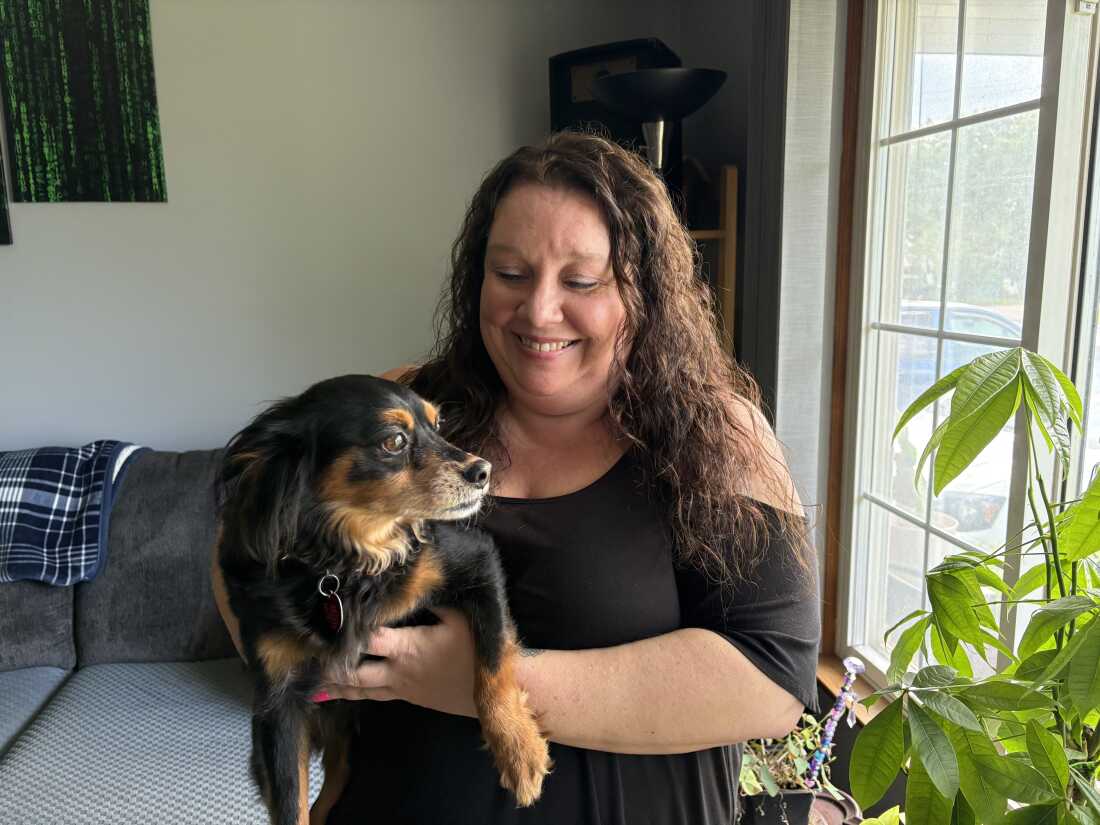
Marie Noon at her home in Brighton, Mich., with her dog,
Ziggy. Despite being eligible for Medicaid, Noon was denied coverage in
2025 because of an error with the state's benefits system. It took
months of pushback before the state reversed its mistake. Even as a
"tech-savvy" former bank manager, Noon says, she wanted to give up
several times along the way.
Kate Wells for KFF Health News
Marie Noon takes eight medications a day. One keeps her heart rate
from spiking to avoid a stroke. One prevents debilitating headaches.
Another ensures she doesn't retain excess fluid.
More than a
decade ago, Noon said, she was diagnosed with adult-onset Still's
disease, a rare type of inflammatory arthritis that can cause rashes,
debilitating pain, and fevers. The disease upended her life.
She
had been living a typical suburban life in Michigan, shuttling her two
kids to activities like cheerleading, choir practice, and track. She was
active in the PTA. She managed a bank.
She went from that to crawling to the bathroom because she was in so much pain, "just crying all day long" from being so sick.
Noon, who is 48 and disabled, said she couldn't work for eight years — a time marked by hospital stays that stretched for weeks.
"I honestly thought I was going to die," Noon said.
So
it was a shock when Michigan denied her application for Medicaid
benefits last year after she lost private insurance. Worse yet, it came
down to an IT error, according to an attorney who helped Noon overturn
the denial.
"I can't afford my medical care. I have to have insurance," said Noon, who has returned to working.
Stay up to date with our Politics newsletter, sent weekly.
Deloitte,
a multibillion-dollar global consulting firm, has operated Michigan's
Medicaid eligibility system under contracts worth roughly $768 million
since 2006, according to contracts reviewed by KFF Health News.
Nationwide, Deloitte dominates this important slice of government
business: At least 25 states have awarded the company contracts to build
or run computer systems that control access to safety net benefits such
as Medicaid.
Michigan's system has incorrectly directed people
with disabilities into skimpier benefits that cover limited care or
denied coverage completely, a KFF Health News investigation found. Similar problems were at the center of a class-action suit in Tennessee, court documents show, and have occurred in Texas, according to interviews and state records.
This KFF Health News investigation is based on statements from
state officials, emails obtained through public records requests, state
government communications sent to Medicaid enrollees and applicants, and
interviews with attorneys and patients or their caregivers.
In
an emailed statement, Deloitte spokesperson Karen Walsh said it found
"no system anomalies causing routine denials of Medicaid for people with
disabilities."
"There are many reasons why someone may no
longer be eligible for a benefit they once received or believe they
deserve," Walsh said. "All of the eligibility systems we support are
owned by the states and built to their unique specifications. We will
continue to work at the direction of our state clients."
Lynn
Sutfin, spokesperson for Michigan's Department of Health and Human
Services, said it "is not aware of any widespread or systemic issues"
within Bridges, Michigan's eligibility system for Medicaid, SNAP, and
other benefits, "related to disability‑based eligibility pathways."
Since
2006, Deloitte's contracts with the state have said the company is
responsible for development, implementation, maintenance, operations,
and enhancements to the Michigan system.
Computer system
problems foreshadow trouble as states prepare to roll out the most
significant and complicated changes to their Medicaid programs in years.
Those changes, dictated by President Donald Trump's landmark One Big
Beautiful Bill Act, have states rushing to update their Medicaid
computer systems to verify details such as employment.
Nationwide, roughly 15.5 million people on Medicaid have a disability, according to KFF.
"When
these administrative systems get overloaded, everyone gets impacted,"
said Pamela Herd, a University of Michigan professor who researches
bureaucratic obstacles to accessing government benefits. "The systems
are going to be really, really strained."
In Michigan, Noon was
eligible for Medicaid through a program that provides coverage to
disabled adults who work. But the state's computer system didn't
register that she is disabled and said she earned too much to qualify,
according to documents reviewed by KFF Health News and interviews with
Noon and Anastassia Kolosova, a disability rights attorney who helped
her.
Anastassia Kolosova, a supervising attorney with
Disability Rights Michigan, helped Marie Noon navigate the complicated
process to obtain safety net health insurance through Medicaid. Kolosova
says she has seen multiple wrongful coverage denials and fears problems
will soon get worse because of changes required by federal law. "I'm
really worried about more people falling through the cracks," she says,
because the state's benefits system "is going to be even more
overburdened than it is right now."
Kate Wells for KFF Health News
Without Medicaid coverage, Noon paid hundreds of dollars out of
pocket for prescriptions, after scrounging for discount coupons. She
takes some of the drugs twice a day.
Without them, "I'm toast," she said. It was stressful "not knowing
if my medicine's going to be $50 or $500 this month, because it changes
constantly."
Noon said her doctor agreed to fewer visits to avoid medical bills.
"It was kind of a nightmare," Noon said.
"I just wanted to give up"
Medicaid, a safety net health program jointly run by the federal government and states, covers roughly 67 million
people with low incomes or disabilities. State governments rely on
companies such as Deloitte to design and operate computer systems that
assess whether people qualify for Medicaid or food aid through the
Supplemental Nutrition Assistance Program, commonly known as food
stamps.
Deloitte-run technology has a history of errors that deprive eligible people of benefits, earlier KFF Health News investigations have shown.
As reported previously, Kenneth Smith, a Deloitte executive who leads
its national human services division, said Medicaid eligibility
technology is state-owned and agencies "direct their operation" and
"make decisions about the policies and processes that they implement."
"They're not Deloitte systems," he said, noting Deloitte is one player among many who together administer Medicaid benefits.
States
are under immense pressure to update their eligibility systems on a
tight schedule to adhere to requirements in the Republicans' sweeping
2025 tax and spending law. Companies including Deloitte, Accenture, and
Optum are being paid millions in taxpayer funds
to make the changes, which are projected to strip Medicaid from roughly
7.5 million people and SNAP from 2.4 million people by 2034.
Many
coverage restrictions in the new federal law don't apply to seniors,
children, or people who are disabled, such as Noon. Nonetheless, the
law's demands on state agencies and the computer systems they oversee
will disrupt benefits, advocates for Medicaid enrollees and other
healthcare experts said in interviews.
The same systems also
need to correctly classify why someone is eligible for Medicaid — and
therefore which rules and restrictions apply.
The law's SNAP restrictions began to take effect in 2025, and
major Medicaid provisions begin later this year, generally after the
midterm elections.
Kolosova is a supervising attorney with
Disability Rights Michigan, a legal advocacy organization for people
with disabilities. She said she has been unable to get a meeting with
Michigan officials to understand the underlying problem that deprived
Noon of health coverage.
State records show Deloitte has held
contracts for at least 14 years for Bridges. In its attempts to secure
more business, the company often cites its nationwide footprint in
Medicaid operations.
"Deloitte understands Bridges," and its history in Michigan makes the company "the ideal vendor," the firm said in its bid documents. Given Deloitte's work on similar systems in 31 other states, the firm said, "Michigan benefits from our technical expertise drawn from across the nation."
But advocates who work with people with disabilities say Michigan's computer system has failed to recognize when certain adults should receive Medicaid benefits.
Problems aren't unique to the Great Lakes State. Medicaid beneficiaries who brought a class-action lawsuit against
Tennessee in 2020 said the state's Deloitte-built system "does not
reliably test for eligibility" for several categories of people with
disabilities. The firm's contract in Tennessee is worth $1.12 billion over a decade.
A federal judge in 2024 sided with the Medicaid beneficiaries, ruling that Tennessee violated federal law and the U.S. Constitution. The lawsuit does not name Deloitte as a defendant.
In Michigan, a 2010 report
from the state's Office of the Auditor General said government agencies
"did not provide effective project administration" and failed to ensure
that the state could "independently maintain and operate Bridges"
because "the contractor did not transfer knowledge and skills" to state
officials, according to the audit.
The auditor's report said
that, as a result, Deloitte's original contract — valued at roughly $70
million — ballooned by $50 million over the initial cost, a 71%
increase. State records show Michigan would go on to add millions more,
bumping the cost of Deloitte's initial contract to $124.1 million.
The audit said maintaining the contract would result "in significant additional costs."
Sutfin said that "the state is now fully capable of operating and maintaining Bridges independently."
Deloitte's latest contract in Michigan — worth $197.4 million — is set to expire in 2030.
Noon
applied for Medicaid in August, she and Kolosova said. In September,
the Michigan Department of Health and Human Services sent a notice
denying her coverage, citing incorrect income information and stating
she wasn't disabled, according to Kolosova and state documents reviewed
by KFF Health News.
Noon said that when she called the state
for help, state workers "didn't know anything about" the Medicaid
program she had applied to, Freedom to Work.
"I can't tell you how many times I just wanted to give up," she said.
After Marie Noon was wrongly denied Medicaid coverage by
Michigan's benefits system, she paid hundreds out of pocket for
medications she takes each day to manage her rare disease. "It was kind
of a nightmare," she says.
Kate Wells for KFF Health News
For some people with disabilities, Medicaid is supposed to count
only half their earnings when assessing whether they should receive
benefits. That didn't happen. Kolosova said she thinks Michigan's
eligibility system didn't identify Noon as disabled, even though the
state "already had all the information they needed" to show she was.
By
failing to recognize her disability, the state used the wrong income
formula and said Noon earned too much to qualify for Medicaid, she
added. Deloitte and Michigan declined to respond to a detailed list of
questions about Noon's experience.
Kolosova said Disability
Rights Michigan has seen a growing number of calls from people about
Freedom to Work benefit denials. "Maybe two or three a month," she said.
"There's
something wrong with the system if they're relying on individual
caseworkers to catch this," Kolosova said. "The system needs to work."
Enrolled in the wrong coverage
Noon's
experience isn't the first time in recent years that people with
disabilities have been denied benefits by Deloitte-run eligibility
systems.
In Texas in 2023, Lilly Livingston, who has Down
syndrome and is now 22, was abruptly cut off from Medicaid benefits,
according to Livingston's mother, Marie. She has undergone numerous
surgeries to reconstruct her severely misaligned jaw, which caused sleep
apnea and impaired her speech and chewing ability. She relied on an
array of Medicaid services, including speech and occupational therapy.
When Livingston lost benefits, she was wrongly enrolled in Healthy
Texas Women, a limited program that provides breast and cervical cancer
screenings and family planning services.
"Trying to fix that was a nightmare," Marie Livingston said.
Terry Anstee, an attorney with Disability Rights Texas, intervened.
In a September 2023 email with the subject line "URGENT," Anstee begged a Texas Medicaid eligibility worker for help.
Some
unknown "error" had occurred and stripped Livingston of her benefits,
Anstee said in an email he sent to a state Medicaid staffer. "Lilly has
had 2 major surgeries, and her recovery is contingent on Medicaid."
It was clear that Livingston qualified for Medicaid through multiple paths, Anstee said: "It never made any sense."
Deloitte
declined to respond to a detailed list of questions about Livingston's
case. Jennifer Ruffcorn, spokesperson for Texas Health and Human
Services, confirmed that Livingston was erroneously enrolled in Healthy
Texas Women. However, Ruffcorn said, she did not experience a lapse in
Medicaid coverage in 2023.
Anstee disputed the state's
characterization: "A glance in the system by a Texas HHS press officer
or other staff 3 years after the fact may not tell the full story or
show the issues that Ms. Livingston endured in August and September
2023. Ms. Livingston experienced lapses in coverage."
The problem Livingston encountered in Texas was also reported in Michigan.
In
2024, mental health services advocates in Michigan raised red flags
about a similar error: People with disabilities were being enrolled in a
limited Medicaid program covering sexual health and family planning
services, instead of in a comprehensive health care plan. Plan First
covers only services such as birth control and treatment for sexually transmitted infections. It doesn't cover other health needs.
But
some enrollees were "being automatically enrolled in Plan First,"
Malcolm Kletke, a lobbyist representing the Community Mental Health
Association of Michigan and other mental health providers, wrote to a
Michigan health official, according to emails obtained by KFF Health
News through a public records request.
These enrollees had "long received Medicaid due to their
disability," and getting enrolled in the wrong plan meant losing access
to "services essential to their recovery and quality of life," Kletke
wrote in September 2024 to Amy Epkey, a senior deputy director of the
Michigan Department of Health and Human Services.
In fact, the state's own records show that Medicaid enrollment for those with disabilities did decline.
Over roughly four years, enrollment in the Medicaid category that includes people with disabilities fell by 10% in the state,
according to the Michigan House Fiscal Agency, which provides
nonpartisan analysis to lawmakers. The drop was unusual, given that
people generally leave the program because of death or having recovered
from a temporary disability, and it's unlikely those numbers would
balloon, said Robert Sheehan, who was the mental health association's
CEO at the time.
Sutfin said the state examined the decline in
enrollment and found "several contributing factors, including post‑COVID
renewal patterns, changes in beneficiary circumstances and movement to
other coverage categories."
After inquiries from KFF Health
News, the Michigan health department acknowledged in April that it had
made changes to "address concerns raised by advocates."
Michigan's
computer system now prevents approval of Plan First benefits until all
other coverage options are evaluated, Sutfin told KFF Health News.
Sutfin said the changes were implemented, but "not to correct system
errors."
Sutfin said the state submitted a change request to Deloitte to address this problem. The fix was implemented in January 2025.
Until presented with Kletke's email, the state had denied there were problems related to Plan First.
Even after the state addressed that issue, other problems persisted.
Noon's
coverage denial notice arrived in September. She fought with the state
for months to reverse its decision, "paying cash for all of the
medicines through these appeals over and over and over again."
It was only in January that she was approved.
"I literally cried," Noon said. "It was a really big deal."
KFF Health News is a national newsroom that produces in-depth journalism about health issues and is one of the core operating programs at KFF.
 US service member killed in Iraq during ‘controlled detonation’ of Iranian drone, military says
 Travel firms and housebuilders lead profit warnings amid Iran war fallout
Trump golfs and attends World Cup final as war in Iran claims another two service members: ‘A very sad thing’
Gaza’s lost generation: children forced into hard labour to avoid starvation








Bookmark popover
Removed from bookmarks